
2027 Senior Engineering Manager Careers: Skills, Education, Salary & Job Outlook

Co-Founder and Chief Data Scientist
Becoming a senior engineering manager is not a quick promotion or a purely technical achievement. It is a career move into high-stakes leadership, where you are expected to guide engineering teams, make trade-offs across people and technology, and connect technical execution to business goals.
This role is best suited for experienced engineers and engineering managers who want broader influence than individual technical contribution alone can provide. The path usually requires a strong engineering foundation, years of progressively responsible experience, and the ability to lead through ambiguity, deadlines, budget limits, and shifting stakeholder priorities.
The payoff can be substantial. Senior engineering manager roles often come with strong compensation, with median pay often exceeding $160,000, and the work can place you close to major product, infrastructure, manufacturing, or technology decisions. This guide explains what senior engineering managers do, the skills and credentials that matter, what the work environment is like, and how to decide whether this career path fits your strengths and long-term goals.
Key Things You Should Know About Senior Engineering Manager Career
- The typical earning potential for a senior engineering manager in the United States ranges from about $136,000 to $168,000 annually, reflecting a strong and competitive salary.
- The field of architectural and engineering management is expected to grow by approximately 4% over the next decade, indicating steady demand and stable opportunities.
- A bachelor's degree in engineering or a related technical area is generally required, with many employers favoring candidates who hold a master's degree in engineering management or an MBA.
- Success hinges on a blend of technical engineering expertise, project management skills, leadership, strategic planning, clear communication, budgeting, and the ability to lead complex, cross-functional teams.
- Career advancement commonly leads from senior engineering manager to director of engineering, then vice president of engineering, and can extend to chief technology officer or other top executive roles.
What do Senior Engineering Managers do?
Senior Engineering Managers lead engineering teams that build, maintain, and improve technical systems, products, infrastructure, or processes. Their job is not only to supervise engineers but to make sure engineering work supports the organization’s priorities, quality standards, timelines, and long-term technical direction.
In practice, the role sits between executive strategy and day-to-day delivery. Senior Engineering Managers translate business goals into engineering plans, help teams prioritize work, remove blockers, manage risks, and make sure technical decisions are sustainable. They may oversee multiple teams, manage engineering managers, or lead a large group of senior engineers depending on the company’s structure.
A Day in the Life of Senior Engineering Managers
A typical day may include reviewing project status, meeting with product or operations leaders, coaching managers or senior engineers, resolving resource conflicts, and evaluating technical risks. They often spend less time writing code or designing systems directly and more time shaping decisions, setting expectations, and ensuring the right people are working on the right problems.
The best Senior Engineering Managers remain technically credible without trying to be the strongest individual contributor in every discussion. Their value comes from judgment: knowing when to push for speed, when to slow down for quality, when to escalate an issue, and when to let a team solve a problem independently.
What are the key responsibilities of Senior Engineering Managers?
Senior Engineering Managers are responsible for both outcomes and the systems that produce those outcomes. They lead people, projects, processes, and technical direction while making sure engineering work stays aligned with business needs.
- Lead engineering teams: Set expectations, assign ownership, support collaboration, and create a team structure that helps engineers do focused, high-quality work.
- Plan and deliver projects: Define scope, timelines, staffing needs, dependencies, and risk mitigation plans so teams can deliver reliably.
- Align engineering with business goals: Work with product, operations, finance, sales, or executive teams to make sure technical decisions support organizational priorities.
- Coach engineers and managers: Develop talent through feedback, career planning, delegation, mentoring, and performance management.
- Improve engineering processes: Evaluate workflows, release practices, incident response, documentation, quality controls, and team operating habits.
- Represent engineering leadership: Communicate engineering progress, risks, staffing needs, and trade-offs to senior leaders and cross-functional partners.
- Maintain technical direction: Help teams evaluate architecture, tools, system reliability, scalability, and long-term maintainability.
The Most Challenging vs. The Most Rewarding Tasks
The hardest part of the role is often balancing urgent execution with long-term technical and organizational health. A Senior Engineering Manager may need to deliver a project quickly while also preventing burnout, reducing technical debt, resolving disagreements, and protecting the team from unclear priorities.
The most rewarding part is seeing teams become stronger because of your leadership. That may mean helping an engineer grow into a technical lead, improving a broken delivery process, launching a product that solves a real customer problem, or building a culture where people make better decisions without constant supervision.
For professionals who want a structured academic boost before moving deeper into leadership, exploring one year masters degrees can help identify accelerated graduate options that may support management, technical, or business preparation.
What are the key skills for Senior Engineering Managers?
Senior Engineering Managers need a rare mix of technical judgment, people leadership, business awareness, and execution discipline. The role does not require being the top expert in every tool or system, but it does require enough technical depth to ask the right questions, evaluate risk, and guide teams toward sound decisions.
Key Technical Skills
- Scalable system design: Understanding how systems perform under growth, load, complexity, and changing reliability expectations.
- Enterprise-level CI/CD management: Knowing how release pipelines, automation, and tools like Jenkins support safer and faster delivery.
- Data-informed decision-making: Using tools such as Tableau or Power BI to interpret trends, identify bottlenecks, and support strategic planning.
- Advanced code review practices: Promoting maintainability, security, test quality, and engineering standards on platforms such as GitHub.
Important Soft Skills
- Critical thinking: Separating urgent noise from the core problem and evaluating options with incomplete information.
- Complex problem solving: Handling technical, organizational, staffing, and stakeholder issues that do not have simple answers.
- Active listening: Understanding what engineers, peer leaders, and executives need before making decisions or giving direction.
- Judgment and decision making: Prioritizing trade-offs across quality, speed, cost, risk, and business impact.
- Communication clarity: Explaining technical risks and delivery realities in language that non-engineering stakeholders can act on.
The One Overlooked Skill That Separates the Good from the Great
Cross-functional leadership is often the skill that separates capable Senior Engineering Managers from exceptional ones. Engineering work rarely succeeds in isolation. Product, design, security, finance, operations, customer success, and executive leadership may all influence what gets built and when.
When requirements change suddenly, a strong cross-functional leader can clarify priorities, expose trade-offs, prevent conflicting assumptions, and keep teams focused. Without that skill, even technically strong teams can lose time to rework, miscommunication, or unclear ownership.
Professionals who want to strengthen strategic leadership through advanced study may also compare doctoral pathways, including resources on the easiest doctorate, while keeping in mind that leadership outcomes depend heavily on experience, credibility, and demonstrated results.
In short, Senior Engineering Manager skills are not just about knowing technology. They are about helping teams make better technical and organizational decisions at scale.
Senior Engineering Manager Careers: A Step-by-Step Guide to Getting Started
The path to becoming a Senior Engineering Manager is usually built over years, not through a single credential. Most professionals move from technical execution into technical leadership, then into people management, and finally into broader organizational leadership.
- Build Foundational Education: Start with a strong technical base through a relevant engineering, computer science, engineering management, or related degree. The goal is to understand engineering principles well enough to earn credibility in technical environments.
- Gain Initial Professional Experience: Begin in entry-level engineering roles where you learn how real systems, products, teams, deadlines, and customer needs interact. Early performance matters because it builds the technical reputation needed for later leadership roles.
- Progress Through Technical Roles: Move into more complex work as a mid-level or senior engineer. At this stage, focus on architecture, quality, mentoring, documentation, incident response, and collaboration beyond your own assigned tasks.
- Develop Leadership and Management Skills: Take on responsibilities such as Technical Lead, team lead, project lead, or manager-in-training. Learn how to delegate, run meetings, give feedback, estimate work, handle conflict, and communicate risk.
- Advance to Engineering Management: Step into Engineering Manager roles where you own team performance, hiring input, delivery planning, and people development. Success here depends on helping the team perform, not simply doing the work yourself.
- Prepare for Senior-Level Scope: Build experience leading larger initiatives, managing managers or senior leads, influencing strategy, and working with executives. Senior roles require broader judgment and less direct control over every detail.
A useful way to evaluate readiness is to ask whether you can create results through systems and people rather than personal technical output alone. Senior Engineering Managers are measured by the health, reliability, and impact of the teams they lead.
What education, training, or certifications are required?
Senior Engineering Managers typically hold a Bachelor of Science in Engineering, such as Mechanical, Electrical, or Civil Engineering, or a Bachelor of Science in Engineering Management. Some professionals enter from related technical fields, depending on the industry and employer, but a strong engineering foundation is usually expected.
For certain engineering disciplines and regulated work, the Professional Engineer (PE) license can be important. It is issued by state boards and requires an accredited degree, passing the FE and PE exams, and relevant work experience. For licensure, supervised engineering work-usually four years-is mandatory. The PE is especially relevant in fields where public safety, infrastructure, construction, utilities, or regulated engineering decisions are involved.
The Project Management Professional (PMP) is another valuable certification for professionals who manage complex projects, schedules, budgets, stakeholders, and cross-functional delivery. It does not replace technical engineering credibility, but it can strengthen a manager’s ability to lead structured execution.
On-the-job training generally involves 3 to 9 years of increasingly responsible engineering roles, often with leadership duties. Internships or cooperative education programs during undergrad are common starting points because they help students connect classroom learning with practical engineering work.
Are advanced degrees or niche certifications worth the investment?
Advanced degrees such as a Master of Science in Engineering Management or an MBA with a technology focus can be useful for professionals who want to move into larger leadership roles, especially in organizations where strategy, finance, operations, and executive communication are part of the job. These programs may also help engineers who need a stronger business or management framework.
However, advanced credentials are not automatic shortcuts to senior leadership. Employers typically look for evidence that you can lead teams, deliver complex work, retain talent, improve processes, and make sound technical trade-offs. Significant industry experience and proven leadership sometimes substitute for advanced degrees, depending on sector and employer.
Certifications such as Certified Professional in Engineering Management (CPEM) and specialized credentials can improve credibility when they match your target role. Before enrolling, compare the cost, time commitment, renewal requirements, employer recognition, and whether the credential fills a real gap in your profile.
If you are still building an affordable foundation for further education, reviewing options such as the cheapest associates degree can help you compare lower-cost academic starting points.
What is the earning potential for Senior Engineering Managers?
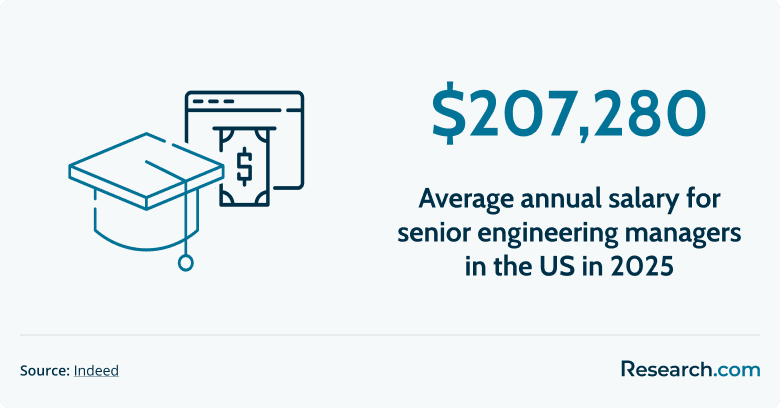
Senior Engineering Manager compensation is one of the main reasons experienced engineers consider moving into management. The median annual salary for a Senior Engineering Manager is $160,232, which reflects the high level of responsibility attached to leading teams, budgets, delivery, and technical direction.
The senior engineering manager salary range 2025 includes an entry-level salary near $113,500 at the 25th percentile and reaches up to $187,500 at the 90th percentile for highly experienced professionals. This wide range is normal for senior leadership roles because compensation depends heavily on company size, industry, geography, technical complexity, and management scope.
| Salary point | Amount | What it generally reflects |
| 25th percentile | $113,500 | Professionals newer to senior-level scope or working in lower-paying markets or industries |
| Median annual salary | $160,232 | A typical midpoint for Senior Engineering Manager compensation |
| 90th percentile | $187,500 | Highly experienced leaders, often with broader scope, specialized expertise, or high-demand industry experience |
Location can significantly affect pay, with metropolitan areas like New York often offering higher pay. Industry also matters. Technology, professional services, manufacturing, energy, and highly regulated engineering environments may value different combinations of technical depth, leadership experience, and project accountability.
When evaluating earning potential, look beyond base salary. Senior roles may include bonuses, equity, profit sharing, or other incentives depending on the employer. Those components can change the total compensation picture, but they also vary widely and should be reviewed carefully during an offer negotiation.
What is the job outlook for Senior Engineering Managers?
The job outlook for senior engineering managers in the U.S. is expected to grow by about 4% from 2022 to 2032, aligning with the average growth rate for all occupations. That points to steady demand rather than explosive growth, which means advancement will likely favor candidates with proven leadership, strong technical judgment, and the ability to deliver measurable results.
The Key Factors Shaping the Future Outlook
Automation, artificial intelligence, digital transformation, cloud platforms, data infrastructure, cybersecurity concerns, and modern manufacturing systems all increase the need for leaders who can manage technical change responsibly. Senior Engineering Managers who understand both emerging tools and organizational adoption challenges will be better positioned than those who rely only on past technical experience.
Persistent shortages of qualified engineers and experienced managers, particularly in energy, manufacturing, and technology, also support demand for senior leaders. Companies need managers who can hire, develop, retain, and organize engineering talent effectively.
At the same time, flatter organizational structures may reduce the number of traditional senior management seats in some companies. In those environments, the roles that remain may carry broader responsibility, larger team scope, and higher expectations for cross-functional influence.
For readers mapping an education path toward this career, a trusted list of top colleges online can help compare programs that may support technical or management preparation.
What is the typical work environment for Senior Engineering Managers?
The senior engineering manager work environment most commonly involves office settings within corporate headquarters, especially in technology companies that employ about 27% of these professionals. Many also find roles in Fortune 500 firms (19%) and manufacturing (9%), where the work may include visits to production facilities, labs, field sites, or industrial environments.
The day-to-day culture is usually meeting-heavy and highly collaborative. Senior Engineering Managers coordinate with engineering teams, product leaders, project managers, executives, customers, operations groups, and sometimes external vendors. A strong manager protects engineers from unnecessary distractions while still keeping leadership informed and aligned.
Standard business hours are common, but the role is not always limited to a predictable schedule. Urgent incidents, release deadlines, production issues, customer escalations, and planning cycles may require occasional evenings or weekends. In global organizations, early or late meetings may also be necessary to work with distributed teams.
Remote and hybrid work options are increasingly available, particularly in tech-driven industries. However, the effectiveness of remote leadership depends on clear communication, well-run documentation, disciplined meeting practices, and deliberate team-building. In manufacturing, infrastructure, or hardware-heavy environments, more onsite presence may be required.
What are the pros and cons of Senior Engineering Manager careers?
A Senior Engineering Manager career can be highly rewarding, but it is not the right fit for every strong engineer. The role requires giving up some direct hands-on technical work in exchange for broader responsibility over people, systems, strategy, and delivery.
| Pros | Cons |
| Opportunity to mentor engineers and help people grow into stronger technical leaders | Less time for direct coding, design, or hands-on technical execution |
| Influence over engineering strategy, team structure, technical priorities, and business outcomes | Frequent ambiguity, competing priorities, and pressure from multiple stakeholders |
| Exposure to senior leadership decisions and broader organizational planning | Responsibility for difficult conversations, performance issues, conflict, and team morale |
| Strong earning potential and access to higher leadership tracks | Risk of burnout if boundaries, delegation, and prioritization are weak |
Intrinsic Rewards
- Guiding and mentoring engineers, fostering professional growth within the team.
- Shaping engineering strategy, influencing technical direction and organizational outcomes.
- Solving complex technical and organizational problems, driving innovation and process improvement.
- Facilitating cross-functional collaboration, building strong relationships across departments.
Intrinsic Challenges
- Navigating ambiguous and rapidly evolving requirements, making decisions with incomplete information.
- Balancing strategic priorities with daily operational demands and tight deadlines.
- Managing conflicts, team dynamics, and stakeholder expectations across multiple functions.
- Maintaining technical expertise while handling extensive administrative and leadership responsibilities.
The best way to decide whether this path fits is to examine what gives you energy. If you enjoy enabling others, clarifying complex trade-offs, and improving how teams work, senior engineering management may be a strong fit. If your main satisfaction comes from deep individual technical work, a senior technical specialist track may be more aligned.
What are the opportunities for advancement for Senior Engineering Managers?
Senior Engineering Manager is not necessarily the endpoint of an engineering leadership career. It can lead to executive management, broader organizational leadership, or specialized technical leadership depending on your strengths and the structure of your employer.
Clear Advancement Path Beyond Senior Engineering Manager
For those pursuing upward mobility, the typical engineering manager career progression moves from Senior Engineering Manager to Director of Engineering, Vice President of Engineering, and potentially CTO. Each step involves less direct involvement in individual team delivery and more responsibility for strategy, organizational design, budgets, executive communication, and long-range technical direction.
- Senior Engineering Manager: Lead larger teams, multiple initiatives, or managers while improving execution and team health.
- Director of Engineering: Own broader engineering strategy, staffing plans, delivery systems, and coordination across teams.
- Vice President of Engineering: Align engineering execution with business goals, scaling needs, budgets, and executive priorities.
- CTO: Guide company-wide technology vision, innovation strategy, technical risk, and long-term competitive advantage.
Specialization and Growth Opportunities
Promotion opportunities for senior engineering managers also exist outside the traditional executive ladder. Some professionals become known for excellence in technical strategy, organizational development, product delivery, platform engineering, DevOps, Security, Cloud, or Data Engineering.
- Guide technical strategy and mentor senior engineers as a Technical Lead.
- Build high-performance teams by focusing on people management and organizational development.
- Champion product and project delivery, aligning engineering with business outcomes.
- Become a domain expert in critical fields such as Cloud or Data Engineering.
The strongest advancement strategy is to build a clear leadership brand. Decide whether you want to be known for scaling teams, fixing execution problems, modernizing architecture, developing leaders, improving reliability, or connecting engineering to business growth. That focus can make your next step easier to communicate and easier for employers to recognize.
What other careers should you consider?
If Senior Engineering Manager sounds close to your goals but not exactly right, several related careers may offer a better fit. The best alternative depends on whether you prefer people leadership, technical depth, program execution, or product strategy.
- Director of Engineering: A stronger fit if you want broader organizational leadership, oversight of multiple teams, and greater responsibility for engineering strategy.
- Principal Engineer / Staff Engineer: A better option if you want deep technical influence, architecture ownership, and cross-team technical leadership without direct people management.
- Technical Program Manager: A good match if you enjoy coordinating complex technology initiatives, managing dependencies, and driving execution across teams without managing engineers directly.
- Engineering Project Manager: Suitable for professionals who want to own project planning, schedules, risks, budgets, and stakeholder communication with a strong delivery focus.
- Product Manager: A strong alternative if you prefer defining product direction, customer needs, market priorities, and feature strategy while collaborating closely with engineering and design.
Use these alternatives to clarify your preferred type of influence. If you want to grow people and systems, senior engineering management may fit. If you want to stay closer to architecture, consider Staff or Principal Engineer. If you want to coordinate delivery without formal engineering management, technical program management may be the better path.
Here's What Professionals Say About Their Senior Engineering Manager Careers
- Laila: "When I transitioned into a Senior Engineering Manager role, I quickly learned that being a good manager goes well beyond just task lists and schedules. It's about creating an environment where engineers feel safe to bring their full selves, not just their technical skills. I found real meaning in supporting my team members as whole people-whether that meant celebrating their successes or helping them balance personal challenges. That human-centered approach doesn't just improve morale; it unlocks creativity and drives better outcomes."
- Marcus: "One of the toughest lessons for me was accepting that management demands a very different mindset than coding. Rather than focusing on specific technical problems, I had to master managing energy-my own and that of my team-and be ready to make difficult calls under pressure. There were moments I felt overwhelmed by the responsibility of supporting others through their struggles, but hearing an engineer tell me I helped them get unstuck made it all worthwhile. That balance between stress and reward defines the role for me."
- Anika: "My favorite part of being a Senior Engineering Manager is the one-on-one time when an engineer comes to me frustrated or stuck on a problem. Just asking the right questions and listening can spark insight and growth that I then get to watch blossom into leadership on major projects. Seeing someone I've guided step confidently into new challenges reminds me why I put in the extra effort every day. Those breakthroughs are what really fuel my passion for this role."
Key Findings
- Senior Engineering Managers lead engineering teams, align technical execution with business goals, and make decisions that affect delivery, quality, staffing, and long-term technical direction.
- The role requires both technical credibility and leadership strength. Scalable system design, CI/CD knowledge, data-informed decision-making, communication, judgment, and cross-functional leadership are especially important.
- The typical path starts with foundational engineering education, progresses through engineering and technical leadership roles, and then moves into people management and broader organizational leadership.
- Senior Engineering Managers typically hold a Bachelor of Science in Engineering or Engineering Management. Some roles may value or require credentials such as the PE license, PMP, CPEM, an advanced engineering management degree, or an MBA with a technology focus.
- The median annual salary for a Senior Engineering Manager is $160,232. The senior engineering manager salary range 2025 includes an entry-level salary near $113,500 at the 25th percentile and reaches up to $187,500 at the 90th percentile.
- The job outlook for senior engineering managers in the U.S. is expected to grow by about 4% from 2022 to 2032, which indicates stable demand but competitive advancement into senior roles.
- Advancement can lead to Director of Engineering, Vice President of Engineering, and CTO roles, or to specialized leadership in areas such as Cloud, Data Engineering, DevOps, Security, product delivery, or organizational development.
- This career is best suited for professionals who enjoy leading through others, resolving ambiguity, coaching talent, and connecting technical work to larger business outcomes.
Other Things You Should Know About Senior Engineering Manager
Effective senior engineering managers rely on enhanced software development life cycle visibility frameworks. Instead of focusing only on high-level metrics like cycle time, they aggregate detailed data across planning, execution, and delivery. This broad visibility helps identify hidden blockers, adjust workloads, and prevent issues before they affect delivery or team health, driving sustainable high performance.
Many believe senior engineering managers mainly focus on technical oversight or strategy, but their role heavily involves managing social dynamics and psychological well-being. Conflict resolution and emotional intelligence are critical daily skills, often surpassing the importance of technical expertise or process management.
References
- Things I've learned transitioning from engineer to engineering manager https://blog.pragmaticengineer.com/things-ive-learned-transitioning-from-engineer-to-engineering-manager/
- 6 Engineering Manager Interview Questions and Answers for 2025 | Himalayas https://himalayas.app/interview-questions/engineering-manager
- Engineering Manager Salary Guide: What to Expect and How to Advance https://online.stevens.edu/blog/engineering-manager-salary-guide/
- How I went from Tech Lead → Engineering Management https://levelupsoftwareengineering.substack.com/p/how-i-went-from-tech-lead-engineering
- Should you Become a Manager or Stay a Senior Engineer? https://blog.nexton.dev/should-you-become-a-manager-or-stay-a-senior-engineer
- What’s Next After Senior Engineer? https://newsletter.eng-leadership.com/p/whats-next-after-senior-engineer
- A Day in the Life of 29 Engineering Managers | Built In https://builtin.com/software-engineering-perspectives/engineering-manager
- Cracking the Engineering Manager Interview — FAQs https://medium.com/srivatsan-sridharan/cracking-the-engineering-manager-interview-faqs-94dcfdf38ef
- Engineering Manager - Alternative Careers and Similar Jobs (Updated for 2025) https://resumeworded.com/career-profiles/engineering-manager-career-profile
- Senior engineering manager https://www.imeche.org/training-qualifications/training-details/senior-engineering-manager


