
2027 What Does a Chief Data Officer Do: Responsibilities, Requirements, and Salary

Co-Founder and Chief Data Scientist
Organizations now collect more data than most teams can organize, trust, or use. According to the IBM Data Differentiator guide, around 82% of enterprises struggle with data silos, and nearly 68% of their data is never analyzed. That gap creates real business risk: leaders make decisions with incomplete information, compliance obligations become harder to manage, and investments in analytics fail to produce value.
A chief data officer is the executive responsible for closing that gap. The role sits at the intersection of data governance, analytics, technology, risk management, and business strategy. This guide explains what a chief data officer does, what education and experience can lead to the role, which skills and tools matter most, and what salary and job demand look like in 2027.
Key Things You Should Know About What a Chief Data Officer Does
- A chief data officer oversees an organization’s entire data strategy, ensuring that information is accurate, secure, and effectively used for decision-making.
- The chief data officer bridges the gap between data management and business strategy by aligning data initiatives with company goals.
- In 2027, the chief data officer plays a critical role in driving innovation, compliance, and competitiveness through responsible data governance and analytics.
What are the main responsibilities of a chief data officer?
A chief data officer, or CDO, is responsible for making sure an organization’s data is accurate, secure, usable, and tied to business goals. Unlike a purely technical data role, the CDO role is executive-level: it requires setting strategy, influencing departments, managing risk, and helping leadership use data to make better decisions.
The exact scope varies by organization. In some companies, the CDO focuses heavily on governance and compliance. In others, the role also oversees analytics, artificial intelligence initiatives, data monetization, or enterprise reporting. In mature data-driven companies, the CDO often acts as the bridge between technical teams and the executive board.
Core responsibilities of a chief data officer
- Creating the enterprise data strategy: The CDO defines how data should support revenue growth, operational efficiency, customer experience, risk reduction, and innovation.
- Leading data governance: This includes setting rules for data ownership, definitions, quality standards, access, retention, privacy, and accountability across departments.
- Improving data quality and trust: A CDO works to reduce duplicate records, inconsistent reporting, outdated systems, and conflicting metrics that weaken decision-making.
- Breaking down data silos: The role often involves connecting data across finance, operations, marketing, sales, product, human resources, and IT so leaders can see a fuller picture of performance.
- Overseeing analytics and AI initiatives: Many CDOs guide the responsible use of business intelligence, predictive modeling, machine learning, and automation.
- Managing compliance and risk: The CDO helps ensure data practices align with requirements such as GDPR or HIPAA, depending on the organization’s industry and location.
- Building a data-driven culture: The role requires improving data literacy so employees can interpret reports correctly and use insights in daily decisions.
- Partnering with technology leaders: CDOs work closely with CIOs, CTOs, CISOs, and engineering leaders to make sure infrastructure, cloud platforms, security controls, and data architecture can support business needs.
Students and professionals interested in this career should understand how modern infrastructure supports enterprise data work. For example, learning what you can do with a cloud computing degree can clarify how cloud platforms support large-scale storage, analytics, integration, and governance—areas that are closely connected to the chief data officer’s responsibilities.
What degree do you need to become a chief data officer?
There is no single required degree for becoming a chief data officer, but most CDOs have a strong academic background in a technical, analytical, or business field. Common degree areas include computer science, data science, statistics, information systems, business analytics, management information systems, engineering, economics, and business administration.
Because the CDO is an executive role, education alone is rarely enough. Employers typically look for a combination of advanced technical knowledge, leadership experience, business judgment, and a record of delivering measurable results through data initiatives.
According to a national survey of executive-level professionals, 46% indicated that a master’s degree is typically required for such roles, while 32% noted that a bachelor’s degree could be sufficient, and 5% reported that an associate’s degree may qualify a new hire depending on experience and performance.
How to choose the right degree path
- Bachelor’s degree: A bachelor’s degree can provide the foundation for entry-level roles in data analysis, business intelligence, software development, database administration, or IT management.
- Master’s degree: A master’s degree can help professionals move into senior roles by deepening expertise in data science, analytics, cybersecurity, information systems, or business strategy.
- MBA or executive program: An MBA can be useful for professionals who already have technical experience and need stronger preparation in finance, leadership, operations, and organizational strategy.
- Certifications and bootcamps: Shorter programs can help experienced professionals update skills in cloud computing, AI, data governance, cybersecurity, or specific enterprise platforms.
For candidates trying to stand out, credentials should match the type of CDO role they want. A governance-focused role may value privacy, risk, compliance, and information management training. A transformation-focused role may place more weight on analytics, AI, cloud architecture, and business leadership. A Microsoft Azure dual certification boot camp online can be useful for professionals who want to strengthen cloud computing knowledge alongside practical technical skills used in modern data environments.
What are the best courses or programs for future chief data officers?
The best preparation for a future chief data officer blends three areas: data and technology, business leadership, and governance or risk management. A CDO does not need to be the strongest programmer in the organization, but they do need to understand how data systems work well enough to make strategic decisions, challenge assumptions, and communicate with technical teams.
Recommended courses and programs
- Data science and analytics: Courses in statistics, data modeling, visualization, experimentation, and interpretation help future CDOs understand how insights are produced and where analytical errors can occur.
- Database systems and data architecture: Training in relational databases, data warehouses, data lakes, metadata, and integration gives professionals the technical vocabulary needed to evaluate enterprise data environments.
- Information systems management: These programs focus on aligning technology with business operations, a core requirement for leaders responsible for enterprise-wide data strategy.
- Data governance and privacy: Coursework in governance frameworks, data stewardship, privacy, compliance, and ethics is especially important for organizations in regulated industries.
- Artificial intelligence and machine learning: AI and machine learning courses help future leaders evaluate predictive models, automation opportunities, algorithmic risk, and responsible AI practices.
- Cloud computing and IT infrastructure: Cloud coursework helps professionals understand scalability, storage, security, access management, and cost trade-offs. Like some of the hardest science majors, this path can require strong quantitative reasoning and technical discipline.
- MBA or executive management programs: Business programs strengthen budgeting, negotiation, organizational change, executive communication, and strategy skills.
- Cybersecurity and risk management: Since data strategy is inseparable from data protection, coursework in security, identity management, risk controls, and incident response can be valuable.
The strongest programs include applied projects, case studies, internships, capstone work, or employer-sponsored data initiatives. Future CDOs should look for learning experiences that require them to explain technical findings to nontechnical stakeholders, build a business case, and weigh trade-offs involving cost, risk, quality, privacy, and speed.
What are the essential skills every chief data officer should have?
A chief data officer needs more than technical fluency. The role requires executive judgment: deciding which data problems matter most, where to invest, how to manage risk, and how to persuade departments to follow shared standards. Strong CDOs know how to turn data from a collection of systems into a trusted business asset.
According to leadership competency research, skills such as judgment and decision-making (94%), complex problem-solving (85%), and critical thinking (85%) are among the most crucial abilities for executives at this level. Coordination (81%) and financial resource management (81%) also rank high in importance, reflecting the cross-functional and budgetary responsibilities of the role.
Essential skills for a chief data officer
- Strategic decision-making: CDOs must decide which data initiatives support the organization’s priorities and which projects are too costly, risky, or poorly aligned.
- Data governance expertise: The role requires setting standards for data definitions, ownership, quality, access, privacy, retention, and accountability.
- Advanced analytical thinking: A CDO should be able to evaluate data quality, question assumptions, interpret trends, and understand the limits of models and dashboards.
- Executive communication: The CDO must explain technical issues in business terms, especially when speaking with boards, CEOs, CFOs, legal teams, and department leaders.
- Leadership and coordination: Data work crosses many teams, so the CDO must align analysts, engineers, data stewards, compliance teams, security teams, and business users.
- Financial and project management: CDOs often oversee budgets for platforms, staffing, vendors, data quality work, analytics products, and transformation initiatives.
- Change management: The role frequently involves changing how employees capture, define, report, and use data, which requires patience and organizational influence.
- Technical literacy: CDOs should understand databases, cloud systems, analytics tools, APIs, security controls, and data pipelines, even if they are not building every system themselves.
- Ethical judgment: The responsible use of sensitive data, AI, and customer information requires careful attention to fairness, transparency, privacy, and business impact.
Professionals moving toward this role can build technical depth in many ways. For example, reviewing skills linked to a master’s in bioinformatics can show how advanced analytics, domain knowledge, and data interpretation come together in complex data-driven fields.
What tools and technologies do chief data officers use most often?
Chief data officers do not usually spend their day operating every tool directly. Instead, they evaluate, select, govern, and oversee the technology ecosystem that allows an organization to collect, protect, analyze, and use data. The specific tools depend on industry, company size, security requirements, legacy systems, and cloud strategy.
Common tools and technologies used by chief data officers
- Data governance platforms: Tools such as Collibra and Informatica help organizations document data ownership, definitions, quality rules, lineage, and compliance workflows.
- Business intelligence tools: Tableau, Power BI, and Looker are commonly used for dashboards, performance tracking, reporting, and self-service analytics.
- Cloud data services: AWS, Google Cloud, and Azure support scalable storage, computing, data integration, and analytics workloads.
- Machine learning and AI platforms: Databricks and TensorFlow can support predictive analytics, model development, experimentation, and automation.
- Database management systems: SQL, PostgreSQL, and Oracle databases are used to manage structured data and support operational and analytical workloads.
- Data integration and pipeline tools: These tools move, transform, and synchronize data across systems so business users can work from consistent information.
- Metadata and data catalog tools: Catalogs help employees find trusted datasets, understand definitions, and avoid using outdated or unauthorized information.
- Security and access management tools: These technologies help control who can view, edit, export, or share sensitive data.
The main decision for a CDO is not simply which tool has the most features. A strong technology strategy considers interoperability, security, total cost, vendor lock-in, user adoption, compliance needs, and whether the organization has the talent to maintain the platform over time.
What is the typical career progression toward becoming a chief data officer?
Most chief data officers reach the role after years of experience in data, analytics, information systems, technology leadership, or business transformation. The path is rarely linear. Some CDOs begin as data analysts or data engineers, while others move into the role from IT leadership, consulting, finance, risk management, or operations.
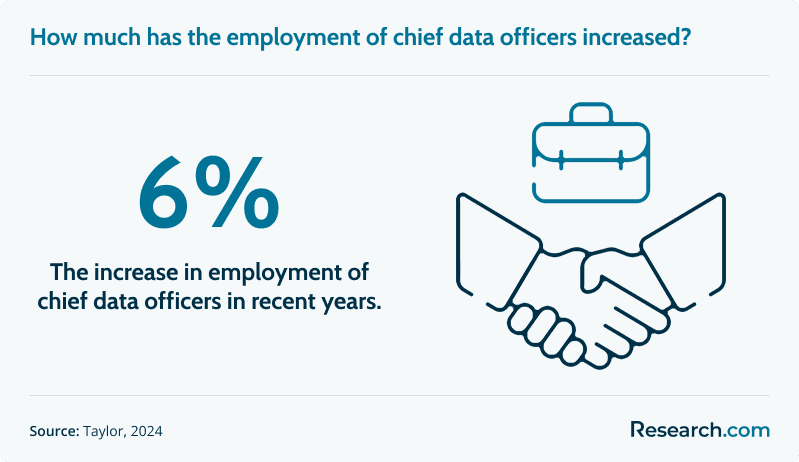
In recent years, the demand for skilled data leaders has risen significantly: the percentage of top global firms employing a chief data officer increased from 21% in 2021 to 27% in 2022, according to global business surveys. This growth highlights how companies are recognizing the importance of data-driven leadership in addressing supply chain disruptions, resource shortages, and digital transformation challenges.
Common career path to chief data officer
- Early-career roles: Data analyst, business intelligence analyst, database administrator, software developer, systems analyst, data engineer, or reporting analyst.
- Mid-level roles: Analytics manager, data architect, data governance lead, product analytics manager, information systems manager, or data engineering manager.
- Senior leadership roles: Director of analytics, head of data governance, vice president of data, chief analytics officer, chief information officer, or senior technology executive.
- Executive role: Chief data officer, often with responsibility for enterprise data strategy, governance, analytics, AI, data risk, and cross-functional adoption.
Professionals preparing for this path should seek projects that show measurable business impact. Examples include improving data quality, reducing reporting conflicts, implementing governance standards, modernizing data infrastructure, launching analytics products, or helping executives make better decisions from trusted data.
Technical credibility also matters. Understanding areas such as programming, cloud systems, security, and risk can help future CDOs communicate effectively with engineering and cybersecurity teams. For example, learning whether cybersecurity professionals need coding skills can help clarify how technical fluency supports risk management and data protection work.
Ultimately, becoming a chief data officer requires proof that you can lead across departments, not just manage data. The strongest candidates combine technical understanding, business acumen, governance discipline, and the ability to turn information into measurable value.
What is the average salary of a chief data officer in 2027?
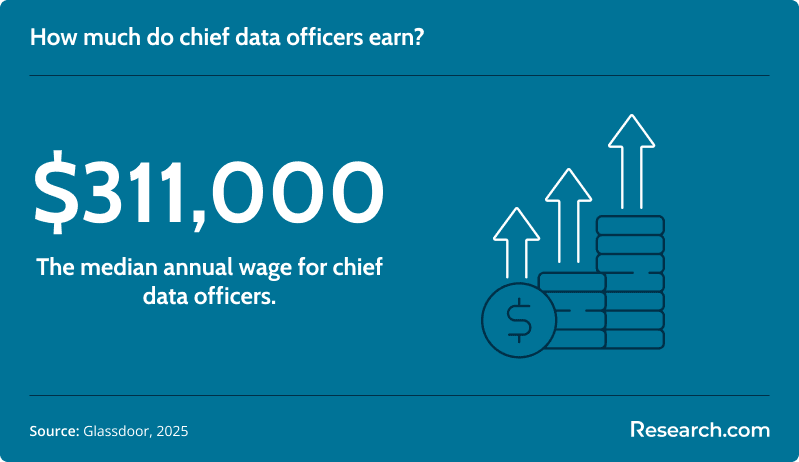
In 2027, chief data officer compensation reflects the role’s executive scope and strategic importance. According to Glassdoor, the median total pay for a chief data officer is approximately $311,000 per year, including base salary, bonuses, and other incentives.
Actual pay can vary widely. A CDO at a large technology, financial services, healthcare, retail, or enterprise software company may have a different compensation package than a CDO at a smaller organization, nonprofit, government agency, or company with a less mature data function. Equity, bonuses, long-term incentives, and performance-based compensation can also make total pay substantially different from base salary.
Factors that influence chief data officer salary
- Company size: Larger organizations often have more complex data ecosystems and may offer higher executive compensation.
- Industry: Data-intensive and highly regulated industries may place a premium on experienced data leaders.
- Location: Compensation can differ by region, especially in markets with strong technology, finance, or enterprise headquarters.
- Scope of responsibility: Some CDOs lead only governance, while others oversee analytics, AI, data engineering, privacy, reporting, and transformation.
- Experience and track record: Executives who have delivered measurable business outcomes through data initiatives are typically more competitive.
- Company maturity: A CDO hired to build a data function from the ground up may face different expectations than one hired to scale an already mature operation.
When comparing offers, candidates should look beyond the headline number. Total compensation, reporting structure, budget authority, team size, board visibility, technology investment, and organizational commitment to data can all affect whether the role is positioned for success.
Is there a high demand for chief data officers in 2027?
Yes, demand for chief data officers remains strong in 2027, especially among organizations that depend on analytics, AI, digital products, customer data, regulatory reporting, or complex operational data. The role has become more important as companies try to improve data quality, manage privacy obligations, modernize legacy systems, and use AI responsibly.
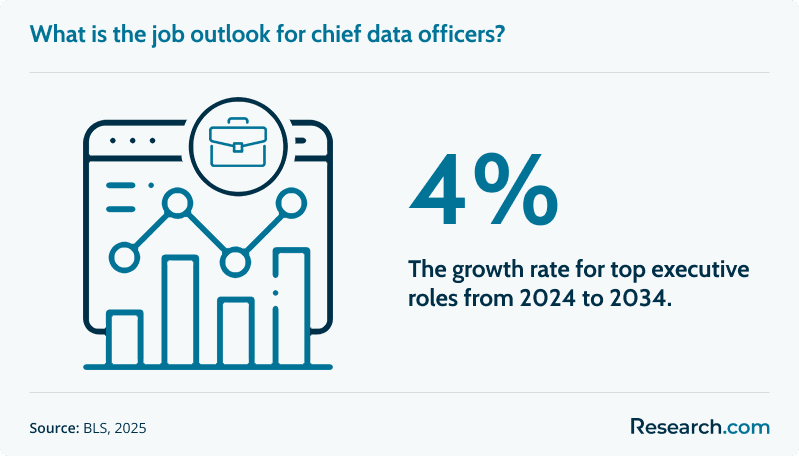
The U.S. Bureau of Labor Statistics (BLS) projects that overall employment of top executives will grow by 4% from 2024 to 2034, with about 331,000 openings each year on average. This broader category includes executive leadership roles, while chief data officer opportunities are shaped by demand for data governance, analytics, digital transformation, and enterprise technology leadership.
Why organizations hire chief data officers
- Data is spread across too many systems: Companies need leadership to reduce fragmentation and build trusted enterprise reporting.
- AI adoption requires governance: Organizations using AI need policies for model risk, data quality, transparency, and ethical use.
- Privacy and compliance demands are increasing: Data leaders help reduce regulatory, legal, and reputational risk.
- Executives want better decision-making: CDOs improve how leaders measure performance, forecast outcomes, and allocate resources.
- Digital transformation depends on usable data: Cloud migration, automation, personalization, and advanced analytics all require reliable data foundations.
The strongest demand is likely to favor candidates who can demonstrate both business impact and governance discipline. Employers are not only looking for technical experts; they need leaders who can make data useful, trustworthy, secure, and strategically aligned.
What are the key performance metrics for evaluating a chief data officer’s success?
A chief data officer should be evaluated by business outcomes as well as technical progress. A data program can have modern tools and impressive dashboards but still fail if employees do not trust the data, if compliance risks remain unresolved, or if initiatives do not improve decisions and performance.
Useful CDO metrics usually combine data quality, adoption, governance maturity, financial impact, risk reduction, and business value. The right mix depends on the organization’s goals and the CDO’s mandate.
Key performance metrics
- Data quality and accuracy: Measures whether data is complete, consistent, current, reliable, and fit for business use.
- Data accessibility and utilization: Tracks whether teams can find and use approved data sources without relying on disconnected spreadsheets or conflicting reports.
- Adoption of governance standards: Evaluates whether departments follow shared definitions, ownership rules, access policies, and data stewardship processes.
- ROI on data initiatives: Assesses whether analytics, data platforms, and governance programs create measurable financial or operational value.
- Compliance and risk management: Measures adherence to privacy, security, retention, and regulatory requirements.
- Speed to insight: Looks at how quickly teams can move from a business question to a trusted answer.
- Reduction in duplicate or conflicting reports: Indicates whether the organization is moving toward a single, trusted view of key metrics.
- Innovation and transformation impact: Monitors how emerging technologies, including AI and automation, contribute to business growth and operational improvement.
- Cross-department collaboration: Reflects whether the CDO has built a data culture that reaches beyond the analytics or IT team.
Executives should avoid judging a CDO only by the number of dashboards delivered, tools purchased, or datasets migrated. Better measures focus on trust, adoption, risk reduction, and business decisions that improve because the organization’s data is stronger.
What are the biggest challenges faced by chief data officers today?
Chief data officers operate in a difficult environment: data volumes are growing, AI expectations are rising, privacy requirements are complex, and many organizations still depend on legacy systems. The challenge is not only technical. CDOs must also change behavior, resolve ownership disputes, and convince business units to adopt shared standards.
Major challenges for chief data officers
- Data silos and fragmentation: Many organizations store data in separate systems with inconsistent definitions, making enterprise reporting difficult.
- Unclear data ownership: Data problems often persist when no team is accountable for quality, definitions, access, or maintenance.
- Regulatory compliance: CDOs must keep pace with changing data privacy laws and global standards that affect how information is collected, stored, shared, and deleted.
- Data literacy gaps: Employees may have access to reports but still misunderstand metrics, confuse correlation with causation, or misuse dashboards.
- Technology integration: Legacy systems, cloud platforms, vendor tools, and custom applications must work together securely and reliably.
- Resource constraints: Data programs often compete for budget, talent, and executive attention against other technology and business priorities.
- Cybersecurity risks: Sensitive data must be protected from breaches, insider misuse, unauthorized access, and weak vendor controls.
- AI governance pressure: As organizations adopt AI, CDOs must address data quality, bias, explainability, privacy, and model risk.
- Measuring business value: It can be difficult to prove the financial return of governance, quality, and infrastructure work, even when those investments are necessary.
The most successful CDOs handle these challenges by prioritizing business-critical data first, securing executive sponsorship, assigning clear ownership, building practical governance processes, and showing early wins that demonstrate value.
Here’s What Graduates Have to Say About What a Chief Data Officer Does
- : "When I first pursued my career in data science, I never imagined leading enterprise-wide data initiatives. As a chief data officer, I learned that leadership is less about coding and more about creating a data culture that empowers every department. It’s rewarding to see analytics directly influence business strategy. The position demands both technical precision and people management. It’s a career where every decision genuinely matters. —Alicia"
- : "My path to becoming a chief data officer started with IT management and evolved into strategic leadership. The role taught me how to align technology investments with measurable business results. Working closely with finance and operations made me realize that data is the true connector between departments. Every dashboard or algorithm you build has to serve a purpose beyond numbers. That’s what makes the job challenging but fulfilling. —David"
- : "Transitioning from data analytics to a chief data officer position reshaped how I see business transformation. I now focus on developing systems that not only collect data but also create value from it. One of the best parts of the role is mentoring teams to think critically about data ethics and strategy. It’s not just about technology—it’s about responsibility and innovation. Every day feels like leading the future of digital intelligence. —Priya"
Other Things You Should Know About What a Chief Data Officer Does
In 2026, a Chief Data Officer focuses on data management, governance, and strategy, while a Chief Information Officer typically oversees technology infrastructure and IT operations. The CDO ensures data is leveraged for strategic insights, whereas the CIO maintains the systems supporting overall business functions.
References
- BLS. (2025, August 28). Top executives. bls.gov.
- Glassdoor. (2025). Chief Data Officer Salaries. glassdoor.com.
- Kosinski, M. & Lindemulder, G. (2025). What is a chief data officer (CDO)?. ibm.com.
- ONET OnLine. (2025). 11-1011.00 - Chief Executives. onetonline.org.
- Taylor, P. (2024, February 28). Chief Data Officers - statistics and facts. statista.com.


