
2027 What Does a Minimum Data Set Nurse Do: Responsibilities, Requirements, and Salary

Co-Founder and Chief Data Scientist
A minimum data set nurse ensures accurate clinical assessments, regulatory compliance, and proper Medicare and Medicaid reimbursement in long-term and post-acute care settings. With demand for skilled RNs, including MDS nurses, projected to maintain a 98% adequacy rate by 2030, this role offers a stable, specialized, non-bedside career with meaningful impact on patient outcomes and facility operations.
In this article, I will explore the core responsibilities, educational requirements, and salary expectations for MDS nurses. I will also share what a typical workday entails, the skills and certifications needed, and how this role serves as a gateway to leadership, administrative, and consulting opportunities in post-acute care.
What are the benefits of becoming a minimum data set nurse?
- MDS nursing offers the satisfaction of improving patient care quality through accurate assessments and data-driven care planning.
- A minimum data set nurse graduate can pursue stable, well-paying roles in long-term care, rehabilitation centers, or senior living facilities, where their expertise is highly valued.
- A minimum data set nurse also ensures compliance and efficiency, helping healthcare organizations maintain high standards and better patient outcomes.
What does an MDS nurse do on a typical workday?
An MDS (Minimum Data Set) nurse ensures quality, compliance, and financial integrity within long-term care settings. Their workday combines clinical judgment with regulatory expertise to ensure that each resident’s needs are documented accurately and that the facility aligns with Medicare and Medicaid reimbursement standards.
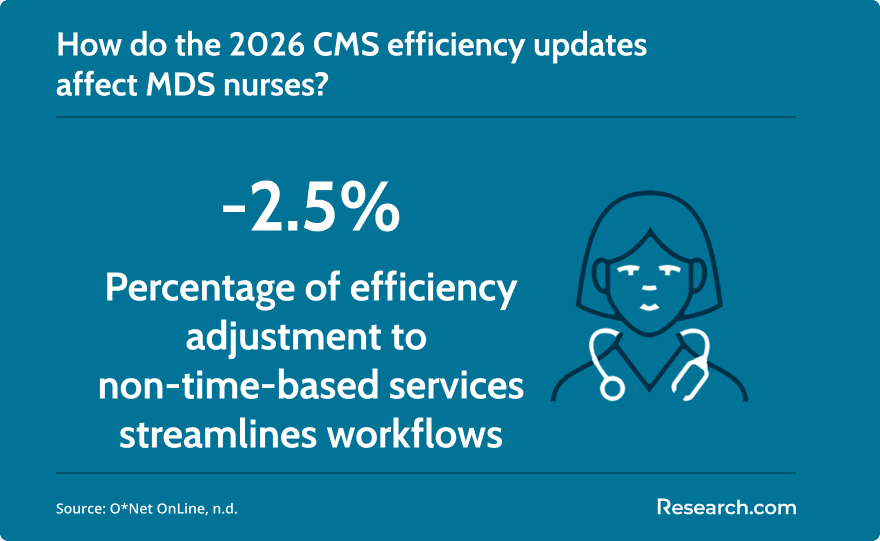
Recent CMS updates, including the CY 2026 Physician Fee Schedule’s 2.5% efficiency adjustment to non-time-based services, reflect a nationwide push toward streamlined workflows, technology-driven documentation, and improved operational efficiency. This directly influences how MDS nurses manage assessments and coordinate care.
The daily responsibilities of a minimum data set nurse focus on both resident well-being and facility compliance, such as:
- Reviewing 24-Hour Reports: Identifying new admissions, discharges, or condition changes that trigger required MDS assessments.
- Coding MDS Sections: Documenting clinical areas such as cognition, mobility, and skin integrity using accurate data from care teams.
- Collaborating With Interdisciplinary Staff: Coordinating with therapy, social work, and dietary teams to align data and care goals.
- Developing Individualized Care Plans: Creating resident-focused strategies that promote well-being and autonomy.
- Leading Care Conferences: Ensuring family and staff alignment on treatment objectives.
- Auditing and Submitting Assessments: Reviewing records for precision and compliance with CMS regulations.
What educational background and training are required to become an MDS nurse?
Becoming a minimum data set nurse requires a combination of formal nursing education, clinical expertise, and regulatory training for accuracy in resident assessments and compliance with CMS standards. Because the role directly impacts facility reimbursement and resident care outcomes, employers seek professionals with strong clinical judgment and meticulous attention to detail.
Here are the requirements for becoming an MDS nurse:
Core Educational Requirements
An MDS nurse must be a licensed nurse, most commonly a Registered Nurse (RN), though some facilities may accept Licensed Practical Nurses (LPNs) or Licensed Vocational Nurses (LVNs). A degree from an accredited program, such as an Associate Degree in Nursing (ADN) or a Bachelor of Science in Nursing (BSN), is required, with BSN graduates generally preferred for their broader clinical and leadership training. Nurses looking to advance quickly can consider a fastest RN to BSN program to meet educational preferences and qualify for MDS roles sooner.
Clinical Experience
Most facilities require at least one to two years of clinical experience in long-term care, skilled nursing, or geriatric settings. This hands-on exposure builds the clinical understanding necessary to interpret complex resident data and coordinate assessments accurately.
Specialized Training and Certification
MDS nurses undergo focused training on the Resident Assessment Instrument (RAI) and MDS 3.0 guidelines, covering assessment coding, scheduling, and care planning. Many pursue the Resident Assessment Coordinator–Certified (RAC-CT) credential from the American Association of Post-Acute Care Nursing (AAPACN), a respected certification that validates expertise and enhances career advancement opportunities.
What types of healthcare settings employ MDS nurses?
A minimum data set nurse is most often employed in healthcare settings that provide long-term or post-acute care under Medicare and Medicaid programs. Their expertise bridges clinical care and compliance, so that resident assessments are both clinically meaningful and accurately coded for federal reimbursement.
Because the MDS process is a regulatory requirement for facilities receiving government funding, these nurses are essential in maintaining both care quality and operational sustainability. Below are the healthcare settings and best places to work as a nurse, particularly as a minimum data set nurse:
- Skilled Nursing Facilities (SNFs): In SNFs, MDS nurses manage detailed, time-sensitive MDS assessments that determine Medicare Part A reimbursement rates for short-term rehabilitation stays and post-hospital recovery.
- Long-Term Care (LTC) Facilities/Nursing Homes: In these settings, MDS nurses oversee ongoing assessments that guide Medicaid case-mix payments. Here, they monitor quality indicators and ensure each resident’s care plan remains person-centered and OBRA-compliant.
- Rehabilitation Hospitals: Some inpatient rehab units employ MDS nurses to coordinate MDS processes for residents requiring extended or specialized recovery services.
- Consulting and Corporations: Experienced MDS professionals often advance into regional, corporate, or consulting positions, training staff, conducting compliance audits, and optimizing reimbursement accuracy.
- Hospitals and Ambulatory Services: As the largest employers of RNs, including MDS nurses, hospitals (state, local, and private) account for 59% of RN employment, while ambulatory healthcare services employ 19%, reflecting additional opportunities in post-acute care coordination and outpatient settings.
This chart from the U.S. BLS shows the largest employers for registered nurses.
What skills are essential for success as an MDS nurse?
An MDS nurse requires a balance of clinical expertise, regulatory knowledge, analytical precision, and strong interpersonal communication to succeed. This multifaceted role bridges patient care, documentation accuracy, and compliance with federal standards.
Below are the mix of technical and soft skills essential for MDS nurses to gain excellence in long-term and post-acute care environments:
- Clinical and Regulatory Expertise: MDS nurses must demonstrate mastery of the Resident Assessment Instrument (RAI) and MDS 3.0 process, including scheduling, coding, and documentation standards. They should also have a strong grasp of Medicare and Medicaid reimbursement models, especially the Patient-Driven Payment Model (PDPM), ensures assessments translate accurately into reimbursement and compliance.
- Analytical and Technical Proficiency: Competence with Electronic Health Records (EHRs), MDS submission software, and ICD-10 coding is critical. MDS nurses must analyze clinical data for accuracy, identify inconsistencies, and interpret trends that affect quality measures and facility ratings.
- Communication and Leadership: The role demands effective coordination among interdisciplinary teams, nurses, therapists, dietitians, and social workers, requiring diplomacy, clarity, and persistence.
- Attention to Detail and Time Management: MDS nurses must have attention to detail and time management skills, as every MDS assessment follows strict federal timelines. This precision and organization prevent costly compliance issues.
- Advocacy and Compassion: Beyond data, successful MDS nurses champion resident-centered care, ensuring that documentation reflects not just clinical facts but each individual’s needs, dignity, and quality of life.
What is the typical career path or advancement opportunity for an MDS nurse?
A career as an MDS nurse offers a structured path that blends clinical expertise with leadership, compliance, and financial insight. This role equips nurses with a unique understanding of how patient care connects to quality outcomes and reimbursement systems
The skills of MDS nurses pave the way for advancement into senior administrative and consulting positions in long-term and post-acute care, such as the following:
Foundational Role: MDS Nurse / Nurse Assessment Coordinator (NAC)
Manages the Resident Assessment Instrument (RAI) process, ensuring accurate and timely completion of assessments under Medicare’s Patient-Driven Payment Model (PDPM). This role is becoming increasingly vital as Medicare continues to serve millions of older adults.
With average monthly enrollment reaching 35.3 million in 2022 and 34.4 million in 2023, this drives sustained demand for precise clinical documentation and reimbursement accuracy.
Mid-Level Advancement: Supervisory and Regional Roles
- Director of Clinical Reimbursement: Oversees MDS staff, audits assessments, and ensures accurate facility reimbursement and compliance.
- Regional or Corporate MDS Consultant: Provides training, audits, and process improvements across multiple facilities to maintain consistency and accuracy.
- Assistant or Director of Nursing (DON): Uses MDS expertise to align clinical operations with financial and quality performance goals.
Executive and Consulting Roles: Leadership and Strategic Impact
- Director of Quality Improvement or Risk Management: Uses MDS data to identify trends, reduce readmissions, and improve facility-wide care outcomes.
- Healthcare or Clinical Consultant: Advises organizations on compliance, reimbursement, and operational efficiency using in-depth MDS knowledge.
- Healthcare Administrator or VP of Compliance: Applies regulatory and data-driven insights to shape strategic decisions and organizational policies.
This chart from CMS.gov shows the Medicare enrollment in recent years.
What is the average salary for an MDS nurse?
According to the U.S. BLS (2025), registered nurses in the U.S. earn a median annual income of $93,600, though this figure does not distinguish between nursing specialties. More specific data from ZipRecruiter (2025) places the median annual salary for MDS nurses at $86,248, reflecting their specialized role in long-term care, compliance, and reimbursement coordination.
An MDS nurse’s earnings typically increase with professional experience and additional training. Entry-level MDS nurses often start between $65,000 and $75,000 per year, while those with 10–20 years of experience or supervisory roles can earn well over $100,000 annually ZipRecruiter (2025). Certification, such as the Resident Assessment Coordinator–Certified (RAC-CT) credential, also contributes to higher pay by demonstrating advanced regulatory and assessment expertise.
Geography plays a significant role in MDS nurse compensation, as regional cost of living, demand for skilled nurses, and local healthcare funding influence salaries. For example, the highest reported averages are in Nome, Alaska ($106,990) and Berkeley, California ($105,605), reflecting higher living costs and competitive local healthcare markets.
Overall, the MDS nurse career offers both competitive pay and long-term stability, rewarding nurses who combine clinical expertise with administrative precision and compliance knowledge.
This chart from ZipRecruiter shows the cities that offer the highest salaries for a minimum data set nurse.
What is the job outlook and demand for MDS nurses?
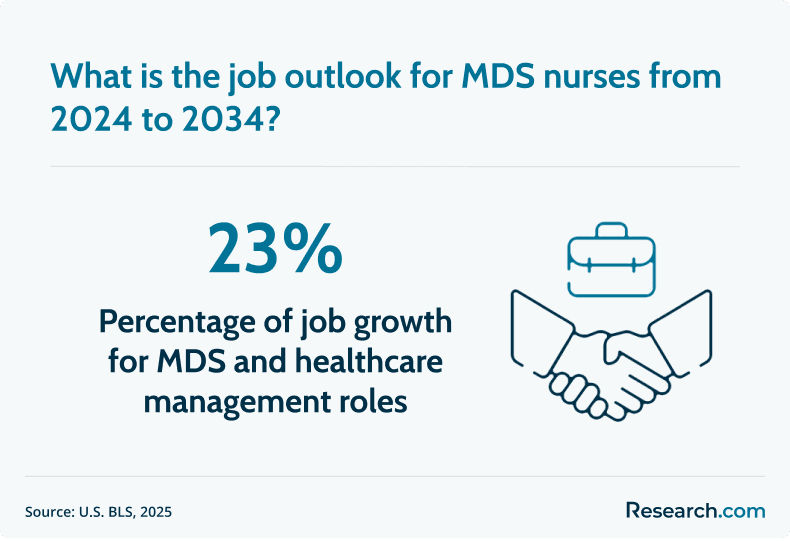
The job outlook for MDS nurses remains highly favorable as healthcare facilities continue to rely on skilled professionals who can bridge clinical care, compliance, and reimbursement processes. The U.S. BLS projects a 5% growth rate for registered nurses over the next decade, while medical and health services management roles, which include MDS and reimbursement-focused nursing positions, are expected to grow by 23% from 2024 to 2034. This is a rate significantly higher than the national average for all occupations.
This rapid expansion reflects systemic changes in post-acute and long-term care, driven by an aging population and evolving federal reimbursement models such as the Patient-Driven Payment Model (PDPM). These models demand precise assessment and data reporting, core functions of the MDS nurse.
Each year, an estimated 62,100 new health services management positions open due to retirements and workforce transitions (U.S. BLS, 2025). Facilities increasingly seek MDS nurses who can ensure compliance, optimize reimbursement accuracy, and improve quality metrics. As a result, MDS nurses actively sustain operational efficiency and regulatory integrity, reinforcing their indispensable role in today’s healthcare landscape.
What are the alternative careers for MDS nurses?
MDS nursing develops a specialized skill set that blends clinical expertise, regulatory compliance, and data management, making it a strong springboard into a variety of non-bedside roles. Nurses who gain experience in MDS assessments and care coordination are well-prepared to influence patient outcomes and facility operations from administrative, analytical, or leadership positions.
For those becoming a nurse later in life, MDS experience offers a clear pathway to meaningful, stable careers that emphasize oversight, quality improvement, and organizational impact rather than direct patient care. The alternative career paths for MDS nurses include:
- Clinical Compliance Specialist: Ensures healthcare facilities meet CMS and state regulations, conducts audits, and supports risk mitigation strategies.
- Quality Improvement Coordinator: Designs and implements initiatives to enhance care quality, patient safety, and facility performance metrics.
- Care Coordination Manager: Oversees interdisciplinary communication and streamlines patient transitions, aligning care plans with reimbursement and regulatory requirements.
- Health Informatics Analyst: Analyzes EHR data to optimize documentation, reporting, and clinical decision-making across care teams.
- Corporate or Consulting Roles: Guides MDS processes, staff training, and reimbursement optimization across multiple facilities or regions.
What are the biggest challenges MDS nurses face in their roles today?
MDS nurses operate at the intersection of clinical care, regulatory compliance, and financial stewardship in long-term and post-acute care settings. Their work ensures accurate patient assessments, supports reimbursement under Medicare and Medicaid, and drives facility quality measures.
However, the role comes with significant challenges, as MDS nurses balance complex documentation, strict deadlines, interdisciplinary coordination, and evolving federal regulations. For those exploring non bedside nurse jobs, these responsibilities highlight the high-stakes nature of the work. It requires precise clinical judgment, advanced organizational skills, and resilience under regulatory and financial pressures.
These are the biggest challenges a minimum data set nurse faces today:
- Regulatory and Documentation Burden: MDS nurses must stay current with frequent CMS updates and accurately code clinical data under the Patient-Driven Payment Model (PDPM), as errors can lead to lost revenue or compliance issues.
- Staffing Shortages and Role Conflict: Many MDS nurses are diverted to bedside duties during staffing gaps, delaying critical assessments and increasing the risk of reimbursement loss.
- Interdisciplinary Team Coordination: MDS nurses collect and synthesize data from multiple departments, requiring them to bridge gaps between bedside staff and administrative teams while ensuring timely and reliable documentation.
- Technological and System Adaptation: Integrating MDS workflows with electronic health records (EHRs) and keeping pace with health IT innovations adds another layer of complexity to daily responsibilities.
How can you tell if a career as an MDS nurse is the right career fit for you?
For students exploring the fastest way to become a nurse, understanding the distinct role of a minimum data set nurse can help determine if this specialized path aligns with their strengths and career goals. Transitioning from bedside care to MDS nursing shifts the focus from direct patient care to administrative, regulatory, and reimbursement responsibilities. Success in this field depends less on clinical specialty and more on attention to detail, organization, and effective collaboration with interdisciplinary teams.
To evaluate if MDS nursing suits your skills and interests, consider three key areas: administrative mindset, professional competencies, and career motivations. This role offers stability, specialized expertise, and meaningful influence on patient outcomes and facility operations.
By reflecting on your strengths and goals, you can decide whether pursuing MDS nursing provides the right balance of challenge, impact, and professional growth. You may also consider the following:
- Administrative and Detail Mindset: MDS nurses act as auditors, analysts, and compliance specialists. You should enjoy meticulous documentation, tracking complex CMS regulations, and managing a desk-based workflow where errors have significant financial consequences.
- Professional Skills and Temperament: Strong communication with interdisciplinary teams, precise organization, and analytical thinking are essential. You must navigate multiple deadlines, review disparate clinical data, and translate findings into accurate assessments that support reimbursement and quality measures.
- Career Motivations: Consider your goals for impact, leadership, and work-life balance. MDS roles allow you to influence care facility-wide, lead compliance initiatives, and pursue advanced administrative or consulting opportunities. However, this also means having regulatory and financial stress that replaces the physical demands of bedside care.
What Professionals Who Work as MDS Nurses Say About Their Careers
- Maria: "Studying to become an MDS nurse gave me the confidence to navigate complex healthcare documentation with precision. The coursework helped me understand how data directly impacts patient outcomes and facility compliance. It’s incredibly rewarding to see how my training contributes to better care every day. "
- James: "The program challenged me to think critically about patient assessments and data accuracy. I loved how practical the lessons were, each module connected directly to real-world scenarios in long-term care. That foundation made my transition into the role smooth and fulfilling. "
- Aileen: "Earning my MDS nurse qualification opened doors I never expected. I gained a deep understanding of care planning, teamwork, and the power of accurate reporting. The balance between technical knowledge and compassionate care truly shaped me as a professional. "
Key Findings
- Ambulatory healthcare services employ 19% of RNs, reflecting expanding roles for MDS nurses in outpatient and care coordination settings.
- The MDS nurse role is increasingly vital as Medicare serves over 34 million older adults, highlighting the need for skilled regulatory and reimbursement-focused nursing.
- Median annual salary for MDS nurses is $86,248, reflecting strong compensation for this specialized role.
- Top-paying locations for MDS nurses include Nome, Alaska ($106,990) and Berkeley, California ($105,605), highlighting regional salary variations.
- Medical and health services management roles, including MDS positions, are projected to grow 23% from 2024 to 2034, far outpacing the national occupational growth average.
Other Things You Need to Know About Becoming an MDS Nurse
To become a Minimum Data Set nurse in 2027, candidates typically need a valid RN or LPN license, experience in geriatric care, and specific training in MDS assessment procedures. Certification through a recognized program such as AANAC can enhance job prospects.
In 2027, MDS nurses are responsible for assessing residents' medical and functional status in long-term care facilities. They collect and input data into the MDS, ensuring accuracy for resident assessments and care planning, while also aligning with federal and state regulations.
References
- CMS.gov (2025). Calendar Year (CY) 2026 Medicare Physician Fee Schedule Final Rule (CMS-1832-F). Retrieved from https://www.cms.gov/newsroom/fact-sheets/calendar-year-cy-2026-medicare-physician-fee-schedule-final-rule-cms-1832-f
- CMS.gov (2025). CMS Fast Facts. Retrieved from https://data.cms.gov/sites/default/files/2025-04/CMSFastFacts2025_508.pdf
- National Center for Health Workforce Analysis (2022). Nurse Workforce Projections, 2020-2035. Retrieved from https://bhw.hrsa.gov/sites/default/files/bureau-health-workforce/Nursing-Workforce-Projections-Factsheet.pdf
- U.S. BLS (2025). Medical and Health Services Managers. Retrieved from https://www.bls.gov/ooh/management/medical-and-health-services-managers.htm#tab-6
- U.S. BLS (2025). Registered Nurses. Retrieved from https://www.bls.gov/ooh/healthcare/registered-nurses.htm
- ZipRecuiter (2025). MDS Nurse Salary. Retrieved from https://www.ziprecruiter.com/Salaries/Mds-Nurse-Salary


