2027 Preparing for BCBA Credentialing & Licensing After Graduation

Co-Founder and Chief Data Scientist
After a master’s degree in applied behavior analysis or a related qualifying program, the next decision is not whether you are “done.” It is how to turn your education, supervised experience, and exam preparation into a valid BCBA credential—and, where required, a state license to practice.
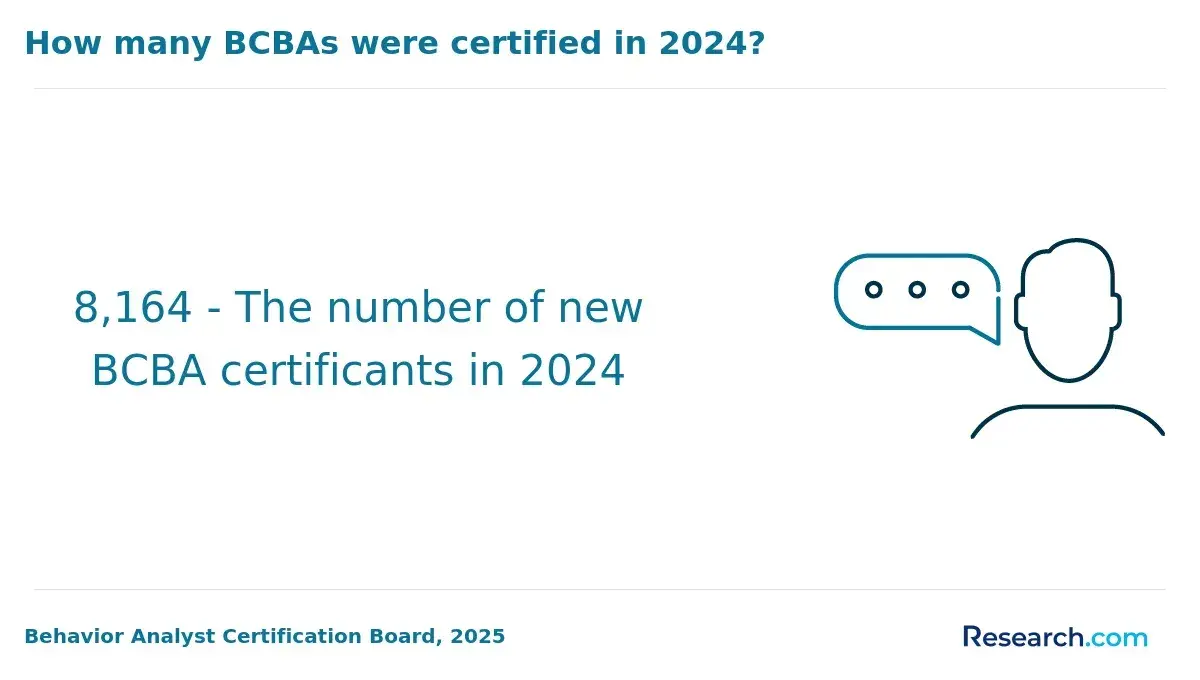
The process is detailed because the credential carries professional and legal responsibility. You must document your degree, verify fieldwork, submit a complete BACB application, pass the certification exam, and then satisfy any state licensing rules that apply where you plan to work. The stakes are practical: the Behavior Analyst Certification Board (BACB) reported a first-time pass rate of just 54% in 2024, so careful planning matters.
This guide walks through the post-graduation sequence step by step. It is designed for recent graduates, final-term students, and career changers who want a clear path from program completion to BCBA certification and state authorization.
Key Benefits of Preparing for BCBA Credentialing & Licensing
- BCBAs are highly compensated professionals. According to 2025 data, the average annual salary for a BCBA in the United States is approximately $89,075, with top earners exceeding $120,000.
- The professional demand for behavior analysts is surging. A 2025 report from the Behavior Analyst Certification Board (BACB) revealed a staggering 58% increase in demand for BCBA between 2023 and 2024 alone, indicating extraordinary job security.
- Your BCBA credential is a key that unlocks doors to diverse and impactful careers. You can effect real change in a variety of settings, including clinical environments, school systems, in-home therapy, and organizational consulting.
What is the very first step I should take after graduation?
Your first step after graduation is to request your official, degree-conferred transcript and have it sent according to BACB requirements. The transcript is the primary proof that you completed the required graduate-level education. Without it, the BACB cannot fully evaluate your application.
Do not request the transcript too early. It must show that the degree was conferred, not merely that coursework was completed. Check your student portal or contact the registrar to confirm that the degree conferral date appears on the record before ordering it.
Why this step prevents delays
Many certification delays begin with transcript problems: a transcript is unofficial, the degree is not yet posted, the document is sent to the wrong destination, or the applicant assumes the university sent it when it has not. Treat this as a trackable administrative task, not a formality.
- Confirm that your legal name matches across your university records, BACB account, and identification documents.
- Ask the registrar how long transcript processing typically takes after degree conferral.
- Order a copy for your own records, especially if your state licensing board later requests one.
- Keep confirmation receipts or tracking details in your certification folder.
If you completed one of the best BCBA programs, your program may provide guidance, but the responsibility for submitting a complete application still rests with you.
How do I finalize and verify my supervised fieldwork hours?
You finalize supervised fieldwork by auditing your records, resolving any discrepancies, and obtaining the required signatures on the BACB’s official forms. Your fieldwork documentation is not a summary of your experience; it is the evidence the BACB uses to determine whether your supervised practice meets its requirements.
Before submitting anything, review the documentation as if an outside reviewer will question every missing date, signature, total, and monthly supervision calculation. Incomplete or inconsistent records can lead to rejection or a request for correction, which can push back your exam authorization.
How to run a final fieldwork audit
Schedule a dedicated final meeting with your supervisor. The agenda should be limited to documentation review, not general career advice or exam preparation. Bring your monthly verification forms, final verification form, personal logs, supervision meeting records, and any supporting notes you used to track activities.
- Check that total hours match across your personal logs and BACB forms.
- Verify that monthly supervision percentages meet the required thresholds for each month claimed.
- Confirm that restricted and unrestricted activities are categorized consistently.
- Make sure every required signature, date, and credential detail is present.
- Scan clean copies of every signed document before submitting anything online.
If your fieldwork was completed while enrolled in an online applied behavior analysis degree, be especially careful to keep documentation organized across sites, supervisors, and digital records. Multiple supervisors or placements can make the final audit more complex.
What's involved in the formal BACB application process?
The formal BACB application process is completed through the BACB’s online system. You create or update your account, enter the required information, upload or arrange submission of required documents, and pay the application fee. The purpose of the application is to show that you meet the education and supervised fieldwork requirements before you are approved to sit for the exam.
A strong application is complete, consistent, and easy to review. Names, dates, degree details, supervisor credentials, and fieldwork totals should align across every document. Even small inconsistencies can trigger questions.
Documents to organize before you apply
Before logging in to submit, create a digital folder with clearly named files. Use file names that make sense later, such as “Final_Fieldwork_Verification_Supervisor_Name” or “Degree_Conferred_Transcript_Receipt.” This reduces the risk of uploading the wrong document under pressure.
- Degree-conferred transcript documentation or confirmation of transcript submission.
- Signed fieldwork verification forms.
- Supervisor information and credentials, if needed for your records.
- Payment method for the application fee.
- Personal identification details that match your testing documents.
Common application mistakes to avoid
- Submitting before the degree is officially conferred.
- Uploading scans that are blurry, incomplete, or missing pages.
- Using different versions of your name across documents.
- Assuming a supervisor’s signature is optional if logs are otherwise complete.
- Waiting until you are ready to test before discovering a documentation issue.
Your BACB account becomes your central dashboard for the certification process, so keep login information secure and monitor messages after submission.
How long does the entire credentialing process take?
From graduation to BCBA certification, the process typically takes between four and six months. The exact timeline depends on how quickly your university posts the degree, how clean your fieldwork documentation is, how long the BACB review takes, and how much time you need for serious exam preparation.
The best approach is to treat credentialing like a project with dependent steps. You cannot control every review timeline, but you can reduce avoidable delays by preparing documents before graduation and scheduling supervisor sign-off promptly.
A realistic post-graduation timeline
- Document collection: 1-3 weeks. This includes waiting for degree conferral, requesting transcripts, collecting signed fieldwork forms, and scanning documents.
- BACB application review: 4-6 weeks. A complete application generally moves more smoothly than one with missing forms or unclear documentation.
- Exam preparation and scheduling: 8-12 weeks. This is often the longest applicant-controlled phase. Most candidates need a structured study plan rather than casual review.
- Exam and certification: 1 week. Candidates receive an unofficial pass/fail result at the testing center, with official certification following from the BACB shortly after.
How to keep the timeline on track
Work backward from the date you would like to be employable as a BCBA. If you plan to accept a role that requires certification or state licensure, remember that certification is not always the final step. Some employers may require the state license before you can practice independently or bill for services.
How much does the entire BCBA certification process cost?
The core BCBA certification fees paid to the BACB and its testing partner total approximately $665. This baseline does not include exam preparation materials, state licensing costs, background checks, or potential retake expenses.
Budgeting early is important because the costs do not all occur at the same time. You will pay some fees when applying, others when scheduling the exam, and another after passing.
Core certification costs
- BCBA application fee: $245, paid when you submit your application.
- Examination appointment fee: $175, paid to Pearson VUE each time you schedule an exam.
- Initial certification fee: $245, paid to the BACB after passing to activate certification.
Additional costs to plan for
Many candidates also purchase exam preparation tools. High-quality exam preparation materials can range from $300 to $800. You should also set aside money for state licensing fees if your state regulates behavior analysis, and for a potential exam retake if you do not pass on the first attempt.
A practical budget should separate required fees from optional but useful preparation expenses. The application and exam fees are unavoidable. Study tools vary by candidate, but underpreparing can cost more if it leads to a retake and delays employment.
What should I expect from the BCBA certification exam?
The BCBA certification exam is a 185-question, multiple-choice exam administered at a Pearson VUE testing center. Candidates have 4 full hours to complete it. The exam is designed to assess whether you can apply behavior-analytic principles in professional scenarios, not simply recall definitions.
The exam is based on the BACB Task List, which outlines the knowledge and skills expected of entry-level BCBAs. Your study plan should follow that document closely because it reflects the content areas the exam is built to measure.
What makes the exam challenging
The difficulty often comes from application-based questions. You may know a concept in isolation but still struggle when the question asks you to choose the best procedure, identify an ethical concern, interpret data, or respond to a clinical scenario. The exam rewards precise reading and professional judgment.
- Expect scenario-based questions that require more than memorization.
- Practice interpreting graphs, measurement systems, and intervention outcomes.
- Review ethics as applied decision-making, not as a list of rules.
- Use the BACB Task List to identify high-priority content areas.
Candidates pursuing BCBA certification should use the exam as a professional readiness checkpoint. Passing demonstrates that your coursework and fieldwork have translated into applied competence.
What are the most effective strategies for exam preparation?
The most effective exam preparation combines a written study schedule, active recall, repeated practice questions, and full-length mock exams under timed conditions. Reviewing graduate notes alone is usually not enough because the exam emphasizes applied problem-solving.
Plan for a two-to-three-month study period if you can. That gives you time to review all major content areas, identify weaknesses, and build the stamina needed for a 4-hour testing appointment.
Build a study plan around the BACB Task List
Start by mapping each Task List area to a weekly study schedule. Spend more time on areas where your practice scores are low, but do not completely ignore stronger areas. The goal is balanced readiness.
- Content review: Revisit core concepts, definitions, measurement methods, assessment procedures, behavior-change strategies, and ethics.
- Active recall: Use flashcards, teach-back methods, and written explanations rather than passive reading.
- Practice questions: Answer questions daily and review why each incorrect option is wrong.
- Mock exams: Complete several timed, full-length practice exams to build endurance and pacing.
- Error tracking: Keep a log of missed questions by content area so your study time targets actual weaknesses.
Use support strategically
Study groups, tutors, and review courses can help if they keep you accountable and clarify difficult concepts. They are less useful if they become passive lectures or unfocused discussion. Choose preparation resources that require you to answer questions, explain reasoning, and correct mistakes.
If you completed one of the BCBA online masters programs, review how your coursework aligns with the Task List and fill any gaps before test day.
How can I find my specific state's licensing requirements?
To find your state’s licensing requirements, go directly to the official state board or government agency that regulates behavior analysis. Do not rely only on employer summaries, social media posts, or outdated third-party checklists. State rules can change, and the licensing board is the authoritative source.
The BCBA credential and a state license are related but not the same. The BCBA is a national professional certification awarded by the BACB. A state license is legal permission from a government entity to practice within that state. In many regulated states, the BCBA is a requirement for licensure, but it does not automatically grant the legal right to practice independently.
What to look for on your state board website
- Whether behavior analysts must be licensed in that state.
- Whether BCBA certification is required before applying.
- Application forms, fees, and renewal rules.
- Background check or fingerprinting requirements.
- Any jurisprudence examination on state laws and regulations.
- Continuing education requirements for license renewal.
- Scope-of-practice rules and supervision requirements.
Common state-specific requirements
Many states add consumer-protection requirements beyond national certification. These can include a criminal background check, a jurisprudence examination, and, in some cases, additional supervised experience. Requirements vary by jurisdiction, so the safest approach is to check your state early—ideally when you receive authorization to test or before you accept a position in a new state.
This two-level system matters for employment. An employer may hire you conditionally after you pass the BCBA exam, but you may still need state approval before practicing independently or providing certain services.
What does the career outlook for BCBAs look like in 2025?
The career outlook for BCBAs in 2025 is strong, with demand continuing to grow across clinical, educational, healthcare, and organizational settings. A 2025 report from the BACB highlighted a 58% increase in demand for BCBAs from 2023 to 2024 alone, signaling a tight labor market for qualified behavior analysts.
This demand is driven by several factors: broader recognition of ABA services, continued need for autism-related behavioral support, insurance coverage requirements, school-based behavioral intervention needs, and expanding use of behavior analysis outside traditional clinical settings.
Where BCBAs commonly work
- Autism and developmental disability service providers.
- Schools and special education programs.
- Hospitals, clinics, and behavioral health organizations.
- Early intervention programs.
- Residential and community-based service agencies.
- Corporate training, performance management, and organizational behavior settings.
How to evaluate job opportunities
Strong demand does not mean every job is equally good. Compare positions based on supervision quality, caseload expectations, billable-hour requirements, ethical support, travel demands, documentation time, career advancement, and whether the employer supports licensure and continuing education.
The BLS further supports this positive outlook by projecting faster-than-average growth for the broader field of psychologists. For new BCBAs, the best strategy is to look beyond the job title and evaluate whether the role offers sustainable practice conditions and professional growth.
How do I maintain my credentials once I'm certified and licensed?
After certification, you maintain your BCBA credential through a recurring two-year renewal cycle that includes continuing education, ethics compliance, and renewal fees. The BACB requires 32 continuing education (CE) units every two years, with at least four units focused on ethics.
If your state requires licensure, you must also maintain that license separately. State renewal periods, CE rules, fees, and reporting requirements may differ from the BACB’s requirements. Meeting BACB renewal rules does not automatically mean you have met your state’s licensing rules.
How to stay compliant
- Create a renewal calendar for both BACB certification and state licensure.
- Track CE units as you complete them rather than waiting until the end of the cycle.
- Keep certificates of completion and course descriptions in a digital folder.
- Separate ethics CE from general CE so you can verify the required four units.
- Review your state board’s renewal rules at least several months before the deadline.
- Maintain professional liability awareness and follow the applicable ethics code in daily practice.
Think of renewal as professional risk management
Credential maintenance is more than paperwork. It protects clients, supports ethical practice, and keeps you current with changes in research, standards, and state rules. A simple tracking spreadsheet for CE activities, renewal dates, fees, and documentation can prevent last-minute stress and reduce the risk of an accidental lapse.
Other Things You Should know About BCBA Credentialing and Licensing
To qualify for the BCBA exam in 2027, candidates must have a graduate degree in behavior analysis or a related field, complete the required coursework, fulfill the supervised fieldwork criteria, and submit official documentation. It is essential to meet the BACB’s updated requirements for educational and experiential standards.
In 2027, the BCBA exam will include updated content reflecting recent advancements in applied behavior analysis. Expect a greater focus on ethical practices and cultural competency, as the task list has been revised to align with current professional standards. Check the BACB website for exact details.
References
- Behavior Analyst Certification Board. (n.d.). BACB certificant annual report data. Retrieved November 11, 2025, from BACB.
- Behavior Analyst Certification Board. (2025). Board Certified Behavior Analyst handbook. Retrieved November 11, 2025, from BACB.
- Behavior Analyst Certification Board. (2025). US employment demand for behavior analysts: 2010–2024. Retrieved November 11, 2025, from BACB.
- U.S. Bureau of Labor Statistics. (2025). Occupational outlook handbook: Psychologists. Retrieved November 11, 2025, from BLS.
- ZipRecruiter. (2025). BCBA salary. Retrieved November 11, 2025, from ZipRecruiter.