
2027 How to Become an Ultrasound Technician in New Hampshire

Co-Founder and Chief Data Scientist
Many aspiring healthcare professionals in New Hampshire face uncertainty about becoming ultrasound technicians. With projected job growth of 15% over the next decade, the field offers strong demand, job stability, competitive salaries, and opportunities for advancement while contributing meaningfully to patient care.
This article, prepared by career planning experts, outlines New Hampshire’s education, certification, and employment pathways, providing clear guidance toward a successful career.
Key Things to Know About Becoming an Ultrasound Technician in New Hampshire
- New Hampshire ultrasound technicians must complete a CAAHEP-accredited degree, clinical hours, national certification, and state licensure with continuing education.
- Professionals can pursue OB/GYN, vascular, cardiac, or pediatric sonography, earning ARDMS, ARRT, or CCI credentials required for licensure and employment.
- The field is projected to grow 19%, with advancement through certifications, higher education, and leadership, though strain, stress, and competition pose challenges.
Table of Contents
- What education is required to become an ultrasound technician in New Hampshire?
- What specialties can ultrasound technicians choose from in New Hampshire?
- Which certification exams are required to become an ultrasound technician in New Hampshire?
- Is a license required to practice as an ultrasound technician in New Hampshire?
- What to expect during ultrasound technician clinical training in New Hampshire?
- How much does it cost to become an ultrasound technician in New Hampshire?
- What is the average salary for ultrasound technicians in New Hampshire?
- What are the ongoing continuing education requirements for ultrasound technicians in New Hampshire?
- What professional associations can ultrasound technicians join in New Hampshire?
- What is the job outlook and demand for ultrasound technicians in New Hampshire?
- What are the career advancement steps for ultrasound technicians in New Hampshire?
- What are the common challenges ultrasound technicians face in New Hampshire?
What education is required to become an ultrasound technician in New Hampshire?
In New Hampshire, becoming an ultrasound technician requires both formal education and clinical training. Programs ensure that students gain academic knowledge, hands-on skills, and certification readiness to meet state licensure standards.
Below are the key educational requirements:
- Minimum Degree Requirement: Applicants must hold at least an Associate of Science or Bachelor’s Degree in Allied Health or a related patient care field before entering sonography programs.
- Accredited Program Completion: Students must complete a CAAHEP-accredited ultrasound technician program to qualify for certification and professional practice.
- Clinical Practicum Hours: Supervised clinical rotations across healthcare facilities provide essential real-world experience under the guidance of registered sonographers.
- National Certification Exam Eligibility: Graduates are eligible to take ARDMS or ARRT certification exams, which are necessary for employment and state licensure.
- State Licensure Requirement: New Hampshire requires sonographers to obtain a state license, granted upon proof of national certification.
- Continuing Education: Licensed professionals must complete continuing education every two years to maintain their credentials and remain current in the field.
- High School Diploma: A high school diploma or GED is required before pursuing any allied health or sonography education.
Those exploring career options may also want to consider the competitive ultrasound technician salary in New Hampshire, reflecting the expertise these education pathways cultivate. For deeper insight on earning potential, see the ultrasound technician salary report.
What specialties can ultrasound technicians choose from in New Hampshire?
Ultrasound technicians in New Hampshire may choose from a range of specialties that reflect both clinical needs and technological advances. These options allow professionals to focus on specific patient populations or medical conditions. Below are the primary specialties available in the state.
- Abdominal Sonography: Focuses on imaging organs such as the liver, kidneys, pancreas, and spleen, supporting diagnosis of tumors, stones, and organ disorders.
- Obstetric and Gynecologic Sonography: Specializes in reproductive health and fetal development, with strong demand in larger facilities across cities such as Manchester.
- Cardiac Sonography (Echocardiography): Involves imaging the heart to assess function and detect abnormalities, offering competitive salaries and career growth opportunities.
- Vascular Sonography: Examines veins and arteries to evaluate blood flow and identify clots or blockages, often complementing cardiac imaging roles.
- Breast Sonography: Focuses on detailed imaging of breast tissue, aiding in early cancer detection alongside mammography.
- Musculoskeletal Sonography: Provides imaging of muscles, ligaments, and joints, frequently used in orthopedic and sports medicine.
- Pediatric Sonography: Specializes in imaging infants and children, addressing unique developmental and anatomical needs in clinical care.
For those curious about how long to be a ultrasound tech, factors like specialty choice and experience can influence career trajectory. Exploring the state’s specialty options lets ultrasound technicians align their skills with fields that match both interest and demand.
Which certification exams are required to become an ultrasound technician in New Hampshire?
Certification exams are mandatory for ultrasound technicians in New Hampshire because state law requires licensure to practice. These exams confirm professional competence, safeguard patients, and ensure diagnostic accuracy. Employers also view them as proof of expertise and dedication. Below are the main certification options recognized in New Hampshire.
- ARDMS Certification Exams: The American Registry for Diagnostic Medical Sonography is the primary pathway. Candidates must pass the Sonography Principles and Instrumentation (SPI) exam and a specialty exam, such as Abdomen or OB/GYN. Eligibility typically requires a CAAHEP-accredited program or equivalent clinical training.
- ARRT Sonography Certification: The American Registry of Radiologic Technologists offers the Sonography (S) credential, which covers patient care, imaging procedures, and safety. Completion of an ARRT-accredited program and compliance with ethics standards are required. This certification is fully accepted for state licensure.
- CCI Certification Exams: Cardiovascular Credentialing International provides credentials like Registered Cardiac Sonographer (RCS) and Registered Vascular Specialist (RVS). These exams focus on cardiovascular imaging and patient evaluation. They are accepted by the state for licensure in specialized practice areas.
- Other Accepted National Credentials: New Hampshire also recognizes certifications from other approved organizations if they meet national standards. These alternative credentials allow flexibility for technicians who pursue specialized training or alternative certification pathways.
Is a license required to practice as an ultrasound technician in New Hampshire?
A state license is required to practice as an ultrasound technician in New Hampshire. This requirement ensures that all professionals meet strict standards designed to protect patients and uphold the quality of medical imaging services.
Below are the main requirements for ultrasound technician licensure in New Hampshire:
- Minimum Age and Education: Applicants must be at least 18 years old and hold a high school diploma or equivalent.
- Accredited Program Completion: Candidates are required to graduate from a CAAHEP-accredited diagnostic medical sonography program.
- National Certification: Individuals must earn certification through ARDMS, ARRT, or CCI to demonstrate technical competency.
- Required Examinations: Passing the Sonography Principles and Instrumentation (SPI) exam and a specialty exam, such as Abdomen or OB/GYN, is mandatory.
- State Licensure Application: The Board of Medical Imaging and Radiation Therapy oversees the licensing process, and no provisional practice is permitted.
- Continuing Education: Licensed sonographers must complete continuing education regularly to maintain active status and stay current in the field.
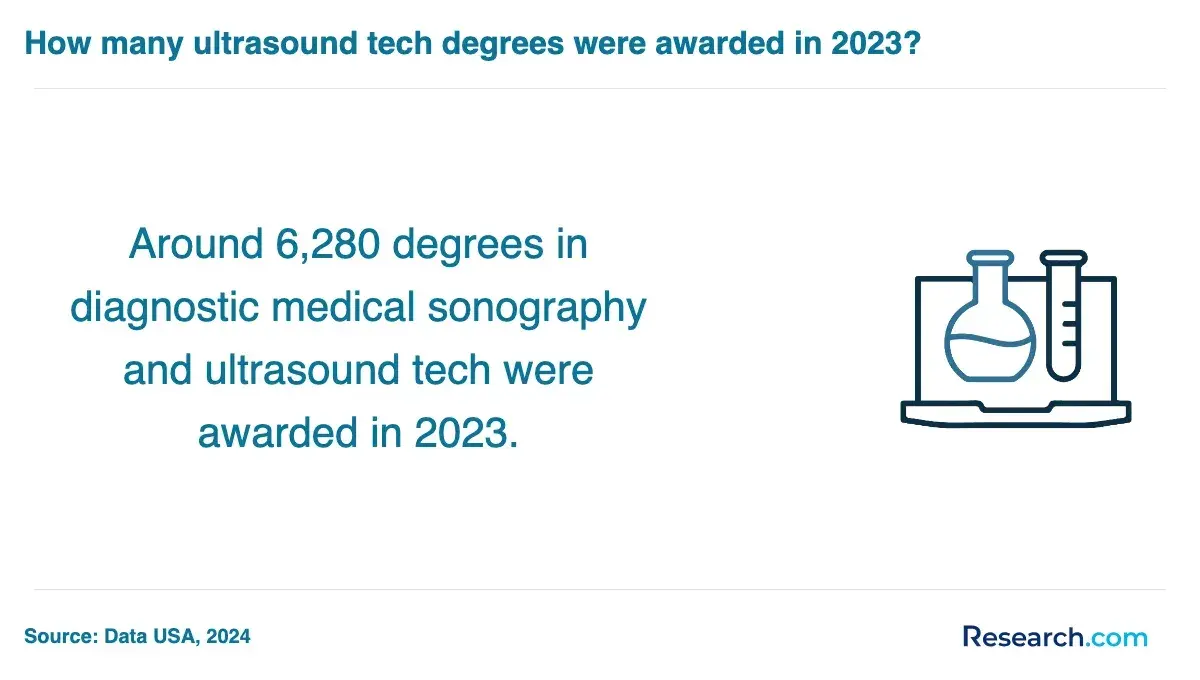
To provide context on how educational preparation supports licensure, the following image illustrates the number of ultrasound technician degrees awarded in 2023.
What to expect during ultrasound technician clinical training in New Hampshire?
Clinical training in New Hampshire serves as the bridge between classroom learning and practical application. It provides students with direct patient care experience, technical proficiency, and professional preparation for both certification and state licensure. Below are the key elements of this stage:
- Hands-On Patient Care: Students perform real ultrasound scans, practicing compassionate communication and professional interaction.
- Supervised Use of Imaging Equipment: Trainees operate ultrasound machines under expert oversight, developing skills in safety and image quality.
- Specialty Rotations: Exposure to OB/GYN, vascular, abdominal, and cardiac sonography builds a broad skill set across imaging fields.
- Mentorship from Licensed Professionals: Experienced sonographers provide guidance, feedback, and role modeling throughout clinical training.
- Competency Evaluations: Assessments measure technical accuracy, patient care, and adherence to professional standards.
- Minimum Clinical Hours: Accredited programs require at least 960 supervised hours, often spanning six months of full-time training.
- Program and State-Specific Requirements: Completion of a CAAHEP-accredited program, certification (ARDMS or ARRT), and proof of clinical experience are necessary for licensure.
- Integration with Coursework: Clinical training aligns with academic instruction, reinforcing theoretical knowledge through practical application.
- Preparation for Certification Exams: Experiences prepare students for national exams, a prerequisite for licensure and employment.
- Development of Professional Demeanor: Students refine their ability to work effectively within healthcare teams and diverse clinical settings.
How much does it cost to become an ultrasound technician in New Hampshire?
The cost of becoming an ultrasound technician in New Hampshire depends on the type of program, institution, and a student’s residency status. While tuition is the main expense, other costs such as clinical training, certification exams, books, and living expenses also play a significant role. Below are the primary expenses to consider.
- Tuition and Fees: Associate degree programs at public colleges average between $12,000 and $18,000, while bachelor’s programs or private institutions may cost $22,000 to $28,000 or more.
- Clinical Training Expenses: Students may need to budget for uniforms, lab fees, liability insurance, and transportation to clinical sites, which can total $800 to $1,500.
- Certification and Exam Fees: The ARDMS Sonography Principles & Instrumentation exam and a specialty exam cost about $225–$250 each, with added charges for retakes or multiple specialties.
- Licensing or State Fees: New Hampshire requires licensure, but fees are modest compared to tuition, generally under $200 for application and renewal.
- Books and Materials: Textbooks, imaging software, and supplies range from $500 to $1,200 across the program.
- Living Expenses: Full-time students typically spend $10,000 to $15,000 annually on housing, meals, transportation, and personal costs.
The cost of ultrasound technician programs in New Hampshire varies depending on the program level, whether a student attends a public or private institution, and individual living expenses. Financial aid, scholarships, and employer tuition assistance are often available to help reduce costs. Students seeking flexible pathways may also explore accredited diagnostic medical sonography online programs, which combine remote coursework with required in-person clinical training.
What is the average salary for ultrasound technicians in New Hampshire?
The average annual salary for ultrasound technicians in New Hampshire is about $85,276, which is above the national average. This reflects the state’s strong healthcare system and high demand for skilled professionals. In major urban hubs such as Manchester, salaries can rise to $120,788, showcasing the impact of location and expertise. Below are the main factors influencing pay in New Hampshire.
- Experience Level: Entry-level technicians begin around $65,929, while seasoned professionals with advanced expertise can earn over $104,000.
- Work Setting: Hospitals and outpatient centers typically offer stronger compensation packages compared to smaller physician practices.
- Geographic Location: Urban areas, especially Manchester, pay significantly more than rural regions, where lower salaries may be offset by other benefits.
- Specialization: Skills in OB/GYN, cardiovascular, or abdominal sonography often lead to premium wages due to strong demand in these specialties.
- Education and Certifications: Higher degrees and advanced certifications open the door to higher pay, rewarding continuous professional development.
What are the ongoing continuing education requirements for ultrasound technicians in New Hampshire?
Ultrasound technicians in New Hampshire must complete mandated continuing education to retain certifications and remain abreast of evolving imaging technologies and regulatory updates. Regular professional development fulfills state licensure renewal requirements while enhancing diagnostic proficiency and patient care standards. Diversifying skills through workshops, specialized courses, and hands-on training can also open pathways to complementary diagnostic roles. For additional insights on alternative career routes, review how to become a radiology technician in New Hampshire.
What professional associations can ultrasound technicians join in New Hampshire?
Ultrasound technicians in New Hampshire can enhance their career trajectory by aligning with dedicated professional organizations and support networks. These groups offer industry-specific resources, such as exclusive conferences, advocacy updates, and targeted continuing education programs that help members stay ahead of regulatory and technological changes. Establishing connections within these networks also facilitates mentorship opportunities and provides insights into emerging interdisciplinary fields, including exploring how to become a nurse midwife in New Hampshire.
What is the job outlook and demand for ultrasound technicians in New Hampshire?
Ultrasound technicians in New Hampshire can expect strong job growth, with employment projected to rise by 19% over the next decade. This rate surpasses the national average and reflects the state’s increasing healthcare needs and adoption of advanced imaging technologies. Below are the primary factors influencing demand.
- Population Growth and Aging: A rising elderly population drives demand for ultrasound services, particularly for diagnosing cardiovascular disease, cancer, and other age-related conditions.
- Healthcare Expansion: The opening of new hospitals, outpatient centers, and clinics, especially in Manchester and Nashua, continues to create employment opportunities.
- Technological Advancements: Advanced ultrasound systems are expanding specialized imaging in areas such as vascular, cardiac, and musculoskeletal care, requiring highly skilled technicians.
- Preventive Care Trends: Greater emphasis on early detection and disease prevention fuels consistent demand for ultrasound as a safe, non-invasive diagnostic tool.
- Regional Demand Variations: Urban regions typically offer more positions and higher wages, while rural areas may provide fewer opportunities but remain essential to local healthcare delivery.
What are the career advancement steps for ultrasound technicians in New Hampshire?
Ultrasound technicians in New Hampshire have multiple pathways to advance their careers, ranging from clinical specialization to leadership and academic roles. Each step helps enhance expertise, expand opportunities, and strengthen long-term career prospects. Below are the key advancement options in the state:
- Specialization: Concentrating on OB/GYN, vascular, or cardiac sonography broadens expertise and creates access to more competitive positions in hospitals and clinics statewide.
- Advanced Certifications: Credentials from ARDMS, CCI, or ARRT are essential for state licensure and improve job security, salary potential, and professional credibility.
- Higher Education: Pursuing bachelor’s or master’s degrees in sonography or health sciences prepares technicians for research, supervisory, or academic roles, supported by local and regional learning programs.
- Leadership Roles: Experienced sonographers may step into supervisory or administrative positions, applying both clinical and management skills to lead healthcare teams effectively.
- Education and Training: Becoming a clinical instructor or trainer allows professionals to mentor new ultrasound technicians and raise the quality of future practitioners in New Hampshire.
- Research and Technology Development: Engaging in clinical research or working with device companies fosters innovation in ultrasound practices and enhances diagnostic capabilities.
Pursuing career advancement for ultrasound technicians in New Hampshire not only boosts earning potential but also enhances their professional impact statewide. For those looking to grow, exploring the best ultrasound technician certification programs offers a valuable starting point.

What are the common challenges ultrasound technicians face in New Hampshire?
Ultrasound technicians in New Hampshire face several challenges that impact their daily work and long-term career development. Being aware of these obstacles allows professionals to adapt effectively, maintain resilience, and succeed in the state’s demanding healthcare environment. Below are the most common challenges sonographers encounter.
- Physical Strain and Ergonomics: Repetitive scanning tasks and extended standing periods often lead to musculoskeletal discomfort, despite training in proper ergonomics.
- Emotional Stress: Managing patient anxieties and performing scans in sensitive medical situations can cause compassion fatigue and emotional strain over time.
- Workload and Staffing Shortages: High caseloads and limited staffing in some facilities create pressures on accuracy, efficiency, and time management.
- Certification and Continuing Education Requirements: New Hampshire’s licensure laws require continuous education and credential maintenance, adding challenges to full-time schedules.
- Technology Adaptation: Ongoing advancements in ultrasound systems demand continual learning and adaptability to new tools and processes.
- Job Market Competition: While urban centers provide more job opportunities, they also come with heightened competition and potential market saturation.
Pursuing professional growth while navigating these factors reveals why it’s beneficial to explore resources like the ranking of most affordable associates degrees in radiology online. Ultimately, understanding these challenges allows ultrasound technicians in New Hampshire to prepare strategically and excel in their careers.
What do ultrasound technicians in New Hampshire say about their career?
Working as an ultrasound technician in New Hampshire has provided me with strong job security and the chance to build meaningful relationships with patients. The variety of cases keeps my work engaging, while knowing I contribute to accurate diagnoses makes each day rewarding. Joseph
This career in New Hampshire has given me professional growth, steady income, and opportunities to specialize in areas like OB/GYN and vascular imaging. I value how my role blends technical skills with compassionate care, creating a positive impact on patients and families. Karina
Becoming an ultrasound technician in New Hampshire has been both challenging and fulfilling. The state’s demand for skilled professionals ensures career stability, and the supportive healthcare environment encourages continuous learning. Each interaction reminds me that my work truly matters in people’s lives. Mateo
Related Articles for Nearby States
- 2027 How to Become an Ultrasound Technician in Vermont
- 2027 How to Become an Ultrasound Technician in Massachusetts
- 2027 How to Become an Ultrasound Technician in Maine
- 2027 How to Become an Ultrasound Technician in New York
- 2027 How To Become an Ultrasound Technician in Connecticut
- 2027 How to Become an Ultrasound Technician in Rhode Island
- 2027 How to Become an Ultrasound Technician in New Jersey
- 2027 How to Become an Ultrasound Technician in Pennsylvania
- 2027 How to Become an Ultrasound Technician in Delaware
- 2027 How to Become an Ultrasound Technician in Maryland
References:
- Diagnostic Medical Sonography Certificate. Retrieved from NHTI
- Find Accredited Ultrasound Technician Schools in New Hampshire. Retrieved from UltrasoundSchoolsInfo
- How to Become an Ultrasound Technician in New Hampshire. Retrieved from HealthJob
- Ultrasound Technician Schools in New Hampshire (Sonography). Retrieved from ExploreMedicalCareers
- Advanced Certificate in Diagnostic Medical Sonography. Retrieved from MCHP
- Here Are The Steps To Becoming An Ultrasound Technician. Retrieved from NurseJournal
- Ultrasound Technician Schools in New Hampshire. Retrieved from UltrasoundSchoolsGuide
- Associate of Science in Diagnostic Medical Sonography. Retrieved from JPU
- Board of Medical Imaging and Radiation Therapy Application Forms. Retrieved from NH Office of Professional Licensure and Certification
- B.S. in Diagnostic Medical Sonography. Retrieved from Rutgers University – School of Health Professions
Other Things You Should Know About Becoming an Ultrasound Technicians in New Hampshire
To become an ultrasound technician in New Hampshire in 2027, one must typically complete a 2-year associate degree in diagnostic medical sonography. Students should attend a program accredited by the Commission on Accreditation of Allied Health Education Programs (CAAHEP) and then pass the American Registry for Diagnostic Medical Sonography (ARDMS) certification exam.
Yes, you can become an ultrasound technician in New Hampshire through an accredited online program that includes clinical training. Coursework may be completed online, but in-person practice is mandatory. Certification from bodies like ARDMS requires both education and hands-on experience, making hybrid programs the most practical option for qualifying in the state.


