
2027 Is Becoming an LPN Worth It?

Co-Founder and Chief Data Scientist
The demand for skilled nurses has never been higher, making it one of the most secure career fields available. According to the U.S. Bureau of Labor Statistics, there are projected to be about 54,400 job openings per year for licensed practical and vocational nurses (LPNs/LVNs) until 2034. But with so many paths—from certificates to four-year degrees—it’s easy to feel lost before you even start.
For those who want to begin a professional career quickly and affordably, the LPN role offers a direct entry point. So, is becoming an LPN worth it as the foundational first step in your healthcare career? This guide provides a clear, data-driven analysis to help you find the answer that’s right for you.
Key Things You Should Know About Becoming an LPN
- The LPN certificate is one of the quickest and most cost-effective ways to become a licensed nurse, typically taking about a year and costing significantly less than a traditional nursing degree.
- Due to persistent staffing needs across the healthcare system, the demand for LPNs is strong and projected to remain stable, offering a high degree of career security upon graduation.
- The majority of LPNs work in settings like nursing homes and extended care facilities, which is a different environment from the hospital-centric roles often associated with registered nurses (RNs).
- While the starting salary is competitive for a one-year program, the long-term earning potential for an LPN is lower than that of an RN, a key factor in your long-term financial planning.
- The LPN role is a common and practical pathway to becoming an RN. Many professionals use it to gain paid, hands-on experience before enrolling in LPN-to-RN bridge programs.
- Is becoming an LPN a good investment today? Degree Overview
- How much does it cost to become an LPN? Program Cost
- How long does it take to become an LPN? Program Duration
- What is the job outlook for LPN graduates? Job Outlook
- What is the earning potential and salary progression of an LPN career? Earning Potential
- What are the benefits of getting an LPN? Advantages
- What does the long-term career progression for an LPN look like? Career Progression
- What is the biggest risk of getting an LPN degree? Challenges
- Who is an LPN degree a great fit for? Who is an LPN degree a great fit for?
- What are the top alternative careers to consider for an LPN? Alternative Careers
- How do you calculate your personal ROI for an LPN career? How do you calculate your personal ROI for an LPN career?
- How do you decide if an LPN career is worth it for you? How do you decide if an LPN career is worth it for you?
Is becoming an LPN worth it in 2026?
Choosing an LPN program is a career and money decision, not just a school decision. Licensed practical nurses, called LPNs in most states and LVNs in some states, provide direct nursing care after completing an approved training program and passing licensing requirements. For many students, this is one of the quickest ways to move into licensed healthcare work without first earning a longer nursing degree.
The trade-off is important. LPN training can be faster and less expensive than many healthcare degree paths, but the role also comes with a narrower scope of practice than registered nursing, physically demanding work, and a lower long-term salary ceiling than RN roles. This guide explains what LPN training costs, how long it takes, what jobs and salaries look like, where LPNs are hired, and how to decide whether this path fits your goals in 2026.
Quick answer: Is an LPN program a good investment?
For many students, yes. An LPN program can be worth it if you want a relatively fast, lower-cost route into licensed nursing and are prepared for hands-on care in long-term care, residential care, clinics, home health, and related settings. One of the strongest reasons to consider the path is workforce need: the U.S. healthcare system is projected to face a 12% shortage of LPNs by 2036.
That projected shortage suggests continued demand for practical nurses, particularly in care environments serving older adults, people with chronic conditions, and patients who need ongoing support. The LPN path is especially useful if you want to start earning sooner, avoid a long degree timeline, and possibly bridge to RN later. It may be less ideal if your main priority is the highest nursing salary, broad clinical authority, or immediate access to hospital specialty roles.
| Decision factor | What prospective LPN students should know |
| Typical program cost | $10,000 to $25,000, depending on institution, location, fees, supplies, and financial aid |
| Typical full-time timeline | About one year for a state-approved LPN educational program |
| Part-time timeline | Often 18 to 24 months for students who need a more flexible schedule |
| Median salary benchmark | $62,340 in May 2024 for licensed practical nurses |
| Main advantage | Quicker entry into licensed nursing than many degree-based routes |
| Main trade-off | Less clinical independence and a lower salary ceiling than registered nursing |
If you are comparing multiple ways to enter nursing, LPN training usually falls between short entry-level healthcare certificates and longer RN degree programs. Students who already have college credits may also want to compare other entry routes, including whether a biology degree can lead to a nursing career.
How much does LPN training cost?
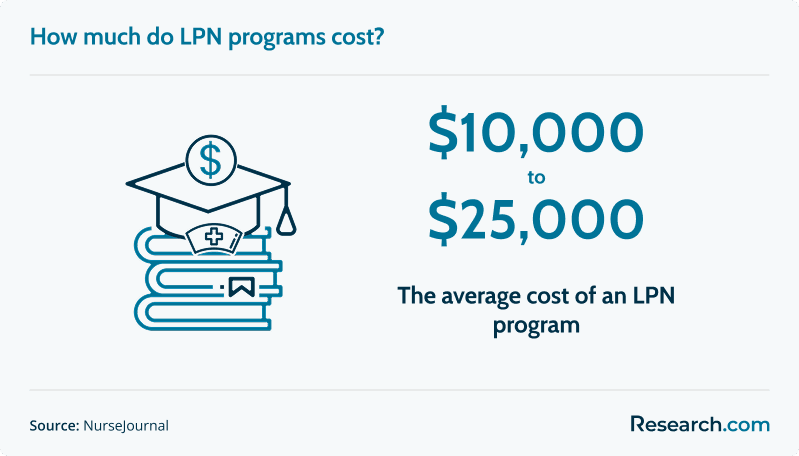
The estimated total cost of a licensed practical nurse program generally ranges from $10,000 to $25,000. That makes LPN training one of the more accessible ways to qualify for licensed clinical work compared with many longer healthcare programs.
Cost is a major reason students choose this route. A shorter, lower-cost program may reduce debt, help you begin earning sooner, and let you test your fit for nursing before committing to a more advanced credential. This can be especially useful for career changers, parents, healthcare aides, and adults returning to school after time away.
What affects the final price of an LPN program?
Your real cost is more than the advertised tuition. Community colleges and public vocational schools may charge less than private institutions, but price alone does not determine value. A low-cost program can become expensive if it has weak clinical placement support, poor licensure preparation, limited scheduling options, or hidden fees.
| Cost item | Why it matters | Question to ask before enrolling |
| Tuition and mandatory fees | This is usually the largest direct expense and can vary greatly by school type. | What is the complete cost from admission through graduation? |
| Books, uniforms, supplies, and equipment | Nursing students often need required materials that are not included in tuition. | Which required items are covered by the school, and which will I need to purchase? |
| Clinical travel and scheduling | Clinical rotations may create transportation, childcare, parking, or work-schedule costs. | Where are clinical sites, and are evening or weekend placements available? |
| Licensing-related expenses | Licensure steps and exam preparation can add costs near the end of the program. | Are licensing and exam-related costs included in the school’s estimate? |
| Financial aid eligibility | Grants, scholarships, employer support, and payment plans can change your out-of-pocket price. | Does this program qualify for federal aid, school scholarships, or employer tuition support? |
If your program participates in federal aid, complete the Free Application for Federal Student Aid before making a final cost comparison. Aid that does not need to be repaid can significantly improve the value of an LPN program.
LPN training is a much shorter commitment than advanced graduate education. A student deciding whether a doctorate in education is worth the investment is evaluating a very different type of credential. LPN programs are built for faster workforce entry, not extended academic specialization.
How long does it take to become an LPN?
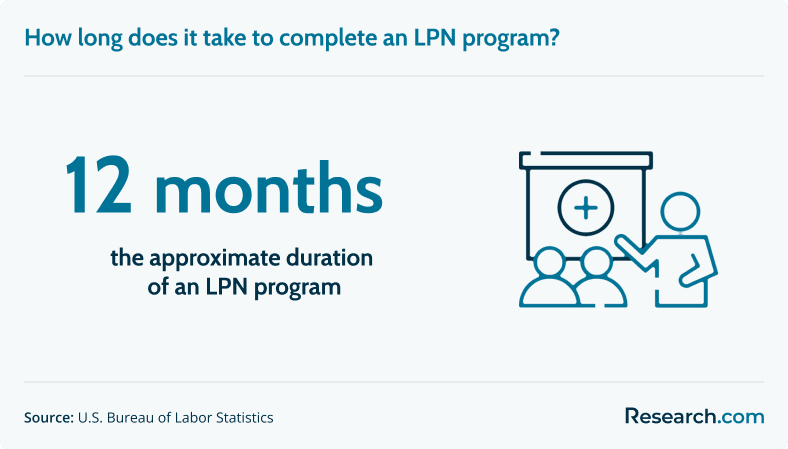
A full-time, state-approved LPN educational program can typically be completed in about one year. This short timeline is one of the biggest advantages of the LPN route because students can move into classroom training, clinical practice, licensure preparation, and employment much faster than they could through many longer nursing pathways.
The time savings can also affect affordability. A shorter program may mean fewer months of reduced income, lower total school costs, and a quicker path to healthcare wages.
Full-time and part-time LPN schedules
The about one year timeline usually applies to full-time students who can keep up with intensive coursework and required clinical hours. Students who need to work, care for children, or manage other responsibilities may prefer part-time study. Part-time LPN programs often take 18 to 24 months, but the slower pace can make school possible for students who cannot step away from work or family obligations.
| Path | Typical timeline | Best for | Main trade-off |
| Full-time LPN program | About one year | Students who can make school and clinical hours their main priority | More intense weekly workload and less scheduling flexibility |
| Part-time LPN program | 18 to 24 months | Working adults, caregivers, and students who need a slower pace | More time before graduation, licensing, and full LPN earnings |
| LPN first, RN later | Begins with LPN training, followed by bridge education if desired | Students who want paid nursing experience before deciding on RN preparation | Requires another education and licensure decision later |
When you compare program lengths, it helps to view LPN training alongside other credentials. For example, students researching how long doctoral degrees take will see that LPN education serves a different purpose: rapid preparation for practical clinical work.
What is the job outlook for LPN graduates?
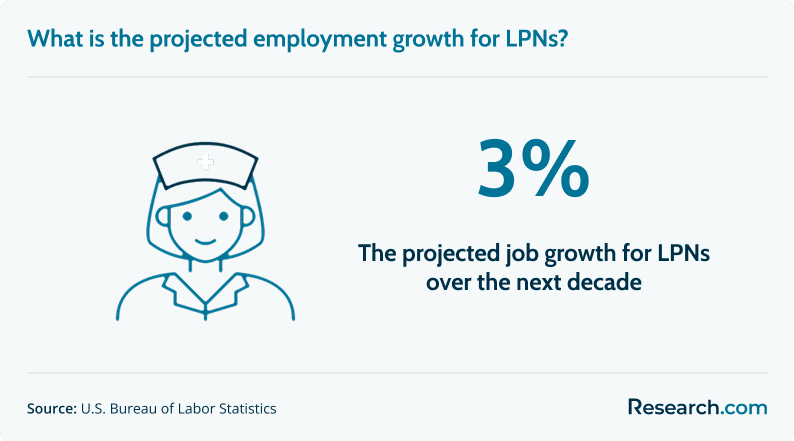
The LPN job market is steady overall, with many opportunities tied to long-term care, residential care, home health, and outpatient settings. According to the U.S. Bureau of Labor Statistics, the LPN occupation is projected to grow 3% until 2024, a pace described as as fast as the national average for all occupations.
Employer demand is also visible in job listings. Indeed shows over 11,000 LPN/LVN job openings in the United States.
Students should not assume that every region offers the same wages, schedules, or employer mix. The practical takeaway is that LPNs remain part of the healthcare staffing model, especially in settings where patients need medication support, daily monitoring, documentation, and consistent nursing assistance.
Where are LPNs most likely to find opportunities?
LPNs work across several care environments, but many openings are concentrated in long-term care, nursing homes, residential care facilities, home healthcare, clinics, and physician offices. Graduates who are flexible about setting and schedule may have more options than those who will consider only one specific workplace.
| Work setting | Common LPN responsibilities | Who may fit this setting |
| Long-term care and nursing homes | Monitor residents, provide routine nursing care, administer medications within scope, document changes, and report concerns to supervising clinicians. | Students who can handle ongoing resident relationships, high patient needs, and physically demanding work. |
| Home healthcare | Follow care plans, support patients at home, track changes, document visits, and communicate with the broader care team. | Independent workers who are comfortable with travel, time management, and one-on-one care. |
| Clinics and physician offices | Support patient intake, assist with basic procedures, provide education, and complete follow-up tasks. | Students who prefer outpatient care and more predictable schedules. |
| Residential care facilities | Help residents manage ongoing health needs, medication routines, and daily monitoring. | People who want regular patient contact in a team-based environment. |
Local research matters. Pay and hiring can differ widely by state, city, and employer type, much like other occupations that vary by region. For example, state-level differences are central in resources such as paralegal salary comparisons by state. LPN students should review job postings in the areas where they actually plan to work.
How much can LPNs earn?
The median annual salary for licensed practical nurses was $62,340 in May 2024. For a nursing credential that may take about one year of full-time study, that figure is one reason many students see LPN training as a potentially strong return on investment.
However, the median is not a guaranteed outcome. Actual pay depends on location, employer, work setting, shift, experience, local staffing needs, and whether you eventually continue toward RN preparation or another healthcare credential.
What can raise or limit LPN salary?
Geography is often one of the strongest pay factors. Some markets pay more because of cost of living, staffing shortages, or employer competition. Setting also matters; LPNs in home healthcare services or government-run facilities may earn more than those in some other environments. Experience, reliability, and strong clinical performance can also improve your earning potential over time.
| Salary factor | How it can affect pay | How to evaluate it before choosing a program |
| Location | Wages can differ by state, city, rural area, and high-demand labor market. | Search current LPN postings near your target work area instead of relying only on national data. |
| Employer type | Long-term care, home health, clinics, government facilities, and residential care may use different pay structures. | Ask programs where their recent graduates typically get hired. |
| Schedule | Evening, overnight, weekend, or high-need shifts may influence compensation. | Decide whether nontraditional shifts are realistic for your life. |
| Experience | Time in practice can support raises, stronger references, and more responsibility. | Choose a program with solid clinical preparation and employer connections. |
| Advancement plan | Staying an LPN can offer stability, while becoming an RN can expand scope and advancement options. | Find out whether credits may apply to future LPN-to-RN bridge opportunities. |
For ROI, compare the $10,000 to $25,000 program cost against realistic local earnings. A lower-priced, state-approved program with strong licensure preparation and clinical support may be a better value than a more expensive program that leads to similar job options.
What are the main benefits of becoming an LPN?
The strongest advantages of the LPN path are speed, cost, practical experience, and career flexibility. These benefits matter most for students who want to enter healthcare quickly while still earning a licensed nursing credential.
- Faster entry into nursing. A typical full-time program takes about one year, which can help you begin clinical work sooner than many degree-based routes.
- Lower initial cost. Estimated program costs of $10,000 to $25,000 may help students limit borrowing compared with longer healthcare programs.
- Real clinical skill development. LPN students learn patient care, communication, documentation, medication support within scope, and teamwork in healthcare settings.
- Workforce need. The projected 12% LPN shortage by 2036 points to ongoing demand for practical nurses in essential care settings.
- Future bridge potential. LPN can be a long-term role or a first step toward RN education through an LPN-to-RN bridge program.
Benefits and trade-offs at a glance
| Advantage | Why it helps | Trade-off to consider |
| Short training period | You can start building income and healthcare experience sooner. | The pace can be demanding, especially when clinical rotations begin. |
| Licensed credential | An LPN license allows more clinical responsibility than many unlicensed support roles. | The legal scope remains narrower than an RN’s scope and varies by state. |
| Hands-on patient care | You can see the direct effect of your work on patients and families. | The job can be physically tiring and emotionally intense. |
| Lower cost than many degree paths | Students may borrow less and recover their investment sooner. | Affordability does not replace the need to check approval, outcomes, and clinical quality. |
| RN bridge option | You can work in nursing while deciding whether to pursue registered nursing later. | Advancement often requires additional education and licensing preparation. |
What does long-term career growth look like for an LPN?
The LPN credential can support more than one career plan. Some nurses remain in practical nursing for years and build strong direct-care careers. Others use LPN experience as the first step toward registered nursing, leadership, or a different healthcare specialty.
The most common advancement path is an LPN-to-RN bridge program. These programs build on practical nursing education and work experience, helping LPNs continue toward RN preparation without treating their original training as a dead end.
Data show that 16% of all registered nurses were previously LPNs. That figure matters because it shows that moving from LPN to RN is a common career ladder, not an unusual exception.
| Long-term option | What it looks like | Best fit |
| Continue in LPN practice | Provide practical nursing care in long-term care, home health, clinics, residential care, or similar settings. | People who value direct patient contact, stable healthcare work, and a focused credential path. |
| Build experience in a specialized LPN setting | Develop deeper practical expertise with a specific patient population or care environment. | LPNs who want to grow in skill without immediately returning to school. |
| Complete an LPN-to-RN bridge | Use LPN training and clinical experience as a foundation for registered nursing education. | Students who want a broader scope of practice and stronger long-term advancement options. |
| Move into another healthcare specialty | Shift into a related patient-care or healthcare support role if practical nursing is not the right long-term fit. | Students who like healthcare but want a different work environment or set of duties. |
Bridge pathways exist across healthcare. Emergency medical professionals, for instance, may compare accelerated EMT-to-RN online bridge programs when planning their next credential. LPNs can use the same logic: early patient-care experience can make the next education decision clearer.
What are the biggest risks of choosing the LPN path?
The main drawbacks are a lower long-term salary ceiling than RN roles and the risk of burnout in demanding care settings. These concerns do not make LPN training a bad choice, but they should influence which program you choose, which employers you target, and whether you plan to bridge later.
The salary ceiling is closely tied to scope of practice. Registered nurses generally have broader clinical responsibilities, which can support higher pay and more advancement options. LPNs provide essential care, but their authority is more limited and depends partly on state rules.
Burnout also deserves serious attention. Data from 2024 show that the largest group of LPNs, 32%, works in extended care and nursing home facilities. These roles can be meaningful and important, but they may involve heavy workloads, emotional stress, high patient needs, and physical strain.
Common mistakes prospective LPN students should avoid
| Mistake | Why it can hurt you | Better approach |
| Choosing a program only because it is cheap | The lowest tuition may come with weak support, limited clinical placement quality, or poor licensure preparation. | Compare total cost, state approval, clinical sites, student support, and graduate outcomes. |
| Skipping state approval and licensure checks | You must complete an appropriate program to qualify for licensure and practice legally. | Verify state approval before applying or paying enrollment fees. |
| Assuming an online program is fully online | LPN education requires in-person clinical training, even when some coursework is online. | Ask where clinical hours take place, how they are scheduled, and whether travel is required. |
| Expecting RN-level pay right away | LPN and RN roles have different scopes of practice, responsibilities, and pay structures. | Use local LPN job postings to estimate realistic starting wages. |
| Underestimating burnout risk | High-need care settings can be stressful if you are not prepared for the pace and workload. | Speak with working LPNs, ask about clinical expectations, and assess your support system. |
| Failing to plan for advancement | You may later want RN options but find that credits, school choice, or policies limit your choices. | Ask about articulation agreements, bridge pathways, and transfer possibilities before enrolling. |
If practical nursing feels too physically or emotionally demanding, compare other allied health options before committing. A student who wants a different type of patient-care role might research the fastest online respiratory care therapy associate programs instead.
Who is an LPN program best for?
An LPN program is best for students who want direct patient care, practical training, and a faster route into licensed healthcare work. It is a strong match for people who value job stability, are comfortable with hands-on care, and want a credential that can be completed more quickly than many nursing degrees.
This path often works well for two types of students. One is the person who wants to enter healthcare at a manageable cost and start earning sooner. The other is the career changer who wants real nursing exposure before deciding whether to pursue RN education.
The educational profile of LPNs reflects the career-focused nature of the role. Data show that 75% hold a vocational or practical certificate as their highest credential. Many LPNs enter the field through applied training rather than a long academic degree path.
Who should consider a different path?
LPN training may not be the best starting point if you already know you want RN-level responsibilities, the highest possible nursing salary growth, or roles that typically require registered nurse preparation. It may also be a poor fit if you want no in-person clinical requirements, dislike direct physical care, or prefer a non-clinical healthcare job.
| You may be a strong LPN candidate if... | You may want another option if... |
| You want to enter nursing quickly without spending several years in school first. | You already know you want RN-level responsibilities as soon as possible. |
| You prefer applied, practical training over a heavily theoretical program. | You are uncomfortable with personal care, patient mobility support, or routine clinical tasks. |
| You want a lower-cost entry point into healthcare. | You are willing to stay in school longer for a higher long-term salary ceiling. |
| You see LPN as either a career or a possible first step toward RN. | You want a healthcare role with little direct patient contact. |
| You are open to long-term care, residential care, home health, or clinic work. | You only want a narrow specialty that rarely hires LPNs in your local market. |
Purpose-driven students have many options beyond nursing. Some may be better suited to education, technology, administration, or another helping profession. For example, students interested in teaching, science communication, or outreach may compare the fastest online STEM education degree programs instead of choosing clinical care.
The chart below shows the educational attainment levels of LPNs in the United States.
What are the best alternatives to becoming an LPN?
Before enrolling in an LPN program, compare nearby healthcare paths with different timelines, responsibilities, and work environments. The right choice depends on how fast you want to start working, how much patient care you want, whether you prefer bedside care or procedures, and how much education you are ready to complete.
| Career path | Typical role focus | How it compares with LPN | Best for |
| Certified Nursing Assistant | Basic bedside support, help with daily living, and patient comfort under nurse supervision. | Usually quicker and less expensive to enter, but with less clinical responsibility than LPN. | Students who want the fastest hands-on start in patient care. |
| Medical Assistant | Clinical and administrative support in outpatient clinics, physician offices, and similar settings. | May offer a more office-based environment but does not provide the same nursing license as LPN. | Students who want patient interaction combined with records, scheduling, and front-office duties. |
| Surgical Technologist | Operating room preparation, sterile field support, and assistance to surgical teams. | More procedure-focused than LPN and usually tied to surgical environments. | Students interested in operating rooms and fast-paced procedural care. |
| Phlebotomist | Blood collection for testing, donation, or treatment support. | More specialized and often faster to enter, but narrower than practical nursing. | Students who want a focused clinical skill with limited training time. |
| Registered Nurse through ADN | Broader nursing assessment, care planning, clinical judgment, and patient management. | Requires more education upfront but can lead to a wider scope of practice and higher salary potential. | Students ready to invest more time at the beginning for RN-level practice. |
If you are drawn to procedural healthcare, you may also compare fast-track online surgical tech certificate options. If you prefer healthcare administration or records work over bedside care, accelerated online medical billing and coding certificate programs may be a more suitable option.
How can you estimate your personal ROI from an LPN program?
National salary and cost figures are helpful, but your decision should be based on your own budget and local job market. A simple return-on-investment estimate can help you compare LPN training with your current job, another healthcare certificate, or going directly into RN education.
Use this formula:
(Projected 5-Year Earnings - Total Investment) / Total Investment = ROI
- Projected 5-Year Earnings: Look up realistic LPN starting wages in your city or state, then multiply that amount by five.
- Total Investment: Add tuition, fees, books, uniforms, supplies, licensing-related expenses, transportation, and other required costs.
Include opportunity cost
Opportunity cost is the income you give up while attending school. If you leave a job to study full time, add one year of your current or expected earnings to the investment side of the calculation. This gives you a more accurate view of the financial trade-off.
| ROI input | What to include | Why it matters |
| Program cost | Tuition, fees, books, supplies, uniforms, and required program expenses. | Shows how much you need to recover through future earnings. |
| Financial aid | Grants, scholarships, and other aid that does not require repayment. | Reduces your actual out-of-pocket investment. |
| Borrowing cost | Loan amounts and repayment obligations. | Influences how quickly the credential improves your finances. |
| Lost wages | Income you give up while studying, especially in a full-time program. | Can be a major hidden cost for working adults and career changers. |
| Local earnings | Starting pay and realistic offers in the region where you plan to work. | Helps prevent overestimating ROI based only on national salary figures. |
ROI is not only a salary calculation. Job stability, schedule fit, physical workload, career satisfaction, and future bridge options also matter. If the numbers look good but the work environment is a poor fit, the credential may still feel costly over time.
How should you decide if LPN training is right for you?
The LPN path is a strong option when you want a faster, comparatively affordable way into licensed nursing and are ready for direct patient care. It is a weaker fit if you want the broadest nursing scope immediately, expect RN-level pay from the start, or are not prepared for demanding clinical environments.
Before applying, ask these questions:
- Is the program state-approved for LPN licensure in the state where I plan to work?
- What is the total cost after tuition, fees, supplies, transportation, and licensing-related expenses?
- Can I handle the clinical schedule alongside work, family, childcare, and transportation needs?
- Where do recent graduates usually get hired?
- How does the school support students preparing for licensure?
- Do I want to work as an LPN long term, or do I want an LPN-to-RN bridge option later?
- Which local employers are hiring LPNs, and what wages and shifts are they offering?
- Am I ready for the physical, emotional, documentation, and communication demands of direct care?
Practical next steps
- Start with local job research. Review LPN openings in your area, including employers, schedules, pay, and experience requirements.
- Build a list of state-approved programs. Do not apply until you confirm the program supports licensure eligibility where you plan to practice.
- Compare full cost instead of tuition only. Include supplies, fees, clinical travel, lost wages, and borrowing costs.
- Ask detailed questions about clinical placements. Clinical quality can influence confidence, readiness, and employer connections.
- Speak with working LPNs. Ask what surprised them, what they would do differently, and which settings they recommend for new graduates.
- Decide on your long-term plan early. Know whether LPN is your destination or a step toward RN before choosing a program.
Some students will find that LPN training is the fastest practical path to meaningful healthcare work. Others will decide that another credential better matches their preferred schedule, salary goals, or work environment. Either outcome is valuable if it prevents you from enrolling in a program that does not fit your life.
The visual below identifies the US states with the highest employment levels for LPNs.
What LPN and LVN graduates say about their programs
- : "Clinical training made the biggest difference for me. We moved from classroom learning into real patient care quickly, and that helped me understand the pace and responsibility of the job. By the end, I felt much more prepared for practical nursing. — Brandy"
- : "I wanted to work in healthcare, but I was not ready to commit to a long degree immediately. The LPN program gave me a clear starting point, practical skills, and a credential I could use. I now have meaningful work and still have room to grow. — Aaliyah"
- : "Returning to school was intimidating, but the flexible format helped me manage family responsibilities. The coursework required discipline, and clinical hours were challenging, but the instructors helped me see what the role would really demand. — Nicole"
Key Insights
- LPN training is strongest when speed and cost matter. A full-time program can take about one year, and estimated total costs usually fall between $10,000 and $25,000.
- Demand supports the value of the credential. The projected 12% shortage of LPNs by 2036 suggests continued need, especially in long-term care, residential care, and related settings.
- The salary can justify the investment, but expectations should be realistic. The median annual salary was $62,340 in May 2024, but LPNs generally have a lower salary ceiling than RNs because their scope of practice is more limited.
- The program you choose affects your outcome. Check state approval, clinical placement quality, licensure support, total cost, financial aid, and schedule fit before enrolling.
- LPN can be either a career or a bridge. Some nurses stay in practical nursing, while others continue into LPN-to-RN pathways. Data show that 16% of all registered nurses were previously LPNs.
- Burnout risk should be part of the decision. In 2024, 32% of LPNs worked in extended care and nursing home facilities, which can be rewarding but physically and emotionally demanding.
- Your local market matters more than national averages alone. Review wages, shifts, employer demand, and job settings where you plan to work before deciding whether LPN training is worth it.
References:
- Health Resources and Services Administration. (2024, March). Fact sheet on the 2022 National Sample Survey of Registered Nurses. Retrieved October 16, 2025, from https://bhw.hrsa.gov/sites/default/files/bureau-health-workforce/Nurse-Survey-Fact-Sheet-2024.pdf
- National Council of State Boards of Nursing. (2024). 2024 LPN/VN workforce survey. Retrieved October 16, 2025, from https://www.ncsbn.org/research/recent-research/workforce/2024-workforce-pn.page
- U.S. Bureau of Labor Statistics. (2024, April 3). Occupational Employment and Wage Statistics for licensed practical and licensed vocational nurses, 29-2061. Retrieved October 16, 2025, from https://www.bls.gov/oes/2023/may/oes292061.htm
- U.S. Bureau of Labor Statistics. (2025, August 28). Occupational Outlook Handbook profile for licensed practical and licensed vocational nurses. Retrieved October 16, 2025, from https://www.bls.gov/ooh/healthcare/licensed-practical-and-licensed-vocational-nurses.htm
- Zippia. (2025, January 8). Education requirements for practical nurses. Retrieved October 16, 2025, from https://www.zippia.com/practical-nurse-jobs/education/
Other Things You Should Know About LPN/LVN Programs
In 2027, the demand for Licensed Practical Nurses (LPNs) remains robust due to an aging population and increased need for healthcare services. LPNs often find employment in nursing homes, home healthcare, and hospitals. Prospective students should assess local job markets and emerging trends in healthcare to make informed decisions.
In 2027, starting salaries for Licensed Practical Nurses (LPNs) generally range from $45,000 to $55,000 annually in the United States, depending on location and healthcare facility. Urban areas and specialized medical facilities often offer higher starting pay to attract talent in this competitive field.
To enroll in an LPN program in 2027, you typically need a high school diploma or GED. Some programs may also require prerequisite courses like basic biology or math. Check with specific schools for their exact admission criteria.


