
2027 Top Careers That Require a Master’s Degree

Co-Founder and Chief Data Scientist
If you are considering advancing your career, one of the most effective steps you can take is to earn a master's degree. In today's competitive job market, an advanced degree is no longer just an academic pursuit, it is a strategic move that can unlock a world of professional opportunities.
This article is your comprehensive guide to the top master's degree careers, providing a deep dive into the high-paying jobs that require or highly value a graduate-level education. We will explore why these roles are in high demand and what the future holds for professionals who invest in a master's degree. You will have a clear understanding of the career paths a master's degree can open and how to determine if it's the right investment for you.
What are the benefits of getting a master’s degree?
- A master's degree often leads to higher-paying careers. According to the U.S. Bureau of Labor Statistics (BLS), professionals with a master's degree have significantly higher median weekly earnings compared to those with a bachelor's degree, with some of the top-paying jobs including Nurse Anesthetist and Physician Assistant. The median annual salary for a master's degree holder is around $90,324.
- It can lead to a diverse range of high-demand jobs. Many specialized professions, particularly in healthcare and STEM fields, require a master's degree for licensure or entry-level positions. This includes careers like Nurse Practitioner, Computer and Information Research Scientist, and Speech-Language Pathologist, which are projected to have strong job growth.
- An online master's degree offers great flexibility and accessibility. It allows you to earn an advanced degree without pausing your career or relocating. Online programs often have a lower total cost due to savings on housing and transportation, while providing the same curriculum and instructors as their on-campus counterparts.
What can I expect from a master’s degree?
A master's degree is a postgraduate academic degree that shows a high level of mastery in a specific field of study. It goes beyond the foundational knowledge of a bachelor's degree, focusing on advanced theory, specialized skills, and practical application. Many master's programs are designed to be career-oriented, preparing graduates for leadership, management, or highly technical roles that are not accessible with a bachelor's alone.
The degree can be a strategic tool for professionals looking to increase their earning potential, pivot to a new industry, or gain a competitive edge in a crowded job market. While it represents a significant investment of time and money, the long-term career benefits often make it a worthwhile decision.
Where can I work with a master’s degree?
Master's degree graduates are highly sought after in a diverse range of fields, with many industries recognizing the value of advanced, specialized knowledge. One of the most common sectors is healthcare, where roles like nurse practitioner, physician assistant, and speech-language pathologist often require a master's degree for entry-level positions.
Similarly, the education sector heavily relies on master's-level graduates for roles such as school administrators, counselors, and post-secondary professors. These individuals are equipped with the deep theoretical and practical knowledge necessary to lead and innovate within their fields.
Beyond healthcare and education, graduates with a master's degree find significant employment opportunities in the business, finance, and technology sectors. Companies across these industries seek individuals with an advanced understanding of complex subjects.
- Technology and Engineering: Jobs like data scientist, software architect, and IT manager are in high demand.
- Finance and Consulting: Roles such as financial manager, investment banker, and management consultant are common destinations for MBA or finance master's degree holders.
- Public and Non-Profit Sectors: Graduates are also employed in government and non-profit organizations in roles like public health consultant or environmental policy analyst, where they apply their specialized knowledge to address complex societal issues.
How much can I make with a master’s degree?
A master's degree can significantly enhance a graduate's earning potential, with salaries often reflecting the specialized expertise and increased responsibility that come with the advanced credential. While earnings vary widely by field, certain professions consistently offer high compensation.
For example, data analysts can earn a median annual salary of around $108,020, while management consultants often have an average annual salary of approximately $115,530. Other high-paying roles for master's graduates include computer and information research scientists with a median salary of $111,840 and medical and health services managers who can make a median wage of $96,540.
The salary for a master's degree holder is influenced by several key factors beyond the degree itself. The specific field of study is paramount, as graduates in high-growth areas like business, technology, and engineering generally earn more than those in other sectors. Geographic location also plays a significant role, with compensation levels often correlating with the cost of living and the concentration of high-paying industries in a particular city or region.
Additionally, an individual's work experience can greatly impact their salary trajectory. A graduate with several years of relevant professional experience will typically command a higher salary than a recent graduate entering the workforce for the first time.
- What are the top careers that require a master’s degree? Top Careers
- Is a master's degree worth the investment for my career? Is a master's degree worth the investment for my career?
- How do you choose the right master's program for your career goals? Program Selection
- What is the average salary increase with a master's degree compared to a bachelor's? Salary
- Will a master's degree guarantee a higher-paying job? Job Opportunities
- What are the top master's degrees in demand in 2025 and beyond? High Demand Programs
- When is a master's degree better than a professional certification? Master's vs Certificate
- Can a certification or license replace a master's degree for certain jobs? Can a certification or license replace a master's degree for certain jobs?
- How do you know whether to get a master's degree or go for a certification in your field? How do you know whether to get a master's degree or go for a certification in your field?
- How can I finance your master's degree effectively? How can I finance your master's degree effectively?
- What is the outlook for careers that require a master's degree? Careers Outlook
Careers That Require a Master’s Degree: Best Options, ROI, and How to Choose
Choosing a master’s degree is not just an academic decision. It can determine which jobs you qualify for, how quickly you can advance, whether you meet licensure rules, and how much debt you may need to take on before seeing a return. Some careers truly require graduate education, especially in healthcare, counseling, education, research, and specialized technical fields. In other careers, a master’s degree is optional but can help professionals move into leadership, higher-paying, or more specialized roles.
This guide explains which careers commonly require or strongly prefer a master’s degree, when graduate school is worth the investment, how master’s-level salaries compare with bachelor’s-level earnings, and when a certification may be the better choice. It is designed for students, working professionals, and career changers who want a practical way to decide whether a master’s degree fits their goals.
Quick Answer: Which Careers Most Often Require a Master’s Degree?
The careers most closely tied to a master’s degree are advanced healthcare roles, clinical and counseling roles, research positions, education specialist roles, and some technical leadership occupations. Nurse anesthetists, nurse practitioners, physician assistants, speech-language pathologists, clinical social workers, school counselors, and many research scientists typically need graduate-level education for entry, licensure, or professional advancement. In business, engineering, finance, and technology, a master’s degree is often not legally required but may be preferred for senior management and specialized positions.
| Career | How the master’s degree helps | Best fit for |
| Nurse anesthetist | Provides advanced clinical preparation for anesthesia care and pain management | Registered nurses seeking a high-responsibility APRN role |
| Nurse practitioner | Prepares nurses for advanced diagnosis, treatment, and patient care responsibilities | Nurses who want more autonomy in primary or specialty care |
| Physician assistant | Supplies the graduate clinical training needed to practice medicine as part of a care team | Students seeking a medical career without becoming physicians |
| Computer and information research scientist | Builds the research, theory, and technical depth needed for advanced computing work | Professionals interested in AI, data, systems research, or innovation |
| Financial manager | Develops advanced finance, risk, and strategic planning skills | Business professionals targeting leadership roles |
| Engineering manager | Combines technical expertise with management preparation | Engineers moving into project or team leadership |
Nurse Anesthetist
Nurse anesthetists are advanced practice registered nurses who administer anesthesia, monitor patients during procedures, and help manage pain before, during, and after medical treatment. This is one of the clearest examples of a career where graduate-level clinical preparation is essential. A Master of Science in Nursing (MSN) has traditionally been required to become a Certified Registered Nurse Anesthetist (CRNA), because the role requires deep knowledge of pharmacology, physiology, patient safety, and acute care monitoring.
The job outlook is described as much faster than average, supported by healthcare demand and the needs of an aging population. This path is best suited to registered nurses who are comfortable with high-pressure clinical decisions and intensive patient monitoring.
Nurse Practitioner
Nurse practitioners are APRNs who deliver primary or specialty care, assess patients, order and interpret tests, diagnose conditions, and manage treatment plans. A Master of Science in Nursing is the standard educational route for this career. The role has grown in importance as healthcare systems look for cost-effective ways to expand patient access, especially in areas with provider shortages.
Prospective students should check whether their target program prepares them for the population focus they want, such as family practice, adult-gerontology, pediatrics, psychiatric-mental health, or women’s health. Students interested in patient-facing behavioral health careers may also want to compare nursing pathways with counseling-related programs, including the best online master’s in clinical counseling and psychology.
Physician Assistant
Physician assistants examine patients, diagnose illnesses, develop treatment plans, prescribe medication where permitted, and work in collaboration with physicians and other healthcare professionals. A master’s degree in physician assistant studies is the standard route into the profession because PA programs combine classroom instruction with intensive clinical training across medical specialties.
The outlook for physician assistants is strong, with growth described as much faster than average because of rising healthcare demand. This path can be attractive for students who want broad medical responsibility but do not want the longer timeline of medical school and residency.
Chief Executive
Chief executives make organization-wide decisions about strategy, operations, budgets, growth, and leadership. A master’s degree is not always a formal requirement for top executive roles, but an MBA is a common graduate path for professionals who want to build the financial, managerial, and strategic skills needed to lead complex organizations.
Growth for this role is expected to be about as fast as the average for all occupations. Because executive roles depend heavily on experience, results, industry knowledge, and leadership reputation, an MBA is usually most valuable when paired with a strong professional track record.
Computer and Information Systems Manager
Computer and information systems managers, often called IT managers, oversee technology strategy, systems implementation, cybersecurity priorities, software projects, and technical teams. A master’s degree in information systems, computer science, data analytics, cybersecurity, or an MBA with a technology focus is often preferred for professionals who want to connect technical decisions with business goals.
This field is projected to grow much faster than average as organizations rely more heavily on digital systems, data infrastructure, cloud computing, and secure technology operations. If you are still comparing broader undergraduate and graduate career paths, resources such as what can you do with a sociology degree can help clarify how different degrees translate into job options.
Financial Manager
Financial managers are responsible for budgeting, forecasting, reporting, investment analysis, risk management, and long-term financial planning. A Master of Business Administration or a master’s in finance can strengthen a candidate’s ability to evaluate complex financial data and advise senior leadership.
This occupation is projected to grow much faster than average, influenced by business growth and the increasing complexity of financial rules and reporting requirements. A graduate degree is especially useful for professionals aiming for controller, treasurer, finance director, or chief financial officer tracks.
Engineering Manager
Engineering managers lead technical teams, coordinate projects, review designs, manage budgets, and make sure engineering work aligns with business, safety, and production goals. A master’s degree in an engineering discipline or an MBA can help engineers move from individual technical work into management.
The outlook for this occupation is projected to be about as fast as the average for all occupations. The degree is most valuable for engineers who already have technical experience and want to supervise teams, manage product development, or lead large-scale projects.
Petroleum Engineer
Petroleum engineers design methods for extracting oil and gas and evaluate drilling, production, and reservoir performance. A master’s degree can support advancement into research, advanced technical analysis, and management roles, particularly where deeper knowledge of geology, extraction systems, and environmental rules is needed.
Job growth is expected to be slower than the average for all occupations. Because demand can be influenced by energy prices, regulation, and industry cycles, students should evaluate this path carefully and consider how transferable their engineering skills would be across energy and infrastructure sectors.
Physicist
Physicists study matter, energy, motion, and the laws that govern the physical world. A master’s in physics can qualify graduates for applied research and development roles in aerospace, technology, defense, government laboratories, and related industries. Academic research and tenure-track faculty positions often require a Ph.D., but a master’s degree may be enough for many applied technical roles.
Demand for physicists is projected to grow about as fast as the average for all occupations. This path is a better fit for students who enjoy advanced mathematics, experimentation, modeling, and problem-solving in technical environments.
Computer and Information Research Scientist
Computer and information research scientists develop new computing methods, improve algorithms, design advanced systems, and work on emerging technologies. A master’s degree is the typical entry-level education because the role requires strong theoretical knowledge, research ability, and advanced computational skills.
The outlook is very strong, with growth projected to be much faster than average due to demand for technologies connected to artificial intelligence, data analytics, and advanced computing systems.
The chart below shows master’s degree careers projected to have the highest number of annual openings over the next decade. It highlights occupations such as substance abuse counselors, with 48,300 openings, and nurse practitioners, with 29,500 openings, both of which commonly require graduate education for entry or advancement.
Is a Master’s Degree Worth It for Your Career?
A master’s degree can be worth the investment when it is required for the job you want, clearly improves your access to higher-paying roles, or gives you specialized skills that employers are actively seeking. It may not be worth it if the degree is expensive, the career outcome is unclear, the salary increase is modest, or a shorter certification would meet your goal.
When the Return on Investment Is Strong
The strongest financial case for graduate school usually appears in fields where the degree is directly connected to licensure, promotion, or a specialized occupation. According to the U.S. Bureau of Labor Statistics, master’s degree holders generally have higher median weekly earnings and lower unemployment rates than workers whose highest credential is a bachelor’s degree. Some fields show especially large returns; for example, a master’s degree in engineering or computer science may lead to a lifetime earnings increase of over $900,000.
However, ROI is not equal across fields. Even among high paying master’s degrees, the payoff depends on program cost, debt, work experience, geographic market, employer demand, and whether the degree is required for the role.
Career Advancement, Specialization, and Job Access
In healthcare, education, social work, counseling, and some research careers, a master’s degree is not just a way to stand out; it is the credential that allows you to enter or legally practice in the field. In business, technology, engineering, and finance, the degree is more often a career accelerator, helping professionals qualify for management, strategy, or expert-level roles.
Graduate school can also support a career change. A well-chosen program can provide the academic foundation, supervised practice, portfolio, network, or industry credibility needed to move into a new field.
Non-Financial Benefits That Still Matter
A master’s program can strengthen your professional network, sharpen your communication and analytical skills, and increase your confidence with complex problems. These benefits are harder to quantify but can be valuable over a long career. For example, professionals in healthcare often benefit from networks and role exposure, whether they are evaluating graduate nursing pathways or learning about frontline roles such as what LPNs do in nursing homes.
| A master’s degree may be worth it if... | Be cautious if... |
| The job requires a graduate degree for licensure or entry | You are enrolling mainly because you feel stuck but have no target role |
| The program has strong career outcomes in your chosen field | The school cannot provide clear information on outcomes, costs, or accreditation |
| Your employer helps pay through tuition assistance | You must borrow heavily for a degree with uncertain salary growth |
| The degree teaches scarce technical, clinical, or leadership skills | A certification would teach the same skill faster and at lower cost |
How to Choose the Right Master’s Program for Your Career Goals
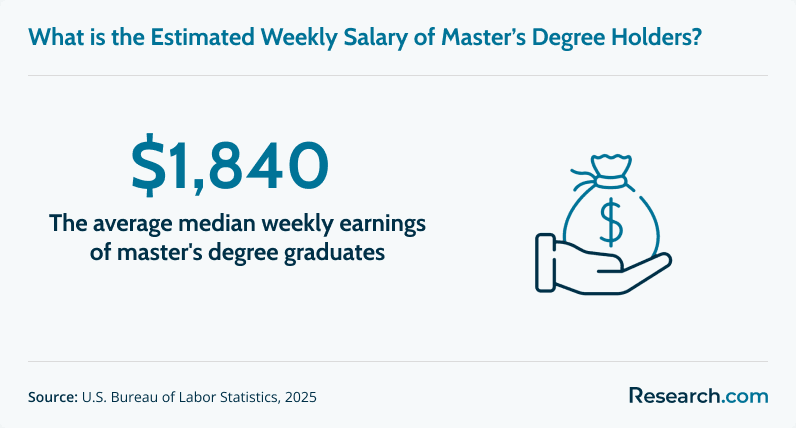
Choosing a master’s program should begin with the career outcome, not the school name. In 2024, master’s degree graduates received $1,840 weekly earnings on average, but that figure does not mean every program produces the same result. Your return depends on the field, credential requirements, debt, work experience, and the program’s quality.
Step 1: Define the Job You Want
Before comparing schools, identify the exact role or career track you are targeting. A vague goal such as “I want a better job” is not enough. Ask yourself:
- Is the master’s degree required? Nurse practitioners, physician assistants, school counselors, speech-language pathologists, and many clinical roles commonly need graduate education for practice or licensure.
- Are you advancing or changing fields? An MBA may help experienced professionals move into management, while a technical master’s may help career changers build credibility in computing, analytics, or engineering.
- Which skills are missing from your resume? Look for programs that directly teach the clinical, analytical, technical, research, or leadership skills employers want in your target job.
Step 2: Evaluate Program Quality Beyond Rankings
Rankings can be useful, but they should not replace deeper research. The same logic applies across many education decisions, including when students are learning what to look for in an early childhood education program. Focus on the program features that affect your employment, licensure, and learning outcomes.
- Curriculum: Review required courses, electives, clinical hours, labs, capstones, internships, and research options. Make sure the coursework matches the job you want.
- Specializations: Choose a concentration only if it supports a specific role, such as cybersecurity, family nurse practitioner, finance, analytics, or health administration.
- Faculty expertise: Look for instructors with research, clinical, or industry experience in your area of interest.
- Career support: Ask about placement support, employer connections, internship pipelines, alumni networks, and career coaching.
- Accreditation: Confirm institutional accreditation and, when relevant, programmatic accreditation. This is especially important for licensure fields.
Step 3: Compare Format, Cost, and Time Commitment
A strong program still has to fit your life. Compare full-time, part-time, online, hybrid, and campus-based options. Working adults may prefer flexible schedules, while students in clinical or lab-heavy fields may need in-person requirements.
| Program factor | Why it matters | Question to ask |
| Accreditation | Affects credit transfer, financial aid, employer recognition, and licensure eligibility | Is the institution and program accredited by the appropriate body? |
| Total cost | Tuition alone does not show the full financial commitment | What is the full cost including fees, books, travel, clinical expenses, and lost work time? |
| Format | Online flexibility can help working adults, but some fields require in-person training | Are there campus visits, labs, practicums, or clinical placements? |
| Career outcomes | Graduate employment data can reveal whether the program serves your target market | Where do recent graduates work, and in what roles? |
| Licensure alignment | Some programs may not meet requirements in every state | Does this program meet licensure rules where I plan to work? |
Average Salary Increase: Master’s Degree vs. Bachelor’s Degree
BLS data shows that workers with education beyond a bachelor’s degree generally earn more than those with only a bachelor’s degree, but the increase varies by occupation and field of study.
The Earnings Difference
Recent BLS data reported median weekly earnings of $1,897 for individuals with an advanced degree, including master’s, professional, and doctoral degrees. Workers with a bachelor’s degree had median weekly earnings of $1,541.
That equals an approximate median annual salary of $98,644 for advanced degree holders and $80,132 for bachelor’s degree holders.
The difference is roughly $18,500 per year. Over time, that gap can become substantial, but it should be weighed against tuition, fees, debt, time out of the workforce, and the specific career outcome tied to the degree.
Why the Salary Premium Varies
- Field of study: STEM, healthcare, finance, analytics, and some business degrees often show stronger salary gains than fields where employers do not consistently reward graduate credentials.
- Role and industry: A master’s degree can qualify you for specialized or leadership jobs, but the payoff depends on whether employers in your field value the credential.
- Experience level: Graduate education often has the greatest impact when it builds on relevant professional experience.
- Program cost: A high salary does not automatically mean a strong ROI if the program requires heavy borrowing.
Employment Stability and Career Mobility
Salary is only one part of the value calculation. BLS data also shows lower unemployment rates for workers with higher levels of education. A master’s degree may improve career mobility, qualify you for regulated professions, and help you move into roles that would otherwise be unavailable.
The chart below illustrates the salary difference among bachelor’s, master’s, and doctoral degree holders and shows why graduate education can produce a meaningful earnings advantage for some professionals.
Will a Master’s Degree Guarantee a Higher-Paying Job?
No. A master’s degree can improve your odds of earning more, but it does not guarantee a higher-paying job. The outcome depends on the field, program quality, employer demand, your work experience, your location, and whether the degree leads to a specific credential or role.
When Graduate School Is a Smart Financial Move
- The degree is required for the occupation: Nurse anesthetists, physician assistants, nurse practitioners, counselors, and many clinical roles require graduate education before licensure or practice.
- The field rewards advanced technical skill: Computer science, engineering, data analytics, finance, and some business specialties may offer strong returns when the program teaches skills employers need.
- You already have relevant experience: A master’s degree can be more powerful when it helps an experienced professional move into leadership or specialization.
- The program has a clear employment pathway: Programs with strong clinical placements, employer partnerships, internships, or alumni networks may provide better career access.
When the Financial Return May Be Weak
- The career goal is unclear: Enrolling without knowing the job you want can lead to debt without direction.
- The degree is not valued by employers in your field: Some industries prioritize portfolios, certifications, licenses, experience, or performance over graduate degrees.
- The program is too expensive relative to expected pay: A modest salary increase may not justify a large loan balance.
- A shorter credential would solve the problem: If you need one specific skill, a certification may be more efficient.
Master’s Degrees in Demand in 2025 and Beyond
The master’s degrees with strong demand are concentrated in healthcare, technology, data, cybersecurity, business leadership, engineering, and selected therapy or communication fields. These areas are shaped by healthcare shortages, aging-population needs, digital transformation, AI adoption, data security risks, and the need for specialized expertise.
Technology, Data, and AI-Related Programs
- Computer science and AI: A master’s in computer science can support careers in software systems, artificial intelligence, machine learning, algorithms, and advanced computing.
- Data science and analytics: These programs teach statistical analysis, programming, data interpretation, and decision-support methods used across many industries.
- Cybersecurity: Graduate cybersecurity and information systems programs prepare professionals to protect networks, data, cloud systems, and organizational infrastructure.
Healthcare and Public Health Programs
The healthcare sector continues to face a significant skills gap, which increases the need for trained professionals in advanced clinical, administrative, and public health roles.
- Nursing (MSN): A Master of Science in Nursing can lead to APRN roles such as nurse practitioner and nurse anesthetist. These roles typically receive $121,610 median annual salary.
- Physician assistant studies: A master’s degree is the standard path to PA practice, preparing graduates to diagnose, treat, and manage patient care with physician collaboration.
- Public health (MPH): A Master of Public Health prepares graduates for work in epidemiology, health policy, prevention, community health, and population-level health planning.
- Healthcare administration: Students who prefer operations, finance, policy, and leadership may want to compare clinical programs with online master’s degree programs in healthcare administration.
Business, Engineering, and Communication Sciences
- Master of Business Administration: An MBA remains a common path for professionals seeking management, executive leadership, finance, operations, or technology management roles.
- Engineering: Graduate engineering programs can support advanced technical work, project leadership, research, infrastructure, and product development.
- Speech-language pathology: A master’s degree is required to become a speech-language pathologist, a role connected to communication and swallowing disorders.
When Is a Master’s Degree Better Than a Professional Certification?
A master’s degree is usually the better choice when you need licensure, deep academic preparation, supervised clinical training, research skills, or a credential with broad long-term recognition. A certification is usually better when you need a specific skill quickly and do not need a graduate degree to qualify for the job.
Choose a Master’s Degree When the Profession Requires It
- Healthcare: Physician assistants, nurse practitioners, and occupational therapists need graduate-level preparation because their work involves advanced patient care and clinical decision-making.
- Counseling and education: School counselors, licensed counselors, and speech-language pathologists typically need a master’s degree tied to licensure requirements.
- Research and academia: Research roles and postsecondary teaching positions often require graduate education, and some require a doctorate.
Choose a Master’s Degree When You Need Depth, Not Just a Skill
Graduate programs teach theory, research methods, advanced analysis, and complex problem-solving. This matters for roles involving strategy, management, clinical judgment, innovation, or systems-level thinking. If cost is a major concern, compare accredited lower-cost options, including the cheapest online master’s programs.
- Leadership advancement: Professionals targeting roles such as chief technology officer, chief financial officer, director, or senior manager may benefit from the broader preparation of an MBA or field-specific master’s degree.
- Career change: A master’s degree can help career changers prove they have a structured foundation in the new field, not just one isolated skill.
Choose a Master’s Degree When Recognition and Network Matter
- Credential portability: An accredited graduate degree is widely recognized by employers, licensing boards, and academic institutions.
- Adaptability: A degree focused on fundamentals can remain useful even as tools and technologies change.
- Professional network: Graduate programs can provide access to faculty, peers, alumni, internships, clinical placements, and career services.
Can a Certification or License Replace a Master’s Degree?
Sometimes, but not in careers where a master’s degree is part of the legal or professional entry requirement. Certifications can be powerful for targeted skills, especially in technology and business, but they cannot replace graduate education when licensure rules require a master’s program and supervised preparation.
When a Certification Can Be a Strong Alternative
- Technology and IT: Certifications from providers such as Google, Amazon Web Services, Cisco, or other industry organizations can help demonstrate skills in cloud computing, cybersecurity, networking, or analytics.
- Project and business roles: A project management certification can be more directly relevant than a graduate degree for some project-based roles, while credentials such as CPA or CFA can matter greatly in accounting and finance.
- Skilled trades: In fields such as HVAC, electrical work, and plumbing, state licenses and hands-on training are typically more important than graduate education.
When a Master’s Degree Cannot Be Replaced
For regulated professions, the license often comes after completing an approved graduate program. In those cases, the degree and license work together; one does not replace the other. Students comparing shorter or less demanding routes should be careful with claims about easy master’s degrees that pay well and verify whether the credential actually leads to the job they want.
- Advanced healthcare roles: Physician assistants, nurse practitioners, and speech-language pathologists need graduate-level education before professional practice.
- Counseling and clinical social work: Licensed practice is typically tied to a master’s degree plus supervised clinical hours.
- Research and postsecondary education: Academic and research roles commonly require graduate degrees, often beyond the master’s level.
Certifications are best for upskilling, reskilling, or proving competence with a defined tool, platform, or method. A master’s degree is better for regulated careers, major career changes, leadership preparation, and long-term specialization.
The following chart shows how earnings rise with higher education levels. Full-time workers with a master’s degree can expect to earn a median weekly salary of approximately $1,840, showing the financial advantage that may come with graduate education.
How to Decide Between a Master’s Degree and a Certification
Deciding between graduate school and a professional certification should be based on the credential your target job actually requires, the skill gap you need to close, and the amount of time and money you can responsibly invest.
| Decision question | Master’s degree is usually better if... | Certification is usually better if... |
| Is the credential required? | The occupation requires graduate education for entry or licensure | The job requires proof of a specific skill, tool, or method |
| How broad is the knowledge gap? | You need deep theory, research, clinical preparation, or leadership development | You need one targeted skill you can use immediately |
| How quickly do you need results? | You can commit to a longer academic timeline | You need a faster option for promotion, job change, or upskilling |
| What is your budget? | The likely career return justifies tuition and possible debt | You need a lower-cost credential with a shorter payoff timeline |
| Are you changing careers? | You need credibility and foundational preparation in a new field | You already have related experience and only need a skill update |
Choose a Master’s Degree When
- Your target career requires it: Licensure-based fields in healthcare, counseling, social work, and education often make the degree non-negotiable.
- You need a complete foundation: Graduate programs teach concepts, frameworks, research, and advanced practice, not only job-specific tasks.
- You are making a major career change: A degree can signal commitment and give employers confidence that you understand the new field.
- You want a deeper network: Faculty, classmates, alumni, and practicum sites can become valuable long-term professional contacts. Students who need a faster academic route may compare one year masters programs.
Choose a Certification When
- You need a specific skill quickly: Certifications are usually more focused and faster than graduate degrees.
- Your field changes rapidly: IT, cloud computing, cybersecurity, analytics tools, and project management methods often reward current technical credentials.
- You want a lower-cost test of a new direction: A certification can help you explore a field before committing to graduate school.
How to Finance a Master’s Degree Effectively
Financing a master’s degree starts with calculating the full cost and comparing it with realistic career outcomes. Do not look only at tuition. Include fees, books, technology expenses, travel, residencies, clinical costs, exam fees, lost income, and interest on loans.
Practical Ways to Reduce Graduate School Costs
- Submit financial aid forms early: Graduate students may qualify for federal aid, institutional aid, or loan options depending on their situation.
- Ask about scholarships and grants: Some awards are field-specific, need-based, merit-based, or tied to public service.
- Look for assistantships: Teaching, research, or graduate assistant roles may reduce tuition or provide a stipend.
- Use employer tuition benefits: Some employers reimburse employees for approved graduate coursework, especially when it supports job advancement.
- Compare online and hybrid formats: Flexible formats may reduce relocation or commuting costs, though students should still check accreditation and licensure rules.
- Consider accelerated options carefully: Faster programs can reduce time away from work, but only if the workload is realistic and the credential is respected.
If you are comparing graduate school with lower-cost career preparation, review alternatives such as online degrees that pay well. A financial aid advisor can also help you estimate borrowing, repayment, and program affordability before you enroll.
Career Outlook for Jobs That Require a Master’s Degree
The outlook for many master’s-level careers is strong, especially in healthcare and STEM fields. Growth is driven by an aging population, rising healthcare demand, technological change, data needs, cybersecurity risks, and the increasing complexity of professional work.
Healthcare Outlook
Healthcare roles such as nurse practitioners and physician assistants are projected to see significant employment growth. These jobs are tied to provider shortages, expanded care teams, and the need to serve older patients. Because graduate education is required for many advanced practice roles, students should compare program quality, clinical placement support, licensure preparation, and cost. Nursing students can also research affordability through options such as the cheapest online nursing master’s programs.
STEM and Technology Outlook
Technology and STEM careers continue to be shaped by artificial intelligence, data analytics, cloud computing, cybersecurity, automation, and advanced research. Roles such as computer and information research scientist and data-focused positions often favor candidates with advanced technical training.
A master’s degree can be a competitive advantage when it teaches skills that are difficult to gain through short courses alone, such as research design, advanced algorithms, applied statistics, systems architecture, clinical practice, or high-level management.
Common Mistakes to Avoid Before Enrolling in a Master’s Program
- Choosing a school without checking accreditation: This can affect licensure, financial aid, transfer credit, and employer recognition.
- Focusing only on tuition: Fees, travel, clinical requirements, books, software, and lost income can change the real cost.
- Assuming online programs meet all licensure rules: Licensure requirements can vary by state and profession.
- Relying only on rankings: A highly ranked program may not be the best fit for your specialization, budget, schedule, or local job market.
- Ignoring career outcomes: Ask where graduates work, what roles they get, and whether the school can document results.
- Borrowing without an ROI estimate: Compare expected salary gains with total debt and repayment obligations.
- Choosing a degree when a certification would be enough: If your goal is a specific technical skill, a shorter credential may be more efficient.
Questions to Ask Before You Apply
- Does this career require a master’s degree, or is it only preferred?
- Is the program accredited by the correct institutional and programmatic accreditor?
- Will the program meet licensure requirements in the state where I plan to work?
- What is the full cost of attendance, not just tuition?
- What scholarships, assistantships, grants, or employer benefits can reduce my cost?
- What jobs do recent graduates get, and how soon after graduation?
- Does the curriculum teach the exact skills required for my target role?
- Are internships, practicums, clinical placements, or capstones included?
- Can I complete the program while working?
- Would a certification, bootcamp, or employer training program meet my goal at lower cost?
Key Insights
- A master’s degree is essential for some careers: Nurse practitioners, physician assistants, nurse anesthetists, counselors, clinical social workers, and speech-language pathologists commonly need graduate education for entry or licensure.
- Graduate school is not automatically worth it: ROI depends on field, cost, debt, program quality, experience, and whether employers reward the credential.
- Healthcare and technology remain strong areas: Many in-demand master’s-level careers are connected to advanced patient care, AI, data analytics, cybersecurity, and research.
- Certifications can be better for targeted skills: If you need a specific technology, platform, or method, a certification may be faster and cheaper than a full degree.
- Accreditation and licensure alignment are non-negotiable: Before enrolling, confirm that the program meets professional and state requirements for your intended career.
- Use career outcomes to judge value: The best program is the one that fits your target role, budget, timeline, and credential requirements—not simply the one with the most recognizable name.
References:
- U.S. Bureau of Labor Statistics. (n.d.). Career outlook: Graduate degree.
- U.S. Bureau of Labor Statistics. (2025). Education level and openings, 2024–34.
- U.S. Bureau of Labor Statistics. (2025). Education pays.
- U.S. Bureau of Labor Statistics. (2022). May 2022 national occupational employment and wage estimates.
- U.S. Bureau of Labor Statistics. (n.d.). Occupational outlook handbook: Nurse anesthetists, nurse midwives, and nurse practitioners.
Other Things You Should Know About the Top Careers That Require a Master's Degree
Master's programs in data science, healthcare administration, and artificial intelligence are anticipated to be in high demand in 2027 due to rapid technological advancements and an increased need for specialized skill sets in these fields.
Genetic Counseling remains a top career in 2027 due to the ongoing advancements in personalized medicine and the increasing demand for specialized healthcare professionals. With a focus on genetics, personalized treatment plans, and preventive healthcare, genetic counselors play a crucial role in patient care, making this career path both impactful and fulfilling.


