
2027 What Can You Do With a DNP in Midwifery?

Co-Founder and Chief Data Scientist
Midwifery isn’t fringe—it’s built into U.S. care. Certified midwives attend 10.9% of births, and 94% of those births happen in hospitals, not living rooms. Pay is serious: the nurse‑midwife median is about $129,650, with outpatient centers averaging around $164,080. Yet demand still outstrips use. BLS projects 7% job growth by 2033, and ACNM estimates thousands more midwives are needed.
This guide shows what a DNP in midwifery empowers you to do for 2027—roles, pay, outlook, settings, program time and hours, admissions, costs, credentials, and practice options.
Key Things You Should Know About DNP in Midwifery
- Nurse‑midwife median is ~$129,650; outpatient centers average ~$164,080; top states exceed $150,000.
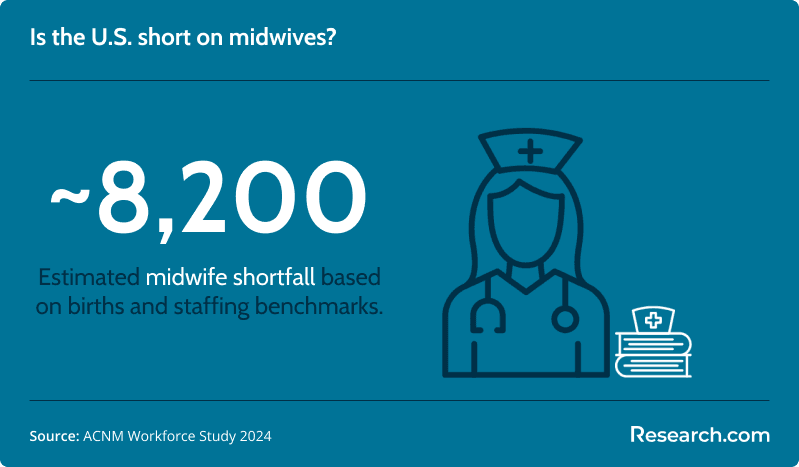
- BLS projects 7% growth to 2033; ACNM estimates a shortfall of ~8,200 midwives.
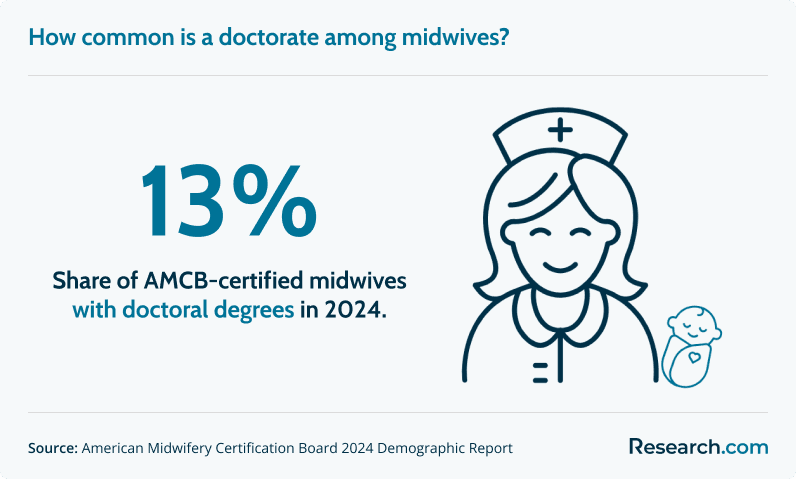
- Only ~13% of certified midwives have doctorates; just 32 doctoral midwifery degrees were conferred in 2021–22.
- What can you do with a DNP in midwifery for 2027? What You Can Do
- Which leadership roles need a DNP in midwifery? Leadership Roles
- How much does a DNP midwife make? Salary
- What’s the job outlook for DNP midwives? Job Outlook
- Where do DNP midwives work most? Work Settings
- How long is a DNP in midwifery from start to finish? Program Duration
- How many clinical/practicum hours are in a DNP midwifery program? Clinical Hours
- What are the admissions requirements for DNP in midwifery? Admission Requirements
- How much does a DNP in midwifery cost—and what’s the ROI? Cost & ROI
- Is an Accelerated BSN Pathway the Right Stepping Stone Toward a DNP in Midwifery? Is an Accelerated BSN Pathway the Right Stepping Stone Toward a DNP in Midwifery?
- What certification and state licensure do I need after the DNP? Certification
- How Do I Choose the Right DNP Midwifery Program? How Do I Choose the Right DNP Midwifery Program?
- Can a DNP midwife run a practice or birth center? Can a DNP midwife run a practice or birth center?
What can you do with a DNP in midwifery for 2027?
With a DNP in midwifery for 2027, you practice full‑scope care and drive system‑level improvements where most births occur.
DNP‑prepared midwives provide pregnancy, birth, postpartum, gynecologic, and primary care; among CNMs/CMs, 55.1% report reproductive care and 38.5% provide primary care within full‑time roles. Care is largely hospital‑based—94% of midwife‑attended births are in hospitals—yet outpatient centers and physician offices are sizable employers, too.
Because pay varies by setting, leadership opportunities often track with site complexity: outpatient care centers average roughly $164,080, hospitals about $135,900, and physician offices around $127,550.
Geography matters as well—annual means exceed $150,000 in several states, led by California at $183,740. Demand remains steady with a 7% growth outlook and documented under‑utilization.
Only about 13% of certified midwives currently hold doctorates, and just 32 doctoral midwifery degrees were awarded in 2021–22, so a DNP sets you apart for quality, safety, informatics, and faculty roles while keeping clinical practice at the center. For comparison, when considering what can you do with a DNP in adult-gerontology acute care, graduates often move into executive clinical leadership, advanced hospital practice, or specialized consultative roles—showing how the DNP expands professional pathways across different areas of nursing practice.
Which leadership roles need a DNP in midwifery?
A DNP widens your lane beyond excellent clinical practice. Because only about 13% of certified midwives hold doctorates and just 32 doctoral midwifery degrees were conferred in 2021–22, the credential signals readiness for roles that shape systems. Common targets include:
- service line or perinatal safety leadership,
- quality‑improvement program lead,
- outcomes and analytics projects,
- clinical educator or faculty appointments,
- informatics or telehealth implementation, and
- policy or reimbursement work.
Settings align with impact and pay: outpatient care centers average roughly $164,080, general hospitals about $135,900, and physician offices around $127,550—so redesigning care where complexity and revenue pool are highest often brings influence and compensation together.
Your capstone can be designed around these outcomes—think hemorrhage bundles, induction protocols, or group prenatal care with measurable metrics.
If affordability is a concern as you plan the doctorate, compare among the cheapest online DNP programs to control tuition without trading rigor or residency needs. Hospital‑centric roles can also connect to payer incentives and Medicare’s 100% CNM reimbursement policies, which support sustainable projects.
How much does a DNP midwife make?
Public datasets report nurse‑midwife pay, not a separate DNP premium—so use the official ranges to set expectations. Nationally, the May 2023 median is $129,650 (mean $131,570). Percentiles run from $87,320 at the 10th to $177,530 at the 90th; the 25th sits at $110,000 and the 75th at $146,770.
Setting matters:
- outpatient care centers ~ $164,080,
- general hospitals ~ $135,900, and
- physicians’ offices ~ $127,550.
Geography matters too. Top‑paying states include:
- California ($183,740),
- Hawaii ($161,820),
- Massachusetts ($154,080),
- Maine ($140,440), and
- Oregon ($139,490).
Several metros exceed $200,000 on average—San Francisco–Oakland–Hayward ~$202,230.
AMCB’s recertification snapshot reinforces the middle of the distribution: among full‑time midwives, 69.2% reported earnings between $100,000 and $149,999. Within industries, outpatient centers lead, while local government averages about $132,190 and colleges and universities around $121,260—useful context if you’re eyeing public health or academic tracks.
As with midwifery, it’s also helpful to compare across specialties; for example, DNP FNP salary ranges tend to be similar but often vary by region and practice setting, with family nurse practitioners seeing strong premiums in primary care, rural health, and leadership roles.
If you’re benchmarking ROI or comparing pacing, remember curriculum format (including so‑called easy DNP programs) doesn’t change market wages; setting and location do.
What’s the job outlook for DNP midwives?
The Bureau of Labor Statistics projects 7% growth for nurse‑midwife jobs from 2023 to 2033—about 7,200 roles rising to 7,700. That’s steady rather than explosive, but it understates unmet need.
- Midwives attend 10.9% of all U.S. births despite caring for low‑risk pregnancies that make up 65% of births; only 13% of those low‑risk births are midwife‑attended.
- Workforce density sits near 4 midwives per 1,000 live births, versus a benchmark of 6.
Based on birth volumes, ACNM estimates roughly 22,000 midwives are needed nationally while only about 14,000 practice, a shortfall near 8,200.
For DNP‑prepared midwives, the takeaway is practical: leadership training positions you to expand access—through hospital service redesign, outpatient models, or collaborative practice—in places where the location quotient and employer demand already run high. Pair this with pay data to decide whether you target a high‑utilization state or a high‑pay metro undergoing maternity‑care consolidation. The broader APRN group is projected to grow about 40%, underscoring systemic expansion for advanced practice roles that midwifery can leverage.
Similarly, growth is also evident in other advanced specialties—pediatric-focused practitioners, for example, are seeing strong demand, with DNP PNP jobs offering opportunities in children’s hospitals, outpatient pediatrics, and leadership roles in pediatric primary care.
Where do DNP midwives work most?
Expect a hospital‑heavy reality paired with diverse ambulatory options. In 2022, 94% of CNM/CM‑attended births occurred in hospitals; 3% took place in freestanding birth centers and 3% at home.
Employment mirrors this: offices of physicians (~3,490) employ the most midwives, followed by general hospitals (~1,640) and outpatient care centers (~1,020). Outpatient centers, however, pay the most on average (~$164,080), which is one reason DNP projects often target ambulatory redesign or integrated prenatal‑to‑postpartum pathways.
Geography can shape scope and schedule. States with the highest employment are CA (890), NY (740), GA (310), NC (300), and PA (290), while concentration is greatest in AK (LQ 6.56) and DC (LQ 2.60). At the metro level, NY‑Newark‑Jersey City (730), Atlanta (230), and San Francisco–Oakland–Hayward (220) lead for headcount, and several West Coast markets top pay tables.
For DNP‑prepared midwives, that mix means weekday clinics, call in hospital units, and occasional community or home‑birth collaboration—balanced by leadership tasks in safety, quality, and patient‑experience workstreams.
How long is a DNP in midwifery from start to finish?
There’s no single national timeline—the clock depends on your entry point, clinical sequencing, and cohort logistics. Programs commonly offer BSN‑to‑DNP and post‑master’s routes with different credit loads and practicum pacing.
Pipeline context helps planning: only 29 colleges offer nurse‑midwife programs, with 21 at the graduate level (8 public / 13 private), and just 4 offer online options. Limited seats and clinical placement coordination drive start dates and duration more than course clicks.
Applicants who want a faster finish often target compressed calendars and front‑loaded clinicals; scanning accelerated DNP programs provides a sense of what “short” looks like in reputable formats. Build slack for onboarding steps that can slow a cohort: compliance checks, EHR access, immunizations, and preceptor contracts. The small doctoral pipeline—32 midwifery doctorates in 2021–22—means advising capacity is finite, which can stretch project timelines if clinical sites change.
How many clinical/practicum hours are in a DNP midwifery program?
National datasets don’t publish a single hour requirement for DNP midwifery; programs disclose totals in their handbooks and plans of study. What we can anchor is where hours typically happen.
In 2022, 94% of CNM/CM‑attended births were in hospitals, with 3% in freestanding birth centers and 3% at home—so most practicum placements skew to inpatient L&D, OB triage, and hospital‑connected clinics. Outpatient care centers are rising employers (about 1,020 midwives) and the highest‑paying setting (about $164,080), so expect ambulatory blocks that tie prenatal, postpartum, and gynecologic care. Programs also align hours with DNP projects—quality, safety, or access initiatives that require measurable outcomes.
If speed matters, compare cohorts marketed as accelerated in adjacent specialties to understand pacing patterns—e.g., fastest online women's health nurse practitioner DNP programs—then verify midwifery‑specific hour counts directly on program pages.
Bottom line: hours vary, but the clinical mix mirrors where midwives work and where leadership projects can move metrics.
What are the admissions requirements for DNP in midwifery?
Selectivity is driven by capacity more than marketing. Only 21 graduate schools offer nurse‑midwife programs and just 4 provide online options; in 2021–22, only 32 doctoral midwifery degrees were awarded. Expect baseline requirements like
- a BSN or relevant master’s,
- an active RN license,
- statistics or research coursework, and
- OB experience—plus immunizations, background checks, BLS/NRP, and clinical site agreements.
Many programs also screen for readiness to complete a DNP project in the employer setting, which can influence start terms.
If you’re applying straight from a BSN, compare affordable online bsn to DNP degree programs to understand tuition bands and pacing before you chase seats. Where programs publish admission profiles, GPA thresholds and recent clinical hours are common soft screens; faculty interviews often double as feasibility checks for local preceptorships.
How much does a DNP in midwifery cost—and what’s the ROI?
Use program‑level averages as your starting point. Across 21 graduate‑level nurse‑midwife programs, average tuition and fees run about $17,129 in‑state and $32,613 out‑of‑state, with 8 public and 13 private schools and 4 online options.
On the earnings side, the national nurse‑midwife median is $129,650 and outpatient centers average roughly $164,080. A back‑of‑the‑envelope payback using median wages suggests tuition can be offset quickly, especially if your role shifts into higher‑pay settings or leadership. Scholarships, loan repayment, and employer tuition support compress timelines further.
To benchmark real sticker prices before you apply, compare reputable most affordable DNP programs and verify the midwifery concentration is ACME‑accredited and AMCB‑eligible. Remember there are only 29 colleges offering nurse‑midwife degrees overall, so pricing spreads are narrower than in larger fields. AMCB recertification data show 69.2% of full‑time midwives reporting $100k–$149,999, which supports conservative ROI cases even before location factors.
Is an Accelerated BSN Pathway the Right Stepping Stone Toward a DNP in Midwifery?
For many aspiring DNP midwives, an accelerated pathway offers a streamlined transition from undergraduate studies to advanced practice. An accelerated BSN route can reduce overall program duration and enhance early exposure to rigorous clinical and academic environments, preparing candidates for the complexities of doctoral midwifery education. This alternative pathway is not only time-efficient but also strategically structured to build a strong foundational skill set that complements the demands of a DNP program. Candidates often weigh the benefits of speed against program intensity and should compare options carefully; information on these accelerated tracks is available through resources such as the online ABSN program.
What certification and state licensure do I need after the DNP?
Graduates pursue national certification through the American Midwifery Certification Board (AMCB), then obtain state licensure. As of January 2024, AMCB reported 14,540 certified midwives (about 14,401 CNMs and 139 CMs).
Licensure scope and prescriptive authority vary by state, but the federal reimbursement floor is clear: Medicare reimburses CNMs at 100% of physician rates, and most state Medicaid programs reimburse CNMs/CMs at 100% as well. Employment data suggest most certificants practice midwifery: among recertificants, 76.2% reported working as full‑ or part‑time midwives; 11.4% were employed outside midwifery. Because statutes and formularies differ, confirm state board requirements early, especially if your DNP project involved protocols or ordering privileges.
If you plan moves across states, pair licensure rules with pay and concentration tables to avoid surprises; for example, location quotients cluster highest in Alaska (6.56) and D.C. (2.60) while average wages top out in California ($183,740). In practice, multilingual care is common in many markets—AMCB data show 80.0% provide services in English and 23.2% in Spanish—so document competencies where your board allows.
And if you are exploring adjacent advanced practice pathways, looking at benchmarks such as the FNP graduate certificate salary can give useful context for understanding earning potential across specialties.
How Do I Choose the Right DNP Midwifery Program?
When evaluating DNP midwifery programs, prioritize those with robust accreditation, a curriculum that emphasizes both clinical leadership and evidence-based practice, and faculty with demonstrated expertise in midwifery innovation. Assess program flexibility by comparing in-person and online delivery models, including options like easy accelerated BSN online programs, to ensure the course structure aligns with your educational needs and professional timeline. Additionally, review comprehensive student support services—clinical placement coordination, mentorship opportunities, and alumni success metrics—to gauge long-term career advancement potential.
Can a DNP midwife run a practice or birth center?
Many DNP‑prepared midwives seek leadership autonomy in outpatient models, collaborative practices, or birth centers. Feasibility rests on state scope, collaborating‑physician rules, and payer panels—but the financial context is encouraging: outpatient care centers average ~$164,080, and several metros pay above $180,000 on average (e.g., San Francisco–Oakland–Hayward $202,230; Los Angeles–Long Beach–Anaheim $184,800).
Market signals also matter. High location quotients suggest deeper midwifery integration—Anchorage (LQ 9.93) and Ann Arbor (5.62)—while high‑employment metros like NY‑Newark‑Jersey City (n=730) or Atlanta (n=230) indicate scale. On the state side, employment is largest in California (890) and New York (740); top pay states include California ($183,740) and Hawaii ($161,820).
Before you plan an ownership path, confirm certificate‑of‑need, transfer agreements, malpractice coverage, and the credentialing timelines with major commercial payers and Medicaid. Use your DNP project to pilot the care model you intend to scale—prenatal group care, home‑to‑clinic continuity, or postpartum access—so your numbers travel into the business plan.
Here's What Graduates Have to Say About Their DNP in Midwifery Program
- Marisol: "The DNP let me design a hemorrhage‑response project that we rolled out across two hospitals. Online courses kept me on call while finishing clinicals. Seeing the nurse‑midwife median near $129.6k and outpatient averages around $164k made the tuition decision easier. The leadership doors opened fast after I defended."
- Keira: "I stayed employed full‑time while completing the DNP online. My capstone focused on induction protocols in our outpatient center—still the highest‑paying setting at about $164k. The doctorate signaled I could lead quality and analytics work, not only catch babies. The median near $129.6k anchored ROI, and scheduling preceptors locally kept momentum."
- Soraya: "I chose the DNP because few midwives hold doctorates—about 13%—and only 32 doctoral midwifery degrees were conferred recently. That scarcity helped me land a clinical educator role and an adjunct faculty slot while practicing. The online format saved commuting hours I poured into project metrics, simulation labs, and precepting. Worth it for impact and flexibility."
Key Findings
- $129,650 median pay; outpatient centers average ~$164,080; California $183,740.
- 7% job growth projected to 2033; ~8,200 midwife shortfall persists.
- 94% of midwife‑attended births occur in hospitals; only 10.9% of all births involve midwives.
- Only ~13% of midwives hold doctorates; 32 doctoral midwifery degrees awarded in 2021–22.
- 21 graduate programs exist; 4 online options at the graduate level; average grad tuition $17,129–$32,613
References:
- ACNM (American College of Nurse-Midwives). 2023 Essential Facts About Midwives.
- ACNM. Midwifery Workforce Study (Executive Summary).
- AMCB (American Midwifery Certification Board). 2024 Demographic Report.
- BLS (U.S. Bureau of Labor Statistics). Nurse Midwives, Occupational Employment and Wage Statistics (May 2023).
- BLS. Nurse Anesthetists, Nurse Midwives, and Nurse Practitioners, Occupational Outlook Handbook.
- CollegeTuitionCompare. Nurse Midwife/Nursing Midwifery Programs.
- NCES (National Center for Education Statistics). Degrees Conferred in Nurse Midwife/Nursing Midwifery, 2021–22 (Table 318.30).
Other Things You Should Know About DNP in Midwifery
In 2027, DNP-prepared midwives can pursue leadership roles in clinical settings, academic positions for teaching, and research roles to advance midwifery. Their skills are in demand for policy development and improving maternal and child health outcomes.
In 2027, several programs offer flexible DNP pathways, including part-time, online, and hybrid options. These formats are designed to accommodate professionals balancing work and family commitments, allowing them to advance their education while managing other responsibilities.


