
2027 What Can You Do with a Master's in Special Education

Co-Founder and Chief Data Scientist
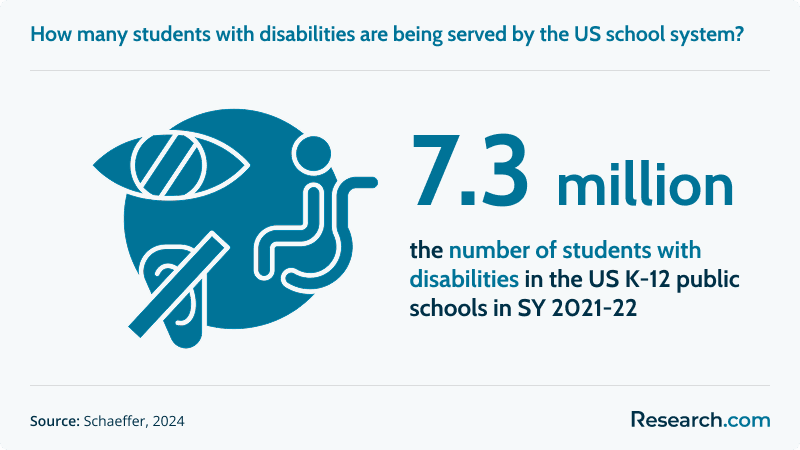
With 7.3 million students in the U.S. needing specialized support, the challenge for dedicated professionals is turning a deep sense of purpose into a sustainable, high-impact career. Whether you are a current educator seeking to deepen your expertise or a professional aspiring to enter this vital field, the pivotal question is if a Master's in Special Education is the right strategic move.
Crafted by career planning experts with over a decade of experience, this guide provides the answers. We'll explore everything you can do with this advanced degree—from jobs and salaries to long-term advancement—to help you build a career that is both personally fulfilling and professionally rewarding.
Key Things You Should Know About Master's in Special Education Degrees
- The median annual wage for special education teachers is $64,270.
- The field has a high demand, with 37,800 job openings expected annually.
- You will be entering a field dedicated to serving 7.3 million students with disabilities.
- Median tuition ranges from approximately $7,600 (in-state, public) to $35,500 (private).
- The master's degree is the most commonly awarded credential in the field.
- What is a Master's in Special Education? Degree Overview
- What jobs can I get with a Master's in Special Education? Jobs
- How much can you earn with a Master's in Special Education? Salary
- What is the job outlook for graduates of Master's in Special Education programs? Job Outlook
- Where can I work with a Master's in Special Education? Where can I work with a Master's in Special Education?
- What skills do you need for Master's in Special Education jobs? Skills
- What are the education requirements to enroll in a Master's in Special Education program? Requirements
- What alternatives to a Master's in Special Education are available? What alternatives to a Master's in Special Education are available?
- What career paths are available to graduates with a Master's in Special Education? Career Paths
- How do you get started on your Master's in Special Education? How do you get started on your Master's in Special Education?
- What advancement opportunities are available after a Master's in Special Education? Advancement
- Is a Master's in Special Education worth it? Is a Master's in Special Education worth it?
- What are the emerging trends in special education? What are the emerging trends in special education?
What is a Master's in Special Education?
A Master's in Special Education is an advanced degree that provides expert-level training in pedagogy, student assessment, and the specific laws, like the Individuals with Disabilities Education Act (IDEA), that shape the field.
For current teachers, it’s the primary tool for career advancement and specialization. For professionals changing careers, it is the most direct and respected path to earning an initial teaching license. The program is designed to make you a highly qualified expert who can meet the complex needs of students.
The Critical Role of Accreditation
The single most important factor in your program search is accreditation. The program you choose must be accredited by the Council for the Accreditation of Educator Preparation (CAEP)—this is the gold standard.
This isn't just a suggestion; it's a non-negotiable. State licensing boards will not issue a teaching license if your degree comes from a non-accredited program, making that investment of time and money worthless.
What jobs can I get with a Master's in Special Education?
This degree prepares you for a wide range of specialized roles, well beyond a single job title. While many of the 559,500 special education teachers in the U.S. work directly in the classroom, a master's degree is what qualifies you for positions with greater leadership and influence.
Here are some of the core roles you can pursue.
- Become a specialized teacher. You can focus your expertise on specific grade levels, from preschool to high school, or on particular student needs.
- Serve as an inclusion specialist. Work with general education teachers to adapt curriculum and create strategies that help students with disabilities succeed in mainstream classrooms.
- Work as an educational diagnostician. Use advanced assessment tools to accurately identify students' learning challenges and collaborate with a team to develop effective support plans.
Beyond the Classroom: Leadership and Advocacy Roles
With experience, this degree opens doors to influential positions outside of a dedicated classroom. You can become an instructional coordinator, coaching other teachers on best practices and helping to shape school-wide curriculum.
Other paths include working as a special education advocate, guiding families through the complexities of the educational system. You could also move into the corporate or non-profit world as an accessibility consultant, helping organizations create more inclusive environments. For students seeking flexible options to continue their education, exploring best online degrees for felons with records can provide accessible pathways to achieving these advanced roles.
The chart below breaks down the employment numbers for special education teachers across different school levels in 2024.
How much can you earn with a Master's in Special Education?
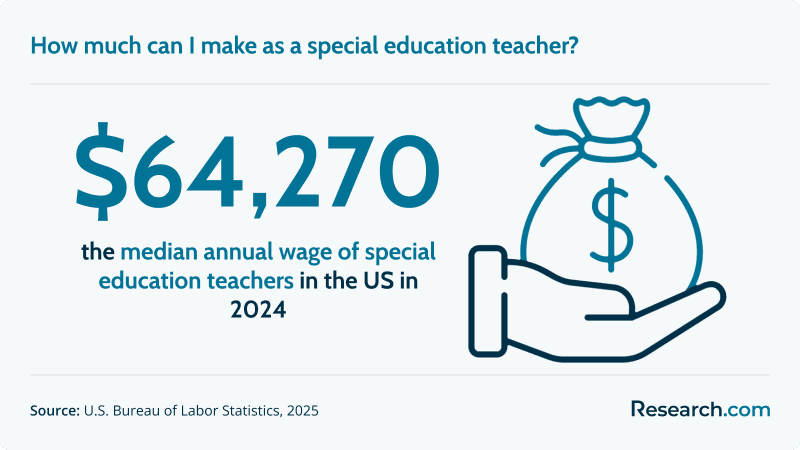
In 2024, the median annual wage for special education teachers in the U.S. was $64,270. That figure varies based on where you work, with secondary school educators earning a median of $69,590 and preschool teachers earning a median of $62,190. To understand the real financial impact of this degree, however, you have to look past the national average and focus on how school districts actually pay their teachers.
How a Master's Degree Impacts Your Paycheck: Understanding Salary Schedules
Most public school districts use a salary schedule—a grid with "steps" and "lanes"—to set teacher pay. "Steps" represent your years of experience, so your pay increases with seniority. "Lanes," on the other hand, represent your level of education.
This is where the master's degree becomes so powerful. Earning it moves you into a higher-paying lane, resulting in a significant and permanent salary increase. It is the single most important mechanism for unlocking your long-term earning potential and securing a clear return on your investment. For healthcare professionals considering advanced leadership roles, exploring careers with a DNP in health systems leadership can highlight the high-impact positions accessible with this degree.
What is the job outlook for graduates of Master's in Special Education programs?
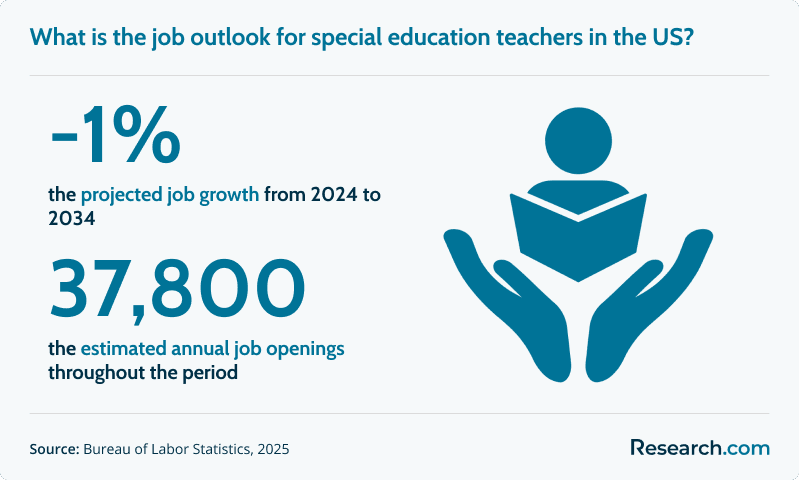
You may have seen a government statistic projecting a -1% decline in this field and felt a sense of concern. That number, when viewed in isolation, is deeply misleading. The reality is that the job market for special education teachers is very stable, with about 37,800 openings projected each year through 2034. The demand isn't shrinking; the workforce is simply in constant motion.
The Real Story: Why High Demand Persists
That high number of openings is driven by a constant "replacement need." As established teachers retire or leave the profession for other roles, a steady stream of opportunities becomes available for qualified professionals. This is where a master's degree becomes a powerful strategic advantage.
Where can I work with a Master's in Special Education?
While the majority of graduates work in public and private K-12 schools, this degree qualifies you for roles in a much wider range of settings. Your expertise is valuable anywhere learning and accessibility are priorities.
Here are some of the other environments where you can build a career.
- Early Intervention Centers: Work with infants and toddlers with developmental delays to provide crucial support before they enter the school system.
- Hospitals and Clinics: Serve as part of a medical team, helping children with significant health needs continue their education during treatment.
- Government Agencies: Shape policy and oversee programs at the state or federal level, working for organizations like the Department of Education.
- Non-Profit Organizations: Develop programs, advocate for disability rights, and provide direct services to communities through mission-driven organizations.
- Corporate/University Offices: Support accessibility and inclusion initiatives, ensuring that employees or college students have the resources they need to succeed.
For those considering broader career options, exploring what can I do with a masters in history provides insight into the diverse paths this degree can open.
Collaborative Roles in Allied Professions
In many of these settings, you won’t be working alone. Special educators are key members of interdisciplinary teams, frequently collaborating with professionals like occupational therapists and speech-language pathologists (SLPs). This collaborative reality means that the places where special educators work often overlap with various SLP work settings, creating a rich, team-based professional environment.
What skills do you need for Master's in Special Education jobs?
Success in this field requires more than just a caring heart. It demands a sophisticated blend of technical expertise and specific personal qualities that you'll develop in a high-quality master's program.
Technical and Analytical Skills
These are the hard skills that form the foundation of your professional practice and differentiate an expert from a well-meaning amateur.
- Individualized Education Program (IEP) Development: You will learn to create and manage this cornerstone legal document that outlines a student's specific goals and the services they will receive.
- Student Assessment and Data Analysis: This involves using formal and informal tools to measure student progress, analyze the data, and adjust teaching strategies accordingly.
- Understanding of Special Education Law (IDEA): You must have a firm grasp of federal and state laws to ensure student rights are protected and procedures are followed correctly.
- Curriculum Modification: This is the skill of adapting general education lessons to make them accessible and effective for students with a wide range of learning needs.
Essential Personal Qualities
While the technical skills are critical, they must be paired with a distinct set of personal strengths to be truly effective.
- Communication and Collaboration: You will be constantly communicating with parents, teachers, administrators, and other specialists, requiring clarity, tact, and professionalism.
- Patience and Empathy: This involves the ability to understand a student's perspective and maintain a calm, supportive presence, even when progress is slow.
- Resilience and Problem-Solving: The work is challenging. The most successful professionals are those who can navigate setbacks, think creatively, and remain focused on finding solutions.
What are the education requirements to enroll in a Master's in Special Education program?
The requirements to enroll in a Master's in Special Education program are straightforward. It is the most common credential in the field, with over 19,000 awarded in 2023 alone. While specific details vary between universities, most programs ask for a similar set of qualifications.
Here are the common requirements you'll need to prepare.
- You will need a bachelor's degree from an accredited institution.
- Most programs require a minimum undergraduate GPA, often around a 3.0.
- You will be asked for two to three letters of recommendation from professional or academic contacts.
- A personal statement explaining your motivations and goals is a standard part of the application.
- Some, but not all, programs may require GRE scores, so check each school's policy.
Do I need an education background?
This is a critical question for career-changers, and the answer is often no. Many universities actively recruit candidates with diverse backgrounds and have specific program tracks designed for those without an undergraduate degree in education.
Degrees in fields like psychology, social work, or even communications can provide a strong foundation for this work. Universities see the value in bringing professionals with varied life experiences into the teaching field, and there are many paths to entry, including programs that support specific groups like veterans seeking a most affordable online bachelor's for veterans degree.
The chart below shows how the master's degree is the most common credential awarded in this field.
What alternative to a Master's in Special Education are available?
The primary alternative to a master's degree is a certificate program. These come in a few common forms, such as an initial licensure certificate for career-changers or an add-on endorsement for current teachers who want to specialize in a new area.
These programs are designed to get you qualified more quickly, often in about a year, by focusing only on the essential coursework for that specific credential. This path presents a clear strategic trade-off.
Certificate vs. Degree: A Strategic Choice
The choice between a certificate and a degree comes down to your career goals. An initial licensure certificate is the fastest path into the classroom. An add-on certificate is a quick way for a current teacher to gain a new credential. A master's degree, however, is a more comprehensive investment in your entire career.
While a certificate provides the core skills for your first year, a master's program delivers the deeper training in assessment, law, and pedagogy that leads to long-term effectiveness. This advanced training is what qualifies you for higher salary lanes and is a prerequisite for nearly all leadership roles, from instructional coach to school administrator.
For those who want to explore this faster route, researching a special education graduate certificate online is an excellent next step. But for long-term growth, the master's remains the more powerful investment.
What career paths are available to graduates with a Master's in Special Education?
A master's degree is the foundation for a long-term professional arc that evolves as you gain experience. It’s not about doing the same job for 30 years; it’s about unlocking a sequence of roles with progressively greater impact and responsibility.
You can think of the career trajectory in distinct stages.
The Foundational Years (1-5): Expert Classroom Practitioner
Your first several years are focused on mastery. This is where you hone your instructional strategies, become an expert in student assessment, and establish yourself as a highly effective, data-driven teacher. You become the go-to resource in your school building.
The Leadership Leap (5-10): Mentor and Specialist
After establishing your expertise, you can leverage it to lead others. This is the stage where many professionals transition into hybrid roles like lead teacher, instructional coach, or IEP coordinator. You move from managing a classroom to mentoring colleagues and guiding school-wide strategy.
The Systemic Impact Stage (10+): Administrator and Advocate
With a decade or more of experience, you are positioned to influence the entire system. This path leads to senior leadership positions like a school principal, a district's director of special services, or even a policy advisor for a state agency. Your focus shifts from individual students to shaping the educational landscape for thousands.
How do you get started on your Master's in Special Education?
Getting started on your Master's in Special Education is a straightforward process when you break it down into manageable steps. Here is the four-step plan to begin.
- Research your state's licensure requirements. Your first stop should always be your state's Department of Education website to understand the specific credentials you will need.
- Identify accredited programs. Use reputable online search tools to find programs that are CAEP-accredited, ensuring your degree will be recognized for licensure.
- Prepare your application materials. Begin gathering your undergraduate transcripts, reach out to potential references for letters of recommendation, and start outlining your personal statement.
- Explore financial aid options. Look into federal aid by filling out the FAFSA, and search for scholarships and grants specifically for educators.
Financing Your Degree
Don't let the cost be an immediate barrier. Many financial resources are available for aspiring special educators. For example, the federal TEACH Grant can provide significant funding to students who commit to teaching in a high-need field at a low-income school. As you explore funding, it is also wise to research the cheapest online special education masters degree programs to maximize your return on investment. A little research can make your degree far more affordable.
What advancement opportunities are available after a Master's in Special Education?
While a master's degree is a powerful credential, it doesn't have to be the final step in your education. For those with the highest leadership aspirations, it serves as the essential prerequisite for doctoral-level studies that unlock the most senior roles in the field.
This is the path you take when your goal is to shape the future of education on a broad scale.
The Path to Senior Leadership: The EdS and Doctorate
The next steps on the educational ladder are the Education Specialist (EdS) degree and a full doctorate, either an EdD (Doctor of Education) or a PhD (Doctor of Philosophy). These advanced credentials are what qualify you for the highest levels of leadership.
For many aspiring principals or district-level administrators, the crucial next step is understanding what is an education specialist degree. An EdS often serves as a direct pathway to building- and district-level administrative licensure. A doctorate, on the other hand, can lead to a role as a school district superintendent or a tenured professor at a university, where you would be responsible for training the next generation of special educators.
Is a Master's in Special Education worth it?
Deciding if a Master's in Special Education is worth it comes down to a personal calculation that rests on three key factors: financial return, professional opportunity, and personal fulfillment.
The financial return is clear through salary schedule advancements. The professional opportunities are extensive, leading to leadership roles both inside and outside the classroom. And the personal fulfillment comes from building a stable career dedicated to serving the 7.3 million students who need expert support. You have to weigh these three elements against your own goals.
Making Your Final Decision
To make your final choice, it helps to frame the question based on your specific situation.
For the current teacher, the question is a pragmatic one: Does the clear financial upside and the direct path to leadership and specialization justify the investment of time and money?
For the professional changing careers, the question is about purpose: Does this path offer the combination of stability, impact, and meaningful work that you are seeking for the next chapter of your professional life?
Only you can answer that, but you now have the information to do so with confidence.
What are the emerging trends in special education?
Recent shifts in teaching methodologies and advanced learning technologies are redefining the landscape of special education. Institutions are increasingly incorporating data-driven decision-making tools and digital platforms to enhance individual learning plans and classroom management. Educators are exploring innovative approaches, such as universal design for learning and evidence-based interventions, to create more inclusive and adaptive environments that address diverse student needs. Additionally, emerging leadership pathways are promoting fast-tracked academic routes, including accelerated EdD programs, to empower educators with advanced skills in policy development and systemic change.
Here’s What Graduates Have to Say about Their Master's in Special Education Program
- Krystal: "I was a good teacher, but I felt like I was hitting a wall with some of my students who had more complex needs. The master's program gave me specific, evidence-based strategies for different learning disabilities that I could apply the very next day in my classroom. Studying online meant I could learn a new technique at night and actually try it with my students in the morning. It completely re-energized my teaching and reminded me why I started this work in the first place."
- Tara: "For me, it was a practical decision that paid off immediately. The day my master's was conferred, I submitted the paperwork to my district and moved over a salary lane, which was a significant pay bump. A year later, that degree is what made me a credible candidate for the new instructional coach position at my school. It was a direct investment in my financial future and my ability to move into leadership."
- Fred: "Walking into a classroom for the first time is intimidating, especially when you didn't study education as an undergrad. My program gave us so much practical simulation and case study work that I felt confident before I even started my student teaching. The professors treated us like future colleagues and gave us the direct, honest feedback we needed to grow. I didn’t feel like a career-switcher; I felt like a teacher in training."
Key Findings
- With 7.3 million students requiring specialized support, earning a master's degree directly addresses a massive and persistent need, offering a clear path to a purposeful career.
- Despite a projected -1% net growth, the field offers high stability with 37,800 job openings annually, driven by a constant need to replace professionals leaving the field.
- The median annual wage of $64,270 serves as a solid financial baseline, with a master's degree being the primary mechanism for unlocking higher pay lanes on district salary schedules.
- As the most common credential in the field, with 19,631 degrees awarded in 2023, the master's is the established standard for career advancement and initial professional licensure.
- With median tuition ranging from about $7,600 for in-state public programs to over $35,000 for private institutions, a careful program search is essential to maximizing the degree's return on investment.
- Earning potential varies by specialization, with secondary school special education teachers earning a median wage of $69,590, demonstrating that advanced expertise can lead to higher financial returns.
References:
- Bureau of Labor Statistics. (2025). Occupational employment and wage statistics (OEWS) profiles. Retrieved September 28, 2025, from BLS.
- Bureau of Labor Statistics. (2025). Special education teachers. Retrieved September 28, 2025, from BLS.
- Data USA. (2025). Special education. Retrieved September 28, 2025, from Data USA.
- Schaeffer, K. (2023, July 24). What federal education data shows about students with disabilities in the U.S. Pew Research Center. Retrieved September 28, 2025, from Pew Research Center.
Other Things You Should Know About Master's in Special Education Programs
In 2027, individuals with a Master's in Special Education can pursue online teaching roles, educating students with diverse needs through digital classrooms. Opportunities include teaching at virtual schools, tutoring, or developing special education curricula for remote learning environments.
In 2027, educators can use technologies like adaptive learning software, virtual reality, and assistive devices to support inclusive classrooms. These tools personalize learning experiences, help students with disabilities engage more effectively, and foster an inclusive environment.
In 2027, graduates with a Master's in Special Education must fulfill state-specific licensure requirements, which typically include passing the Special Education Praxis exam and completing a fieldwork component. Some states may also require ongoing professional development credits to maintain licensure.
In 2027, you can apply strategies like Universal Design for Learning (UDL), differentiated instruction, and the use of assistive technology to support inclusive classrooms. These approaches help accommodate diverse learning needs, fostering an environment where all students can thrive.


