
2027 Best Online Web Development Programs

Co-Founder and Chief Data Scientist
With over 71% of professional developers holding a bachelor's degree, the path to a top tech job can seem clear. Yet, choosing the right educational path feels more confusing than ever, especially when you're weighing a degree against faster alternatives.
That's why this guide is more than just a list. Our career planning experts, with over 10 years of experience, have created a comprehensive roadmap. We're here to help you confidently select from the best online web development degree programs and make the smartest investment for your future.
What are the benefits of getting an online web development degree?
- You will be prepared for a wide range of stable, in-demand jobs in every sector of the economy, from finance and healthcare to entertainment and manufacturing.
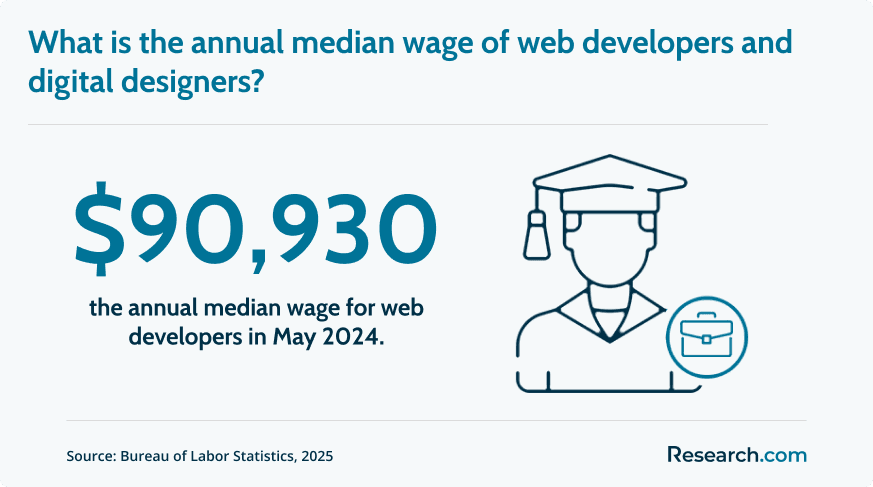
- You can expect strong earning potential, with web developers earning a median annual salary of around $90,930.
- The online format gives you the flexibility to learn from anywhere while building the real-world remote collaboration skills that employers now expect.
What can I expect from an online web development program?
You can expect a structured curriculum that carefully balances foundational knowledge with the practical, hands-on skills employers want right now. These programs are designed to build your abilities from the ground up, so you don't need to be a coding expert before you start.
Forget the idea of learning in isolation. Modern online programs are built around interaction and collaboration. You’ll work on team projects in virtual labs, building real-world applications and getting feedback from instructors and peers. This approach doesn't just teach you to code; it teaches you how to work effectively on a development team, a critical skill for your first job.
Where can I work with an online web development degree?
With this degree, you can work in virtually any industry you can think of. While the big tech companies are always an option, the largest and most stable demand for developers now comes from established sectors like finance, healthcare, manufacturing, and retail.
Every modern company is a tech company in some way. They all need websites, applications, and internal systems to function. This "digital transformation" across the entire economy means that your skills are in high demand everywhere. Pursuing one of the available online web development degree programs opens doors to a vast and varied job market, giving you incredible career flexibility.
How much can I make with an online web development degree?
You can expect to be well-compensated for your skills. The median annual wage for web developers is approximately $90,930, which is a fantastic starting point for a career in tech.
Think of this as the baseline. A bachelor's degree provides you with the deep foundational knowledge that is essential for moving into senior roles, specialization, and leadership positions over time. This creates a much higher long-term earning ceiling compared to more tactical, short-term training paths.
- List of the Best Online Web Development Programs for 2027 List of Programs
- How long does it take to complete an online web development degree program? Completion Time
- How does an online web development degree program compare to an on-campus program? How does an online web development degree program compare to an on-campus program?
- What is the average cost of an online web development degree program? Program Cost
- What are the financial aid options for students enrolling in an online web development degree program? Financial Aid
- What are the prerequisites for enrolling in an online web development degree program? What are the prerequisites for enrolling in an online web development degree program?
- What courses are typically in an online web development degree program? What courses are typically in an online web development degree program?
- What types of specializations are available in an online web development degree program? Specializations
- How to Choose the Best Online Web Development Degree Program How to Choose the Best Online Web Development Degree Program
- What career paths are available for graduates of an online web development degree program? Career Paths
- What is the job market for graduates with an online web development degree program? Job Market
List of the Best Online Web Development Programs for 2027
How do we rank the programs?
Recognizing that paying for a bachelor's degree is a significant investment, our ranking methodology ensures that students can make informed decisions based on comprehensive and transparent information. The ranking draws upon reliable sources such as the IPEDS database, Peterson's database, the College Scorecard database, and The National Center for Education Statistics.
These sources provide a robust foundation of data to evaluate and rank best online web development programs. For more details on our methodology, please visit Research.com's methodology page.
1. Arizona State University - Bachelor of Applied Science in Internet and Web Development
ASU's program focuses on the core principles of effective web design, teaching students how to create deeper audience connections and manage an organization's web presence. The curriculum builds on existing design knowledge while introducing advanced concepts in web markup, scripting, and e-commerce strategies.
- Program Length: 4 years
- Required Credits to Graduate: 120 credits
- Cost per Credit: $394.07 (in-state); $464 (out-of-state)
- Accreditation: Higher Learning Commission (HLC)
2. Liberty University - B.S. in Information Technology – Web & Mobile Programming
Liberty University prepares students to develop high-quality websites and applications that function seamlessly across mobile, tablet, and desktop browsers. The program blends information technology with business practices, providing hands-on training in database management, web architecture, and mobile programming languages.
- Program Length: 4 years
- Required Credits to Graduate: 120 credits
- Cost per Credit: $390
- Accreditation: Southern Association of Colleges and Schools Commission on Colleges (SACSCOC)
3. Franklin University - B.S. in Web Development
This interdisciplinary program equips students with skills in web development, marketing, and graphic design to manage robust e-commerce systems. Franklin's curriculum focuses on the technologies needed for enterprise-level websites, covering Java software development, client/server programming, and web applications development.
- Program Length: 4 years
- Required Credits to Graduate: 120 credits
- Cost per Credit: $398
- Accreditation: Higher Learning Commission (HLC)
4. Champlain College - B.S. in Web Design & Development
Champlain College offers an integrated approach that marries creative design with back-end programming, preparing students to launch or advance their careers. The curriculum builds technical proficiency in over 30 applications and languages while developing essential soft skills like problem-solving and communication.
- Program Length: 4 years
- Required Credits to Graduate: 120 credits
- Cost per Credit: $335
- Accreditation: New England Commission of Higher Education (NECHE)
5. University of Maryland Global Campus - B.S. in Web & Digital Design
The program at University of Maryland provides a broad knowledge base in web design, graphic design, and emerging technologies like augmented and virtual reality. Students can tailor their degree to a specific career path by choosing a focus area, ensuring their skills are aligned with current industry demands.
- Program Length: 4 years
- Required Credits to Graduate: 120 credits
- Cost per Credit: $330 (in-state); $499 (out-of-state)
- Accreditation: Middle States Commission on Higher Education (MSCHE)
6. Full Sail University - B.S. in Web Development
Full Sail University provides focused knowledge for deploying modern websites and web applications using industry-standard tools and languages. The accelerated program is designed to immerse students in modern web stacks, covering both client-side and server-side development, databases, and cloud application development.
- Program Length: ~3 years
- Required Courses to Graduate: 26 courses
- Total Tuition: $67,000
- Accreditation: Accrediting Commission of Career Schools and Colleges (ACCSC)
7. Bellevue University - B.S. in Web Development
Designed by developers for developers, Bellevue's program provides a full-stack experience, from front-end design to back-end scripting and databases. The curriculum culminates in an immersive boot camp course where students deliver a project, preparing them for the collaborative demands of the workplace.
- Program Length: 4 years
- Required Credits to Graduate: 127 credits
- Cost per Credit: $449
- Accreditation: Higher Learning Commission (HLC)
8. ECPI University - B.S. in Information Technology with a track in User Experience and Web/Mobile Development
ECPI's accelerated program prepares students to create engaging, user-centric applications by combining user experience (UX) design with software development. The curriculum focuses on understanding user needs and behavior while teaching the technical skills needed to build and secure web and mobile applications.
- Program Length: ~2.5 years
- Required Credits to Graduate: 120 credits
- Total Tuition: $43,560
- Accreditation: Southern Association of Colleges and Schools Commission on Colleges (SACSCOC)
How long does it take to complete an online web development degree program?
A bachelor's degree in web development is designed as a four-year program for most full-time students. If you have existing college credits from a community college or another university, you may be able to transfer them and accelerate your timeline. Programs offered by some of the cheapest online open admission colleges can make this path even more accessible and affordable for students looking to complete their degree without significant financial burden.
While that might sound like a long time compared to shorter options, it’s a major strategic advantage. This timeframe gives you the space to secure one or two summer internships or even a co-op experience. That professional, real-world experience is what makes your resume stand out and leads to much stronger job offers upon graduation.
The Industry Standard for a Reason
You should also know that this four-year path is what the industry expects. It’s the established standard for preparing for a durable, long-term career. The vast majority of professional developers have a bachelor's degree, which shows employers a deep level of commitment and foundational knowledge.
How does an online web development degree program compare to an on-campus program?
Employers see no difference between an accredited online degree and an on-campus one. The diploma is the same, and the quality of education is equivalent. The primary difference is the delivery method. Online programs offer far more flexibility to balance your studies with work or family commitments, and they help you master the remote collaboration skills that are now standard in the tech industry.
Similarly, some online dental assistant schools with financial assistance provide comparable flexibility and support, making education more accessible to working students.
Degrees vs. Bootcamps: A Strategic Comparison
The more important question is how a degree compares to a bootcamp. The clearest way to think about it is this: a degree is a long-term investment in your entire career, while a bootcamp is a short-term tactic to learn a specific skill. While there are many excellent and fast-paced options, including the fastest online IT training bootcamps, they serve a different purpose.
Think of it like building a house. A four-year degree gives you the deep, solid foundation—the engineering principles, critical thinking, and architectural knowledge to build anything and adapt to any changes for the next 30 years. A bootcamp is like a quick, targeted renovation on a single room. It’s useful, but it can’t replace the underlying structure.
What is the average cost of an online web development degree program?
While costs for online programs can vary significantly, the most important number to focus on is your potential Return on Investment (ROI). A degree is an investment in your future earning power, and it's one that pays off very well in the tech field. Programs like RN to BSN online no statistics follow a similar pattern, where understanding tuition ranges and financial planning is key to maximizing ROI.
Here’s a general look at what you can expect for tuition, keeping in mind that the net price after financial aid is what you'll actually pay:
- In-State Public University: Typically ranges from $300 to $700 per credit hour.
- Out-of-State Public University: Can range from $800 to $1,300 per credit hour.
- Private University: Often ranges from $1,200 to $1,800 per credit hour.
- Total Program Cost: A full 120-credit degree can range from $36,000 to over $100,000 before aid.
When you consider the high median salary for this role, the ROI becomes very clear. The initial investment provides access to a stable, high-paying career with significant long-term growth. Students can also explore web development courses for students to strengthen their skills and build a competitive edge.
What are the financial aid options for students enrolling in an online web development degree program?
One of the biggest advantages of choosing an accredited degree program is that it makes you eligible for federal financial aid. This is a key differentiator from most bootcamps and unaccredited programs. You have a full range of options to help fund your education. Students in programs like online master’s in social work that accept low GPA also benefit from similar financial aid opportunities, making higher education more accessible.
Here are the primary sources of aid you should explore:
- Federal Grants: These are typically need-based and do not have to be repaid. The Pell Grant is the most common example.
- Federal Student Loans: These government-backed loans offer fixed interest rates and flexible repayment options. They come in two forms: Subsidized (interest is paid by the government while you're in school) and Unsubsidized.
- Institutional Scholarships: These are offered directly by the university. They can be based on academic merit, financial need, or other specific criteria.
- Private Loans: These are offered by banks and other financial institutions. They can help bridge the gap but should be considered after you've exhausted federal options.
Always start by filling out the Free Application for Federal Student Aid (FAFSA), which is the universal key to unlocking these options.
What are the prerequisites for enrolling in an online web development degree program?
The entry requirements for most online web development degree programs are straightforward and designed to be accessible. The primary prerequisite is a high school diploma or an equivalent credential like a GED.
Most programs will also look for a solid GPA, typically in the 2.75 to 3.0 range on a 4.0 scale. Some may also require specific high school coursework in mathematics, such as algebra and geometry, to ensure you're prepared for the logical thinking involved in programming.
Building a Strong Foundational Skillset
Here’s some advice: don't think you need to be a coding genius to apply. These programs are designed to teach you everything from the ground up. What admissions teams really want to see is a strong drive to learn and a genuine passion for solving problems. That’s a far better indicator of success than prior coding experience.
If you do want to build your confidence and get a head start, you could explore foundational certifications. For example, a credential like the fast-track CompTIA network+ training certification online can give you a great introduction to the core principles of how the internet works.
What courses are typically in an online web development degree program?
A strong web development curriculum is designed to make you a "T-shaped" professional: you get a broad understanding of the entire tech ecosystem, plus deep, practical skills in specific areas. You'll see a mix of foundational theory and hands-on, project-based courses.
Here’s a sample of what you can expect to see:
- Information Infrastructure: This covers the fundamentals of computer networks, protocols, and the hardware that makes the internet work.
- Information Design and Usability: You'll learn the principles of creating intuitive, user-friendly interfaces and experiences (UI/UX).
- Enterprise JavaScript: This goes beyond basic scripting to teach you how to build complex, large-scale applications with modern frameworks.
- DevOps: You’ll learn about the tools and processes for automating software development and deployment, a highly in-demand skill. Many programs even touch on cloud platforms, for which you can later pursue specialized credentials like the fastest online Microsoft Azure dual certification bootcamps.
- Multi-Device Web Development: With over 60% of web traffic now coming from mobile devices, this course teaches you how to build responsive websites that work flawlessly on any screen size.
What types of specializations are available in an online web development degree program?
Most programs offer specializations that allow you to focus your studies on a specific area of web development that aligns with your career goals. This is a great way to build deep expertise and stand out in the job market.
Common specialization tracks include:
- Front-End Development: Focusing on the user-facing parts of a website—what people see and interact with.
- Back-End Development: Concentrating on the server, database, and application logic that powers the website from behind the scenes.
- Full-Stack Development: A comprehensive track that covers both front-end and back-end development.
- UI/UX Design: A specialization that blends design principles with user research to create highly effective and intuitive digital experiences.
High-Paying Industries to Consider
Choosing a specialization is a strategic move that can directly impact your earning potential. Certain industries pay a premium for developers with specific, deep knowledge. For instance, a back-end specialization with a focus on security is highly valued in the finance sector. To build that kind of expertise, you might even supplement your degree with advanced credentials like an accelerated CCNA certification training online.
As you can see in the chart below, industries like information services and finance offer some of the highest salaries for developers, making them excellent targets for your career path.
How to Choose the Best Online Web Development Degree Program
Choosing the right program isn't about finding the fanciest name or the top-ranked school. It's about identifying the key signals of quality that employers recognize and that will lead to a successful career.
Focus your evaluation on these three core pillars. If a program is strong in all three areas, you can be confident you're making a great choice for your future.
- Check for Accreditation. This is the single most important factor. Regional accreditation ensures the program meets rigorous academic standards, that your credits will transfer, and that you'll be eligible for federal financial aid. It is a non-negotiable mark of legitimacy.
- Analyze the Curriculum. Look for a healthy balance between foundational computer science theory and hands-on work with modern, in-demand technologies. A great curriculum builds resilient problem-solvers, not just coders who know a single framework.
- Investigate Portfolio Opportunities. Your portfolio of projects is the proof of your skills. The best online web development degree programs have project-based courses, a final capstone project, and strong career services that help you find internships to build a professional-grade portfolio before you even graduate.
What career paths are available for graduates of an online web development degree program?
A degree in web development is a versatile credential that serves as a direct launchpad into a variety of high-demand, entry-level tech roles. You will be qualified to pursue several distinct and rewarding career paths right after graduation.
Here are some of the most common job titles graduates pursue:
- Web Developer. Build and maintain websites and web applications for businesses in every industry.
- Front-End Developer. Specialize in creating the visual elements and interactive features of a website that users see and engage with.
- Junior Full-Stack Developer. Work on both the front-end (client-side) and back-end (server-side) of web applications.
- UI/UX Designer. Focus on designing the overall look, feel, and usability of a website to ensure a seamless and intuitive user experience. This is a rapidly growing field, and many supplement their degree with specialized training from the fastest UX design bootcamps online.
- Computer Programmer. Write and test the code that allows computer applications and software programs to function properly.
Geographic Hotspots for Developers
While the growth of remote work has opened up opportunities everywhere, certain states offer significantly higher average salaries for developers. If you're looking to maximize your earning potential, focusing your job search on these geographic hubs can be a smart strategic move, as shown in the data below.
What is the job market for graduates with an online web development degree program?
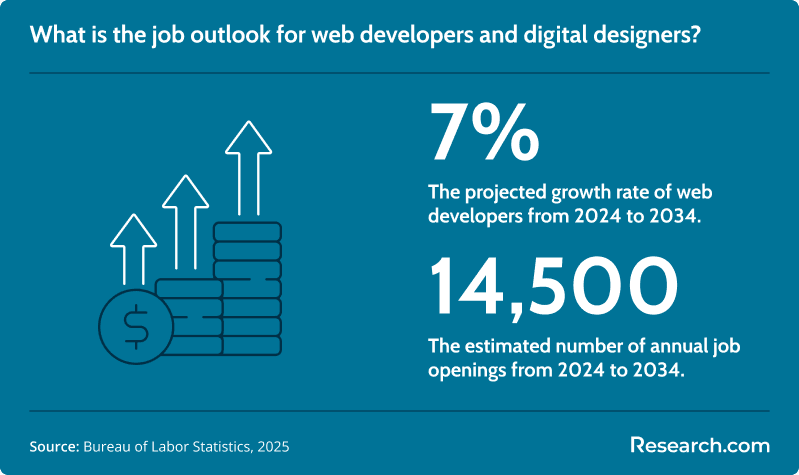
The job market for web developers is strong, stable, and growing. The U.S. Bureau of Labor Statistics projects that employment for web developers and digital designers will grow 7% over the next decade, which is faster than the average for all occupations.
This translates to roughly 14,500 job openings each year, on average, as new positions are created and others need to be filled.
A Strong and Stable Outlook
It's important not to confuse headlines about layoffs at a few massive tech companies with the overall health of the job market. The reality is that the foundational demand for skilled developers across the entire economy—in finance, healthcare, retail, and manufacturing—remains incredibly robust.
The broader field for all software developers is projected to grow even faster at 18%, indicating a healthy and expanding ecosystem for tech talent. Choosing to earn a degree in this field means you are preparing for a career with excellent long-term stability and a clear runway for growth.
Here’s What Graduates Have to Say about Their Web Development Management Program
- Leo: "I was worried a degree would be all theory, but my classes were built around projects that became my professional portfolio. I actually showed my capstone project during my final interview, and they were incredibly impressed with the scope of it. The online format forced me to become a better project manager, which is a skill I use every single day at my new job as a front-end developer."
- Celia: "As a parent, I was concerned that learning online would feel isolating, but it was the complete opposite. I was constantly working on group projects with classmates from all over the country, collaborating through video calls and chat. We built a really strong support system for each other, and I made connections that I know will last throughout my career."
- Austin: "I always thought of myself as more of a creative person, so I was a bit intimidated by the technical side of web development. I was so relieved to discover the UI/UX specialization, which felt like the perfect blend of art, psychology, and technology. The program showed me that building for the web is as much about understanding people as it is about writing code."
Key Findings
- A bachelor's degree is the established industry standard for a long-term career in web development, with over 71% of professional developers holding this credential.
- The financial return on investment for a web development degree is significant, as graduates enter a field where the median annual salary is approximately $90,930.
- The job market is strong and stable, with a projected 7% growth rate over the next decade creating an average of 14,500 job openings for developers each year.
- Degree curriculums are highly relevant to modern industry demands, with courses on multi-device development directly addressing the fact that over 60% of web traffic now comes from mobile devices.
- Specializing within a degree program prepares graduates for the most lucrative career paths, such as roles in the information services sector where the median annual wage can exceed $140,000.
- The fundamental need for web development expertise is constantly growing, with an estimated 252,000 new websites created every day, ensuring a durable demand for skilled professionals.
References:
- Clutch.co. (n.d.). Web development stats. Retrieved September 16, 2025, from https://clutch.co/resources/web-development-stats
- Digital Silk. (n.d.). Web development statistics. Retrieved September 16, 2025, from https://www.digitalsilk.com/digital-trends/web-development-statistics/
- National Center for Education Statistics. (n.d.). Graduate degree fields. Condition of Education. Retrieved September 16, 2025, from https://nces.ed.gov/programs/coe/indicator/ctb/graduate-degree-fields
- Skillsoft. (2024). IT skills & salary report 2024. Retrieved September 16, 2025, from https://cdn.bfldr.com/SDYPVW60/at/vfhxpgf7bh3qnc8bhnj9wk7/Skillsoft_IT_Skills_Salary_Report_2024.pdf
- U.S. Bureau of Labor Statistics. (n.d.-a). Computer and information technology occupations. Occupational Outlook Handbook. Retrieved September 16, 2025, from https://www.bls.gov/ooh/computer-and-information-technology/
- U.S. Bureau of Labor Statistics. (n.d.-b). Occupational employment and wage statistics. Retrieved September 16, 2025, from https://data.bls.gov/oesprofile/
- U.S. Bureau of Labor Statistics. (n.d.-c). Web developers and digital designers. Occupational Outlook Handbook. Retrieved September 16, 2025, from https://www.bls.gov/ooh/computer-and-information-technology/web-developers.htm
- World Economic Forum. (2025). The future of jobs report 2025. Retrieved September 16, 2025, from https://reports.weforum.org/docs/WEF_Future_of_Jobs_Report_2025.pdf
- Zippia. (n.d.). Web developer jobs. Retrieved September 16, 2025, from https://www.zippia.com/web-developer-jobs/
Other Things You Should Know About Online Web Development Degree Programs
Key factors to consider include the program's curriculum relevance, industry expertise of instructors, access to up-to-date tools and technologies, flexibility, cost, and career support services. Review alumni outcomes and program accreditation to ensure the program aligns with your career goals.
You can build an impressive portfolio by treating every class project as a potential showcase piece. Focus especially on your final capstone project, which allows you to build a complete application from start to finish. You should also actively seek out internship opportunities through your university's career services. Be sure to host your work on a platform like GitHub so you have a professional, shareable link for your resume and job applications.
In 2027, some of the top online web development programs include those offered by Stanford University, Coursera in collaboration with top institutions, and Udacity's Nanodegree programs. These programs provide comprehensive curricula focusing on modern web technologies and development practices.
For online web development programs in 2027, a bachelor's degree or equivalent experience is typically sufficient. While a master's degree can deepen your expertise, most employers prioritize practical skills and real-world projects over advanced academic credentials. Focus on building a strong portfolio to showcase your capabilities.


