
2027 Mergers & Acquisitions Accounting Concentration: Benefits, Courses & Careers

Co-Founder and Chief Data Scientist
Corporate finance is a complex world, and you need a solid grasp of specialized accounting principles to succeed. Mergers and acquisitions (M&A) accounting is a specialized field that focuses on the financial reporting and integration that occurs when companies merge or are acquired.
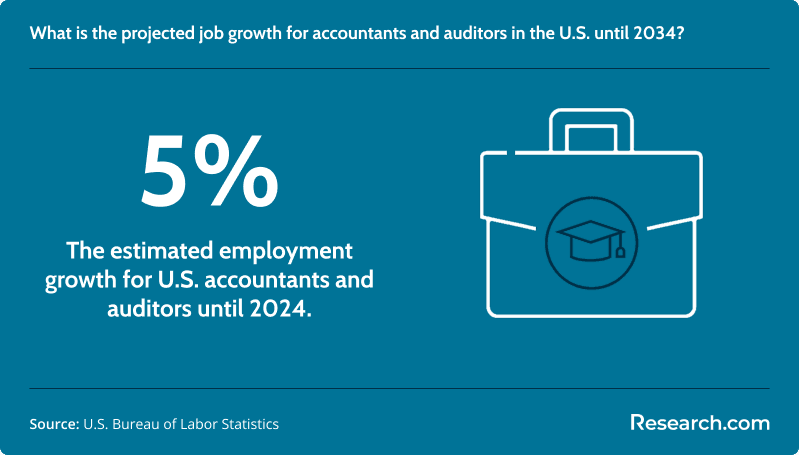
Due to a projected 5% growth in jobs for accountants and auditors until 2034, expertise in M&A accounting can lead to significant career opportunities within corporate finance. With more than ten years of experience in career planning, our team at Research.com created this guide to simplify M&A accounting for you. This article will show you the benefits of focusing on this area, the classes you need to take, and the exciting career paths you can follow.
Key Things You Should Know About Mergers & Acquisitions Accounting Concentration
- M&A accounting is a specialized field that focuses on the detailed financial reporting and integration of acquired companies at fair market value, whereas corporate finance is a broader discipline encompassing a company's overall financial strategy and management.
- Accountants and auditors held approximately 1.6 million jobs in 2024, primarily in accounting, finance, and corporate management.
- A career in M&A accounting typically requires a bachelor's degree in accounting, with advanced degrees and certifications being valuable, and a strong foundation in skills like financial modeling and valuation, aligning with the projected 5% job growth for accountants and auditors between 2024 and 2034.
- What is mergers and acquisitions accounting, and how does it differ from corporate finance? M&A Accounting
- Where do M&A accountants work? Top Industries
- What degrees do you need to get a job in mergers and acquisitions accounting? Required Education
- What are the best undergraduate courses for a career in M&A accounting? Undergrad Courses
- Is an MBA or a Master's in Accounting required for an M&A career? MBA & Master's
- How important are internships for students seeking M&A accounting experience? Internships
- What technical skills do you need for a job in M&A accounting? Technical Skills
- What are the different job titles for a professional in M&A accounting? Careers
- What is the average salary for an M&A accounting professional? Average Salary
- What are the long-term career benefits of M&A accounting experience? What are the long-term career benefits of M&A accounting experience?
- What are the ethical considerations in modern M&A accounting? What are the ethical considerations in modern M&A accounting?
What is mergers and acquisitions accounting, and how does it differ from corporate finance?
Mergers and acquisitions (M&A) accounting is the set of formal guidelines and practices for how the acquiring company reports the assets, liabilities, non-controlling interests, and goodwill of the acquired company on its consolidated financial statements. It involves measuring all these elements at their fair market value at the acquisition date, which is when control of the target company is obtained.
Just as understanding factors that influence MD MPH salary is important for evaluating the value of advanced professional training, mastering M&A accounting requires a clear grasp of how different financial components are recognized, measured, and reported.
This process includes adjustments for tangible and intangible assets, liabilities, consideration paid (cash, stock, earnouts), and the calculation of goodwill if the purchase price exceeds the fair value of identifiable assets acquired.
Acquisition accounting aims to provide transparent, market-value-based reporting of business combinations, rather than historical cost accounting alone.
Corporate finance, by contrast, is a broader field encompassing the management of a company’s capital structure, financing decisions, investment appraisals, and financial strategy. It focuses on how companies raise funds (equity, debt), allocate capital to projects, manage risk, and maximize shareholder value over time.
While mergers and acquisitions accounting deals specifically with the accounting treatment and financial reporting of business combination transactions, corporate finance covers a wide array of corporate financial activities, including but not limited to mergers and acquisitions.
Transitioning from the technical differences between M&A accounting and corporate finance, it's worth exploring the educational backgrounds that prepare professionals for these roles. When considering a career in this field, it's important to understand the things to consider before obtaining an accounting degree, such as the specific skill sets and career paths available.
Where do M&A accountants work?
M&A accounting is a highly specialized field, and the professionals who perform these tasks are typically found in specific sectors of the industry. Of the approximately 1.6 million jobs held by accountants and auditors in 2024, M&A accountants fall into several key employer categories.
Understanding the qualifications needed for specialized roles—whether it’s medical billing and coding certification requirements or advanced credentials in finance—helps highlight how targeted training and certification shape career opportunities.
- Accounting, tax preparation, bookkeeping, and payroll services (23%): These professionals are often employed by large accounting and advisory firms that provide M&A services to their clients.
- Finance and insurance (8%): This category includes investment banks, private equity firms, and corporate finance departments. M&A accountants in these roles work directly on the buy-side or sell-side of deals, providing in-house expertise.
- Management of companies and enterprises (6%): This represents in-house corporate development or strategic finance roles. Accountants in this sector manage a company's internal M&A activities, from identifying potential targets to overseeing the integration process.
Understanding the practical steps and where M&A accountants work is essential, but it’s just one part of the picture; exploring the educational backgrounds of these professionals provides crucial context on the skills and qualifications needed to enter this demanding field.
The chart below shows the most common accounting staff degrees:
What degrees do you need to get a job in mergers and acquisitions accounting?
To get a job in mergers and acquisitions accounting, the key degree requirements are typically:
- A bachelor's degree in accounting is generally the minimum requirement. Coursework in accounting principles, cost accounting, business finance, and statistics forms the foundation for M&A accounting roles.
- Specialized graduate certificates in mergers and acquisitions are also available and valuable. These certificates focus on valuation, financial modeling, capital structure, and financial statement analysis specifically for M&A deals.
- Certifications such as the Certified Merger and Acquisition Advisor (CM&AA) designation can further demonstrate expertise and knowledge in the mergers and acquisitions accounting field.
Similar to how professionals explore MBA MHA careers to combine business and healthcare management expertise, pursuing the right degrees and certifications in M&A accounting equips candidates with the specialized skills needed to succeed in complex financial transactions.
Beyond educational requirements, it's also important to consider the overall job outlook for accountants and auditors, as projected employment growth can significantly impact your career path in M&A.
This is a crucial part of the process, much like understanding the shortest online bachelor's degree in entrepreneurship can help you jumpstart a career in that field.
What are the best undergraduate courses for a career in M&A accounting?
The best undergraduate courses for a career in mergers and acquisitions accounting typically include:
- Accounting: Fundamental courses in financial and managerial accounting provide core principles essential for understanding financial statements and transaction impacts in M&A.
- Corporate Finance: Courses covering capital structure, valuation, financing methods, and investment analysis lay the groundwork for deal structuring.
- Financial Modeling and Analysis: Classes that teach building financial models, forecasting, and valuation techniques are highly relevant.
- Business Strategy: Strategy courses help understand the rationale behind mergers and acquisitions and assess the strategic fit of deals.
- Economics: Microeconomics and industrial organization provide insight into market dynamics that affect M&A decisions.
- Statistics or Quantitative Methods: Analytical skills to interpret data and conduct due diligence analysis.
- Legal Aspects of Business: Exposure to corporate law, contract law, and regulations related to M&A transactions is useful.
Just as understanding factors like Med Surg nursing salary helps nurses and administrators evaluate career options and growth potential, selecting the right undergraduate courses in accounting, finance, and strategy equips aspiring M&A accountants with the skills needed to succeed in high-demand financial roles.
Is an MBA or a Master's in Accounting required for an M&A career?
An MBA is not strictly required for a career in mergers and acquisitions accounting, nor is a Master’s in Accounting mandatory, but both advanced degrees can significantly enhance career prospects and opportunities in the field.
MBA for an M&A accounting career
An MBA, especially with an accounting or finance concentration, provides broad business knowledge, including leadership, strategy, marketing, and operations management. It prepares professionals for managerial, strategic, and cross-functional roles in M&A, helping them become well-rounded business leaders.
An MBA also tends to require prior work experience and is suited for those aiming for senior roles beyond purely technical accounting functions.
Master’s in Accounting for an M&A accounting career
A Master’s in Accounting offers deep, specialized accounting knowledge covering advanced accounting principles, auditing, taxation, and financial reporting, all essential for the detailed technical work in M&A accounting.
This advanced degree is particularly valuable for those seeking CPA certification and roles that emphasize accounting expertise. This degree is more focused on the technical accounting side rather than broad business management.
Regardless of the degree, gaining advanced knowledge in business is key. This is true whether you're looking for an advanced degree in a field like M&A accounting or exploring options like the shortest MBA programs in marketing online to advance your career.
How important are internships for students seeking M&A accounting experience?
Internships are extremely important for students seeking experience in mergers and acquisitions. They offer more than just a résumé line; internships provide formative, hands-on exposure to the complex financial, strategic, and legal aspects of M&A transactions, making them critical stepping stones for future careers in this competitive field.
During an M&A internship, students gain essential skills such as financial modeling, due diligence, market research, and preparation of transaction documents. They also build professional relationships, learn industry jargon, and understand how deals unfold day-to-day.
Employers highly value candidates with internship experience because it demonstrates practical knowledge and commitment to the M&A field.
Moreover, the ability to effectively communicate and present the value of the internship experience can differentiate candidates with similar academic backgrounds. Internships provide networking opportunities, insights into corporate culture, and sometimes pathways to full-time offers, making them invaluable for launching successful M&A careers.
This emphasis on hands-on experience is a key part of many career paths, just as finding the best online sports management bachelor's degree can often hinge on programs that offer practical training.
What technical skills do you need for a job in M&A accounting?
Mergers and acquisitions (M&A) accounting requires more than a general understanding of finance; it demands a sharp set of technical skills tailored to complex transactions. Professionals in this field must be able to analyze financial statements, navigate valuation models, and apply regulatory standards with precision.
Developing the following abilities is essential for ensuring accurate reporting, successful deal execution, and long-term business growth.
- Financial Modeling: The ability to build detailed financial models to evaluate the financial impact of deals, forecast outcomes, and analyze profitability and shareholder value.
- Valuation Techniques: Proficiency in various valuation methods such as discounted cash flow (DCF), market comparables, and asset-based approaches to accurately assess company or asset values.
- Accounting Expertise: Deep understanding of accounting principles, financial statement analysis, fair value measurement, goodwill calculation, and consolidation rules specific to M&A transactions.
- Corporate Law Awareness: Knowledge of legal frameworks, contractual terms, regulatory compliance, and due diligence processes involved in M&A to ensure lawful structuring and risk management.
- Business Acumen: Strong comprehension of business strategy, industry dynamics, risk assessment, and financial complexities to support strategic decision-making and deal negotiation.
- Technical Tool Proficiency: Advanced skills in Excel, financial analysis software, and familiarity with data room management platforms are often required.
What are the different job titles for a professional in M&A accounting?
Careers in mergers and acquisitions accounting span a wide range of job titles, each reflecting different levels of responsibility and expertise. From entry-level analysts to senior managers and directors, professionals in this field play vital roles in evaluating deals, ensuring compliance, and guiding strategic decisions.
- Mergers & Acquisitions Accountant: Handles financial reporting, due diligence, and consolidation activities related to M&A transactions, ensuring compliance with accounting standards.
- M&A Analyst: Supports deal evaluation through financial modeling, market research, and analysis to aid decision-making in mergers and acquisitions.
- M&A Associate: Manages transaction execution processes, coordinates between teams, and assists in financial analysis and due diligence.
- Acquisition Specialist: Focuses on identifying, evaluating, and facilitating acquisition opportunities, often involving deal structuring and negotiation support.
- Manager of M&A Accounting: Oversees the accounting team’s activities in M&A transactions, ensuring accurate financial integration, compliance, and reporting post-acquisition.
What is the average salary for an M&A accounting professional?
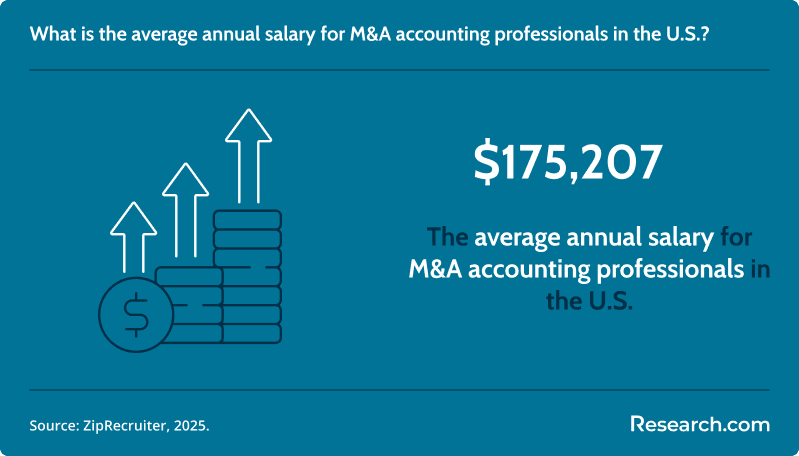
The average salary for an M&A accounting professional in the United States is approximately $175,207 per year, making it one of the more lucrative specialties in the accounting and finance sector.
Professionals who bring years of experience, advanced certifications, or who hold senior-level positions often see their compensation climb much higher, with top earners making upwards of $294,500 annually.
Salaries can also vary depending on factors such as the size of the firm, the complexity of the deals being managed, and the geographic market, with major financial hubs like New York, San Francisco, and Chicago offering higher pay to remain competitive.
While understanding the earning potential is important, it is equally valuable to examine how these figures break down across different roles, levels of expertise, and industries where M&A professionals are in high demand.
The compensation for M&A accounting professionals also reflects the demanding and specialized nature of the work. Employers are willing to pay a premium for individuals who can navigate high-stakes mergers and acquisitions while minimizing risk and ensuring compliance with regulatory requirements.
Bonuses and performance-based incentives are also common, often tied to the successful completion of deals, which can significantly increase overall earnings.
Here is a more detailed look at the typical compensation for M&A accounting professionals in 2027 across different pay periods.
What are the long-term career benefits of M&A experience?
The long-term career benefits of M&A experience extend far beyond immediate financial rewards. One of the most significant advantages is the expanded career opportunities it creates.
Professionals with M&A expertise often find themselves in demand at larger, more diversified organizations, where they can pursue new roles that range from corporate strategy and finance to operations and executive leadership.
Another key benefit lies in the networking opportunities that come with M&A work. Collaboration with senior executives, board members, investors, and advisors allow professionals in this field to develop relationships with influential decision-makers and open doors to future career opportunities, mentorship, and even entrepreneurial ventures.
M&A experience also provides a unique platform for skill development. By working on high-stakes transactions, professionals gain exposure to critical areas such as financial modeling, valuation, due diligence, and negotiation.
The nature of M&A deals—often fast-paced, complex, and high-pressure— also helps professionals cultivate resilience, adaptability, and advanced project management skills.
Successfully navigating M&A challenges demonstrates a level of competence and leadership that stands out across industries. Collectively, these benefits support accelerated career growth, leadership development, and access to a wide range of high-level corporate roles, including those in finance, consulting, and even real estate jobs.
What are the ethical considerations in modern M&A accounting?
The ethical considerations in modern mergers and acquisitions accounting focus on ensuring transparency, fairness, and integrity throughout the transaction process. Key points include:
- Transparency and Full Disclosure: Companies must openly communicate all material information, risks, and potential impacts to stakeholders, avoiding misinformation or withholding critical details.
- Fair Treatment of Stakeholders: Ethical M&A accounting balances the interests of shareholders, employees, customers, and communities, addressing impacts such as job security and cultural integration responsibly.
- Conflict of Interest Management: Identifying and disclosing potential conflicts to prevent bias or insider trading is crucial to maintain trust and legal compliance.
- Compliance with Legal and Regulatory Standards: Adherence to antitrust laws, financial reporting standards, and confidentiality requirements safeguards corporate integrity and market fairness.
- Corporate Social Responsibility: Ethical M&A accounting includes assessing broader social and environmental effects, ensuring decisions contribute to sustainable and responsible business practices.
Here's what mergers & acquisitions professionals have to say about their career:
- Colleen: "Studying mergers and acquisitions gave me the confidence to handle complex negotiations and financial modeling with ease. The hands-on exposure to real-world case studies prepared me for the fast-paced nature of deal-making, and now I thrive in a career where no two days are ever the same."
- Josephine: "What I value most about my M&A experience is the way it opened doors to senior leaders and decision-makers across industries. The networking opportunities and practical skills I gained have accelerated my career trajectory far faster than I ever expected."
- Joanne: "M&A work is challenging, but it taught me resilience, adaptability, and the importance of seeing the big picture in every transaction. Today, I enjoy a career that constantly pushes me to grow while making a real impact on the future of companies and industries."
Key Findings
- The number of jobs for accountants and auditors is projected to grow by 5% between 2024 and 2034.
- Accountants and auditors held approximately 1.6 million jobs in 2024.
- About 23% of accountants and auditors work in accounting, tax preparation, bookkeeping, and payroll services, making it the largest employer.
- Government and finance/insurance sectors are the second-largest employers of accountants and auditors, each accounting for 8% of jobs.
- The average salary for a mergers and acquisitions (M&A) accounting professional is approximately $175,207 per year.
References:
- Accountants and auditors. (2025, August 28). U.S. Bureau of Labor Statistics. Retrieved September 18, 2025, from https://www.bls.gov/ooh/business-and-financial/accountants-and-auditors.htm
- Hayes, A. (2025, May 31). Mergers and Acquisitions (M&A): Types, Structures, and Valuations. Investopedia. https://www.investopedia.com/terms/m/mergersandacquisitions.asp
- How to become an Accounting staff: What it is and career path - Zippia. (2025, January 8). https://www.zippia.com/accounting-staff-jobs
- Mergers Acquisitions Salary. (2025). ZipRecruiter. Retrieved September 18, 2025, from https://www.ziprecruiter.com/Salaries/Mergers-Acquisitions-Salary#TableView
Other Things You Should Know About Mergers & Acquisitions Accounting Concentration
In 2027, a typical Mergers & Acquisitions Accounting Concentration will include courses such as Advanced Financial Statement Analysis, Valuation Techniques, M&A Strategy, Legal Aspects of M&A, and Integration & Change Management. These courses equip students with crucial financial and strategic skills necessary for M&A roles.
Yes, online M&A accounting concentrations are widely respected by employers, particularly when they are offered by an accredited and reputable university. The value of the degree is increasingly tied to the institution's brand and the rigor of the curriculum, rather than whether it was completed in a physical classroom.
Many professionals who pursue these degrees are already working in the field, which means they can immediately apply what they learn and bring valuable, practical experience to the table.
M&A accountants today face significant challenges in a dynamic financial landscape. A primary hurdle is navigating complex regulatory environments and reconciling disparate accounting standards from different countries. They also struggle with technological and data integration, as merging two companies often means consolidating fragmented and incompatible financial systems.
Furthermore, a major challenge lies in conducting meticulous due diligence to accurately value a target company and uncover hidden liabilities that could jeopardize the entire deal, all under immense time pressure.


