
2027 What Degree Do You Need To Be a Social Worker: Education Requirements in Maine

Co-Founder and Chief Data Scientist
Maine’s workforce is expected to reflect a growing need for social workers, with projected employment reaching 970 by 2032. Maine, being a mix of coastal cities, small towns, and rural communities, creates diverse social challenges, from limited healthcare access in remote areas to rising demands in child welfare and mental health services. These dynamics highlight the critical role social workers play across the state.
In this article, I will explain the education requirements for becoming a social worker in Maine, from bachelor’s degrees to advanced licensure. I will also cover the academic pathways, licensing steps, and career opportunities within the state.
Key Things to Know About Social Work Education Requirements in Maine
- In Maine, a Bachelor of Social Work (BSW) is the minimum degree, preparing graduates for entry-level roles that impact local communities.
- For clinical licensure and advanced practice, Maine requires a Master of Social Work (MSW), ensuring professionals have the skills for specialized care.
- Continuing education and supervised experience are mandatory in Maine, supporting career growth and maintaining high professional standards in the field.
- What is the minimum degree required to become a licensed social worker in Maine?
- What courses are covered in a social work degree program in Maine?
- How long does it take to complete a social work degree program in Maine?
- How much does a social work degree cost in Maine?
- What degrees are required for different social work specializations in Maine?
- What financial aid options are available to social work students in Maine?
- What are the alternative pathways to become a social worker in Maine?
- What are the emerging trends affecting the social work job market in Maine?
- What is the process for obtaining social work licensure in Maine?
- Are online social work degrees recognized in Maine?
- What organizations accredit social work degree programs in Maine?
- What are the top institutions offering social work degree programs in Maine?
What is the minimum degree required to become a licensed social worker in Maine?
To pursue a rewarding career as a social worker in Maine, obtaining the correct accredited social work degree programs in Maine is a fundamental step that unlocks many opportunities. Each level of licensure aligns with specific degrees designed to prepare professionals for their impactful roles.
- Bachelor’s Degree in Social Work (BSW): This degree serves as the foundation for entry-level licensure as a Licensed Social Worker (LSW). The program must be accredited and equip graduates for meaningful non-clinical social work roles.
- Master’s Degree in Social Work (MSW): Essential for advanced licensure, such as Licensed Master Social Worker (LMSW) and Licensed Clinical Social Worker (LCSW), the MSW is required to practice independently in non-clinical or clinical settings, including private practice.
- Doctoral Degree in Social Work or Social Welfare: While not mandatory for most licenses, a doctoral degree can substitute for the MSW for high-level licensure and is ideal for professionals aiming at academic or leadership positions within the social work field.
The minimum education requirement for social workers in Maine ensures professionals are well-prepared to meet the needs of diverse communities, from healthcare to public agencies. Those interested in further specialized areas may explore pathways related to social work children and families, highlighting the breadth of this inspiring profession.
What courses are covered in a social work degree program in Maine?
Choosing the right coursework in a social work degree program lays a vital foundation for a meaningful career dedicated to making a positive impact. The courses offered in Maine’s programs are thoughtfully designed to equip students with essential skills, ethical understanding, and real-world experience needed to serve diverse communities effectively.
Below is an overview of the core courses typically featured in social work degree programs in Maine, along with any state-specific requirements:
- Introduction to Social Work: Provides a comprehensive overview of social work’s history, values, and societal roles, establishing the profession’s foundation.
- Human Behavior and the Social Environment: Explores theories addressing individual and community behaviors to enhance client understanding.
- Social Welfare Policy and Advocacy: Focuses on analyzing social policies and developing advocacy skills to promote justice and effect change.
- Research Methods for Evidence-Based Practice: Introduces research design and data use to ensure ethical and effective interventions.
- Ethics in Social Work Practice: Covers ethical decision-making frameworks and professional standards central to responsible practice.
- Social Work Practice Methods I & II: Builds core skills to engage with individuals, families, and groups through a generalist practice lens.
- Field Practicum & Seminar: Provides supervised hands-on experience, with undergraduate students completing 400+ hours and Master’s students up to 900 hours.
- Trauma & Resiliency: Trains students to respond to trauma, emphasizing resilience-building across populations.
- Social Work with Substance Use Disorders: Prepares students to assess and intervene in cases involving substance use, reflecting state public health priorities.
State requirements include completing a minimum practicum hour threshold and achieving a passing grade in all essential courses to meet licensure eligibility. These rigorous standards, accredited by the Council on Social Work Education, ensure that graduates are fully prepared for Maine’s growing social work field.
How long does it take to complete a social work degree program in Maine?
The time it takes to complete a social work degree program in Maine varies depending on the level of study, enrollment status, and individual circumstances. Knowing these timelines helps you plan effectively, balancing your education with personal and professional commitments. This clarity allows you to pursue your social work aspirations with confidence and purpose.
- Bachelor of Social Work (BSW): Full-time students usually finish in four years, including a senior-year internship of 400 hours; part-time study may extend to five or six years.
- Master of Social Work (MSW): Typically requires two years full-time, or three to four years part-time; advanced standing options shorten duration to as little as one year full-time for qualifying students.
- Doctor of Social Work (DSW): Completion takes about three to five years full-time, with part-time paths extending to six years or more due to coursework, research, and dissertation demands.
- PhD in Social Work: Generally requires four to seven years, influenced by full-time or part-time status and the scope of dissertation research and academic obligations.
Factors such as full-time versus part-time enrollment and advanced standing based on prior degrees can significantly affect how quickly you finish. Fieldwork requirements, integral to all programs, also influence the length since scheduling internships involves coordination with agencies, which can vary especially in rural Maine.
A social worker from Maine shared her experience after graduating from a local university. She described balancing coursework, a 400-hour internship, and a part-time job, explaining that her BSW took five years instead of four. “The internship was challenging but crucial in building real skills,” she noted, “and while part-time classes slowed me down, the flexibility allowed me to support my family.”
She emphasized the importance of persistence and planning, saying, “Knowing the timeline helped me stay motivated even when things took longer than expected.” Her journey reflects the realities many face, showing how the path to becoming a social worker in Maine is manageable with dedication and the right support.
The chart below from the Council on Social Work Education shows the full-time social work faculty by gender.
How much does a social work degree cost in Maine?
Costs associated with tuition and fees play a key role in deciding where to pursue a social work degree in Maine. Careful planning of these expenses empowers students to manage finances effectively while investing in a rewarding career.
- Bachelor of Social Work (BSW) Tuition: Public universities charge between $9,000 and $12,000 per year for in-state students, with out-of-state tuition reaching up to $30,000 yearly. Private colleges typically exceed $35,000 annually, while online options may offer lower rates for residents.
- Master of Social Work (MSW) Tuition: In-state tuition at public institutions ranges from $10,000 to $14,000 per year; out-of-state costs are commonly above $28,000. Private universities may charge $40,000 to $50,000 for the full program, with online programs providing flexible and sometimes reduced tuition options.
- Doctor of Social Work (DSW) Tuition: Public DSW programs range from $12,000 to $18,000 yearly for residents, and $30,000 or more for non-residents. Private programs can exceed $50,000 total, and online formats often help reduce campus-related fees.
- PhD in Social Work Tuition: Public university tuition generally spans $13,000 to $20,000 annually for Maine students, with out-of-state tuition surpassing $32,000. Private doctoral programs often charge $55,000 or more for completion, while hybrid online tracks may lower commuting expenses.
Exploring tuition for BSW/MSW programs in Maine and financial aid opportunities helps prospective students find affordable paths to success. For expectations about future earnings, consider this master in social work salary guide to help align education costs with career goals.
What degrees are required for different social work specializations in Maine?
Different social work roles in Maine require specific educational pathways to align with the complexity and responsibility of each specialization. Meeting the degree requirements for social work specializations in Maine ensures you are fully prepared to make a meaningful impact in your chosen field.
- Clinical Social Work: A Master of Social Work (MSW) with a clinical focus from a CSWE-accredited program is required, followed by 3,000 hours of supervised experience to become a Licensed Clinical Social Worker (LCSW).
- School Social Work: An MSW is commonly needed, with coursework emphasizing school or child welfare settings, plus licensure at the LMSW or LMSW-CC level to work effectively in Maine public schools.
- Healthcare Social Work: Most roles require an MSW and state licensure (LMSW or LMSW-CC), with relevant health-focused coursework and practicum experience; some entry-level positions may accept a Bachelor of Social Work (BSW) with certification.
- Child and Family Services: A BSW is the minimum degree for LSW licensure and entry-level positions, but clinical or supervisory roles typically require an MSW.
- Generalist Social Work: A BSW from a CSWE-accredited program prepares graduates for entry-level work in diverse settings, building a strong foundation for advanced specialization.
Knowing what degree is needed to become a clinical or school social worker in Maine empowers you to chart a clear path toward licensure and professional success. Advanced standing MSW programs are also available for BSW holders, accelerating your journey to specialized social work careers.
What financial aid options are available to social work students in Maine?
Financial aid for social work students in Maine plays a crucial role in making education accessible and affordable, helping to reduce the burden of tuition and related expenses. With the average annual pay for a social worker in Maine at $73,840, exploring funding opportunities allows students to invest confidently in their education while focusing more on their studies and future care
Key financial aid options include:
- Federal Grants: Pell Grants and Supplemental Educational Opportunity Grants (SEOG) are awarded based on financial need and do not require repayment, providing thousands of dollars annually to eligible undergraduate students in Maine.
- State of Maine Grants: Need-based grants such as the State of Maine Grant Program support resident students, with applications managed through the Finance Authority of Maine (FAME) to help reduce tuition costs.
- University and Institutional Scholarships: Prestigious awards at the University of Maine and the University of Southern Maine offer scholarships and tuition waivers for BSW and MSW programs, assisting students with tuition for multiple credit hours.
- Graduate Assistantships: MSW students can earn stipends or tuition waivers by contributing through research or administrative roles within their universities, combining professional experience with financial support.
- Federal Work-Study Programs: These programs allow eligible students to work part-time while enrolled, helping to generate income to cover educational expenses and gain work experience.
- Student Loans: Federal Direct Subsidized and Unsubsidized Loans provide necessary funds with repayment deferred until after graduation; alongside, Maine social work student loan forgiveness programs like PSLF can ease future financial obligations.
- Professional Organization Scholarships: The National Association of Social Workers (NASW) Maine Chapter offers scholarships and fellowships to develop leadership and advance professional growth among social work students.
- Special Programs for Underrepresented Groups: Tuition waivers and housing grants are available for eligible Native American students in the University of Maine System, promoting diversity and inclusion.
Students interested in enhancing their education can also explore online social work graduate programs, which may offer additional financial aid opportunities tailored to social work scholarships in Maine.
What are the alternative pathways to become a social worker in Maine?
Individuals with degrees in related fields or from other professions can smoothly transition into social work in Maine without starting over, thanks to several flexible alternative pathways. These routes value prior education and experience, making the career more accessible.
With a work–life balance rating of 5.5, considered fair, social work in Maine offers both challenges and rewards, giving professionals a meaningful way to apply their skills while serving communities.
These are the alternative pathways social workers in Maine can pursue:
- Master’s in Social Work (MSW) Traditional Track: For those without a Bachelor of Social Work, this two-year full-time program offers foundational coursework and supervised fieldwork.
- MSW Advanced Standing Track: Holders of a CSWE-accredited BSW can complete the MSW in about one year through advanced standing programs.
- Using Related Degrees: Degrees in psychology, sociology, or counseling may satisfy prerequisites or facilitate entry-level positions and sometimes offer course credit.
- Post-Bachelor’s Certificate or Bridge Programs: These prepare candidates from non-social work backgrounds with essential coursework and field experience for MSW admission or licensure.
- State-Specific Alternative Certification: Maine’s new pathway allows licensure through supervised practice and competency evaluations without passing the board exam.
A social worker from Maine recently shared his journey of shifting careers after graduating from a local university. “At first, I felt overwhelmed going back to school after years in another field, but the bridge program was a game-changer,” he recalled. “It gave me the tools I needed without starting from scratch, and the supervised hours really built my confidence.”
He emphasized that the alternative pathway allowed him to stay connected with his prior experience while embracing a new purpose. “It wasn’t always easy, but the support and flexibility made it possible to achieve my goal of becoming a social worker here in Maine.”
What are the emerging trends affecting the social work job market in Maine?
Emerging trends in Maine’s social work sector are driven by shifts in digital resource management, evolving telehealth practices, and progressive state policies that emphasize community-based mental health support. These factors are influencing new models of service delivery across both urban and rural areas, encouraging professionals to broaden their competencies and adapt to innovative practice settings. Additionally, for professionals seeking to diversify their expertise, exploring the fastest way to become a counselor in Maine can offer valuable insights into expanding career opportunities alongside traditional social work roles.
What is the process for obtaining social work licensure in Maine?
Maine requires applicants to complete an accredited social work program followed by a period of supervised fieldwork and successful passage of a state-recognized examination. Applicants must submit detailed documentation of their practicum hours, academic credentials, and professional references to the Maine Board of Social Work Licensure. For further guidance on fulfilling these steps and preparing for the examination process, explore how to become a social worker in Maine.
Are online social work degrees recognized in Maine?
Online social work degrees such as the Bachelor of Social Work (BSW) and Master of Social Work (MSW) are becoming increasingly popular in Maine, offering flexibility that supports work and family commitments. Recognition of these programs is vital because only degrees from approved programs qualify students for licensure and employment in social work roles statewide. Without this recognition, graduates risk facing barriers to entering the profession or advancing their careers.
The key to recognition lies in accreditation by the Council on Social Work Education (CSWE), which the Maine Board of Social Work Licensure requires for both BSW and MSW credentials. Employers widely accept CSWE-accredited online degrees, as online graduates are equally prepared as those from campus programs. Schools like the University of Maine provide accredited online social work degrees, ensuring graduates meet rigorous standards and are eligible for licensure.
Students should also focus on programs that offer in-person supervised fieldwork, a crucial component of social work training, often completed locally through partnerships with community organizations. Hybrid programs blending online coursework with face-to-face experiences accommodate diverse learning needs and schedules. Choosing a CSWE-accredited Maine institution with strong fieldwork support maximizes the value and recognition of an online social work degree for a successful career.
What organizations accredit social work degree programs in Maine?
Accreditation is vital for ensuring that social work degree programs meet high academic and professional standards, making graduates eligible for licensure and respected by employers. This quality assurance supports a strong foundation for those committed to making a difference through social work in Maine.
- Council on Social Work Education (CSWE): The CSWE is the national accrediting body for social work programs and is required by the Maine Board of Social Work Licensure. Candidates seeking licensure must earn a Bachelor's or Master's of Social Work from a CSWE-accredited program, reflecting the importance of Council on Social Work Education accreditation in Maine.
- New England Commission of Higher Education (NECHE): As Maine’s regional accreditor, NECHE ensures that colleges and universities maintain institutional quality standards. This regional accreditation is necessary to recognize degrees for professional licensing and federal financial aid eligibility.
- Maine Board of Social Work Licensure: Although not an accrediting organization, this state board oversees compliance with licensing laws and requires graduation from a CSWE-accredited program. It conducts thorough application reviews, demonstrating the key role of the Maine State Board of Social Work Licensure Accreditation in the process.
For students exploring pathways to become licensed social workers, considering programs with recognized accreditation is crucial. Those interested might also explore options like MSW programs online that meet these quality and licensure standards, offering flexibility without compromising professional readiness.
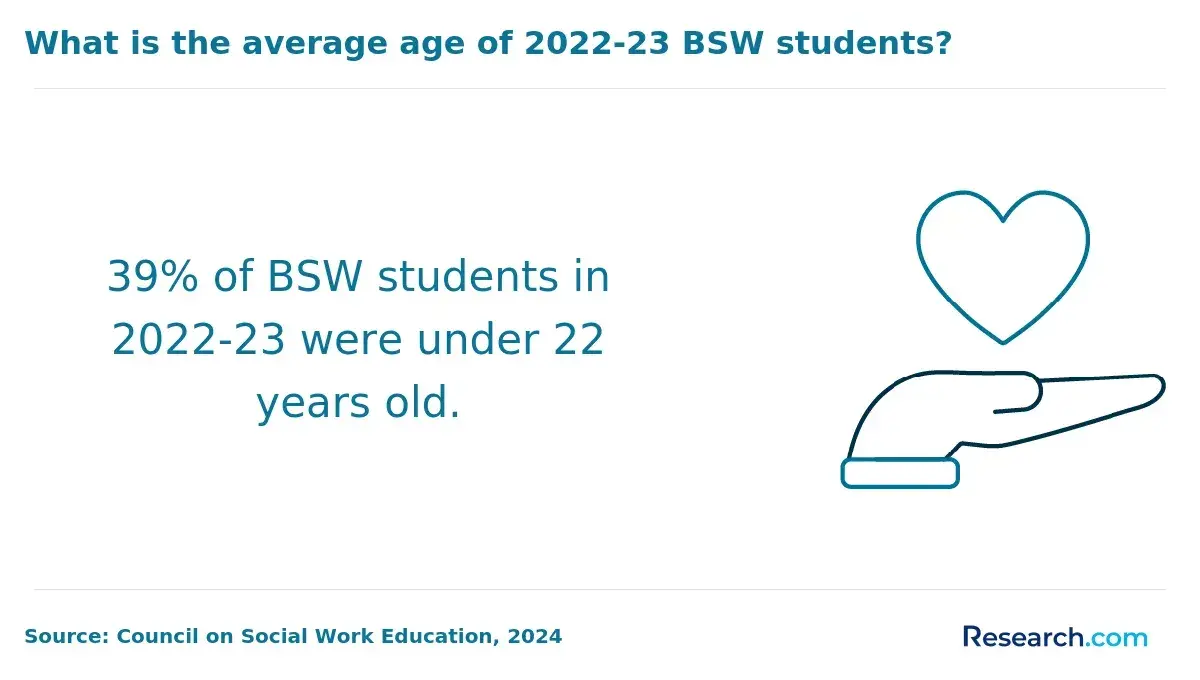
The chart below from CSWE shares the enrollment rates for BSW programs during the 2022 to 2023 school year.
What are the top institutions offering social work degree programs in Maine?
Choosing the right school for your social work education in Maine is essential for access to accredited programs, strong career preparation, and maximizing your educational investment. Accredited institutions provide the foundation needed to qualify for licensure and launch a rewarding career in this impactful field.
- University of Maine (UMaine), Orono: Offers comprehensive BSW and MSW programs with both campus-based and fully online options, recognized for rural practice training and specialized electives.
- University of Southern Maine (USM): Features a flexible MSW curriculum integrating clinical and macro practice, with part-time and accelerated pathways ideal for busy students.
- University of New England (UNE), Biddeford/Portland: Provides traditional and online MSW tracks with extensive field education, focusing heavily on clinical skills and licensure readiness.
- University of Maine at Presque Isle (UMPI): Home to a BSW program tailored to rural and underserved communities, emphasizing field experience and local impact.
- Saint Joseph’s College of Maine: Developing a values-driven BSW program rooted in community partnerships, designed to prepare graduates for meaningful practice and further study.
These top social work degree programs in Maine not only align with your career goals but also equip you to meet the state’s growing need for skilled professionals. With Maine holding the highest concentration of social work jobs nationally, your education here can open doors to rewarding roles with competitive salaries and growth opportunities.
More so, exploring the difference in earning potential between social workers and related professions can be helpful. For further insight, review the therapist salary data to make informed decisions about your career path.
What Social Workers Say About Their Careers in Maine
- Pursuing my social work degree at the University of Southern Maine was a transformative experience that allowed me to stay close to my roots while gaining a strong academic foundation. The program’s focus on community engagement prepared me well for the realities of working in Maine’s unique rural and coastal environments. Starting my career in a local school, I found that the support and resources I received during my studies translated directly into helping young people overcome challenges and thrive. I feel deeply fulfilled knowing my work contributes to supporting families in a state I genuinely care about. - Deana
- The chance to study social work at Husson University gave me the tools and confidence to grow personally and professionally. Maine’s distinct culture and smaller communities allowed me to connect more authentically with clients and colleagues, which was incredibly rewarding. I appreciate how the program balanced rigorous coursework with practical experience, preparing me to face complex social issues head-on. My career started in a local school, where I feel my impact every day, contributing positively to the well-being of young students. - Lena
- One of the most valuable aspects of earning my social work degree from the University of Maine was the emphasis on Maine’s environmental and social resources, shaping a unique perspective on community support. Beginning my social work career in an academic institution here was both challenging and invigorating, as I learned to adapt services to better fit the needs of local families. This path has opened many doors for professional development and advancement, and I’m proud to contribute to the state's ongoing social health. The balance between professional rigor and heartfelt service is something I cherish deeply. - Zia
Related Articles for Nearby States
- 2027 What Degree Do You Need to Be a Social Worker: Education Requirements in New Hampshire
- 2027 What Degree Do You Need To Be a Social Worker: Education Requirements in Massachusetts
- 2027 What Degree Do You Need To Be a Social Worker: Education Requirements in Vermont
- 2027 What Degree Do You Need To Be a Social Worker: Education Requirements in Connecticut
- 2027 What Degree Do You Need To Be a Social Worker: Education Requirements in Rhode Island
- 2027 What Degree Do You Need To Be a Social Worker: Education Requirements in New York
- 2027 What Degree Do You Need To Be a Social Worker: Education Requirements in New Jersey
- 2027 What Degree Do You Need To Be a Social Worker: Education Requirements in Pennsylvania
- 2027 What Degree Do You Need To Be a Social Worker: Education Requirements in Delaware
- 2027 What Degree Do You Need To Be a Social Worker: Education Requirements in Maryland
References:
- Council on Social Work Education (2024). Research Briefs and Publications. Retrieved from https://www.cswe.org/Research-Statistics/Research-Briefs-andPublications/2022-2023-Annual-Statistics-on-Social-Work-Education
- O*NET OnLine (n.d.). Maine Employment Trends 21-1029.00 - Social Workers, All Other. Retrieved from https://www.onetonline.org/link/localtrends/21-1029.00?st=ME
- Zippia (2025). What is a Social Worker and How to Become One. Retrieved from https://www.zippia.com/social-worker-jobs/
- ZipRecruiter (2025). Social Work Salary in Maine. Retrieved from https://www.ziprecruiter.com/Salaries/Social-Worker-Salary--in-Maine
Other Things You Should Know About Being a Social Worker in Maine
To become a licensed social worker in Maine, a Bachelor of Social Work (BSW) degree is necessary for entry-level positions. For advanced roles, such as clinical social worker, a Master of Social Work (MSW) is required. A doctorate is not mandatory but can enhance career opportunities.
In Maine, a doctorate is not required to practice advanced clinical social work. Instead, a Licensed Clinical Social Worker (LCSW) credential typically requires a master's degree in social work (MSW) and additional supervised clinical experience to qualify for licensure.
Admission requirements for a Bachelor of Social Work (BSW) degree in Maine typically include a high school diploma or GED, completion of prerequisite courses, and submission of an application with transcripts and letters of recommendation. Many programs also require a personal statement outlining the applicant's interest in social work and relevant experience or volunteer work.
Some institutions may conduct interviews or require standardized test scores, though this varies by school. Prospective students should check specific college requirements, but can generally expect a combination of academic preparation and demonstrated commitment to the field.


