
2027 Aeronautical Engineering Careers: Skills, Education, Salary & Job Outlook

Co-Founder and Chief Data Scientist
Choosing an aeronautical engineering career means deciding whether you are ready for a demanding technical path with strong long-term rewards. The field is built for people who like aircraft, complex systems, applied physics, and high-stakes problem solving. It is not an easy route: most roles require a strong background in mathematics and physics, a relevant bachelor’s degree, practical experience, and, in some positions, eligibility for security clearances.
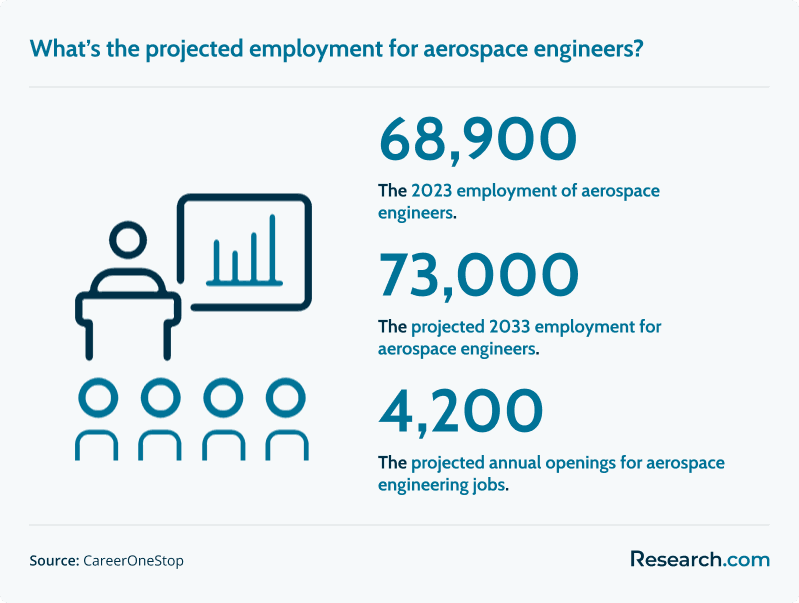
The payoff can be substantial for students and career changers who prepare carefully. Aeronautical engineers work on aircraft and flight systems that affect transportation, defense, safety, and emerging aviation technology. Demand is projected to grow 6% through 2034, and median salaries exceed $130,000. This guide explains what aeronautical engineers do, what training is required, how much they can earn, where the career can lead, and how to decide whether this path fits your strengths and goals.
Key Things You Should Know About Aeronautical Engineering Career
- The typical earning potential for an aeronautical engineer is around $91,580 annually, with variations depending on experience and location.
- Employment in aerospace engineering, including aeronautical roles, is expected to grow by 6% from 2024 to 2034, indicating a stable and expanding field.
- A bachelor's degree in aerospace or aeronautical engineering, or a closely related field, is generally required to enter this profession.
- Success in aeronautical engineering depends on strong technical skills like CAD proficiency and programming (Python, C++), alongside crucial soft skills such as problem-solving, communication, and teamwork.
- Career progression often leads from entry-level positions to senior or lead roles and can extend into management, with advanced degrees enhancing opportunities for leadership.
What do aeronautical engineers do?
Aeronautical engineers design, test, analyze, and improve aircraft and related systems that operate within Earth’s atmosphere. Their work can involve wings, propulsion, structures, control systems, materials, aerodynamics, performance, safety, and manufacturing processes. In practical terms, they help turn flight concepts into aircraft components and systems that can be built, tested, certified, maintained, and operated safely.
This career sits at the intersection of theory and real-world performance. An aeronautical engineer may use equations and simulation software to predict how a component will behave, then compare those results with laboratory tests, wind tunnel data, manufacturing constraints, and regulatory requirements. The goal is not only to make an aircraft fly, but to make it fly reliably, efficiently, and safely under demanding conditions.
A day in the life of aeronautical engineers
Most aeronautical engineers spend a large part of the workday in offices using engineering software, reviewing technical drawings, running simulations, writing reports, and meeting with project teams. Their work often shifts into laboratories, manufacturing facilities, hangars, or test sites when designs need validation or when a component fails to perform as expected.
Collaboration is constant. Aeronautical engineers frequently work with mechanical engineers, electrical engineers, systems engineers, software teams, manufacturing specialists, quality teams, pilots, and regulatory staff. A design decision that improves performance may affect weight, cost, safety, maintenance, or certification, so engineers must understand both their specialty and the broader aircraft system.
What are the key responsibilities of aeronautical engineers?
Aeronautical engineers are responsible for making sure aircraft designs and components meet performance, safety, reliability, and regulatory expectations. Their work combines design judgment, mathematical analysis, testing discipline, documentation, and cross-functional coordination.
- Design and refine aircraft structures, components, and systems using CAD tools, modeling software, and aerodynamic analysis.
- Run simulations and evaluate test data to understand lift, drag, stress, fatigue, vibration, thermal behavior, and overall system performance.
- Develop prototypes, test plans, engineering specifications, and technical documentation for aircraft parts and systems.
- Investigate malfunctioning components, identify root causes, and recommend design changes, repairs, or process improvements.
- Review designs for compliance with safety standards, regulatory requirements, manufacturing limits, and customer specifications.
- Coordinate with manufacturing, quality assurance, maintenance, and project teams to move designs from concept to production or operational use.
- Support repairs, alterations, preventive maintenance procedures, and long-term reliability improvements for aircraft systems.
The most challenging vs. the most rewarding tasks
The hardest part of the job is often balancing innovation with strict constraints. An aeronautical engineer may need to improve performance while reducing weight, meeting safety rules, staying within budget, and keeping a project on schedule. Small errors can have serious consequences, so the work requires patience, documentation, peer review, and a willingness to revisit designs repeatedly.
The most rewarding part is seeing a technical idea become a functioning aircraft component or system. Engineers in this field can point to tangible outcomes: a lighter structure, a safer system, a more efficient wing, a better test result, or a successful first flight. For people who enjoy applied science and visible impact, that connection between calculation and real-world flight is a major draw.
Students exploring shorter training routes before committing to a full engineering degree may also compare technical programs such as the best paying 6 month certificate programs online, although most aeronautical engineering roles still require a bachelor’s degree in a relevant engineering field.
What are the key skills for aeronautical engineers?
Aeronautical engineers need strong technical ability, but technical knowledge alone is not enough. Employers look for professionals who can solve ambiguous problems, communicate clearly, document decisions, and work across disciplines where safety, cost, schedule, and performance all matter.
Key hard skills
- Advanced mathematics: Calculus, algebra, statistics, and numerical methods are used to model flight behavior, structural loads, performance, and uncertainty.
- Physics and fluid dynamics: Engineers need a deep understanding of forces, motion, airflow, thermodynamics, vibration, and stability.
- Materials science: Aircraft design depends on choosing materials that can handle stress, fatigue, temperature, corrosion, and weight constraints.
- CAD and simulation software: Design tools, modeling platforms, and simulation software help engineers create, test, and refine aircraft systems before physical production.
- Experimental testing and data analysis: Engineers must compare predictions with test results, identify discrepancies, and make evidence-based design decisions.
- Technical documentation: Clear drawings, specifications, test reports, and compliance records are essential in aviation environments.
Essential soft skills
- Critical thinking: Aeronautical engineers must evaluate assumptions, trade-offs, and failure modes before recommending a solution.
- Complex problem solving: Many design issues have no simple answer and require balancing performance, weight, safety, cost, and manufacturability.
- Attention to detail: Small mistakes in calculations, drawings, or test procedures can create major downstream problems.
- Communication: Engineers must explain technical decisions to specialists and non-specialists, often under schedule pressure.
- Teamwork: Aircraft systems are too complex for isolated work, so collaboration across engineering and operations teams is central.
The overlooked skill that separates good engineers from great engineers
Systems integration is one of the most valuable but underappreciated skills in aeronautical engineering. A strong engineer understands not only one component, but how that component affects the aircraft as a whole. A change to a structural part may affect aerodynamics, wiring, maintenance access, manufacturing cost, and certification documentation.
For example, an engineer who notices early that a mechanical design creates problems for software-controlled sensors can prevent expensive redesigns later. That ability to connect disciplines, identify interface risks, and communicate across teams often distinguishes high-performing engineers from those who focus too narrowly on their own task.
Professionals who want to keep building technical depth later in life may explore flexible education options, including top degrees for seniors online, especially if they are returning to school or shifting into a more technical role.
Aeronautical Engineering Careers: A Step-by-Step Guide to Getting Started
Becoming an aeronautical engineer is a multi-stage process. The path is manageable when you treat it as a sequence of decisions: prepare academically, choose the right degree, gain practical experience, build credentials when needed, and apply for roles that match your skills and eligibility.
- Build the academic foundation early. Focus on mathematics, physics, computer science, and engineering-related coursework. Strong preparation makes college-level engineering more manageable.
- Earn a relevant bachelor’s degree. Most entry-level roles require a degree in Aeronautical Engineering, Aerospace Engineering, Aeronautics, or a closely related field.
- Choose an accredited program when possible. Accreditation matters for employer confidence, graduate study, and licensing pathways, especially if you may pursue the FE, EIT, or PE route.
- Gain hands-on experience. Internships, cooperative education, laboratory research, design teams, and undergraduate projects help you apply theory and build a credible resume.
- Develop a technical focus. Common areas include aerodynamics, propulsion, structures, avionics, controls, materials, testing, manufacturing, and systems engineering.
- Pursue early credentials if they fit your goals. The FE or EIT credential can be useful for engineers planning to work toward professional licensure.
- Apply strategically for entry-level roles. Target employers that match your specialization, project experience, citizenship or clearance eligibility, location preferences, and long-term career goals.
- Keep learning after your first job. Aeronautical engineering changes with technology, so continuing education, mentorship, advanced software skills, and project experience matter throughout your career.
The simplest roadmap is this: earn the right degree, get practical experience before graduation, learn the tools used in your target specialty, and apply for entry-level engineering roles with a portfolio of projects, internships, or research that proves you can work on real aircraft problems.
What education, training, or certifications are required?
The standard entry qualification for aeronautical engineering is a Bachelor of Science degree in Aeronautical Engineering, Aerospace Engineering, or Aeronautics. These programs typically cover mathematics, physics, aerodynamics, propulsion, structures, materials, controls, design, and engineering analysis. Students who want maximum flexibility should pay close attention to accreditation, curriculum depth, internship access, laboratory facilities, and employer connections.
For professional credentials, the Engineer-in-Training (EIT) or Fundamentals of Engineering (FE) certification is issued by the National Council of Examiners for Engineering and Surveying (NCEES). These credentials can be useful for engineers who want to demonstrate core engineering competence and pursue licensure later.
A Professional Engineer (PE) license can support career progression, especially for engineers who sign off on public-facing engineering work, move into leadership, or work in roles where licensure is valued. The PE pathway requires an ABET-accredited degree, successful completion of the FE exam, four years of supervised work experience, and passing the PE exam. On-the-job training often includes supervised practical experience under licensed engineers, internships, cooperative programs, or structured early-career engineering rotations.
Are advanced degrees or niche certifications worth the investment?
Advanced degrees, including a Master of Science or Ph.D. in Aeronautical or Aerospace Engineering, are most valuable for engineers who want to enter specialized research, advanced design, university-level research, high-level technical leadership, or niche areas such as propulsion, computational fluid dynamics, structural analysis, controls, or space systems. They can also help candidates stand out for competitive roles, but they are not required for many entry-level engineering jobs.
Specialized certifications and professional society involvement through organizations such as AIAA or SAE International can strengthen credibility, expand networks, and support continuing education. The value depends on your career target. A certification that aligns with your specialty and employer expectations is more useful than collecting credentials without a clear purpose.
The trade-off is time and cost. A graduate degree may delay full-time earnings and can require a major financial commitment. Before enrolling, compare the degree’s cost, research opportunities, employer demand, funding options, and expected career benefit. If you are comparing graduate pathways broadly, Research.com’s guide to the highest paying masters degrees can help put advanced education into a wider salary and career context.
What is the earning potential for aeronautical engineers?
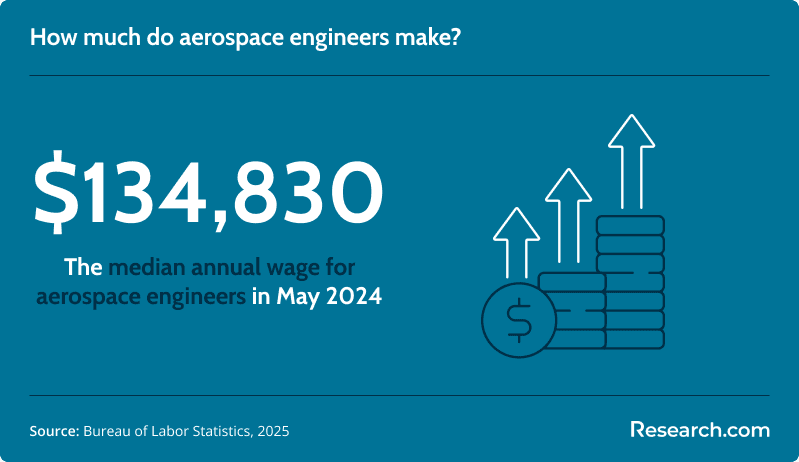
Aeronautical engineering can offer strong compensation, especially for professionals who build specialized technical expertise, gain experience on high-value projects, or work in aerospace hubs. The median annual salary for aerospace engineers is $134,830, which gives a useful benchmark for the broader field that includes aeronautical engineering roles.
For readers comparing early-career pay, the aeronautical engineering starting salary 2025 is represented by entry-level aerospace engineers earning around $84,020 annually. This is a realistic planning figure for new graduates, but actual offers can vary based on employer, location, internship experience, academic record, technical skills, and whether the position requires specialized knowledge or clearance eligibility.
Pay can rise substantially with experience. The top 10% tier reaches approximately $180,050, showing the financial upside for engineers who develop advanced expertise, lead major projects, move into high-demand specialties, or progress into senior technical and management roles.
What affects aeronautical engineering pay?
- Location: Aerospace hubs such as California and Texas often offer higher wages, though cost of living should be considered alongside salary.
- Industry: Defense contractors, government agencies, private aerospace companies, research organizations, and manufacturers may compensate differently.
- Specialization: Skills in propulsion, avionics, systems engineering, structural analysis, simulation, and testing can improve competitiveness.
- Experience level: Salaries typically rise as engineers move from supervised design work to independent responsibility, technical leadership, or project management.
- Education and credentials: Advanced degrees, licensure, and specialized training may improve earning potential when they align with employer needs.
What is the job outlook for aeronautical engineers?
The job outlook for aeronautical engineers is positive. Employment is projected to grow 6% from 2024 to 2034, which is faster than the average for all occupations. This suggests steady demand, but candidates should understand that aerospace hiring can vary by defense budgets, commercial aviation cycles, space-sector investment, and major program timelines.
The key factors shaping the future outlook
Several forces support demand for aeronautical engineering talent. Commercial aviation continues to need safer, more efficient, and lower-emission aircraft. Defense programs require advanced aircraft, unmanned systems, materials, propulsion technologies, and testing expertise. Space exploration and related aerospace systems also create opportunities for engineers with strong systems, structures, controls, and propulsion knowledge.
Another important factor is workforce turnover. Retirements and professionals moving into other fields create openings for new engineers. Candidates with specialized skills and security clearances may find especially strong job security, particularly in defense and government-related work.
Students planning for this career should also think about affordability. Engineering degrees can be expensive, and the best program is not always the most costly one. Comparing accredited options, aid eligibility, and completion support is essential. Researching colleges that accept financial aid can help students identify programs that better fit their budget.
What is the typical work environment for aeronautical engineers?
Aeronautical engineers usually work in office-based engineering environments, spending much of the day at computers using design, modeling, simulation, data analysis, and documentation tools. However, the job is not limited to desk work. Depending on the role, engineers may also spend time in laboratories, manufacturing facilities, aircraft hangars, wind tunnels, test ranges, or customer and supplier sites.
The field is highly collaborative. Engineers often work in multidisciplinary teams with specialists in structures, propulsion, avionics, software, manufacturing, quality, safety, and program management. Meetings, design reviews, technical reports, test planning, and compliance documentation are part of the work environment.
Employment settings vary. Over 5% of aerospace engineers work in aerospace product and parts manufacturing, with smaller shares employed in architectural, engineering, and related services or scientific research and development. The exact workplace depends on whether the employer builds aircraft, tests components, conducts research, supports defense systems, or provides engineering services.
Aeronautical engineer work-life balance is often based on a standard full-time schedule, but deadlines can lead to more than 40 hours per week during design reviews, testing phases, certification milestones, or production issues. Remote or hybrid work may be limited when projects require secure facilities, specialized equipment, classified information, or hands-on testing. Candidates who value flexibility should ask employers directly about schedule expectations, travel, overtime, and onsite requirements.
What are the pros and cons of aeronautical engineers careers?
Aeronautical engineering can be highly rewarding, but it is not the right fit for everyone. The same factors that make the career exciting—complex technology, safety-critical work, and high standards—also create pressure. A realistic decision requires weighing both sides.
Pros
- Meaningful technical impact: Aeronautical engineers contribute to aircraft safety, efficiency, performance, transportation, and defense.
- Strong compensation: The field offers salaries that can be attractive compared with many other career paths, especially with experience and specialization.
- Intellectual challenge: The work suits people who enjoy mathematics, physics, design trade-offs, testing, and complex systems.
- Tangible outcomes: Engineers can see their designs become real components, systems, prototypes, or aircraft.
- Specialization options: Professionals can build careers in aerodynamics, propulsion, structures, avionics, testing, space systems, or systems engineering.
Cons
- High responsibility: Aviation work carries serious safety and reliability obligations, leaving little room for careless decisions.
- Difficult education path: Students need strong preparation in advanced mathematics, physics, and engineering analysis.
- Regulation and documentation: Design work often requires extensive review, compliance records, and formal processes.
- Project pressure: Engineers may face tight deadlines, failed tests, budget limits, and repeated design revisions.
- Limited remote flexibility: Some roles require secure facilities, labs, manufacturing sites, or specialized equipment.
This career is a strong fit if you enjoy disciplined problem solving and can handle high standards. If you prefer faster workforce entry or more hands-on technical work with less emphasis on advanced theory, it may be useful to compare other pathways, including Research.com’s guide to choosing a trade career.
What are the opportunities for advancement for aeronautical engineers?
Aeronautical engineering offers two main advancement routes: moving into leadership or becoming a deeper technical specialist. Some engineers eventually combine both, leading teams while remaining closely involved in design decisions and technical reviews.
Common promotion path
- Entry-level aeronautical engineer: Works on design, analysis, documentation, or testing tasks under supervision while learning employer processes and tools.
- Experienced engineer: Handles more independent technical assignments, evaluates data, supports design reviews, and contributes to project decisions.
- Senior or lead engineer: Oversees major technical work, mentors junior engineers, coordinates across teams, and takes responsibility for design quality.
- Principal engineer or engineering manager: Leads strategic initiatives, approves complex technical approaches, manages teams, or guides high-impact programs.
Specialization paths to expand expertise
- Aircraft design: Focuses on aerodynamic, structural, and systems design for different aircraft types.
- Propulsion systems: Develops and improves engines and propulsion technologies.
- Avionics: Works on navigation, communication, control, and electronic systems.
- Structural analysis: Uses modeling and testing to verify the strength, fatigue life, and safety of aircraft structures.
- Space systems: Applies aerospace engineering principles to satellites, launch-related technologies, and systems designed for space exploration.
Advancement usually depends on performance, technical credibility, communication skills, project experience, and the ability to make sound engineering decisions under constraints. Engineers who document results clearly, understand the full system, and build trust across teams are often better positioned for promotion.
What other careers should you consider?
If aeronautical engineering interests you but you are still comparing options, look at related careers that use similar strengths in mathematics, physics, design, systems thinking, or aviation. The best alternative depends on whether you prefer hands-on technical work, broad mechanical design, project leadership, or system integration.
- Mechanical engineer: Designs and analyzes mechanical systems across many industries. This path offers broader employment options and can still connect to aircraft, spacecraft, vehicles, energy systems, or manufacturing.
- Aerospace engineering technician: Supports testing, assembly, maintenance, and troubleshooting of aerospace components. This may suit people who prefer practical, hands-on technical work over full engineering design responsibility.
- Aircraft designer: Focuses on aircraft modeling, aerodynamics, structures, layout, and design details. This role may appeal to people who are especially interested in shaping the form and function of aircraft.
- Systems engineer: Integrates complex subsystems such as avionics, propulsion, structures, controls, and software. This is a strong fit for big-picture thinkers who like coordinating technical interfaces.
- Aviation manager: Combines aviation operations, regulatory knowledge, project management, and leadership. This path can be a better match for people who want to work around aircraft while focusing more on teams, budgets, compliance, and operations.
Use these comparisons to clarify what you actually want from your career. If your strongest interests are advanced math, aircraft performance, and technical design, aeronautical engineering may be the best fit. If you prefer operations, maintenance, management, or broader mechanical systems, a related career may offer a better match.
Here's What Professionals Say About Their Aeronautical Engineering Careers
- Nikki: "At Aerion Supersonic, I focus on refining the aerodynamics of our supersonic business jet, which we aim to launch by 2023. The pace is intense, and every adjustment I make directly affects the plane's performance and efficiency. Working within a small, innovative team means I constantly tackle new problems that keep me energized and committed. It's incredibly fulfilling to see how my technical contributions shape a cutting-edge aircraft that could redefine air travel."
- Shamee: "After completing my master's in space engineering, I struggled to find a position for weeks despite my strong academic background. Thanks to a mentor's practical advice on tailoring my resume and interview preparation, I was able to secure a role as a Hardware Engineer at Lockheed Martin Space Systems. The structured coaching gave me confidence and broke down the process into manageable steps, removing the anxiety I initially felt. This hands-on support made all the difference in overcoming the obstacles of reentering the aerospace field."
- Annabelle: "I really enjoy the tangible aspect of being an aeronautical engineer - designing parts that become real components on aircraft that fly. It never gets old to see a design move from initial sketches and simulations to a physical prototype and then to a functioning airplane in the sky. My daily work surrounds me with the machines I love and the knowledge that my efforts contribute to safe, efficient flight. That feeling of accomplishment when a plane takes off for the first time with systems I helped build is something I cherish deeply."
Key Findings
- Aeronautical engineers design, test, analyze, and improve aircraft and flight systems that operate within Earth’s atmosphere.
- The career requires strong preparation in mathematics, physics, engineering analysis, software tools, testing, and technical documentation.
- A Bachelor of Science degree in Aeronautical Engineering, Aerospace Engineering, or Aeronautics is the standard entry requirement for most roles.
- The FE, EIT, and PE pathway can support professional growth, with the PE requiring an ABET-accredited degree, the FE exam, four years of supervised work experience, and the PE exam.
- The median annual salary for aerospace engineers is $134,830, with entry-level aerospace engineers earning around $84,020 annually and the top 10% tier reaching approximately $180,050.
- Employment is projected to grow 6% from 2024 to 2034, supported by aviation innovation, defense needs, efficiency demands, and workforce turnover.
- The work is often office-based but may involve laboratories, manufacturing facilities, hangars, and test locations, with limited remote flexibility in some roles.
- The best candidates combine technical depth with systems thinking, communication, careful documentation, and the ability to work across multidisciplinary teams.
Other Things You Should Know About Aeronautical Engineering
In 2027, aeronautical engineers rely on methodologies like computational fluid dynamics (CFD) and finite element analysis (FEA) to design and test aircraft. Frameworks like Agile project management and systems engineering principles are fundamental in efficiently managing complex aerospace projects.
To succeed in aeronautical engineering by 2026, relevant internships or co-op programs are crucial. Practical experience with CAD software, drone technology, and aerodynamic testing enhances job prospects alongside academic qualifications.
References
- Aeronautical Engineer vs. Aerospace Engineer: A Career Guide https://und.edu/blog/aeronautical-engineer-vs-aerospace-engineer.html
- Frequently Asked Questions about Aerospace Engineer Careers https://www.jobzmall.com/careers/aerospace-engineer/faqs
- What is the Role and Responsibilities of Aeronautical Engineer? - AME CEE Exam 2024 India https://www.amecee.in/blog/role-and-responsibilities-of-aeronautical-engineer/
- Testimonials — Aerospace Career Coaching https://www.aerospacecareercoaching.com/testimonials
- Soft skills advice https://www.careersinaerospace.com/career-resources/softskills/
- Aeronautical Engineers: Salary Guide https://www.aviationjobsearch.com/career-hub/articles/career-advice/salary-and-benefits/aeronautical-engineers-salary-guide
- How to Stand Out in the Competitive Aerospace Engineering Job Market | EuroEngineerJobs https://www.euroengineerjobs.com/article/835/how-to-stand-out-in-the-competitive-aerospace-engineering-job-market
- What is Aeronautical Engineering? https://www.snhu.edu/about-us/newsroom/stem/what-is-aeronautical-engineering
- Aerospace engineer https://www.prospects.ac.uk/job-profiles/aerospace-engineer
- A Day in the Life of an Aerospace Engineer https://katelyngunderson.com/a-day-in-the-life-of-an-aerospace-engineer/


