
2027 Forensic Accounting Degree vs. Certificate: Which Should You Choose?

Co-Founder and Chief Data Scientist
Choosing between a forensic accounting degree and a certificate is mainly a question of career direction, time, cost, and how much academic depth you need. A degree is usually the stronger option if you are preparing for broader accounting roles, graduate study, CPA-related plans, management responsibilities, or long-term advancement. A certificate is usually better if you already have accounting, finance, auditing, or business experience and want focused training in fraud examination, litigation support, or financial investigation without committing to a full program.
The right choice depends on where you are starting. New students often benefit from the structure and wider foundation of a degree. Working professionals may prefer a certificate because it is shorter, more targeted, and easier to fit around a job. An estimated 22% of forensic accountants hold advanced degrees, but certificates can still be useful for building current, job-relevant skills or preparing for specialized credentials.
This guide compares forensic accounting degrees and certificates by completion time, online availability, admissions, credits, tuition, accreditation, transferability, job options, and starting salary so you can choose the path that best matches your goals.
Key Points About Forensic Accounting Degree vs. Certificate Programs
- A forensic accounting degree offers comprehensive knowledge and higher salary potential, with graduates earning on average 20% more than certificate holders.
- Certificate programs focus on practical skills and quicker completion, ideal for professionals seeking targeted expertise without a full degree commitment.
- Degrees typically provide broader career growth opportunities, while certificates suit those aiming for specific roles or continuing education in forensic accounting.
What Are the Differences Between Forensic Accounting Degree and Certificate Programs?
A forensic accounting degree is a broader academic credential. It usually combines accounting principles, auditing, fraud examination, business law, ethics, data analysis, and general education or advanced coursework. A forensic accounting certificate is narrower. It focuses on specific skills, such as fraud detection, investigative accounting, financial statement analysis, and evidence documentation.
The better choice depends on whether you need a full academic credential or a targeted skill upgrade.
Key differences to compare
- Purpose: A degree is designed to prepare students for wider accounting and forensic roles over the long term. A certificate is designed to add specialized knowledge more quickly.
- Career advancement: Degrees often carry more weight for roles that require a bachelor's or graduate-level education, especially supervisory, analytical, or licensed accounting paths. Certificates can strengthen a resume but may not replace a required degree.
- Depth of learning: Degree programs cover forensic accounting in a larger business and accounting context. Certificate programs usually skip broader general education and concentrate on applied topics.
- Time commitment: A degree normally takes much longer because it includes more credits and a wider curriculum. A certificate can often be completed in months to one year.
- Cost: Certificates usually cost less in total because they require fewer courses. Degrees require a larger investment but may support broader career mobility.
- Best fit: A degree is often better for students entering the accounting field or pursuing long-term advancement. A certificate is often better for professionals who already have a degree or work experience and want focused forensic accounting training.
One common mistake is choosing a certificate because it is faster without checking whether target jobs require a degree. Another is choosing a degree when a short certificate would be enough to build a specific fraud examination skill. Start with job postings in your preferred market, then work backward to the credential those employers actually request.
How Long Does It Take to Complete a Forensic Accounting Degree vs. a Certificate Program?
A forensic accounting degree usually requires a multi-year commitment, while a certificate is built for faster completion. Time to completion matters because it affects tuition, opportunity cost, work-life balance, and how quickly you can apply new skills on the job.
- Typical degree timeline: A forensic accounting degree usually requires about four years of full-time study at the bachelor's level. Graduate degrees add roughly two more years.
- Typical certificate timeline: Certificate programs are much shorter and are often designed for completion within months up to one year.
- Full-time vs. part-time pacing: Degree programs often follow academic terms and sequenced requirements. Certificate programs are commonly easier to complete part time because they include fewer courses.
- Transfer credits and prior coursework: Students with previous college credits may shorten a degree timeline. Certificate timelines are already compact, so transfer credits may have a smaller impact.
- Program format: Online and hybrid programs may offer more flexible pacing than traditional on-campus schedules, but students should still check course availability, start dates, and required prerequisites.
If your goal is to move into forensic accounting as quickly as possible from a related field, a certificate may be the more practical first step. If your goal is to qualify for roles that list a bachelor's or master's degree as a requirement, a degree is the safer route. Students comparing graduate options may also want to review 1 year master programs to understand how accelerated graduate study can affect completion time.
Can You Complete a Forensic Accounting Degree or Certificate Entirely Online?
Yes, many forensic accounting degrees and certificates can be completed entirely online, but students should verify requirements before enrolling. Online availability is especially useful for working adults, military students, parents, and learners who do not live near a campus with forensic accounting coursework.
Accredited institutions such as Purdue University Global, Eastern Oregon University, and Liberty University offer bachelor's and master's forensic accounting degrees with asynchronous coursework tailored for working professionals and nontraditional students. Online certificate options are also available, including the Forensic Accounting Professional Certificate at the University of North Carolina Charlotte.
What to check before choosing an online program
- Accreditation: Confirm that the institution is properly accredited and that the credential will be recognized by employers or future schools.
- Course delivery: Asynchronous courses are more flexible because students can access coursework on their own schedule. Synchronous courses require attendance at set times.
- Experiential requirements: Some bachelor's degrees may include internships, supervised practice, or other applied requirements. These can affect whether the program is fully online in practice.
- CPA-related planning: If you are pursuing CPA certification, check your state's education requirements early. A forensic accounting program may help, but CPA eligibility depends on specific accounting credits and state rules.
- Technology and proctoring: Online programs may require proctored exams, accounting software, analytics tools, or secure testing platforms.
Certificate programs are more likely to be fully online with no campus visits because they typically focus on coursework rather than internships or practicum experiences. Students who are still exploring entry-level online college pathways can use easy associate degrees online as a broader reference point for flexible academic options.
What Are the Admission Requirements for a Forensic Accounting Degree vs. a Certificate Program?
Forensic accounting degree programs usually have more formal admission requirements than certificate programs. Degrees must verify that students are ready for a full academic curriculum, while certificates are often designed for applicants who already have some college background or professional experience.
Admission requirements for forensic accounting degree programs
- Educational background: Undergraduate applicants generally need a high school diploma or equivalent. Graduate applicants need a bachelor's degree.
- Official transcripts: Schools typically require transcripts from prior high schools, colleges, or universities to confirm academic history and prerequisites.
- Standardized test scores: Some programs request SAT, ACT, GRE, or GMAT scores, especially for competitive or graduate-level admission.
- Prerequisite courses: Graduate programs may expect prior coursework in accounting, business, economics, statistics, or mathematics.
- Personal statement: Many programs ask applicants to explain their interest in forensic accounting and their career goals.
- Letters of recommendation: Graduate applicants commonly need academic or professional references.
- Resume: Master's programs may request a resume showing accounting, auditing, finance, compliance, or investigative experience.
Admission requirements for forensic accounting certificate programs
- Minimum education: Most certificate programs require a bachelor's degree but may not require a specific major.
- Transcripts: Applicants are usually asked to submit official transcripts, often to verify degree completion and a minimum GPA of 2.75 or higher.
- Open to multiple backgrounds: Some certificates accept students from accounting, business, criminal justice, finance, or other majors if they meet prerequisite expectations.
- Professional experience: Some programs prefer or require relevant work experience, though this is less common than formal academic prerequisites.
- No standardized test scores: Certificates generally do not require GRE, GMAT, or similar exams, which can make admission simpler for working professionals.
Degree admission is typically more comprehensive because the credential is broader and may lead into advanced academic or professional pathways. Certificate admission is usually more accessible, but applicants should still confirm prerequisites before applying. Students considering a longer academic route after graduate study can compare future options such as an affordable online PhD, while those who only need targeted fraud investigation coursework may not need that level of commitment.
How Many Credits Do You Need to Complete a Forensic Accounting Degree vs. a Certificate?
Credit requirements are one of the clearest differences between a forensic accounting degree and a certificate. Degrees require substantially more credits because they include general education, accounting foundations, business coursework, electives, and forensic accounting specialization. Certificates are much shorter and focus mainly on the forensic accounting skill set.
- Degree credits: Associate and bachelor's degrees generally require between 60 and 120 semester credits, including general education and forensic accounting courses, over two to four years.
- Certificate credits: Certificate programs usually require 9 to 15 credits focused on forensic accounting topics and are often completed in less than a year.
A lower credit load can be a major advantage for students who work full time or need a credential quickly. However, fewer credits also mean less breadth. A certificate may help you build fraud examination skills, but it may not satisfy employer requirements for accounting roles that specify a bachelor's degree.
Before enrolling, compare the course list rather than looking only at the total credit count. A strong certificate should include practical coursework in fraud schemes, investigative techniques, financial statement analysis, evidence handling, and ethics. A strong degree should provide both forensic accounting specialization and a solid accounting foundation.
What Is the Average Tuition for a Forensic Accounting Degree vs. a Certificate?
Forensic accounting certificates usually cost less than degrees because they require fewer courses. A degree costs more overall, but it may provide broader eligibility for accounting, auditing, compliance, and management roles. The best value depends on whether you need a full credential or a targeted skill upgrade.
Average tuition for forensic accounting degree programs
- Tuition range: Bachelor's degrees in forensic accounting generally range from $9,750 to $37,095 per year, depending on institution type and location.
- Public vs. private schools: In-state public universities usually charge between $7,869 and $12,394 annually, while private schools may have tuition as high as $37,095 per year.
- Online vs. on-campus costs: Online programs may reduce housing, commuting, and relocation costs, although tuition per credit can be similar to on-campus rates.
- Per-credit cost: Tuition per credit hour varies from $261 to $1,099, and most bachelor's programs require about 120 credits total.
- Additional fees: Students should budget for technology fees, student services, books, software, and other institutional charges.
Average tuition for forensic accounting certificate programs
- Tuition range: Forensic accounting certificate tuition is often around $700 per course or between $5,000 and $7,000 in total, depending on program length.
- Program length: Certificates require approximately 12 to 18 credits and can be completed in months to a year, which lowers total tuition exposure.
- Institution type: Private or highly recognized universities may charge more, while many certificate programs are designed for affordability and professional access.
- Online vs. on-campus costs: Online certificate courses can reduce commuting and relocation expenses.
- Financial aid: Some certificate programs may not qualify for federal aid, so students should confirm aid eligibility before enrolling.
When comparing cost, look beyond advertised tuition. Ask whether the program charges per credit or per course, whether fees are included, whether textbooks or software are extra, and whether the credential is eligible for employer tuition assistance. Students prioritizing affordability can also compare a cheapest accounting degree online option against certificate pricing to see which path offers the better long-term return.
It can also help to review institutions listed among accredited non profit online universities when searching for flexible programs with recognized institutional oversight.
Can You Transfer Certificate Credits Toward a Forensic Accounting Degree Later On?
Sometimes. Certificate credits may transfer toward a forensic accounting degree, but transfer is never guaranteed. The decision depends on the receiving school's policies, the accreditation of the institution that issued the certificate, course level, grades earned, and whether the certificate courses match degree requirements.
Transfer is usually more likely when the certificate and degree are offered by the same accredited institution or when both programs use comparable graduate or undergraduate course numbering. It is less likely when the certificate is noncredit, offered through continuing education, or not aligned with the degree curriculum.
Questions to ask before enrolling in a certificate
- Are the certificate courses credit-bearing? Noncredit professional development courses usually do not transfer into degree programs.
- Will these credits apply to a specific degree? Ask for written confirmation, not just a general statement that credits may transfer.
- What grade is required? Many schools require a minimum grade, usually a B or higher, for transfer consideration.
- How many credits can transfer? Schools often limit the number of outside or certificate credits that can count toward a degree.
- Do credits expire? Some institutions require coursework to be completed within a recent time frame.
- Will credits count as core requirements or electives? Credits that transfer only as electives may not shorten the degree as much as expected.
The safest approach is to choose a certificate with a clear pathway into a degree if you think you may continue later. Contact admissions and academic advising before enrolling, save course syllabi, and keep documentation of grades and course descriptions. These records can help during a future transfer review.
Are Certificate Programs Accredited the Same Way as Forensic Accounting Degrees?
No. Forensic accounting certificates are generally not accredited in the same way as degree programs. A degree is usually part of an accredited institution and may also be connected to business or accounting accreditation, such as accreditation from the Association to Advance Collegiate Schools of Business (AACSB). A certificate may be offered by an accredited university, but the certificate itself often does not have separate programmatic accreditation.
This distinction matters because accreditation can affect employer confidence, credit transfer, financial aid eligibility, and preparation for professional credentials. A certificate from a reputable accredited university can still be valuable, especially if the coursework supports goals such as Certified Fraud Examiner (CFE) or Certified in Financial Forensics (CFF) preparation. However, students should not assume that a certificate has the same recognition as a bachelor's or master's degree.
How to evaluate accreditation and credibility
- Verify institutional accreditation: Confirm that the college or university is regionally or nationally accredited by a recognized accrediting agency.
- Check business school recognition: For degree programs, accreditation from bodies such as AACSB can be an important quality signal.
- Ask whether the certificate is credit-bearing: Credit-bearing certificates may have stronger transfer potential than noncredit certificates.
- Review faculty qualifications: Look for instructors with accounting, auditing, fraud examination, litigation support, or investigative experience.
- Compare curriculum to professional goals: If you plan to pursue CFE or CFF-related work, make sure the coursework aligns with fraud examination and financial forensics topics.
Before enrolling, verify accreditation through official accreditor or school sources. Do not rely only on marketing language. Terms such as “recognized,” “approved,” or “career-focused” are not substitutes for accreditation.
What Jobs Can You Get with a Forensic Accounting Degree vs. a Certificate?
A forensic accounting degree generally supports a wider range of accounting, auditing, compliance, and investigation-related roles. A certificate can help professionals qualify for more specialized responsibilities, but by itself it may be better suited to support roles unless the student already has a degree or relevant experience.
Jobs you can get with a forensic accounting degree
- Forensic accountant: Investigates suspected fraud, traces funds, reviews financial records, and may support legal or law enforcement teams.
- Internal auditor: Reviews financial controls, identifies irregularities, and helps organizations reduce risk.
- Financial analyst with forensic specialization: Examines financial data for litigation, disputes, compliance reviews, or suspected misconduct.
- Compliance officer: Helps organizations follow financial laws, internal policies, and anti-fraud procedures.
- Risk consultant: Advises organizations on fraud risk, embezzlement prevention, internal controls, and financial exposure.
Jobs you can get with a forensic accounting certificate
- Accounting technician: Supports bookkeeping, audit preparation, document review, and financial record organization.
- Fraud examiner assistant: Helps gather, organize, and analyze evidence under the direction of senior investigators or accountants.
- Compliance support specialist: Assists with anti-fraud policies, documentation, monitoring, and internal reporting.
The same certificate can have very different value depending on the student's background. For example, a certificate added to an accounting degree may help a candidate move toward forensic accounting work. A certificate without prior accounting education may be a useful introduction, but it may not be enough for jobs requiring advanced accounting judgment, CPA eligibility, or independent investigation responsibilities.
What Is the Average Starting Salary for a Certificate vs. Forensic Accounting Degree Graduates?
Starting salary tends to be higher for forensic accounting degree graduates than for certificate holders because degrees usually provide broader preparation and may qualify graduates for roles with more responsibility. Certificates can still improve earning potential, especially for professionals who already have accounting or finance experience.
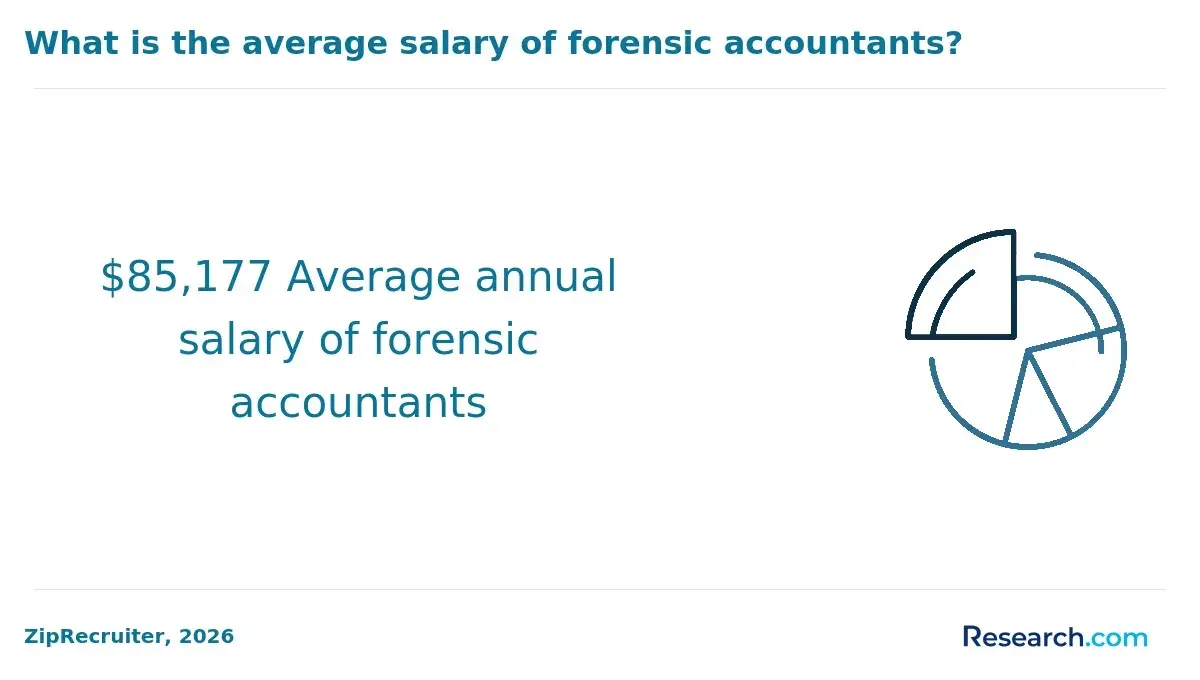
- Typical salary range: Graduates with a forensic accounting degree generally earn starting salaries between $51,000 and $80,000 per year, with bachelor's degree holders averaging around $55,000 and master's degree recipients closer to $77,000. The median salary is about $85,177. In comparison, forensic accounting certificate holder salary in the US typically falls between $45,000 and $55,000 annually.
- Experience: Prior accounting, auditing, finance, compliance, or investigative experience can raise starting pay for both degree and certificate holders.
- Industry: Forensic accountants working in finance and insurance often see higher salaries, with median earnings approaching $90,000 because of the specialized nature of those sectors.
- Location: Metropolitan areas such as New York, Chicago, and Washington, D.C. usually offer higher starting salaries than rural or less competitive labor markets.
- Certification and credentials: Professional certifications such as the Certified Fraud Examiner (CFE) can boost salaries by up to 32% over non-certified peers.
- Career outlook: Degree holders often have stronger long-term advancement options because more roles require a bachelor's or master's degree. Certificate holders may start in support or specialized roles and later pursue a degree or additional credentialing for promotion.
Salary should not be the only deciding factor. A less expensive certificate may offer a faster return if you already work in accounting and need a specialization. A degree may be a better investment if you need the credential to qualify for higher-level jobs. Students comparing online options can also review top online colleges with national accredited status when evaluating flexible programs.
Here's What Graduates of Forensic Accounting Programs Say About Their Degree or Certificate
- Joey: "Enrolling in the forensic accounting certificate program was a game-changer for me. The focused curriculum allowed me to learn at a faster pace and at a much lower cost than a full degree program, around $4,000 compared to the degree's average $40,000. For anyone looking to quickly enter the field or boost my resume without a huge time or financial commitment, the certificate was a practical choice."
- Morgan: "Pursuing the forensic accounting degree was rigorous but rewarding. The pace gave me a deeper understanding of the field than a certificate alone could provide. It required a larger investment of time and money, but the broader learning experience and career opportunities made it worthwhile. Looking back, I think students should be honest about their long-term career goals and how much depth they need before choosing between a degree and a certificate."
- Hudson: "After completing both the forensic accounting certificate and degree programs, I see them as serving different purposes. The certificate gave me a quick foundation and a cost-effective entry point, while the degree expanded my expertise and opened doors to senior roles. Prospective students should weigh learning pace, personal finances, and career aspirations carefully because the difference in cost and time commitment is significant, with degrees often costing ten times more than certificates."
Other Things You Should Know About Forensic Accounting Degrees
While forensic accounting certificate programs are typically designed for individuals with a foundational understanding of accounting principles, many programs provide introductory courses to help newcomers. Success largely depends on the individual's commitment to learning and adapting to the specialized skills essential for forensic accounting.
Forensic accounting degrees generally provide more in-depth and practical experience compared to certificate programs. Degrees often include internship opportunities and comprehensive coursework, which are critical for hands-on learning, while certificates typically offer a more condensed curriculum focused on core concepts.
References
- Forensic Accounting Certificate Online https://www.snhu.edu/online-degrees/certificates/graduate-forensic-accounting-and-fraud-examination
- Kickstart Your Accounting Education: Degree vs. Certification | Bryan University Online© https://bryanuniversity.edu/faq/kickstart-your-accounting-education-degree-vs-certification/
- Forensic Accounting Career Overview | Accounting.com https://www.accounting.com/careers/forensic-accountant/
- Innovative Training for Forensic Professionals. https://www.forensicglobal.org/
- Graduate Certificate in Forensic Accounting https://www.isenberg.umass.edu/programs/certificates/grad/forensic-accounting
- Admission Requirements https://www.missouristate.edu/SOA/Forensic/AdmReqs.htm
- Specialized Forensic Accounting Certificate https://www.ficpa.org/cpe/573989mb:specialized-forensic-accounting-certificate
- Forensic Accounting Careers Are Far from Ordinary https://www.apu.edu/articles/forensic-accounting-careers-are-far-from-ordinary/
- Forensic Accountant Career And Salary Information https://www.criminaljusticedegreeschools.com/careers/forensic-accountant/
- BLS. (2024). May 2024 Occupational Employment and Wage Statistics. Occupational Employment and Wage Statistics Query System. Retrieved January 2026, from https://data.bls.gov/oes/#/industry/000000
- National Student Clearinghouse Research Center. (2025). Clearinghouse Enrollment Insights Series: Final Fall Enrollment Trends. https://nscresearchcenter.org/final-fall-enrollment-trends/
- ZipRecruiter. (2026). Forensic Accountant salary. https://www.ziprecruiter.com/Salaries/Forensic-Accountant-Salary
- IBISWorld. (2025, October). Forensic Accounting Services in the US - Employment (2002–2031). https://www.ibisworld.com/united-states/employment/forensic-accounting-services/4791/
- Zippia. (2025, January 8). Forensic accountant demographics and statistics in the US. https://www.zippia.com/forensic-accountant-jobs/demographics/#degree-level-types


![2027 Best Advanced Standing Online MSW Programs [CSWE Accredited] thumbnail](/uploads/Online_Advanced_Standing_MSW_301dbd5368.jpg)


