
2027 Is Communication a Hard Major? What Students Should Know

Co-Founder and Chief Data Scientist
The perception that communication is an easy major often overlooks its academic demands and practical challenges. In fact, communication programs in the U.S. have grown by over 15% in enrollment in the past five years, reflecting rising interest and rigor. Students navigate complex theories, media analysis, and strategic messaging, requiring critical thinking and adaptability.
This article explores the academic rigor, workload expectations, and essential skills communication students must develop. It also examines how individual strengths and career goals influence the perceived difficulty of the major, helping prospective students make well-informed decisions about their educational paths.
Key Benefits of Communication as a Major
- Communication develops versatile skills in writing, speaking, and critical analysis, benefiting career changers adapting to new fields or full-time workers balancing studies with job demands.
- The major offers diverse academic paths-media, interpersonal, or organizational communication-allowing traditional undergraduates to explore specialized disciplines aligned with their interests and career goals.
- Challenging coursework in communication builds confidence through practical projects and collaborative learning, preparing students to navigate complex real-world professional environments effectively.
Where Does Communication Rank Among the Hardest College Majors?
Communication is generally viewed as a moderately challenging major but does not rank among the most difficult fields in national surveys. Difficulty assessments often consider average GPA, weekly hours spent on coursework, and the complexity of assignments. Unlike engineering, physics, or computer science, which demand extensive lab work, advanced math, and technical projects, communication focuses more on writing, presentations, group projects, and some research or fieldwork.
For example, communication students typically spend about 13 to 15 hours per week on homework and projects, notably less than engineering majors who often report over 20 hours weekly. These factors place communication below the hardest majors in terms of workload and technical intensity.
Perceptions of difficulty in communication vary widely depending on the institution and the student's skills. At universities with top-ranked programs, such as the University of Southern California or Northwestern, curricula may include rigorous theory, media analysis, and research demands, increasing academic challenges.
Compared to majors like psychology or business, communication often shares similar study intensity. However, when stacked against highly technical or quantitative fields like engineering or chemistry, it's generally considered less demanding.
Ultimately, the difficulty of communication depends on individual strengths-students excelling in writing, critical thinking, and speaking may find it more manageable than those better suited for heavily scientific or mathematical disciplines.
What Factors Make Communication a Hard Major?
Certain academic and skill-related demands make communication a challenging major for many students. These challenges stem from the program's multidimensional nature and the workload demands communication studies typically require.
- Academic rigor: Communication majors must master a blend of analytic, critical, historical, and theoretical approaches. The interdisciplinary coursework demands deep engagement with complex ideas and various communication frameworks.
- Time commitment: Completing this major often requires at least 124 semester hours, including writing-intensive and advanced-level courses that necessitate significant research and analysis. Additional general education and proficiency requirements further extend the workload.
- Technical and analytical complexity: Students develop advanced skills in public speaking, research methods, statistics, and media analysis. Challenging prerequisites and strategic communication projects push critical thinking and applied learning.
- Field-specific demands: Experiential components like internships and cross-cultural exchanges are typical, intensifying the workload and requiring excellent time management. Maintaining minimum grade standards and GPA thresholds is essential for progression and graduation.
For students seeking an efficient path through demanding curricula, options like the fastest online bachelor degree may offer alternatives while accommodating the rigorous nature of communication studies.
Who Is a Good Fit for a Communication Major?
Identifying who succeeds in communication degree programs helps potential students align their strengths with the major's demands. This major requires a unique mix of interpersonal skills and intellectual curiosity to navigate its interactive and team-based coursework effectively.
- Strong Writers and Speakers: Students with well-developed writing and public speaking skills thrive because much of the coursework emphasizes clear, persuasive communication. Their ability to express ideas confidently gives them an advantage in presentations and debates.
- Collaborative Leaders: Those who enjoy teamwork and can take initiative excel, as many assignments require active participation and leadership in group settings. These students manage project dynamics well and contribute meaningfully to discussions.
- Creative Thinkers: Communication majors benefit from creativity and emotional intelligence, traits that help in crafting compelling messages and understanding diverse audiences. This openness to new perspectives supports academic and professional growth.
- Curious and Inquisitive Minds: Students naturally drawn to exploring how people connect and share ideas find the coursework engaging. Their curiosity drives deeper engagement and helps them adapt successfully to challenges.
- Proactive Participants: Success correlates with being willing to voice ideas and engage actively in class discussions and presentations. These students build confidence and mastery through consistent effort, supported by research showing an average GPA near 3.3[6].
These traits align with the best personality traits for communication majors, fostering a skill set that suits the field's interactive learning environment. For those wondering about the workload and fit, this major's balance of creativity and collaboration makes it appealing to many who seek a versatile degree.
For more insight on related degree programs, see which is the easiest bachelor degree.
How Can You Make a Communication Major Easier?
Students often find a communication major demanding due to its heavy emphasis on writing, research, and collaboration. However, adopting targeted strategies can ease these challenges and create a more manageable academic experience.
- Develop strong writing habits: Communication coursework frequently requires essays and presentations, so enhancing writing skills through free workshops or online courses builds confidence and reduces stress.
- Practice effective time management: Handling multiple projects and deadlines calls for tools like planners or digital calendars to organize tasks and prevent last-minute cramming.
- Master foundational research skills: Grasping both qualitative and quantitative methods through coursework and detailed note-taking makes complex assignments simpler to tackle.
- Utilize campus academic resources: Accessing writing centers, peer tutoring, and faculty consultations helps clarify assignments and improve academic results.
- Build and maintain study groups: Learning with peers supports deeper content comprehension and offers a chance to hone public speaking and interpersonal skills.
A graduate who majored in communication shared her reflections after navigating the major's demands. She recalled struggling early on, especially with balancing writing deadlines and group work. "At first, I felt overwhelmed by how many papers and presentations were due close together," she said.
Over time, she found that setting firm blocks of study time on her calendar and attending writing center sessions made a big difference. Joining a study group not only boosted her understanding but also eased the pressure of public speaking through regular practice.
"It wasn't easy, but by focusing on these steps, I gained confidence and managed the workload without burning out," she reflected. Her experience underscores how strategic effort and campus support can transform the communication major into a rewarding journey.
Are Admissions to Communication Programs Competitive?
Admissions to communication programs are often competitive, especially at top universities where acceptance rates can be as low as 7 to 9 percent due to high applicant volume and limited spaces.
Programs also commonly require prerequisites like introductory communication or writing courses, further narrowing the pool of eligible students.
Selectivity varies widely among schools and depends on several factors. Elite programs frequently look for GPAs above 4.0 and strong standardized test scores, typically SAT ranges from 1400 to 1530 or ACT scores between 32 and 34.
Student demand plays a significant role, as communication's broad career applications draw large numbers of applicants, making admissions more selective at prestigious institutions compared to those with more flexible requirements.
A professional Communication major I spoke with shared that applying to a highly ranked program was "both thrilling and nerve-wracking." He mentioned that balancing prerequisite coursework with maintaining a strong GPA felt overwhelming at times, and that the detailed application process required careful preparation.
Still, he emphasized that the challenge made acceptance feel especially rewarding, noting, "I realized how much every step, from testing to essays, shaped my path."
Is an Online Communication Major Harder Than an On-Campus Program?
Online communication programs are not inherently harder or easier than on-campus ones; the difficulty depends largely on individual learning preferences and program structure. Academic expectations tend to be similar, but the challenges students face vary by format.
Below are key distinctions in the online vs in-person communication degree difficulty and challenges of online communication major programs:
- Academic expectations: Both online and traditional programs maintain comparable standards, with core courses and assessments designed to achieve equivalent learning outcomes.
- Workload and pacing: Online students experience more flexibility to set their own schedules, which demands strong self-discipline, as about 70% report procrastination and motivation issues, while on-campus learners follow fixed timetables that aid routine but leave less room for personal time management.
- Interaction and support: Students studying online often encounter difficulties accessing academic support and peer interaction, with nearly 60% noting fewer opportunities for immediate feedback compared to the face-to-face engagement on campus.
- Learning environment: Online learning requires reliable technology and self-motivation to navigate virtual discussions and digital assignments; those less comfortable with tech may find these aspects more challenging.
- Unique challenges: Feelings of isolation and the need for self-regulation are more common for online learners, whereas on-campus students benefit from structured routines and direct faculty guidance.
Academic rigor remains consistent, but understanding these differences helps students assess which format might better suit their strengths when facing the challenges of online communication major programs.
Those exploring alternatives in higher education can consider low cost PhD programs as part of their planning.
Are Accelerated Communication Programs Harder Than Traditional Formats?
Accelerated communication programs are generally more demanding than traditional formats due to condensed timelines and increased workload intensity. The faster pacing requires students to quickly master complex material, which can make an accelerated communication degree workload feel significantly heavier.
Below is a comparison highlighting key differences between accelerated and traditional communication programs:
- Course pacing and content density: Accelerated programs compress the same core curriculum into fewer terms, increasing content density and requiring quicker absorption of communication theories and practical skills.
- Workload management: Students with strong motivation may adapt well to the fast pace, but others might experience higher stress and difficulty keeping up, especially if balancing external responsibilities.
- Academic expectations and skill demands: Accelerated majors require mastering research methods and theory rapidly, often with concurrent internships or workshops, leaving less room for electives.
- Learning retention and stress: The condensed schedule can limit opportunities for revisiting concepts, potentially reducing retention, while traditional programs allow more time for reflection and reinforcement.
- Flexibility and scheduling structure: Day-to-day scheduling is more rigid in accelerated formats with fewer breaks, affecting students who need time to manage coursework or experiential learning activities, unlike the greater flexibility found in traditional programs.
Whether is an accelerated communication major harder depends largely on individual learning preferences and time management skills. Those evaluating program difficulty should weigh the accelerated communication degree workload carefully, especially when considering life balance.
For students exploring affordable options, universities with low tuition programs that accept financial aid can be a practical choice when pursuing communication studies. More details can be found universities with low tuition programs that accept financial aid.
Can You Manage a Part-Time Job While Majoring in Communication?
Students majoring in communication can often balance part-time employment alongside their studies, though success depends on several factors. The intensity of the course load, weekly deadlines, job schedule flexibility, and individual study habits all play crucial roles.
Communication programs typically emphasize projects, presentations, and group work rather than fixed lab hours, allowing for some scheduling adaptability. However, managing overlapping assignments and work commitments requires careful planning.
Balancing work and communication classes usually involves strategic course selection, such as taking lighter credit loads to create space for part-time jobs with flexible hours like freelance writing or social media roles.
Strong organizational skills, honed through communication coursework, become essential for meeting concurrent deadlines. Since communication studies involve various media assignments and collaborative projects rather than repetitive lab work, students with disciplined routines can more readily handle both responsibilities.
Additionally, campus writing centers and online academic resources offer important support during busy periods, helping maintain academic performance without sacrificing employment opportunities.
What Jobs Do Communication Majors Get, and Are They as Hard as the Degree Itself?
Career paths for communication majors vary widely in terms of difficulty, responsibility, and required skills. While some roles demand the same level of rigor as the degree itself, others may feel less challenging or require a different set of abilities, such as tight deadline management or interpersonal agility.
- Public Relations Specialist: Manages an organization's public image, crafts press releases, and coordinates media relations. This role is comparably rigorous to the communication major due to fast-paced crises and public scrutiny, requiring quick thinking, high stress tolerance, and exceptional communication skills.
- Marketing Manager: Develops marketing campaigns, oversees budgets, and analyzes market trends. Often more demanding than undergraduate coursework, this job requires advanced strategic planning, analytical skills, and the ability to perform under significant responsibility and pressure.
- Technical Writer: Produces manuals, guides, and other detailed documentation. It is less stressful but demands meticulous attention to detail and the skill to simplify complex information, presenting a different kind of challenge compared to the broader communication curriculum.
- Social Media Manager: Creates and curates content, manages brand presence, and analyzes audience engagement across digital platforms. Although less academically intensive, this position is challenging due to rapid technological changes and the constant need for creative content under tight deadlines.
- Corporate Communications Specialist: Crafts internal and external messages, develops communication strategies, and maintains consistent branding. The difficulty is similar to the major, requiring strong writing and public speaking skills, but typically involves routine tasks and less theoretical complexity.
Exploring high paying communication degree jobs reveals that these career paths not only vary in work demands but also in potential earnings. For those interested in career paths for communication majors with salary prospects, some roles can offer substantial rewards relative to the effort involved.
To learn more about lucrative alternatives, consider reviewing the list of highest paid trade jobs.
Do Communication Graduates Earn Higher Salaries Because the Major Is Harder?
Communication graduates do not typically earn higher salaries because the major is more difficult. Academic rigor in communication tends to be lower compared to STEM fields, as reflected in higher average GPAs. Instead, salary differences are largely shaped by marketable skills such as public speaking, digital communication, and media strategy.
Employers value these abilities alongside industry demand, which plays a significant role in determining salary potential. Thus, earnings correlate more closely with skill acquisition and job market trends than with the challenge of the coursework itself.
Several factors influence salary variations among communication graduates. Job roles differ widely, with marketing managers earning median salaries above $150,000, while entry-level social media positions often start near $60,000. Geographic location also impacts pay; metropolitan areas generally offer higher wages than smaller cities.
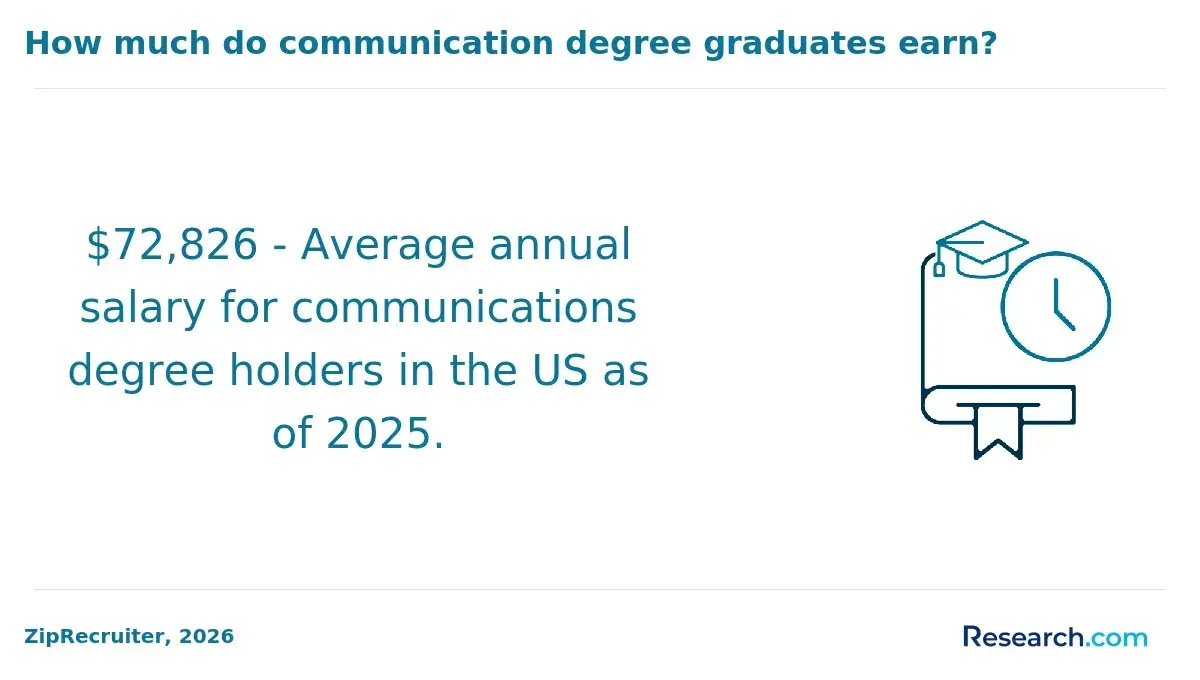
Gaining hands-on experience through internships and developing technical skills like data analysis or digital marketing further enhance earning potential. Notably, the average entry-level salary for communications degree holders reached $67,006 in 2026, as reported by recent job market data.
What Graduates Say About Communication as Their Major
- Paxton: "Pursuing communication was definitely challenging, but the skills I gained were invaluable. The average cost of attendance was steep, yet every dollar felt worth it because of how well it prepared me for a career in public relations. I'm grateful for the hands-on learning experience that opened doors I never expected. "
- Ameer: "Communication wasn't the easiest major, but it was incredibly rewarding. Balancing coursework with the financial commitment-around $25,000 annually-made me more disciplined. This major sharpened my critical thinking and interpersonal skills, which have had a lasting impact on both my professional growth and personal relationships. "
- Nathan: "The major required serious dedication, especially considering the tuition costs, but it was worth it. Studying communication taught me how to craft clear messages and understand audiences, which has been crucial in my marketing career. While the cost was high, the career opportunities and confidence it provided make it a strong investment. "
Other Things You Should Know About Communication Degrees
In 2027, communication majors face challenges including staying updated with rapidly changing media technologies and platforms. Additionally, students must adapt to a growing emphasis on digital content creation and data analysis while maintaining strong traditional communication skills. Balancing these elements requires a diverse skill set and continuous learning.
Communication theory can be challenging because it involves abstract concepts and interdisciplinary approaches from sociology, psychology, and linguistics. However, with consistent study and practical application, students typically become comfortable with these theories. Courses often blend theory with real-world examples, which aids comprehension.
By majoring in communication in 2027, students develop skills in critical thinking, public speaking, and writing. Additionally, they enhance their ability to analyze messages, understand audience dynamics, and use digital media effectively. These skills prepare students for roles in diverse fields like public relations, media, and corporate communication.
References
- How to Tackle the 13 Most Common Communication Barriers https://blog.haiilo.com/blog/communication-barriers/
- Is a communication degree a good fit for me? https://online.lynn.edu/resources/arts-sciences/is-communication-degree-right-fit
- Is a Communication Degree Worth It? https://und.edu/blog/is-a-communication-degree-worth-it.html
- How I Decided to Major in Communications | Bruin Blog https://www.georgefox.edu/bruin-blog/posts/2024/05/communications-major/index.html
- Is a Communication Degree Worth It? https://www.snhu.edu/about-us/newsroom/liberal-arts/is-a-communication-degree-worth-it
- What jobs can I get with a communications degree? https://study.uq.edu.au/stories/what-jobs-can-i-get-communications-degree
- 6 Tips Every Communications Major Should Know https://www.pearsonaccelerated.com/blog/what-communication-majors-should-know.html
- How To Choose Between Online Vs. Traditional Education Programs | PLNU https://www.pointloma.edu/resources/accelerated-undergraduate/how-choose-between-online-vs-traditional-education-programs


