
2027 MLS vs. MLIS: Explaining the Difference

Co-Founder and Chief Data Scientist
The choice between a Master of Library Science (MLS) and a Master of Library and Information Science (MLIS) is less about which degree sounds better and more about which curriculum matches the work you want to do. Both degrees can prepare students for librarian, archive, research, and information-management roles, but schools use the titles differently. In some universities, MLS is the traditional professional library degree; in others, MLIS signals a broader program that includes information systems, digital collections, data organization, and user-centered technology.
For prospective students, the most important questions are practical: Is the program accredited by the American Library Association? Does it support your target role, such as public librarian, academic librarian, school media specialist, digital archivist, or information manager? Can you complete the degree in a format and at a cost that fits your life? This guide compares MLS and MLIS programs by curriculum, skills, difficulty, cost, and career outcomes so you can evaluate programs with clearer expectations.
Key Points About Pursuing an MLS vs. MLIS
- MLS programs focus on practical library skills with a typical length of 1.5 to 2 years, often costing between $20,000 and $45,000 in tuition, and lead to librarian or archivist careers.
- MLIS programs emphasize information science theory, research, and technology integration, usually lasting 2 years with tuition from $15,000 to $40,000, suiting careers in digital libraries or data management.
- Both degrees offer strong job prospects, but an MLIS may provide broader roles in digital information fields, while an MLS is more traditional, centered on public and academic libraries.
What are MLS programs?
MLS programs, or Master of Library Science degrees, are graduate programs focused on the professional practice of librarianship. They prepare students to organize collections, support research, manage library services, and help users find reliable information in public, academic, school, government, and specialized library settings.
A typical MLS curriculum covers information organization, cataloging, reference services, collection development, library leadership, professional ethics, digital literacy, and user services. The degree is often a strong fit for students who want a library-centered education and expect to work directly with collections, patrons, faculty, students, researchers, or community members.
Most MLS programs require around 36 credit hours and can be completed in about two years of full-time study. Part-time students may take longer, especially if they are working while enrolled. Many programs now include online or hybrid options, but applicants should still look closely at fieldwork, internship, practicum, or capstone requirements because those experiences can affect scheduling and career preparation.
Admission generally requires a bachelor's degree and a satisfactory undergraduate GPA, often a minimum of 3.0. Some schools evaluate the last 60 credit hours if the overall GPA is lower. For many professional library positions, especially in academic and public libraries, accreditation by the American Library Association (ALA) is an important credential because it signals that the program meets recognized professional standards. Students pursuing school library roles should also check state certification or licensure rules before enrolling.
What are MLIS programs?
Master of Library and Information Science (MLIS) programs prepare students to manage, preserve, organize, analyze, and provide access to information in both library and non-library environments. The degree usually keeps the foundation of library science while adding a stronger emphasis on information systems, digital resources, metadata, data management, technology, and user experience.
MLIS programs are commonly designed for students who want flexibility in where they work. Graduates may pursue roles in public libraries, academic libraries, archives, digital repositories, corporate knowledge centers, cultural institutions, government agencies, or technology-supported information services. The program title often reflects the reality that modern information work extends beyond shelves, catalogs, and reference desks.
Full-time students typically complete an MLIS in around two years, while part-time and online formats can extend the timeline. Coursework often includes cataloging, information retrieval, data management, digital libraries, metadata, digital preservation, research methods, information policy, and ethics in information use. Many programs allow students to choose a concentration, complete an internship, build a portfolio, or write a thesis.
Admission usually requires a bachelor's degree in any discipline. This makes MLIS programs accessible to applicants from humanities, social science, education, technology, business, and other academic backgrounds. Students comparing programs should review not only the degree title but also the actual course list, specialization options, faculty expertise, and ALA accreditation status.
What are the similarities between MLS programs and MLIS programs?
MLS and MLIS programs overlap substantially. In many cases, the difference is a matter of institutional naming rather than a completely separate professional path. Both degrees are intended to prepare graduate-level professionals who can connect people with information, manage collections, evaluate sources, and support ethical access to knowledge.
- Shared professional foundation: Both programs commonly teach information organization, reference services, research support, collection development, library ethics, and user-centered service.
- Core library science coursework: Students in either degree may study cataloging, classification, metadata, knowledge organization, digital librarianship, information retrieval, and management of information resources.
- Similar program length: Most MLS and MLIS programs last between two and four years, depending on whether students enroll full-time or part-time.
- Comparable admissions expectations: Both typically require a bachelor's degree. Programs may review GPA, statements of purpose, recommendations, resumes, and, in some cases, standardized test scores.
- Flexible delivery options: Online, hybrid, evening, and part-time formats are common in both degree types, which can help working adults compare graduate study with other flexible pathways such as accelerated online degree options for working adults.
- Importance of accreditation: For students seeking professional librarian roles, the most important quality marker is often ALA accreditation rather than whether the title says MLS or MLIS.
The practical takeaway is that students should not choose based on the acronym alone. A well-designed MLS can include digital librarianship and information technology, while an MLIS can still provide strong preparation for traditional public, academic, or school library roles. The curriculum, accreditation, fieldwork, and career support matter more than the label.
What are the differences between MLS programs and MLIS programs?
The main difference is emphasis. MLS programs are usually framed around librarianship as a profession, while MLIS programs more explicitly combine library science with information science. That distinction can affect required courses, electives, technical depth, and the kinds of roles students feel prepared to pursue after graduation.
| Comparison point | MLS programs | MLIS programs |
| Primary focus | Traditional and contemporary library services, including cataloging, reference, collection management, and library administration. | Library services plus broader information science topics such as digital systems, data organization, metadata, and information technology. |
| Curriculum emphasis | Often centered on public, academic, school, or special library operations. | Often includes digital preservation, IT, data management, user experience design, and information architecture. |
| Skill profile | Strong preparation for patron services, collection work, research support, and library leadership. | Strong preparation for technology-supported information roles, digital collections, data workflows, and cross-sector information management. |
| Career flexibility | Commonly aligned with public, academic, school, law, and special libraries. | May support broader paths in libraries, archives, corporate information services, digital repositories, and technology-adjacent roles. |
| Best fit | Students who primarily want to work in library settings and value a focused professional library curriculum. | Students who want library training plus stronger preparation for digital, data, and information-systems work. |
These differences are not absolute. Some MLS programs are highly technical, and some MLIS programs are deeply grounded in traditional librarianship. When comparing programs, read the required courses first, then look at electives, practicum options, faculty specializations, and graduate job outcomes.
What skills do you gain from MLS programs vs MLIS programs?
MLS and MLIS programs build many of the same professional abilities, including research support, ethical information access, source evaluation, communication, and service design. The difference is usually in the balance between library operations and information-technology applications.
Skill Outcomes for MLS Programs
- Cataloging and classification: Students learn how to describe, organize, and maintain access to physical and digital materials so users can find them efficiently.
- Reference and research support: MLS programs train students to conduct reference interviews, guide users through databases, and help patrons evaluate sources.
- Collection development: Graduates learn to select, assess, preserve, and manage resources based on community, institutional, or academic needs.
- Library management: Coursework may cover budgeting, policy development, staff supervision, planning, outreach, and assessment of library services.
- Public service and community engagement: MLS students often develop skills in programming, literacy support, instruction, and inclusive service delivery.
These skills are especially useful for students pursuing public librarian, academic librarian, school librarian, law library, or special library roles that require direct service and collection expertise.
Skill Outcomes for MLIS Programs
- Digital resource management: MLIS programs often place stronger emphasis on electronic collections, digital repositories, and access systems.
- Metadata and information architecture: Students learn how information is structured, tagged, retrieved, and displayed across databases, archives, and digital platforms.
- Data analytics and governance: Some programs train students to use user data, information policies, and preservation standards to improve services and manage digital assets.
- User experience and systems thinking: MLIS coursework may include usability, interface design, search behavior, and the design of information environments.
- Technology-supported preservation: Students may study digital preservation, records management, and long-term access to born-digital materials.
Students who want stronger technical preparation may find an MLIS a better fit, particularly if they are interested in archives, digital libraries, knowledge management, or corporate information work. Those comparing flexible admissions and online options may also want to review open enrollment colleges as part of a broader education-planning process.
The strongest graduates from either degree combine service skills with technical fluency. Modern library and information work increasingly requires both: the ability to understand users and the ability to manage complex information systems.
Which is more difficult, MLS programs or MLIS programs?
Neither degree is automatically harder. MLS and MLIS programs typically last about two years and require around 36 credit hours, but the difficulty depends on the curriculum, the delivery format, the student's background, and the amount of research, technology, and fieldwork required.
MLS programs can be demanding because they require strong writing, research, user-service judgment, and applied knowledge of cataloging, collection development, and library operations. Students who have not worked in libraries may need time to understand professional vocabulary, service models, and ethical standards.
MLIS programs may feel more challenging for students who are less comfortable with technology, data, metadata, systems design, or digital preservation. These programs generally include more courses in information science, management, and technology, creating broader academic exposure. Some may also require original research theses or portfolios, which can increase the workload.
The better question is not “Which is harder?” but “Which kind of challenge matches my strengths?” Students who enjoy community service, reading, instruction, and collection work may find MLS coursework more intuitive. Students who like databases, digital platforms, information systems, and analytical projects may find MLIS coursework more engaging, even if it is technically demanding.
Assessment methods in both programs can include exams, research papers, group projects, cataloging assignments, technology projects, portfolios, internships, and capstones. Before enrolling, review sample syllabi when available and ask whether the program requires synchronous classes, campus visits, practicum hours, or a thesis. Students weighing graduate education against broader earning goals may also compare related fields and majors that lead to high paying jobs.
What are the career outcomes for MLS programs vs MLIS programs?
MLS and MLIS graduates often compete for many of the same library jobs, especially when both degrees are ALA-accredited. Career outcomes depend heavily on specialization, location, work experience, internships, technology skills, and whether the role requires state certification, school media credentials, or subject expertise.
Career Outcomes for MLS Programs
MLS graduates are commonly prepared for roles centered on library operations, research support, collections, and specialized information services. Some career paths may have a strong legal or specialized focus, and advancement may require additional subject knowledge, management experience, or a concentration within the degree.
- Legal Information Specialist - Managing specialized resources and supporting legal research in law libraries or legal information environments.
- Law Library Manager - Overseeing operations, staff, collections, and services within legal libraries.
- Information Services Coordinator - Supporting access to specialized information for clients, researchers, students, or organizations.
Career Outcomes for MLIS Programs
MLIS graduates may have broader options because the degree often includes information technology, digital curation, data organization, and digital access skills. Demand is described as approximately 3% over the next decade, with median salaries above $64,000. Roles may span academic, corporate, government, school, and cultural heritage settings.
- School Librarian - Managing educational resources, teaching information literacy, and supporting student learning in K-12 settings.
- Digital Archivist - Preserving, organizing, describing, and providing access to digital collections for institutions.
- Reference Librarian - Assisting users with research, database searching, source evaluation, and information retrieval across different sectors.
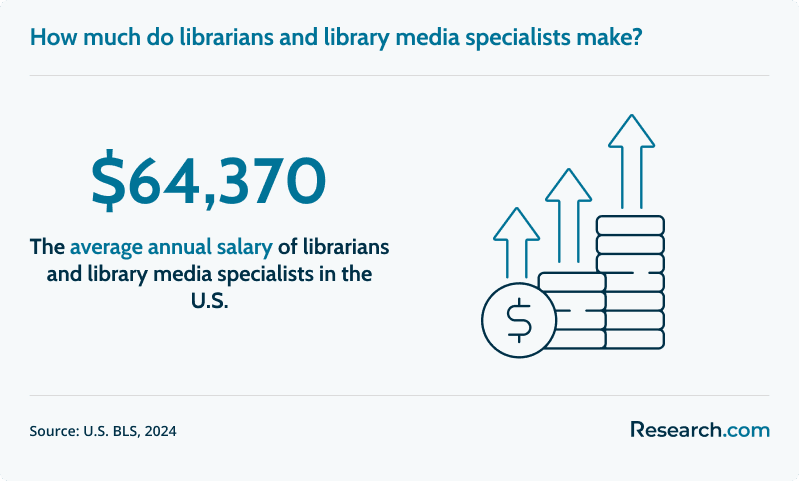
Median salaries for librarians and media specialists hovered near $60,820 in 2020, with top earners exceeding $94,520. These figures can vary by employer type, region, union status, education setting, and years of experience. Students who want leadership, faculty, research, or advanced administrative opportunities may eventually consider further graduate study, including options such as the shortest doctoral programs.
How much does it cost to pursue MLS programs vs MLIS programs?
The cost of an MLS or MLIS degree varies widely by institution type, residency status, online versus campus format, fees, and the number of credits required. The degree title alone does not determine cost. Public universities may be more affordable for in-state students, while private universities and out-of-state tuition can increase the total price significantly.
| Cost factor | MLS programs | MLIS programs |
| Public in-state tuition | Can be comparatively affordable. North Carolina Central University charges $10,750 for its online MLS program to residents. | Public university programs generally range from $8,000 to $22,000 for the full degree, whether online or on campus for resident students. |
| Out-of-state or non-resident tuition | Non-resident students at North Carolina Central University can expect costs near $35,000. | Costs vary by institution and may rise substantially for non-resident students. |
| Private university cost | Private universities and out-of-state tuition at public schools often push total expenses beyond $30,000. | Private or higher-cost programs may also exceed lower public university rates. |
| Examples | MLS pricing varies by school, residency, and delivery format. | The University of Southern Mississippi has a total online MLIS cost of about $20,480, and the University of Missouri charges around $21,910. Northeastern State University offers annual tuition as low as $4,816. |
| Additional expenses | Fees, textbooks, and technology usually add between $1,000 and $3,000 annually. | Fees, textbooks, and technology usually add between $1,000 and $3,000 annually. |
To estimate the real cost, calculate total tuition, mandatory fees, technology fees, books, travel for any required campus visits, practicum-related expenses, and the opportunity cost of reducing work hours. Online programs can reduce relocation and commuting expenses, but they are not always cheaper on a tuition-per-credit basis.
Financial aid, scholarships, assistantships, employer tuition benefits, and federal assistance may be available for both MLS and MLIS students. Compare the net cost after aid, not just the advertised tuition. Also ask whether the program charges different rates for online students, out-of-state students, or part-time enrollment.
How to Choose Between MLS Programs and MLIS Programs
Choose between an MLS and an MLIS by starting with your target job, then working backward to the program requirements. The best degree is the one that gives you the accreditation, coursework, field experience, and professional network needed for the roles you actually want.
- Check accreditation first: If you want professional librarian roles, confirm whether the program is accredited by the American Library Association. Accreditation may matter more to employers than the MLS or MLIS title.
- Match the curriculum to your career goal: Choose an MLS if you want a more library-centered curriculum focused on public, academic, school, law, or special library services. Choose an MLIS if you want stronger exposure to digital curation, information systems, data management, metadata, or corporate information work.
- Review specializations: Look for concentrations in areas such as archives, youth services, school librarianship, digital libraries, data curation, law librarianship, or academic librarianship.
- Confirm certification requirements: If you plan to become a school librarian or media specialist, check your state’s certification or licensure requirements before enrolling.
- Compare field experience: Internships, practicums, portfolios, and capstones can help you build experience, especially if you are entering the field without prior library work.
- Evaluate format and workload: Online and hybrid programs can be convenient, but synchronous meetings, group projects, practicum hours, and technology requirements can still affect your schedule.
- Look at career support: Ask about placement data, employer partnerships, alumni networks, assistantships, and whether faculty have expertise in your area of interest.
- Calculate total cost: Compare tuition, fees, books, technology costs, residency rates, and aid. A lower sticker price is not always the lowest net cost.
A practical decision rule is simple: choose an MLS if your goal is primarily traditional library service and leadership; choose an MLIS if you want library training combined with broader information technology and digital information skills. If two programs are both ALA-accredited and have similar outcomes, choose the one with stronger courses, fieldwork, affordability, and employer connections in your intended specialty.
Students still exploring career direction may find it useful to compare graduate library pathways with other occupational routes, including resources on career options for trade school graduates. The point is not that these paths are interchangeable, but that education decisions should be tied to realistic job goals, costs, and timelines.
What Graduates Say About Their Degrees in MLS and MLIS
Graduate feedback can be helpful, but readers should interpret comments carefully because the acronym “MLS” may refer to different degrees in different fields. In library education, MLS usually means Master of Library Science; in healthcare contexts, it may refer to medical laboratory science. Always verify the degree title, program curriculum, and career field when comparing testimonials.
- Arden: "The MLS program challenged me academically in ways I hadn't expected, especially with its focus on critical thinking and hands-on laboratory skills. The integrated internships prepared me well for the real-world demands of clinical settings. It truly made me confident stepping into my role as a medical technologist."
- Chienna: "What I appreciated most about the MLIS program was the diverse learning opportunities, from digital archiving to information ethics. The virtual workshops were extremely beneficial, offering exposure to cutting-edge technologies while maintaining flexibility. This experience enriched my perspective on how libraries evolve in the digital age."
- Matthew: "Completing the MLS degree substantially boosted my career prospects, allowing me to secure a position in a hospital's diagnostic laboratory within months. The program's emphasis on both theory and practical skills meant I was job-ready and more competitive in a growing healthcare industry. My income growth since graduation has reflected that advantage."
Other Things You Should Know About MLS Programs & MLIS Programs
In 2027, MLS programs typically require a bachelor's degree and coursework in information science, while MLIS programs may require a background in library science, a statement of purpose, and sometimes GRE scores, making admissions slightly more competitive.
In 2027, MLIS graduates often have an edge in digital or technology roles due to their specialized training in information science. They are well-prepared for positions like digital librarianship, data management, and digital archiving, which require strong technical and analytical skills.
An MLIS is better suited for roles in 2027 like digital curation, information architecture, and user experience design. These positions require skills in information technology and digital management, areas where MLIS programs often focus more intensely compared to a generalist MLS.
References
- Choosing the Right Library Science Program: Factors to Consider – Librarian Certification https://www.librariancertification.com/choosing-the-right-library-science-program-factors-to-consider/
- Accreditation Frequently Asked Questions | ALA https://www.ala.org/educationcareers/accreditedprograms/faq
- Is the MLS Necessary? Rethinking Library Science Education | Steffy | College & Research Libraries News https://crln.acrl.org/index.php/crlnews/article/view/26512/34424
- MLS vs. MLIS Programs: What’s the Difference? https://howtobecomealibrarian.com/mls-vs-mlis/
- MLIS Master of Library and Information Studies - The University of Alabama https://online.ua.edu/degrees/mlis-master-of-library-and-information-studies/
- What Can You Do With a Library Science Degree? | Syracuse University https://onlinegrad.syracuse.edu/information-science/mslis/library-science-careers/
- Medical Laboratory Scientist | Responsibilities, Salary, & Education https://onlinedegrees.uwf.edu/program-resources/what-is-a-medical-laboratory-scientist/
- Library Science Salary with Masters Degree - MLS, MLIS, MSLS https://www.mastersinlibraryscience.net/salary-outlook-masters-librarian-degree/
- MLS Degree vs MLIS Degree | Compare Master's in Library Science https://www.mastersinlibraryscience.org/mls-vs-mlis/
- Master of Library & Information Science (MLIS) - UCLA School of Education & Information Studies https://seis.ucla.edu/academics/department-of-information-studies/master-of-library-information-science-mlis/


