
2027 Public Service Careers: Skills, Education, Salary & Job Outlook

Co-Founder and Chief Data Scientist
Public service careers can be rewarding, stable, and difficult to enter without a clear plan. The field spans government agencies, community programs, public safety, policy, administration, public works, human services, and nonprofit-adjacent roles. Some jobs are accessible with a high school diploma or associate degree, while professional and leadership roles often expect a relevant bachelor's degree, specialized training, security clearance, or graduate education.
The main decision is not simply whether public service is meaningful. It is whether the day-to-day work, hiring process, pay structure, advancement timeline, and public accountability match your goals. Public service can offer strong long-term stability, with median salaries surpassing $100,000 for key roles and a job tenure twice that of the private sector, but pay and mobility vary widely by agency, location, role, budget, and credential requirements.
This guide explains what public service professionals do, the skills and education employers look for, realistic salary and job outlook expectations, and how to decide whether this path fits your strengths. With over a decade of expert career guidance behind this advice, the goal is to help you move from broad interest to a practical career plan.
Key Things You Should Know About Public Service Careers
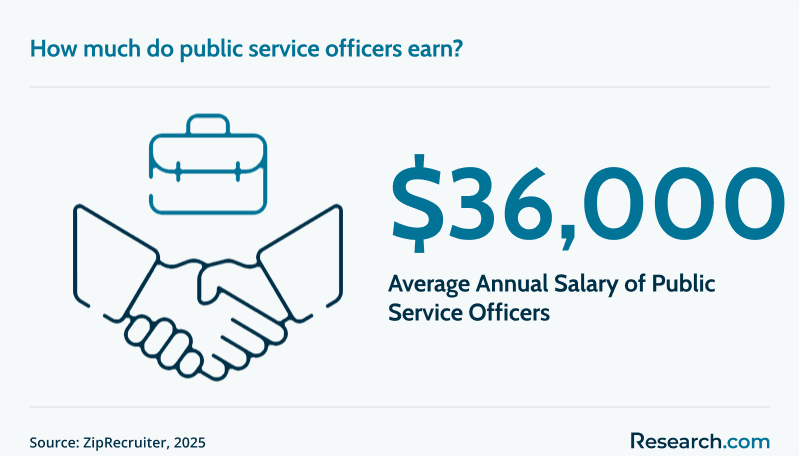
- The average public service officer in the United States earns about $36,000 annually, with most salaries falling between $32,000 and $40,500.
- This field has a broad pay range and an active job market, indicating steady demand and opportunities for growth.
- At least a high school diploma or equivalent is usually needed to start, though some roles may require extra certifications or postsecondary education.
- Success depends on strong communication, problem-solving, conflict resolution, integrity, and the ability to work well with diverse populations and in challenging situations.
- Experience and skill development can lead to supervisory or specialized roles, and eventually to senior management or administrative positions.
What do public service professionals do?
Public service professionals help government agencies and community-serving organizations deliver programs, enforce rules, manage resources, respond to public needs, and improve quality of life. Their work may involve direct citizen support, program administration, policy research, budgeting, emergency response coordination, inspection, outreach, case management, or operations support.
What makes public service different from many private-sector careers is the purpose of the work. The primary goal is not profit. It is to provide reliable services, protect public interests, comply with laws, and use taxpayer or grant-funded resources responsibly. That can make the work highly meaningful, but it also brings public scrutiny, strict procedures, and slower decision-making.
A day in the life of public service professionals
A typical day depends heavily on the role. An administrative employee may answer public inquiries, prepare documents, update records, and coordinate meetings. A program analyst may review data, evaluate whether a public program is working, and brief agency leaders. A public works or field-based employee may inspect infrastructure, coordinate vendors, respond to service requests, or manage community projects.
Across these roles, public service professionals often balance three demands at once: serving people, following rules, and solving practical problems with limited resources. The work can be structured and procedural, but it can also change quickly when a community issue, policy change, budget deadline, public complaint, or emergency requires immediate attention.
What are the key responsibilities of public service professionals?
Public service responsibilities vary by agency and job level, but most roles require accurate communication, careful recordkeeping, program knowledge, and sound judgment. Employees often serve as the link between the public and the systems designed to support them.
- Answer telephone calls, greet visitors, identify their needs, and route them to the appropriate department, official, or service provider.
- Prepare official documents, including reports, letters, notices, meeting materials, and correspondence that follow required formats.
- Enter accurate data into computer systems and maintain records of services, activities, applications, complaints, or citizen interactions.
- Research specialized topics related to programs, laws, funding rules, or community needs, then summarize findings and alternatives clearly.
- Explain government services, programs, procedures, and policies to residents, partner organizations, elected officials, or internal teams.
- Organize public events, tours, meetings, outreach efforts, and educational activities for community groups, schools, or stakeholder organizations.
The most challenging vs. the most rewarding tasks
The most difficult part of many public service jobs is handling problems that are both personal and procedural. A resident may be angry, frightened, confused, or under financial pressure, while the employee still has to apply laws, eligibility rules, deadlines, documentation standards, or agency policies accurately.
Strong professionals learn how to stay calm, explain complex requirements in plain language, and avoid promising outcomes they cannot control. This is especially important when several rules apply at once or when the public expects faster answers than the system can provide.
The most rewarding moments often come when that same system becomes easier for someone to navigate. Helping a family understand a benefit, guiding a resident to the right department, resolving a service delay, or improving a public process can create a direct and visible impact.
If you want a shorter training route before committing to a degree, exploring 6 month certifications that pay well may help you compare practical credentials that can support entry into public-facing or administrative roles.
What are the key skills for public service professionals?
Public service employers usually look for a mix of technical competence, communication ability, ethical judgment, and reliability. The best candidates can follow rules without becoming rigid, work with data without ignoring people, and communicate clearly with audiences that may have very different levels of knowledge.
Key hard skills
- Policy analysis and evaluation: Review laws, regulations, program data, and outcomes to determine whether public initiatives are effective.
- Strategic planning: Set priorities, define goals, coordinate timelines, and help agencies move from ideas to implementation.
- Financial and budgetary management: Prepare, monitor, and explain budgets while following funding requirements and compliance rules.
- Stakeholder engagement and communication: Work with residents, officials, vendors, community groups, and partner agencies to gather input and coordinate action.
- Records and information management: Maintain accurate documentation, protect sensitive information, and use databases or case management systems correctly.
- Digital and data literacy: Use common office software, reporting tools, dashboards, and online service platforms to improve accuracy and efficiency.
Core soft skills
- Critical thinking: Break down complex public problems, identify constraints, and recommend practical next steps.
- Leadership: Coordinate people, projects, and priorities, even when authority is shared across departments or agencies.
- Communication: Explain rules, decisions, and services clearly to diverse audiences, including people under stress.
- Ethical judgment and integrity: Protect confidential information, avoid conflicts of interest, and make decisions that can withstand public review.
- Patience and emotional control: Stay professional during complaints, delays, public meetings, or high-pressure service interactions.
The one overlooked skill that separates the good from the great
Change management is often the skill that separates competent public service employees from future leaders. Agencies regularly face new laws, budget changes, technology upgrades, leadership transitions, emergencies, and shifting community expectations. A strong change manager can help teams adapt without losing service quality or public trust.
This skill matters because public agencies cannot simply pause essential services while they reorganize. Professionals who can explain the reason for change, train colleagues, anticipate resistance, and keep projects moving are more likely to be trusted with larger responsibilities.
Those who combine change management with policy, budget, communication, and data skills can become stronger candidates for leadership roles, including roles within the Federal Executive Branch, the top-paying industry in the field.
If you are comparing long-term academic options, reviewing the easiest doctorate degrees to get may help you understand how advanced credentials differ by workload, structure, and career use.
Public Policy and Social Services Degree Statistics

Public Service Careers: A Step-by-Step Guide to Getting Started
Starting a public service career is easier when you match your preparation to a specific role instead of applying broadly to every government opening. Use the steps below to move from exploration to a competitive application.
- Choose a public service lane. Decide whether you are more interested in administration, public safety, policy, social services, public health, environmental work, public works, human resources, finance, or technology. Each path has different education and hiring requirements.
- Build the right educational foundation. Entry-level support roles may require a high school diploma or equivalent, while many professional roles expect an associate degree, bachelor's degree, or specialized coursework in a relevant field.
- Gain practical experience early. Use internships, AmeriCorps-style service, campus jobs, volunteer roles, city or county seasonal work, nonprofit experience, or entry-level administrative jobs to learn how public-facing systems operate.
- Learn the hiring process. Government applications often require detailed resumes, eligibility screening, exams, background checks, veteran preference review, or civil service lists. Read each posting carefully and mirror the required qualifications with specific evidence.
- Obtain required credentials or clearances. Some roles require background checks, drug screening, driving records, exams, licenses, security clearance, or role-specific certifications before hiring or promotion.
- Keep training after you are hired. Public service careers reward employees who understand policies, systems, procurement rules, data tools, leadership practices, and agency-specific procedures.
- Specialize or move into leadership. After building experience, you can pursue program management, analysis, supervision, compliance, budgeting, emergency management, public works management, or policy leadership.
A common mistake is treating public service as one career. It is better to treat it as a broad employment sector with many tracks. The more precisely you define the role you want, the easier it becomes to choose the right degree, credential, internship, and application strategy.
What education, training, or certifications are required?
Education requirements in public service depend on the position. Some entry-level federal roles require at least a high school diploma or equivalent. Many professional positions list a bachelor's degree in public administration, political science, or a related field as the standard. Associate degrees can also support technical, administrative, public works, emergency management, or paraprofessional pathways, especially when paired with relevant experience or certifications.
Common fields of study include public administration, political science, criminal justice, social work, public health, business administration, finance, information technology, environmental science, emergency management, communications, and urban planning. The best choice depends on the job family you want to enter.
Relevant certifications may include the Certified Public Works Professional-Management (CPWP-M) from the American Public Works Association and the Public Sector HR Associate (PSHRA-CP) by the Public Sector HR Association. These credentials often require several years of supervised public service experience, so they are usually more useful after you have already entered the field.
Training also happens on the job. Internships, rotational programs, leadership development programs, civil service training, compliance training, and agency-specific systems training are common ways to build practical knowledge.
Are advanced degrees or niche certifications worth the investment?
Advanced degrees, such as a Master of Public Administration, can be valuable for people targeting policy, management, budgeting, analysis, nonprofit leadership, or executive-track roles. They can also expand professional networks and help candidates compete for roles that require stronger writing, research, and leadership preparation.
The trade-off is cost and time. Graduate programs often take two years full-time, and certifications may require renewal, continuing education, exams, fees, or documented experience. A credential is most useful when it appears in job postings you actually want or when your agency clearly ties it to promotion, pay, or eligibility.
| Credential path | Best fit | What to check before enrolling |
| Associate degree | Administrative, technical, public works, support, or transfer pathways | Whether credits transfer and whether local agencies value the program |
| Bachelor's degree | Professional public administration, policy, analysis, HR, finance, and program roles | Required major, internship access, and public-sector career placement |
| Master's degree | Management, policy, executive-track, research, or specialized leadership roles | Return on investment, employer tuition support, and promotion relevance |
| Professional certification | Specialized roles in public works, HR, emergency management, finance, or compliance | Experience requirements, renewal rules, and whether postings request it |
If cost is a major concern, comparing the cheapest associate programs online can be a practical starting point before committing to a longer degree path.
What is the earning potential for public service professionals?
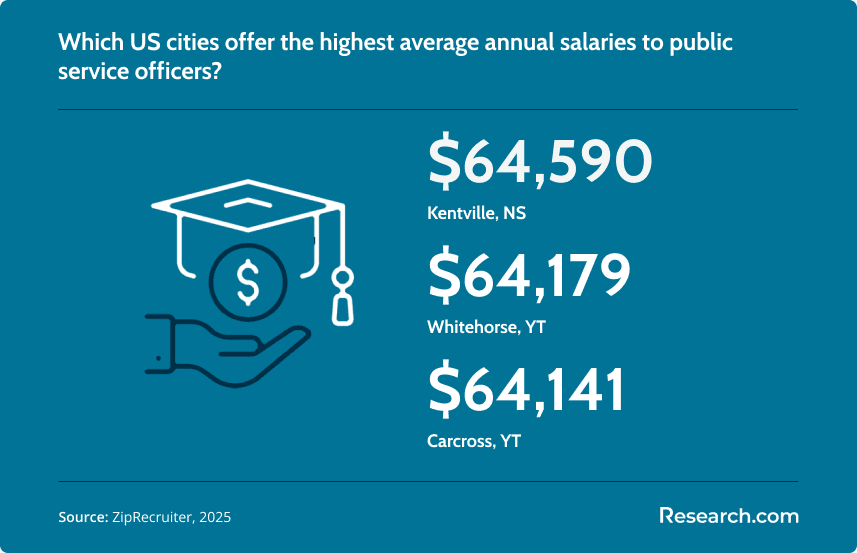
The average salary for public service officer positions in the United States is $36,000 annually, or approximately $17.31 per hour. The public service career salary range from entry to senior level spans from $32,000 for entry-level roles to $43,500 for top earners.
These figures should be interpreted carefully because “public service professional” is a broad label. Earnings can differ substantially by job title, level of government, union contract, locality pay, overtime eligibility, agency budget, education level, and whether the role is administrative, technical, analytical, supervisory, or field-based.
| Factor | How it affects pay |
| Location | Higher-cost regions may offer higher pay scales, while smaller or less-funded jurisdictions may pay less. |
| Experience | Employees often move through steps, grades, or classifications as they gain time in role and stronger performance records. |
| Agency and sector | Federal, state, and local agencies may use different pay systems, benefits, and promotion rules. |
| Specialization | Skills in budgeting, IT, cybersecurity, data analysis, public works, compliance, and management may improve competitiveness for better-paid roles. |
| Education and credentials | Degrees and certifications can help when they match the minimum qualifications or preferred qualifications in job postings. |
For career planning, look beyond the starting salary. Public-sector compensation may also include health insurance, retirement plans, paid leave, tuition assistance, predictable schedules, and job stability. These benefits can be important, but they do not replace the need to compare actual pay scales for the roles and locations you are considering.
What is the job outlook for public service professionals?
The projected growth rate for public service professional roles is about 2% from 2024 to 2034, which is slower than the average for all occupations. Even with modest growth, public service employment remains important because communities continue to need government operations, public safety, infrastructure support, benefit administration, public health programs, records management, and regulatory services.
The key factors shaping the future outlook
One major factor is retirement. Nearly half of organizations expect major retirement surges soon, which may create openings but also leave agencies with knowledge gaps. Newer employees who learn quickly, document processes, and develop leadership potential may find opportunities as experienced workers exit.
Technology is also changing the field. Automation and AI may reduce some routine administrative tasks, but they can increase demand for employees who understand digital services, data quality, cybersecurity, privacy, online case management, and technology-supported public engagement.
Budget pressure is another reality. Agencies may need employees who can do more with limited resources, justify programs with data, manage grants carefully, and improve service delivery without sacrificing compliance or equity.
For people who want a faster route into stable roles, researching short programs that pay well can help identify training options aligned with practical public-sector needs.
What is the typical work environment for public service professionals?
The public service work environment is usually structured, policy-driven, and team-oriented. Many roles follow standard weekday business hours, such as 8 a.m. to 5 p.m. However, public safety, emergency services, infrastructure, inspections, public health response, and community outreach roles may require evenings, weekends, fieldwork, travel, or on-call shifts.
Remote work depends on the job. Administrative, analytical, technology, finance, HR, and policy roles may offer hybrid or remote options when duties can be performed securely online. Direct service, public-facing, inspection, emergency response, and field roles usually require more on-site work.
Many public service professionals work in government office buildings or agency facilities. The employment distribution reflects that 36% of these professionals work for the federal government (excluding postal service), 28% for state government (excluding education and hospitals), and 24% for local government (excluding education and hospitals).
Collaboration is common. You may work with supervisors, legal staff, finance teams, elected officials, vendors, community partners, residents, and other agencies. At the same time, much of the work requires independent attention to details, deadlines, records, and compliance requirements.
What are the pros and cons of public service careers?
Public service can be an excellent fit for people who value mission, stability, structure, and community impact. It can be frustrating for people who prefer rapid change, high earning ceilings, minimal bureaucracy, or complete control over decisions. The right choice depends on what motivates you and how you handle public accountability.
| Pros | Cons |
| Work can create visible benefits for residents, families, neighborhoods, and public systems. | Progress may be slowed by rules, approval chains, limited budgets, and political constraints. |
| Many roles offer stable schedules, benefits, retirement plans, and predictable advancement systems. | Pay may be lower than comparable private-sector roles, especially in highly technical fields. |
| The mission can provide strong personal meaning and a sense of public purpose. | Public scrutiny, complaints, and emotionally difficult cases can lead to stress or burnout. |
| Clear procedures can make expectations, eligibility, and promotion criteria easier to understand. | Strict procedures can also limit creativity and slow responses to urgent problems. |
Intrinsic rewards
- Making a tangible difference in the community and seeing how daily work improves lives.
- Serving a public mission that can make routine tasks feel connected to a larger purpose.
- Celebrating practical wins, such as resolving a case, improving a process, or helping a resident access a service.
- Working on complex problems that affect long-term community well-being.
Intrinsic challenges
- Managing emotional exhaustion from public scrutiny, complaints, and high expectations.
- Handling heavy workloads with limited staffing, funding, or technology.
- Navigating bureaucracy, changing policies, and information overload.
- Responding to unpredictable or high-stakes situations that require careful judgment.
If your top priorities are income growth, hands-on work, and a shorter training timeline, you may also want to compare public service with the best paying trade school jobs, which offer a different balance of stability, pay, and daily responsibilities.
What are the opportunities for advancement for public service professionals?
Public service advancement is often more structured than advancement in the private sector. Many agencies use grades, classifications, step increases, civil service exams, supervisory tracks, or formal promotion requirements. That structure can make growth predictable, but it also means employees must pay close attention to eligibility rules, required experience, performance reviews, and application timelines.
Clear advancement pathways
- Entry level: Begin as a Public Service Professional in roles such as Program Assistant, Administrative Assistant, Case Aide, Technician, or Analyst, where you learn systems, procedures, and public-facing responsibilities.
- Mid level: Move into roles such as Project Manager, Program Manager, Senior Analyst, Coordinator, or Specialist after building experience and stronger technical or functional expertise.
- Senior level: Advance into Senior-Expert Program/Project Manager, supervisory roles, department leadership, or positions aligned with higher government classifications, such as GS-13.
Strategies for growth and specialization
Understanding how to get promoted in government jobs starts with reading promotion criteria early. Do not wait until you are ready to apply. Identify the experience, education, competencies, exams, supervisory recommendations, or specialized skills required for the next level, then build evidence over time.
- Choose specialization areas such as Public Safety, Social Welfare & Counseling, Natural Resources & Environmental Services, or Administration & Program Management.
- Pursue targeted training and certifications that match your desired role, not credentials that sound impressive but are absent from job postings.
- Seek mentors who understand your agency's classification system, promotion process, and unwritten expectations.
- Volunteer for cross-functional projects that expose you to budgeting, data, compliance, procurement, or community engagement.
- Document measurable accomplishments, such as reduced processing time, improved outreach, stronger reporting accuracy, or successful program implementation.
- Watch for skills-based hiring opportunities tied to technology, cybersecurity, data, emergency management, grants, and program evaluation.
Public service career advancement opportunities are real, but they reward patience, documentation, credibility, and consistent performance. Employees who combine mission commitment with practical evidence of results are usually better positioned for promotion.
What other careers should you consider?
If you are interested in public service but unsure whether a government role is the best fit, compare nearby careers that use similar skills. These options may offer different work environments, funding models, advancement patterns, or levels of public interaction.
- Non-Governmental Organization (NGO) Professional: Works on social, humanitarian, environmental, or development goals through advocacy, program delivery, partnerships, and community engagement.
- Policy Analyst: Uses research, data, writing, and stakeholder input to evaluate policy options and recommend improvements for government agencies, think tanks, nonprofits, or consulting groups.
- Nonprofit Executive/Administrator: Leads mission-driven organizations by managing programs, staff, budgets, fundraising, compliance, and community partnerships.
- Urban and Regional Planner: Helps shape land use, transportation, housing, environmental planning, and community development through research, public meetings, and long-range plans.
- Public Health Educator: Promotes health and wellness through education, outreach, prevention campaigns, and community-based programs, often with a focus on underserved populations.
Use these alternatives to clarify what you want most. If you want policy influence, analysis may fit. If you want direct community impact, public health education or nonprofit work may be stronger. If you want structured employment and public accountability, a government public service role may be the better match.
Here's What Professionals Say About Their Public Service Careers
-
: "Every day, I left work feeling like I had made a real difference, even if it was just helping a single family navigate the housing application process. Knowing that my experience growing up in a low-income neighborhood gave me insight into the struggles they face made my work all the more meaningful. I often reminded myself that these small moments kept the community moving in the right direction. It's this connection to people's real lives that keeps me motivated.
Malik"
-
: "I've faced my own battles with addiction, and being open about that has helped me build trust with those I serve. Sharing my story wasn't easy, but it broke down barriers and allowed me to push more compassionate solutions on overdose prevention. Tackling these challenges means facing stigma head-on and balancing empathy with hard decisions every day. My hope is that by being honest, I make it easier for others to seek help too.
Claire"
-
: "One of the most rewarding parts of my role was creating a health outreach program that directly linked vulnerable families to essential services. Seeing parents come in and access resources I helped organize was a powerful reminder that policy isn't just on paper-it changes lives. Those moments made me realize why I chose public service in the first place. Each success story became its own motivation to keep improving our approach.
Jonathan"
Key Findings
- Public service careers cover many roles, including administration, policy, public works, public safety, human services, public health, environmental services, and program management.
- Entry requirements vary widely. Some roles require a high school diploma or equivalent, while many professional positions expect a bachelor's degree in public administration, political science, or a related field.
- Important skills include policy analysis, budgeting, communication, stakeholder engagement, ethical judgment, data literacy, and change management.
- The average salary for public service officer positions in the United States is $36,000 annually, or approximately $17.31 per hour, with a stated range from $32,000 for entry-level roles to $43,500 for top earners.
- The projected growth rate for public service professional roles is about 2% from 2024 to 2034, but retirements, technology change, and essential public needs may continue to create openings.
- Public service can offer stability, purpose, and strong benefits, but it can also involve bureaucracy, emotional pressure, limited resources, and slower advancement.
- The best way to start is to choose a specific public service track, build the required education and experience, learn the hiring process, and pursue credentials only when they match your target role.
Other Things You Should Know About Public Service
In 2027, public service careers demand skills in data analysis, communication, and project management. As digital transformation continues, proficiency in technology and adaptability to change are crucial. Soft skills like empathy and collaboration also remain highly valued in this sector.
Competency-based frameworks are vital tools for hiring, performance evaluation, and professional development in public service. These frameworks align employee skills with shifting organizational needs, including digital literacy and adaptability. They foster fair, transparent decision making, which is crucial in a sector under constant public scrutiny.
Contrary to popular belief, public service roles are not static or slow-moving. The sector demands continuous upskilling, particularly in digital skills and innovative problem solving, and embraces flexible work models. This makes public service both dynamic and intellectually stimulating, offering substantial opportunities for professional growth.
References
- Tips and tricks to kick-start your public service career https://www.publicserviceresumes.com.au/tips-and-tricks-to-kick-start-your-public-service-career/
- Public Service Careers: A Mission-Driven Industry with Real Rewards https://carsey.unh.edu/blog/2025/05/public-service-careers-mission-driven-industry-real-rewards
- 8 Public Administration Careers and Salaries https://online.hilbert.edu/blog/public-administration-careers/
- Civil Servant - Alternative Careers and Similar Jobs (Updated for 2025) https://resumeworded.com/career-profiles/civil-servant-career-profile
- Public sector and civil service: career FAQs https://gradireland.com/careers-advice/public-services-and-administration/public-sector-and-civil-service-career-faqs
- Civil Service grades and pay https://www.civil-service-careers.gov.uk/civil-service-grades-and-pay/
- Public Service Careers | Careers In Government https://www.careersingovernment.com/tools/blog/public-service-careers/
- Public VS Private Sector Careers: Which One is Right for You? - MANCOSA https://www.mancosa.co.za/blog/public-vs-private-sector-careers-which-one-is-right-for-you/
- Careers guidance and access for education and training providers https://www.gov.uk/government/publications/careers-guidance-provision-for-young-people-in-schools
- The highs and lows of working in the public sector https://studynewzealand.nz/career-planning/the-highs-and-lows-of-working-in-the-public-sector


