
2027 Security Architect Careers: Skills, Education, Salary & Job Outlook

Co-Founder and Chief Data Scientist
Becoming a security architect is a senior cybersecurity goal, not an entry-level job. The decision is whether you are willing to build several layers of expertise: systems and networking, secure design, cloud environments, risk management, compliance, incident response, and leadership. For people who enjoy both deep technical work and high-stakes business decisions, the role can be one of the most rewarding paths in cybersecurity.
The career also requires realistic planning. Security architects are expected to make decisions that affect how an organization protects data, applications, infrastructure, and operations. That level of responsibility usually comes after a computer science, cybersecurity, or information technology education, followed by years of hands-on work and recognized certifications. The pace of change is fast, but the core principles of secure architecture, threat modeling, governance, and risk-based decision-making remain valuable across tools and technologies.
The opportunity is significant. With job growth projected at 37% and median salaries exceeding $150,000 annually, security architect careers offer strong financial upside and long-term relevance. This guide explains what security architects do, the skills and credentials employers look for, how to enter the field, what the work environment is like, and how to decide whether this path fits your strengths and goals.
Key Things You Should Know About Security Architect Career
- The typical earning potential for a security architect ranges between $148,000 and $220,000 per year, depending on experience and location.
- Demand for security architects is strong, supported by the significant growth projected for information security analysts and the expanding cybersecurity field.
- A bachelor's degree in computer science, cybersecurity, or a related field is usually required, along with certifications like CEH or CISA, to enhance credentials.
- Success relies on skills in security frameworks, threat analysis, risk management, compliance, plus technical expertise in active directory and cloud security, combined with strong communication and project management abilities.
- This career can advance to senior roles such as principal security architect or chief security architect, with greater responsibilities and higher salaries as expertise grows.
What do Security Architects do?
Security architects design the blueprint for how an organization protects its digital environment. They decide how networks, applications, cloud platforms, identity systems, data stores, and security tools should work together to reduce risk without blocking normal business operations.
The role is broader than configuring firewalls or responding to alerts. A security architect translates business risks into technical designs, policies, controls, and standards. They may evaluate a new cloud deployment, design a zero-trust access model, review an application architecture, or advise executives on the security impact of a major technology change.
A Day in the Life of Security Architects
A typical day combines technical analysis, planning, meetings, documentation, and urgent problem-solving. Security architects often work with security engineers, software developers, system administrators, compliance teams, business leaders, vendors, and auditors. They may review diagrams, assess vulnerabilities, approve security exceptions, investigate architecture risks, or guide teams through secure implementation choices.
The work is usually office-based, remote, or hybrid, but it is rarely isolated. Strong security architecture depends on collaboration. The architect must be able to explain why a control matters, what risk it reduces, how it affects users, and what trade-offs the organization is accepting.
Where the Role Fits in Cybersecurity
Security architects typically sit between hands-on engineering and executive security leadership. They do not only ask, “Is this system secure?” They ask, “Is this system designed in a way that can stay secure as the organization grows, faces new threats, and changes technology?”
What are the key responsibilities of Security Architects?
Security architects are responsible for creating secure, scalable, and practical designs for technology environments. Their work must support business goals, meet compliance expectations, and reduce the likelihood and impact of cyber incidents.
- Design security architecture: Create and update security models, reference architectures, standards, and policies for networks, applications, cloud services, identity systems, and data protection.
- Assess vulnerabilities and attack paths: Review systems for weaknesses through vulnerability assessments, architecture reviews, penetration testing findings, and threat modeling.
- Analyze risk: Evaluate threats, business impact, likelihood, and mitigation options so leaders can make informed security decisions.
- Guide security technology implementation: Oversee or advise on firewalls, identity and access management, encryption, authentication, monitoring, endpoint protection, and related controls.
- Support incident response: Help contain breaches, analyze root causes, and redesign systems or processes to prevent repeat incidents.
- Align security with compliance: Ensure architecture decisions support regulatory, contractual, and internal governance requirements.
- Work across teams: Partner with IT, development, operations, legal, compliance, risk, and business stakeholders to make security workable in real environments.
The Most Challenging vs. The Most Rewarding Tasks
The hardest part of the job is often not the technology. It is balancing strong protection with usability, budget, timelines, legacy systems, and business priorities. A design that is technically ideal may be too costly or disruptive. A design that is easy to deploy may leave unacceptable risk. Security architects must explain these trade-offs clearly and help organizations choose defensible solutions.
The most rewarding part is seeing architecture decisions prevent real damage. A well-designed access model can stop privilege abuse. Network segmentation can limit the spread of an attack. Strong backup and recovery planning can protect operations during an incident. These outcomes make the role highly consequential.
Professionals who need to build credentials more efficiently sometimes compare accelerated degree programs online as one possible way to strengthen their academic foundation while continuing to gain experience.
What are the key skills for Security Architects?
Security architects need a mix of technical depth, risk judgment, communication, and leadership. Employers look for people who can design secure systems, evaluate threats, and influence teams that may not report directly to them.
Key Hard Skills
- Network security architecture: Designing segmentation, secure routing, firewalls, VPNs, intrusion detection, and secure connectivity between systems.
- Risk assessment and vulnerability analysis: Identifying weaknesses, prioritizing remediation, and understanding how technical flaws translate into business exposure.
- Cloud security architecture: Building secure environments across AWS, Azure, GCP, and hybrid infrastructure, including identity, logging, encryption, and workload protection.
- Identity and access management: Designing authentication, authorization, privileged access, single sign-on, and least-privilege access models.
- Cryptography and data protection: Applying encryption, key management, tokenization, secure storage, and data classification appropriately.
- Compliance and security frameworks: Implementing controls aligned with standards such as NIST and ISO 27001.
- Secure application and DevSecOps practices: Advising teams on threat modeling, secure coding, testing, secrets management, and deployment controls.
Crucial Soft Skills
- Strategic thinking: Connecting security architecture to business goals, risk appetite, and long-term technology plans.
- Cross-functional leadership: Guiding engineers, developers, operations teams, and executives without relying only on formal authority.
- Clear communication: Explaining technical risk in business language that decision-makers can act on.
- Judgment under pressure: Making practical decisions during incidents, audits, migrations, and urgent deployments.
- Negotiation: Finding workable compromises when teams face competing priorities.
The One Overlooked Skill That Separates the Good from the Great
Security governance and policy development often separate strong architects from purely technical specialists. Governance is the ability to define how security decisions are made, documented, enforced, measured, and improved across the organization.
A security architect who understands governance can standardize security practices, reduce inconsistent implementation, and help leadership prioritize controls based on business impact. Frameworks like ISO 27001 and NIST become more useful when the architect can turn them into practical policies, review processes, and design standards that teams actually follow.
This skill also supports advancement. Architects who can speak to both technical teams and executives are better positioned for leadership roles in industries such as Computer Systems Design and Related Services, where advanced security architecture protects critical infrastructure and sensitive data.
For professionals thinking about long-term academic options, reviewing resources on what's the easiest doctorate degree to get may help clarify how advanced study could fit into a broader career plan.
Security Architect Careers: A Step-by-Step Guide to Getting Started
The path to becoming a security architect is usually progressive. Most people first build technical fundamentals, then move into cybersecurity roles, and only later take on architecture-level responsibility.
- Build a technical education foundation. Start with computer science, cybersecurity, information technology, network engineering, or a related field. Focus on operating systems, networks, programming basics, databases, cloud computing, and security principles.
- Gain hands-on IT experience. Early roles such as help desk technician, system administrator, network administrator, cloud support specialist, or junior security analyst help you understand how systems work in production.
- Move into cybersecurity roles. Progress into positions such as security analyst, security engineer, penetration tester, incident responder, or network security engineer. These roles build the practical judgment architects need.
- Earn relevant certifications. Certifications can validate your knowledge, especially when combined with experience. Choose credentials that match your target responsibilities rather than collecting certificates without a plan.
- Take on design and architecture tasks. Volunteer for projects involving cloud migrations, identity redesign, network segmentation, secure application review, compliance remediation, or incident recovery planning.
- Develop business and leadership skills. Learn to write clear standards, present risk to leaders, document trade-offs, and guide teams through security decisions.
- Specialize or move into senior architecture. Build depth in cloud security, enterprise security, application security, network security, or governance, risk, and compliance.
A realistic roadmap is less about rushing and more about stacking the right experiences. Each stage should make you better at answering architecture-level questions: What needs protection? What could go wrong? Which controls reduce risk? What trade-offs are acceptable? How will the design hold up over time?
What education, training, or certifications are required?
The typical qualifications to become a Security Architect include a bachelor's degree in Computer Science, Cybersecurity, Information Technology, Network Engineering and Security, Information Assurance, or a closely related field. Some professionals enter the field through alternative routes, but employers commonly expect a strong technical education plus substantial experience.
Common certifications include the Certified Information Systems Security Professional (CISSP) from (ISC)² and the Certified Ethical Hacker (CEH) from EC-Council. These credentials can help demonstrate security knowledge, but they do not replace practical experience designing, implementing, and evaluating secure systems.
There are no formalized on-the-job training requirements for the occupation. In practice, most security architects accumulate 3 to 8 years of experience in IT or cybersecurity roles such as analyst, engineer, system administrator, network administrator, incident responder, or penetration tester before advancing into architecture.
Are advanced degrees or niche certifications worth the investment?
Advanced degrees such as a Master of Science in Cybersecurity or Information Assurance can be useful for people aiming at specialized, research-oriented, consulting, or leadership roles. Senior-level certifications such as CISM or CCSP may also strengthen credibility, especially for roles focused on governance, cloud security, or management.
The investment is not automatically necessary for every role. Many employers prioritize a bachelor's degree, relevant certifications, and demonstrated experience over an advanced degree. Before enrolling, compare the cost, time commitment, accreditation, curriculum, employer recognition, and how directly the program supports your target job.
How to Choose Training Wisely
- Check accreditation and reputation: For degree programs, confirm institutional accreditation and review whether the curriculum covers current cybersecurity and architecture topics.
- Prioritize hands-on work: Labs, projects, cloud environments, capstones, internships, and applied security exercises are especially valuable.
- Match credentials to your goals: Cloud-focused architects may benefit from cloud security credentials, while governance-focused architects may prioritize management and risk certifications.
- Avoid credential overload: More certificates do not automatically mean stronger qualifications. Employers want evidence that you can solve real architecture problems.
For students seeking a lower-cost starting point, the most affordable associate degrees online can be worth comparing before committing to a longer academic path.
What is the earning potential for Security Architects?
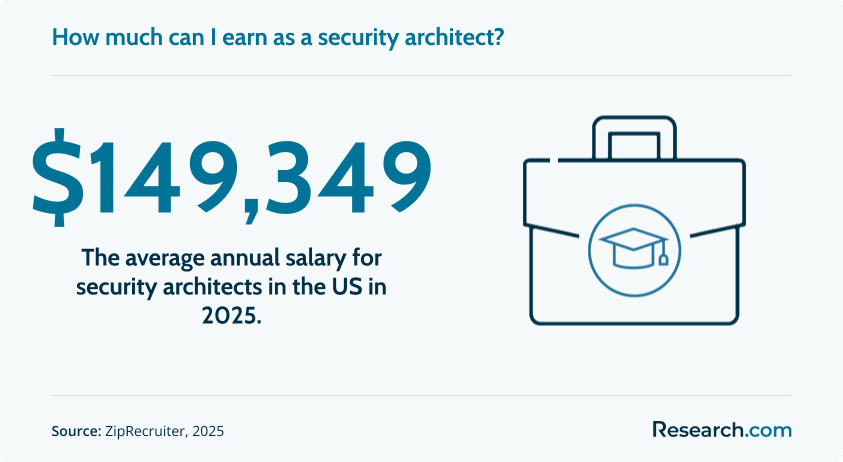
Security architects have strong earning potential because the role combines senior technical expertise with business-critical risk responsibility. The national average annual salary for a Security Architect stands at $163,902.
The Security architect salary range 2025 shows how much compensation can vary by experience and role scope. Entry-level roles typically start around $97,250, while senior-level positions can reach up to $260,000. These figures reflect a wide market, so candidates should evaluate salary expectations in context rather than treating one number as guaranteed.
What Affects Pay?
- Experience level: Architects who have led major cloud, identity, network, or incident-response initiatives often command higher compensation.
- Location: Major metropolitan areas and technology hubs may offer higher salaries, though cost of living can reduce the advantage.
- Industry: Finance, consulting, technology, healthcare, and critical infrastructure employers may pay more for specialized security architecture expertise.
- Certifications and specialization: CISSP, cloud security, governance, and advanced technical credentials can improve marketability when supported by real experience.
- Leadership scope: Roles that include enterprise architecture, team leadership, vendor strategy, or executive advising often pay more than narrower design positions.
When comparing offers, consider base salary, bonus potential, equity, retirement benefits, health benefits, remote-work flexibility, training budget, on-call expectations, and incident-response demands. A higher salary may come with more pressure, broader accountability, or less predictable hours.
What is the job outlook for Security Architects?
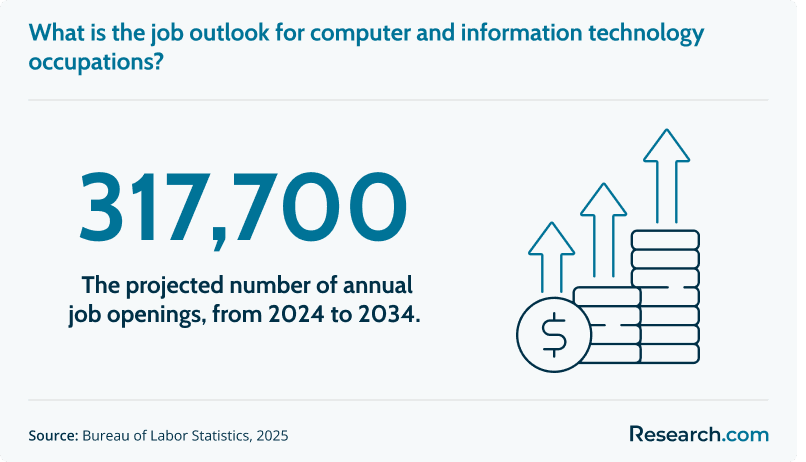
The job outlook for security architects is very strong, with a projected growth rate of 29% from 2024 to 2034. This is much faster than the average for all occupations and reflects the continuing need for organizations to secure increasingly complex digital environments.
Demand is supported by a shortage of experienced cybersecurity professionals, the expansion of cloud infrastructure, greater reliance on software and data, and the need to design security into systems before incidents occur. Organizations cannot rely only on reactive monitoring; they need professionals who can build resilient architectures from the start.
The Key Factors Shaping the Future Outlook
- More sophisticated cyber threats: Ransomware, supply-chain attacks, credential abuse, cloud misconfigurations, and application vulnerabilities all increase the need for stronger design.
- Cloud and hybrid infrastructure: As organizations move workloads across cloud and on-premises systems, architecture decisions become more complex.
- Regulatory pressure: Requirements related to data privacy, cybersecurity, and industry compliance, including GDPR and HIPAA, make security leadership more important.
- Digital transformation: New applications, automation, remote work, connected devices, and data platforms create more systems that must be secured.
- Board-level security attention: Security risk is increasingly treated as a business risk, which raises the value of architects who can communicate with executives.
Advanced credentials are not the only route to career growth, but some professionals consider further study to support research, teaching, consulting, or executive goals. In that context, comparing the shortest doctoral programs may help clarify whether additional academic training is worth the investment.
What is the typical work environment for Security Architects?
Security architects usually work in office, remote, or hybrid environments. Their daily work involves collaboration with IT teams, developers, cloud engineers, business managers, compliance staff, vendors, consultants, and senior leaders. The role is common in organizations where security failures could disrupt operations, expose sensitive data, or create regulatory risk.
Most security architects are employed in computer systems design and related services (27%), finance and insurance (12%), and management of companies and enterprises (11%). These sectors depend heavily on secure systems, complex infrastructure, and reliable data protection.
Schedule and Workload
A security architect daily schedule usually follows standard weekday hours, especially during planning, review, and project work. However, overtime may be required during major deployments, audits, urgent risk reviews, or security incidents. Evening or weekend work can occur when changes must be made outside business hours or when a serious threat requires immediate attention.
Remote and Hybrid Work
Remote and hybrid work options are increasingly common, particularly in organizations with cloud infrastructure and distributed teams. Even in remote roles, security architects need strong documentation habits, disciplined communication, and the ability to coordinate decisions across many stakeholders.
Workplace Pressures
The environment can be demanding because architecture decisions affect real risk. Security architects may need to defend unpopular controls, explain incidents to leadership, or make rapid decisions with incomplete information. People who prefer predictable, isolated technical work may find the collaboration and pressure challenging.
What are the pros and cons of Security Architect careers?
A security architect career can offer high compensation, meaningful work, and strong long-term demand. It also comes with pressure, constant learning, and responsibility for decisions that can affect the entire organization. Understanding both sides helps you decide whether the role fits your temperament and career goals.
Pros
- High-impact work: Your designs can prevent breaches, protect customers, and keep critical systems running.
- Strong earning potential: Senior security architecture roles can offer substantial compensation compared with many other technology positions.
- Intellectual challenge: The work requires creative problem-solving, systems thinking, and continuous adaptation.
- Career stability: Cybersecurity needs remain strong across industries, especially as organizations adopt cloud and digital platforms.
- Leadership opportunities: The role can lead toward enterprise architecture, security management, or executive cybersecurity positions.
- Cross-functional influence: Security architects help shape technology strategy, not just security tooling.
Cons
- High pressure during incidents: Breaches, audits, and urgent vulnerabilities can create intense workloads and stress.
- Constant learning requirement: Threats, tools, regulations, and cloud platforms change quickly.
- Difficult trade-offs: You may need to balance security against cost, usability, deadlines, and business demands.
- Stakeholder resistance: Teams may push back when security requirements slow delivery or change workflows.
- Broad accountability: Architects may be blamed for weaknesses even when implementation decisions involve many teams.
If the field interests you but you need a flexible or lower-cost educational route, comparing low cost online universities for working students can help you plan a more affordable path into cybersecurity education.
What are the opportunities for advancement for Security Architects?
Security architecture can lead to both technical specialization and executive leadership. Advancement depends on the problems you can solve, the scale of systems you can secure, and your ability to influence decisions across the organization.
Clear Advancement Pathways
- Foundational roles: System Administrator, Network Administrator, Help Desk Technician, Cloud Support Specialist, or Security Analyst.
- Intermediate cybersecurity roles: Security Engineer, Security Specialist, Penetration Tester, Incident Responder, or Network Security Engineer.
- Core architecture role: Security Architect, focused on designing secure systems, standards, and controls.
- Senior architecture roles: Senior Security Architect, Enterprise Security Architect, Cloud Security Architect, or Director of Security Architecture.
- Leadership roles: Security Engineering Manager, Information Security Manager, Chief Information Security Officer (CISO), or related executive security positions.
Expanding Horizons Through Specializations
Specialization can make a security architect more competitive and may lead to higher-responsibility roles. Common paths include:
- Cloud Security: Designing and protecting AWS, Azure, and Google Cloud environments, including identity, network controls, logging, workload security, and cloud governance.
- Application Security: Building secure software development practices, threat modeling, secure code review, and DevSecOps controls.
- Network Security: Specializing in firewalls, VPNs, segmentation, intrusion detection, secure connectivity, and network resilience.
- Governance, Risk, and Compliance (GRC): Leading security policies, control frameworks, risk assessments, audits, and regulatory alignment.
- Identity and Access Management: Designing authentication, authorization, privileged access, and zero-trust access models.
- Enterprise Security Architecture: Setting organization-wide standards and aligning security architecture with long-term business strategy.
How to Prepare for Advancement
To move beyond the architect level, build evidence of enterprise impact. Lead major initiatives, document measurable risk reduction, present to executives, mentor junior staff, and learn financial and governance language. Senior roles reward people who can connect security design to business continuity, compliance, customer trust, and operational resilience.
What other careers should you consider?
If security architecture interests you, several related careers may also fit. The right choice depends on whether you prefer hands-on implementation, analysis, ethical hacking, management, or enterprise-level design.
- Cybersecurity Engineer: Designs, implements, and maintains security controls. This is a strong fit if you enjoy building and operating defenses more than writing architecture standards.
- Information Security Analyst: Monitors threats, analyzes vulnerabilities, investigates alerts, and recommends improvements. This role can be a practical entry point into cybersecurity.
- Network Security Engineer: Focuses on securing network infrastructure with firewalls, intrusion detection, segmentation, VPNs, and secure routing.
- Penetration Tester: Simulates attacks to find weaknesses before malicious actors exploit them. This path suits people who enjoy ethical hacking, testing, and adversarial thinking.
- Information Security Manager: Oversees security teams, policies, operations, budgets, and compliance efforts. This option fits professionals who want more people management and governance responsibility.
- Cloud Security Architect: Specializes in securing cloud environments and may be a good target for professionals with strong AWS, Azure, or GCP experience.
- Governance, Risk, and Compliance Specialist: Focuses on policies, audits, frameworks, vendor risk, and regulatory requirements rather than deep technical design.
Choose the path that matches how you like to work. If you enjoy designing systems, influencing strategy, and balancing risk against business needs, security architecture may be a strong fit. If you prefer hands-on testing, daily monitoring, or direct team management, one of the related roles may be a better match.
Here's What Professionals Say About Their Security Architect Careers
- Victor: "As a Security Architect, I find it profoundly rewarding to know that the frameworks I build directly safeguard critical systems and personal data from ever-evolving cyber threats. Each project challenges me to adapt and innovate, whether it's integrating zero-trust principles or refining encryption protocols. The knowledge that my solutions help prevent costly breaches and sustain customer confidence inspires me to stay vigilant and curious every day."
- Maribel: "Handling the pressure of designing security for complex environments is intense, especially when compliance standards like PCI DSS are non-negotiable. Early in my role, I led a network redesign to meet these rigorous standards, which demanded deep understanding and precise execution. Although it was exhausting, focusing on mastering the audit requirements and collaborating with specialized colleagues transformed that challenge into a proud achievement."
- Vanessa: "The moment a security system I architected goes live and withstands real attacks is unmatched in satisfaction. I still recall implementing a major application overhaul where our layered defenses successfully blocked an intrusion attempt shortly after rollout. Experiencing that validation of my work, alongside genuine appreciation from the team, makes every late night and complex decision worthwhile."
Key Findings
- Security architects design the security blueprint for an organization’s networks, applications, cloud environments, identity systems, data, and controls.
- The role is typically senior-level. Most professionals build 3 to 8 years of IT or cybersecurity experience before moving into security architecture.
- A bachelor's degree in Computer Science, Cybersecurity, Information Technology, Network Engineering and Security, Information Assurance, or a related field is commonly expected.
- Common credentials include CISSP from (ISC)² and CEH from EC-Council, while advanced options such as CISM, CCSP, or a Master of Science in Cybersecurity may support specialized or leadership goals.
- The national average annual salary for a Security Architect stands at $163,902, with entry-level roles typically starting around $97,250 and senior-level positions reaching up to $260,000.
- The job outlook is strong, with a projected growth rate of 29% from 2024 to 2034, driven by cyber threats, cloud adoption, digital transformation, and regulatory pressure.
- Most security architects work in computer systems design and related services (27%), finance and insurance (12%), and management of companies and enterprises (11%).
- The best candidates combine hard skills such as network security, cloud security, risk assessment, and compliance with soft skills such as communication, leadership, negotiation, and strategic thinking.
- This career is a strong fit for people who enjoy high-impact technical design, business risk decisions, and continuous learning, but it may be stressful for those who want predictable workloads or limited stakeholder interaction.
Other Things You Should Know About Security Architect
The job outlook for security architect careers in 2027 is positive, with an increasing demand due to the growing importance of cybersecurity. As organizations seek to protect their networks from threats, the need for skilled security architects is expected to remain strong.
Becoming a Security Architect by 2026 typically requires 5-8 years, combining education and relevant work experience. This timeline includes earning a bachelor’s degree in cybersecurity or a related field, gaining entry-level experience, and obtaining certifications such as CISSP or CISM, which can enhance career prospects.
References
- Microsoft Certified: Cybersecurity Architect Expert - Certifications | Microsoft Learn https://learn.microsoft.com/en-us/credentials/certifications/cybersecurity-architect-expert/
- Cybersecurity Jobs in 2026: Top Roles, Responsibilities, and Skills | Splunk https://www.splunk.com/en_us/blog/learn/cybersecurity-jobs-skills-responsibilities.html
- 20 Coolest Cybersecurity Careers and Jobs | SANS Institute https://www.sans.org/cybersecurity-focus-areas/cybersecurity-careers/20-coolest-cyber-security-careers
- Useful training and mindset for becoming a Cloud Security Architect https://dawidbalut.com/2019/11/20/useful-training-and-mindset-for-becoming-a-cloud-security-architect/
- Security Architect Salary and Career Path | CyberSN https://cybersn.com/role/security-architect/
- Your Next Move: Security Architect https://www.comptia.org/en/blog/your-next-move-security-architect/
- How to Be a Security Architect | Career & Certification Guide https://destcert.com/resources/how-to-be-a-security-architect/
- Security Architect Interview Questions https://www.betterteam.com/security-architect-interview-questions


