
2027 Tax Preparer Careers: Skills, Education, Salary & Job Outlook

Co-Founder and Chief Data Scientist
Becoming a tax preparer is a practical career option for people who are comfortable with details, deadlines, client service, and rules that change often. The work is not limited to entering numbers into software. Tax preparers help individuals and businesses organize financial records, apply federal and state tax requirements, identify allowable deductions and credits, and file accurate returns on time.
This path can appeal to career changers, accounting students, bookkeepers, seasonal workers, and anyone looking for a finance-related role that may offer flexible or part-time opportunities. It also requires a realistic understanding of the trade-offs: tax season can be intense, technology is changing the market for simple returns, and paid preparers must meet IRS requirements such as obtaining a Preparer Tax Identification Number.
For readers comparing education and career options, tax preparation remains worth considering because it has steady client demand, relatively accessible entry requirements, and income potential that can improve with experience, credentials, specialization, and client complexity. Some summaries describe median pay as near $41,000 annually, while the salary section below explains the stated 2025 median and earning range in more detail. This guide explains what tax preparers do, what skills and credentials matter, how much they can earn, where the job outlook is strongest, and how to decide whether this career fits your goals.
Key Things You Should Know About Tax Preparer Career
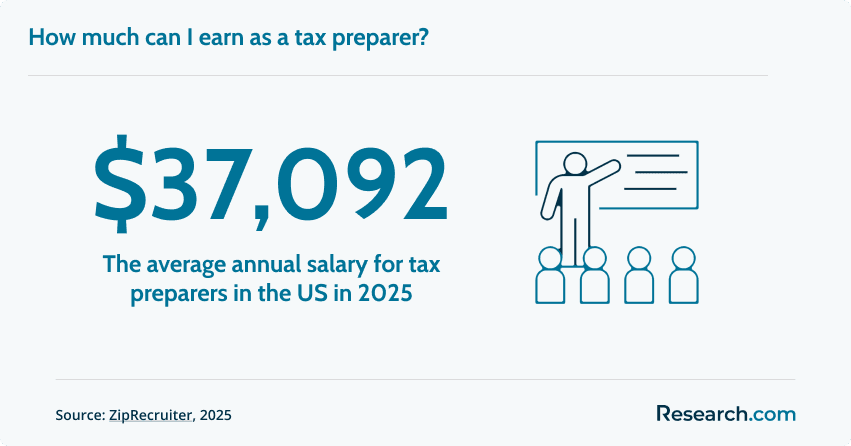
- The typical earning potential for a tax preparer in the United States is around $37,092 annually, with most professionals earning between $26,500 and $40,000.
- The field offers ongoing demand, especially during tax season, but long-term growth is modest due to increasing software automation; however, experienced and credentialed preparers continue to find opportunities.
- Getting started usually requires at least a high school diploma, with some roles or states demanding completion of tax courses, certifications, and IRS registration for paid federal return preparation.
- Success depends on strong attention to detail, solid math skills, familiarity with tax laws and software, and excellent interpersonal abilities for working with clients.
- Career advancement can lead to senior preparer, tax advisor, or management positions, and also opens paths into accounting, auditing, or launching an independent tax preparation business.
What do Tax Preparers do?
Tax preparers help clients complete and file tax returns accurately while complying with federal, state, and sometimes local tax rules. Their work typically includes collecting financial documents, reviewing income and expense records, applying current tax law, entering information into tax software, checking for errors, and explaining the return to the client before filing.
The role can be straightforward or highly complex depending on the client. A simple individual return may involve wages, interest, and standard deductions. A more complex return may include self-employment income, rental property, investment gains, multi-state income, business expenses, credits, prior-year issues, or IRS notices. The more complicated the tax situation, the more valuable professional judgment becomes.
A Day in the Life of Tax Preparers
A typical day often combines document review, software work, client communication, and quality checks. Tax preparers may begin by reviewing W-2s, 1099s, business expense records, receipts, prior-year returns, and client questionnaires. They then prepare returns using tax software, research unclear issues, request missing information, and explain results to clients in plain language.
During tax season, the pace can be fast and deadline-driven. Preparers may handle several client files in a day, respond to urgent questions, and correct incomplete or inconsistent records. Outside peak season, the work may shift toward amended returns, tax planning, responding to notices, bookkeeping support, or continuing education. The best tax preparers are not just accurate; they are organized, calm under pressure, and able to help clients understand what is happening and why.
What are the key responsibilities of Tax Preparers?
Tax preparers are responsible for turning a client’s financial information into a complete, accurate, and timely tax filing. That requires technical knowledge, careful documentation, and clear communication. Errors can delay refunds, trigger notices, increase tax liability, or damage client trust, so the work must be handled with discipline.
Key responsibilities include:
- Interviewing clients to understand their income, deductions, credits, filing status, dependents, prior-year tax issues, and major life or business changes.
- Collecting and organizing financial documents such as W-2s, 1099s, expense records, receipts, bank statements, business records, and previous tax returns.
- Reviewing records for accuracy, completeness, and consistency before entering information into tax preparation software.
- Preparing and filing individual or business tax returns in accordance with current federal and state tax rules.
- Identifying allowable deductions, credits, and tax-saving opportunities without making unsupported or risky claims.
- Explaining tax results to clients, including refunds, balances due, filing deadlines, payment options, and documentation requirements.
- Maintaining confidentiality and protecting sensitive personal and financial information.
- Responding to IRS notices, audit requests, or client questions when the preparer is qualified and authorized to do so.
The Most Challenging vs. The Most Rewarding Tasks
The most challenging part of tax preparation is often working with incomplete records, unclear facts, and strict deadlines. Clients may not understand what documents are required, may mix personal and business expenses, or may bring in disorganized records late in the season. Preparers must remain accurate even when the workload is high and clients are anxious.
The most rewarding part is helping clients avoid mistakes, claim legitimate benefits, and gain confidence about their finances. A preparer who explains a return clearly can turn a stressful obligation into a manageable process. For people who want a faster training route into this kind of practical finance work, exploring the best 6 month certificate programs that pay well online can be a useful starting point.
What are the key skills for Tax Preparers?
Successful tax preparers combine technical tax knowledge with strong client-facing skills. Software can perform calculations, but it cannot fully replace judgment, document review, ethical decision-making, or the ability to ask the right follow-up questions. Employers and clients usually look for preparers who are accurate, organized, trustworthy, and able to explain complicated rules clearly.
Key Hard Skills
- Tax return preparation and review: Knowing how to prepare returns, check inputs, review forms, and spot inconsistencies before filing.
- Federal and state tax knowledge: Understanding how tax laws, deductions, credits, filing status, dependents, and business income rules affect a return.
- Financial record analysis: Reviewing income statements, expense records, receipts, bank records, and prior-year returns to confirm accuracy and completeness.
- Tax software proficiency: Using preparation platforms efficiently, including tools such as Lacerte and QuickBooks, while understanding that software output still requires professional review.
- Documentation and compliance: Maintaining proper records, following due diligence rules, and supporting positions taken on a return.
Key Soft Skills
- Attention to detail: Small errors in names, Social Security numbers, income entries, or deductions can create major problems.
- Analytical thinking: Preparers must interpret financial facts, identify missing information, and apply rules to real client situations.
- Active listening: Clients often do not know which details matter, so preparers need to ask clear questions and listen carefully for tax-relevant information.
- Communication: Strong preparers explain refunds, balances due, credits, and risks in language clients can understand.
- Time management: Tax season requires prioritizing files, tracking missing documents, and meeting filing deadlines without sacrificing accuracy.
The One Overlooked Skill That Separates the Good from the Great
Client relationship management is one of the most underrated skills in tax preparation. A technically competent preparer can complete a return. A trusted preparer helps clients prepare better records, avoid repeat mistakes, plan ahead, and return year after year.
This skill matters because tax work often depends on information the client provides. If clients trust the preparer, they are more likely to disclose relevant details, ask questions early, and follow documentation guidance. That can reduce errors and create opportunities for year-round advisory services rather than one-time seasonal transactions.
For readers who need to strengthen accounting, communication, or business fundamentals before entering the field, online colleges with open enrollment may offer flexible ways to build relevant skills.
Tax Preparer Careers: A Step-by-Step Guide to Getting Started
Starting a tax preparer career is more manageable when you treat it as a sequence of practical steps. The exact path depends on whether you want seasonal work, a full-time role in an accounting or tax firm, self-employment, or a long-term route toward advanced credentials.
- Build a foundation in basic finance and tax concepts. A high school diploma or GED is typically the starting point, but coursework in accounting, bookkeeping, business math, or personal finance can make training easier.
- Learn tax preparation procedures and software. Many beginners complete a tax preparation course, employer training program, certificate, or entry-level accounting coursework to understand forms, filing requirements, deductions, credits, and tax software workflows.
- Meet IRS requirements for paid preparation. Paid preparers generally need a Preparer Tax Identification Number before preparing federal tax returns for compensation.
- Get supervised experience. Entry-level or seasonal roles can help you learn how real client files differ from textbook examples. This is where you develop speed, accuracy, client communication, and judgment.
- Decide whether to specialize. Over time, you may focus on individuals, small businesses, self-employed clients, rental property owners, multi-state returns, tax notices, or other niches.
- Consider advanced credentials if they match your goals. Credentials such as Enrolled Agent, CPA, or advanced tax education can expand the services you can offer and improve long-term advancement potential.
- Maintain continuing education. Tax rules and software change regularly, so ongoing learning is part of the job, not an optional extra.
The fastest route is usually entry-level training plus a PTIN and supervised seasonal experience. The stronger long-term route often adds accounting education, deeper tax study, and credentials that support more complex work.
What education, training, or certifications are required?
Tax preparer requirements vary by employer, state, and the type of returns being prepared. At the entry level, a high school diploma or GED may be enough for some seasonal roles, especially when the employer provides training. However, candidates with accounting, bookkeeping, finance, or business coursework are usually better prepared for the accuracy and compliance demands of the job.
Common education and training options include an Associate Degree in Accounting, a Bachelor of Science in Accounting or Finance, tax preparation certificates, employer-sponsored tax schools, internships, and hands-on software training. Shorter certificate programs can be useful for people who want targeted preparation without committing immediately to a full degree.
The most important baseline requirement for paid federal tax return preparation is the Preparer Tax Identification Number, which is required by the IRS for legally preparing tax returns for compensation. The Enrolled Agent credential is a more advanced option that requires passing a rigorous IRS exam and completing ongoing education. It can be especially valuable for preparers who want stronger credibility and broader tax representation work.
Are advanced degrees or niche certifications worth the investment?
Advanced credentials can be worth it when they match a clear career goal. A CPA license, Master of Science in Accounting, or Master of Taxation may support advancement into tax accounting, management, consulting, complex business tax work, or leadership roles. These paths can also increase credibility with employers and clients.
They are not always necessary for beginners. If your immediate goal is seasonal individual tax preparation, a certificate, employer training, and a PTIN may be a more efficient starting point. If your goal is to advise businesses, represent clients in more complex matters, manage a tax department, or build a higher-level practice, advanced education and credentials may provide a stronger return over time.
The best choice depends on cost, time, career ambition, and the type of clients you want to serve. If you are comparing broader education investments, reviewing majors that make the most money can help you think more strategically about long-term value.
What is the earning potential for Tax Preparers?
Tax preparer earnings vary widely because the occupation includes seasonal preparers, full-time employees, self-employed professionals, and experienced specialists who handle complex returns. Location, employer type, client base, credentials, and workload all influence income.
Entry-level tax preparers earn around $29,170 annually, which reflects the starting point for many workers in the field. The tax preparer average salary 2025 stands at a median of $49,010 annually. Senior-level preparers with stronger technical skills, more complex clients, or advanced credentials can earn as high as $98,810 per year.
Several factors can raise earning potential. Preparers in higher-cost urban markets and states such as New York and California often see salaries above the national median. Professionals who work with businesses, high-net-worth clients, multi-state filings, tax planning, or dispute support may also command higher compensation than preparers focused only on simple seasonal returns.
Income can also depend on work model. A seasonal employee may value flexibility but earn less over the full year. A full-time preparer in an accounting or tax firm may have steadier income and benefits. A self-employed preparer may have higher upside but also carries the burden of finding clients, managing software costs, handling compliance, and maintaining year-round service quality.
What is the job outlook for Tax Preparers?
The projected 10-year growth rate for tax preparers is -1%, compared with a 3% increase for all occupations. That means this is not a fast-growth occupation overall. The market is being reshaped by tax software, automation, online filing tools, and changing client expectations.
However, the outlook is not the same for every type of tax preparer. Basic, simple-return preparation is the most exposed to automation and self-service software. Preparers who can handle complex returns, small business issues, tax planning, IRS notices, multi-state situations, or advisory work may be better positioned because those services require judgment and client-specific analysis.
The Key Factors Shaping the Future Outlook
Automation is the biggest pressure on the field. Many taxpayers with uncomplicated returns can use software to file on their own, reducing demand for preparers who only handle simple filings. This makes it important for new entrants to build skills beyond basic data entry.
Tax complexity is the counterweight. Changes in tax law, credits, business rules, self-employment income, investment activity, and state tax issues can make professional help valuable. Clients often need someone who can interpret rules, document positions, and explain consequences rather than simply prepare a form.
Service models are also changing. Many firms are expanding from once-a-year filing into bookkeeping, payroll, planning, advisory services, and notice response. Tax preparers who understand accounting systems, client communication, and year-round service may have more durable opportunities. For those planning to strengthen their education for this changing market, accredited colleges online with no application payment may be worth reviewing.
What is the typical work environment for Tax Preparers?
Tax preparers usually work in office-based settings such as accounting firms, tax preparation businesses, bookkeeping firms, payroll service providers, and financial service offices. Industries focused on accounting, tax preparation, bookkeeping, and payroll services employ over 90% of tax preparers. The work is computer-heavy and document-heavy, with a mix of independent analysis and direct client interaction.
Remote and hybrid work can be available, especially when clients submit documents electronically and firms use secure portals. Still, in-person meetings remain common for clients who prefer face-to-face service, have complex documents, or need help understanding their return. Confidentiality and secure handling of sensitive financial information are essential in any work setting.
The schedule is highly seasonal. For much of the year, tax preparers may work standard business hours or part-time schedules. During tax season from January to April, overtime, evenings, and weekends are common because client demand and filing deadlines increase sharply. This seasonal rhythm is one of the defining features of the career: it can offer flexibility in slower months, but the busy season can be demanding.
What are the pros and cons of Tax Preparer careers?
A tax preparer career can be a strong fit for detail-oriented people who like structured work, practical problem-solving, and client service. It may be less appealing to people who dislike repetitive documentation, seasonal pressure, or constant rule changes. The best decision comes from weighing both sides honestly.
Pros
- Accessible entry path: Some roles are available with a high school diploma or GED, training, and the required IRS registration for paid preparation.
- Flexible work options: Seasonal, part-time, remote, hybrid, and self-employed arrangements may be available depending on employer and client base.
- Clear skill development: Preparers build practical knowledge in tax law, accounting basics, software, documentation, and client communication.
- Client impact: Helping clients file correctly, avoid penalties, and claim legitimate deductions or credits can be personally rewarding.
- Advancement potential: With experience and credentials, preparers can move into senior tax roles, advisory services, management, or specialization.
Cons
- Seasonal stress: Tax season can bring long hours, tight deadlines, and high client volume.
- Repetitive work: Many returns involve similar forms, document checks, and data entry tasks.
- Technology pressure: Self-filing software and automation reduce demand for simple return preparation.
- Client challenges: Preparers often deal with missing documents, anxious clients, unrealistic refund expectations, or difficult financial news.
- Ongoing learning requirement: Tax rules, forms, software, and compliance expectations change regularly.
This career is best for people who can stay accurate under pressure and communicate calmly with clients. If you want a practical training route before entering the field, programs at accredited online trade schools may help you compare career-focused options.
What are the opportunities for advancement for Tax Preparers?
Tax preparer advancement usually comes from three sources: experience with more complex returns, stronger credentials, and a more valuable client or employer niche. A preparer who only handles simple seasonal filings may have limited upward mobility. A preparer who develops business tax, representation, planning, or management skills can build a longer-term career path.
Advancement Path
- Entry-Level Tax Preparer: Prepares basic individual returns, learns software workflows, gathers client documents, and builds accuracy under supervision.
- Experienced Tax Preparer: Handles more varied returns, identifies common issues, communicates directly with clients, and may support amended returns or notices.
- Senior Tax Preparer / Tax Accountant: Works on complex returns, advises clients, reviews the work of junior staff, and may hold credentials such as EA or CPA.
- Tax Manager / Senior Tax Consultant / Partner: Leads teams, manages client portfolios, oversees audits, develops tax strategies, and may require a master's degree and extensive experience.
Specialization Areas
- Corporate Taxation: Focuses on business tax compliance and planning, including complex organizational structures, mergers, and international tax issues.
- Individual & Estate Tax Planning: Helps high-net-worth individuals with trusts, inheritance strategies, and long-term tax planning.
- Tax Dispute Resolution & Audit Defense: Supports clients during IRS audits, notices, and disputes, using documentation and negotiation skills.
- Sales & Use Tax / State & Local Taxation (SALT): Handles multi-state rules and compliance challenges for businesses operating across jurisdictions.
The strongest advancement strategy is to move from preparation-only work toward higher-value judgment. That may mean earning an EA credential, pursuing CPA eligibility, learning business accounting, developing a niche, or taking on review and leadership responsibilities within a firm.
What other careers should you consider?
If tax preparation interests you but you are unsure about the seasonal workload or long-term outlook, several related careers use similar skills. Comparing these options can help you decide whether you prefer client tax work, broader accounting duties, recordkeeping, compliance, or management.
- Accountant: Prepares and analyzes financial records, supports compliance, and may provide broader financial reporting or advisory services beyond tax filing.
- Bookkeeper: Records transactions, reconciles accounts, organizes receipts, and maintains financial records, making it a good fit for people who enjoy accuracy and routine financial organization.
- Tax Manager: Oversees tax preparation processes, supervises staff, manages compliance, and advises on more complex tax matters.
- Auditor: Examines financial records for accuracy, internal controls, and compliance, often identifying discrepancies that can affect reporting and tax outcomes.
- Accounting Specialist: Uses accounting software and financial procedures to support reconciliations, reporting, accounts payable or receivable, payroll, and tax-related functions.
Choose tax preparation if you like client-facing work, deadline-based tasks, and applying tax rules to specific financial situations. Consider bookkeeping or accounting if you prefer year-round financial record management. Consider auditing if you enjoy investigation and compliance review. Consider tax management if your long-term goal is leadership and complex advisory work.
Here's What Professionals Say About Their Tax Preparer Careers
- Andreia: "The tax code can feel like an endless maze, and I take pride in helping my clients navigate it confidently. I make it a point to stay updated on every new regulation so that I can represent them accurately and protect their interests. There's a real satisfaction in knowing that my knowledge can shield someone from costly mistakes or audits. For me, this role is about being a steady guide through complexity."
- Tariq: "Tax season can push you to your limits, especially when I get handed a plastic bag stuffed with receipts and mileage notes from clients who don't track their expenses. It's frustrating at times, but I've learned to approach the chaos with patience and methodical problem-solving. What keeps me going is knowing that after hours of sifting through the mess, I've helped someone maximize their refund or sort out a tangled financial situation. That pressure is tough, but it sharpens my skills every year."
- Lucia: "I've watched clients transform from coming in disorganized and overwhelmed to arriving with their paperwork neatly prepared and ready for filing. Being part of that progress makes the long days worth it, especially when I see how much easier their lives become. Managing my own schedule with this work also gave me the freedom to choose higher-paying jobs that fit my lifestyle. Helping people get a handle on their taxes doesn't just impact their finances - it builds trust and real relationships."
Other Things You Should Know About Tax Preparer
Key skills for tax preparers in 2027 include attention to detail, proficiency in tax software, understanding of tax legislation, and strong analytical abilities. Staying updated on financial regulations is crucial, as tax laws frequently change. Effective communication skills are also vital to explain complex tax matters to clients.
To become a tax preparer in 2027, a high school diploma is typically sufficient, but many pursue additional certifications, such as the IRS's Annual Filing Season Program. Some may choose to complete a degree in accounting or finance to enhance their expertise and career prospects.
References
- Why soft skills are as important as hard skills in tax https://www.brewermorris.com/career-advice/why-soft-skills-are-as-important-as-hard-skills-in-tax/
- 8 Tax Careers: Professional Specializations https://tsengcollege.csun.edu/blog/tax-careers
- Top 6 Most Frequently Asked Questions About Becoming a Tax Preparer https://www.surgent.com/blog/top-6-most-frequently-asked-questions-about-becoming-a-tax-preparer/
- How to Market Your Tax Preparation Services https://www.taxslayerpro.com/blog/post/how-to-market-your-tax-preparation-business
- How to Become a Tax Accountant | Accounting.com https://www.accounting.com/careers/tax-accountant/how-to-become/
- 22 Tax Preparer Interview Questions https://insightglobal.com/blog/tax-preparer-interview-questions/
- Marketing for Tax Professionals: 14 Proven Tactics - Future Firm https://futurefirm.co/marketing-for-tax-professionals-proven-tactics/
- Tax Preparer Career Path - National Tax Training School https://www.nationaltax.edu/tax-preparer-career-path/
- How Do I Start as a Tax Preparer and Make Good Money Right Away? ⋆ Pronto Tax School https://prontotaxschool.com/how-do-i-start-as-a-tax-preparer-and-make-good-money-right-away/
- Tax Preparer Skills in 2025 (Top + Most Underrated Skills) https://www.tealhq.com/skills/tax-preparer


