
2027 What Does a Healthcare Quality Director Do: Responsibilities, Requirements, and Salary

Co-Founder and Chief Data Scientist
Many healthcare organizations struggle to ensure that patients consistently receive safe and effective care. Hospitals and clinics face increasing scrutiny from regulators and rising expectations from patients, making strong leadership in quality essential. According to the BLS, employment of speech-language pathologists is projected to grow 15% from 2024 to 2034, highlighting broader trends in healthcare roles that demand skilled oversight.
A healthcare quality director helps solve these challenges by leading quality initiatives, monitoring outcomes, and guiding staff to improve care delivery. This article explains what the role entails, the education and skills needed, salary expectations, and career growth opportunities.
Key Things to Know Before Pursuing a Healthcare Quality Director Career
- Healthcare quality directors lead teams that ensure patient safety, compliance, and high-quality care delivery.
- Most professionals in this field hold a bachelor’s degree, with a median annual pay of $117,960 in 2024 and projected employment growth of 23% from 2024 to 2034.
- Advanced education, certifications, and leadership experience are critical for career advancement, especially for positions overseeing health plan quality programs with salaries averaging $161,814 per year.
What is a healthcare quality director?
A healthcare quality director is a senior professional responsible for overseeing the quality and safety of patient care in hospitals, clinics, and health systems. Their core mission is to ensure that care delivery meets established clinical standards, regulatory requirements, and patient expectations. They serve as the bridge between administrative leadership, clinical staff, and regulatory agencies, helping to align organizational goals with measurable quality outcomes.
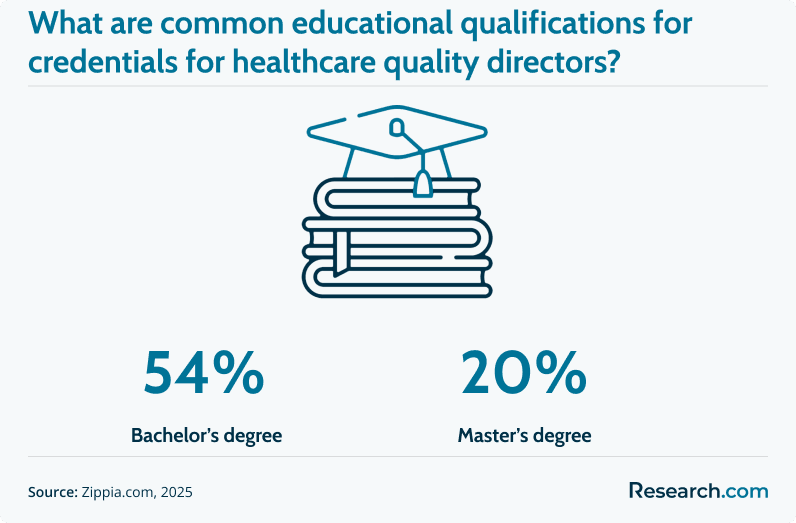
Healthcare quality directors often have a background in nursing, health administration, or clinical care. Most professionals enter the field with a bachelor’s degree—54% of health services managers hold a bachelor’s—and many pursue advanced degrees like an MSN or a master’s in nursing leadership and management to strengthen their leadership and problem-solving skills. Their work directly impacts patient outcomes, staff performance, and institutional reputation.
In addition to academic credentials, healthcare quality directors must understand healthcare systems, regulatory compliance, and organizational workflows. This ensures they can design and implement policies, lead quality improvement projects, and support a culture of continuous improvement. Their position requires both clinical knowledge and administrative acumen, making it one of the most influential roles in ensuring safe and effective healthcare delivery.
What does a healthcare quality director do every day?
Healthcare quality directors manage and coordinate quality initiatives across healthcare facilities. Their daily responsibilities include monitoring clinical practices, reviewing patient outcomes, and ensuring compliance with regulatory standards. Key daily tasks include:
- Data review and reporting: Analyze patient care metrics, safety incidents, and audit results to identify areas needing improvement.
- Staff coordination: Lead meetings with clinical teams to discuss quality goals, performance, and best practices.
- Compliance management: Ensure that hospital policies and procedures meet state and federal regulations.
- Project oversight: Implement quality improvement projects and track progress toward organizational benchmarks.
Healthcare quality directors spend a portion of their day interpreting data dashboards and quality reports, identifying trends, and recommending changes. Their work requires strong organizational skills, leadership, and a keen understanding of clinical processes. They also mentor staff on quality initiatives, which improves long-term outcomes and aligns daily operations with the institution’s overall quality goals.
How do healthcare quality directors protect patient safety?
Protecting patient safety is central to a healthcare quality director’s role. These professionals implement protocols, monitor compliance, and investigate incidents to prevent harm. They work to minimize errors, ensure proper clinical practices, and maintain a safe environment for patients and staff.
Key strategies include:
- Safety audits and inspections: Regularly review hospital units and clinical workflows to detect potential hazards.
- Incident analysis: Investigate adverse events, identify root causes, and develop corrective action plans.
- Staff education: Conduct training programs on infection control, medication safety, and emergency protocols.
- Policy development: Establish clear guidelines for safe care, including equipment usage, patient handling, and clinical documentation.
By applying these strategies, healthcare quality directors reduce medical errors and improve patient outcomes. They also contribute to regulatory compliance and accreditation readiness, which is essential for hospital funding and public trust. A director’s ability to foster a culture of safety ensures that quality remains a core priority throughout the organization.
How do they measure and improve clinical quality?
Healthcare quality directors rely on measurable indicators to evaluate and enhance clinical performance. They use data-driven approaches to track outcomes, compare benchmarks, and guide decision-making. This continuous assessment ensures that care delivery meets or exceeds standards.
Common methods include:
- Quality metrics and key performance indicators (KPIs): Track patient satisfaction, readmission rates, infection rates, and other clinical outcomes.
- Benchmarking: Compare organizational performance against regional or national standards.
- Audits and inspections: Regularly review charts, procedures, and protocols for adherence to guidelines.
- Performance improvement initiatives: Implement interventions, monitor results, and adjust strategies based on outcomes.
Healthcare quality directors integrate these insights into strategic planning, aligning quality improvement projects with organizational objectives. For example, using analytics to identify high-risk areas in patient care allows directors to prioritize training or workflow changes.
This role combines clinical expertise, analytical skills, and leadership to maintain and elevate the standard of care. In some cases, directors may oversee cross-functional teams to implement large-scale initiatives, such as reducing hospital-acquired infections or enhancing chronic disease management programs.
What tools and analytics do they use today?
Healthcare quality directors depend on a range of digital tools and analytics platforms to monitor performance and ensure patient safety. These tools allow them to track clinical outcomes, manage compliance, and generate reports that guide decision-making.
Key tools include:
- Electronic Health Records (EHRs): Centralize patient information, enabling directors to identify trends and monitor care quality.
- Clinical dashboards: Provide real-time metrics for infection rates, readmissions, and patient satisfaction.
- Data analytics platforms: Help analyze large datasets to detect patterns, predict risks, and prioritize interventions.
- Compliance software: Tracks adherence to federal, state, and accreditation requirements.
In addition, directors may use predictive modeling tools to forecast outcomes and recommend proactive improvements. Effective use of these platforms enhances efficiency, ensures regulatory compliance, and strengthens clinical decision-making. For healthcare organizations looking to accelerate staff training, fast track online phlebotomy technician certification programs can help frontline teams maintain quality standards, which complements the director’s oversight.
What major skills does this leadership role require?
A healthcare quality director requires a combination of clinical knowledge, leadership, and analytical skills to manage quality initiatives successfully. The role demands the ability to interpret data, oversee staff, and implement policies that improve patient outcomes.
Essential skills include:
- Leadership and communication: Direct multidisciplinary teams and clearly convey expectations.
- Data analysis: Evaluate clinical metrics, quality indicators, and trends.
- Regulatory knowledge: Understand state, federal, and accreditation standards.
- Problem-solving: Quickly address issues affecting care quality or patient safety.
- Patient-centered focus: Ensure strategies prioritize patient outcomes and satisfaction.
Soft skills, such as adaptability and conflict resolution, are equally important. These skills enable the director to navigate complex healthcare environments, implement effective quality improvements, and mentor staff, fostering a culture of continuous improvement.
What degrees do employers prefer in 2027?
Employers typically look for candidates with a bachelor’s or master’s degree to serve as healthcare quality directors. A background in nursing is highly valued, though degrees in healthcare administration, business, or related fields are also common. Key degree paths:
- Bachelor of Science in Nursing (BSN): 28% of health services managers major in nursing.
- Master’s in Nursing Leadership & Management: Prepares professionals for senior management and strategic roles.
- RN-to-MSN bridge programs: Ideal for registered nurses seeking advanced leadership education.
- Healthcare administration or business degrees: Develop organizational, financial, and management skills.
Advanced degrees enhance credibility and improve promotion prospects. Professionals can also pursue post-master’s certificates to refine leadership and operational expertise. For those exploring related educational options, natural sciences masters salary data shows strong earning potential for advanced degrees in allied healthcare fields.
Which certifications help professionals advance in this field?
Certifications signal expertise and can improve hiring prospects for healthcare quality directors. They often reflect mastery of quality standards, patient safety, and leadership in healthcare environments. Top certifications include:
- Certified Professional in Healthcare Quality (CPHQ): Widely recognized for quality management competence.
- Lean Six Sigma Green Belt/Black Belt: Supports process improvement and efficiency in healthcare operations.
- Certified Professional in Patient Safety (CPPS): Focuses on risk reduction and safety initiatives.
- Certified in Healthcare Compliance (CHC): Validates knowledge of regulatory and ethical compliance.
Pursuing these credentials demonstrates commitment to excellence and enhances career growth. Some programs, such as the shortest sterile processing technician certification programs, provide fast, focused training for staff who support quality initiatives, complementing the director’s oversight of clinical operations.
What experience is needed before becoming a quality director?
Healthcare quality directors typically advance from clinical or administrative roles within healthcare settings. Prior experience helps develop the leadership, operational, and regulatory knowledge essential for this position. Common pathways include:
- Clinical experience: Many directors start as registered nurses or allied health professionals, gaining firsthand knowledge of patient care.
- Administrative roles: Positions such as unit managers, department supervisors, or health services coordinators provide exposure to operational management.
- Project management: Experience leading quality improvement projects demonstrates the ability to implement effective strategies.
- Regulatory compliance: Understanding healthcare laws, accreditation standards, and patient safety protocols is essential for senior leadership.
Employers often prefer candidates with less than five years in prior management roles, although hands-on experience with quality initiatives is highly valuable. Programs like medical assistant associate degree salary highlight the value of starting in clinical roles and progressing toward administrative leadership. By combining clinical and management experience, professionals prepare to oversee complex quality programs and lead multidisciplinary teams effectively.
How much do healthcare quality directors earn in 2027?
Healthcare quality directors are well-compensated, reflecting the level of responsibility and expertise required. Salaries vary based on location, organization type, and experience. Salary insights for 2027:
- Average salary: $161,814 per year ($78 per hour).
- Entry-level (10th percentile): $130,230 per year.
- Typical range (25th–75th percentile): $145,282 to $173,998.
- Top earners (90th percentile): $185,091 or higher.
Salaries also differ by healthcare setting. For instance, directors in hospitals, outpatient care centers, or health plans often earn more than those in smaller clinics. State variations are significant; New York, DC, and Delaware top the list for high-paying positions.
Earnings are closely tied to experience, advanced degrees, and certifications. Professionals with additional credentials, such as Lean Six Sigma or CPHQ, often command higher pay.
Which future trends will reshape this career?
The role of healthcare quality directors is evolving with technological, regulatory, and patient-centered trends. Staying ahead of these changes ensures continued impact and relevance. Emerging trends include:
- Digital quality tools: AI-driven analytics and predictive modeling help identify risks before they affect patients.
- Value-based care: Reimbursement increasingly depends on outcomes rather than services, emphasizing efficiency and safety.
- Regulatory changes: New laws and accreditation standards require updated policies and documentation practices.
- Telehealth and remote monitoring: Expanding access to care requires directors to integrate quality measures across digital platforms.
Healthcare quality directors must embrace these trends to maintain high standards, enhance patient outcomes, and lead teams through complex transformations. Those who adapt early will shape the future of safe, efficient, and patient-focused care delivery—especially as roles across healthcare rapidly evolve, from executive leadership to front-line professionals comparing pay benchmarks like nutritionist salary to better understand market pressures and workforce expectations.
What do healthcare quality directors say about working in this field?
- Rose: "No one in my family works in healthcare leadership, so I had no idea this career path existed. What surprised me is how much influence this role has behind the scenes. It is not bedside care — but the impact is system-wide. The day I presented data that reduced 30-day readmissions by 14%, I realized this career lets me improve patient outcomes at scale — not just one patient at a time."
- Gayle: "I shifted into quality because I wanted meaningful work without going back to school for five more years. Once I started working on process improvement teams, I knew this field fit me. Quality work blends data, policy, and people. When I saw the NICU nurses implement a best-practice bundle I helped design — and infection rates dropped — I realized: this is leadership, but it’s leadership rooted in evidence."
- Ruben: "Working in operations burned me out because every day felt reactive. Quality gave me space to be strategic. It’s structured, collaborative, and forward-looking. In this job, I focus on long-term safety outcomes instead of firefighting daily chaos. I still work directly with clinicians, but now I guide system change. That is what made me finally feel like I am supporting healthcare the way it should work — deliberately, and sustainably."
Key Findings
- The average salary for healthcare quality directors is $161,814 per year, with the top 10% earning $185,091 or more annually.
- More than 54% of health services managers hold at least a bachelor’s degree, and many healthcare quality directors pursue advanced education in nursing leadership or healthcare administration.
- The most common undergraduate major feeding into quality leadership is nursing — 28% of health services managers hold a nursing degree.
- Employers strongly value specialized certifications, with CPHQ, Lean Six Sigma, and CPPS being among the most widely recognized credentials for quality advancement.
- Core quality work is increasingly data-driven, with directors using dashboards, EHR analytics, and compliance software to track infection rates, readmissions, and safety events in real time.
- The role is expanding due to system-wide shifts toward value-based care, digital quality tools, and new reimbursement models tied to outcomes — not volume — elevating the strategic power of this function.
Other Things You Should Know About Healthcare Quality Directors
A bachelor's degree in healthcare administration or a related field is typically required for a healthcare quality director role in 2027. A master's degree, such as an MHA or MBA with a focus on healthcare, can enhance prospects and salary potential.
In 2027, a healthcare quality director's responsibilities include ensuring compliance with healthcare regulations, leading quality improvement initiatives, managing patient safety programs, and analyzing data to improve patient outcomes. They also collaborate with medical staff to implement best practices and foster a culture of continuous improvement within the organization.
References
- U.S. Bureau of Labor Statistics. (n.d.). Medical and health services managers. https://www.bls.gov/ooh/management/medical-and-health-services-managers.htm#tab-1
- Western Governors University. (n.d.). How to become a healthcare quality director. https://www.wgu.edu/career-guide/healthcare/healthcare-quality-director-career.html
- Salary.com. (2025, October 1). Quality management director – health plan salary in the United States. https://www.salary.com/research/salary/benchmark/quality-management-director-health-plan-salary
- Zippia. (2025, January 8). How to become a health services manager: What it is and career path. https://www.zippia.com/health-services-manager-jobs/
- CAQH. (n.d.). Making healthcare work better. https://www.caqh.org/
- American College of Healthcare Executives. (n.d.). American College of Healthcare Executives. https://www.ache.org/


