
2027 How Much Do Dental Assistant Classes & Certification Cost?

Co-Founder and Chief Data Scientist
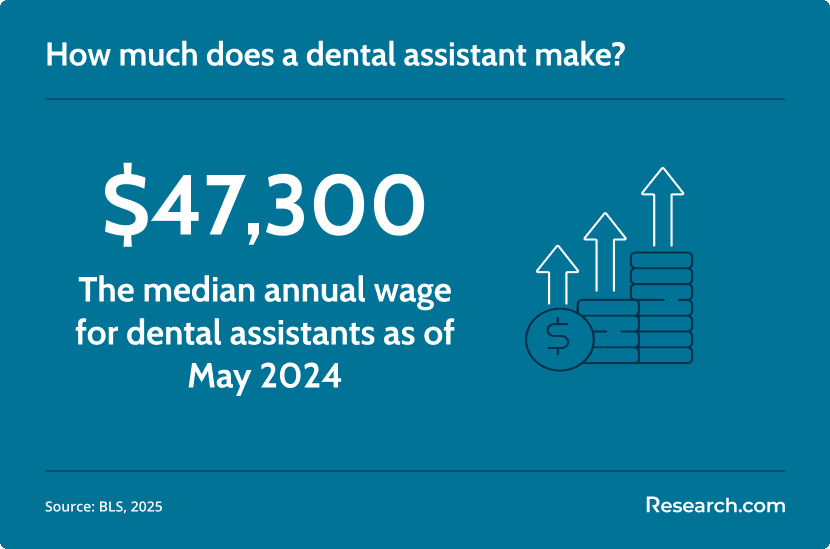
Dental assisting remains a stable healthcare career with strong national demand. The Bureau of Labor Statistics reported 381,900 dental assistants employed in 2024, with employment projected to grow 6% over the next decade, faster than the average for all occupations (BLS, 2024). This growth has expanded the number of training programs, yet dental assistant certification cost varies significantly depending on location, program type, and delivery format.
In this article, I will explain what the average tuition looks like in 2027, which extra expenses can raise overall costs, how online programs compare with on-campus training, what financial aid options exist, and whether certification ultimately justifies the investment. By the end, you will have a clear understanding of both the price of training and the value it delivers.
Key Things You Should Know About Dental Assistant Tuition Costs
- The average tuition for dental assistant certificate programs in 2025 ranges from $1,440–$8,660 at public two-year colleges to $16,300–$19,500 at private institutions.
- Fast-track dental assistant certificates usually cost under $10,000 at public colleges, exceed $10,000 at private schools, and may be fully funded through state workforce grants.
- Online dental assistant programs can reduce costs through savings on travel and housing, though total expenses still depend on tuition policies, residency status, and program fees.
- What is the average tuition for a dental assistant certificate program in 2027? Average Tuition
- What extra expenses can increase the cost of dental assistant programs? Extra Expenses
- Do online dental assistant programs cost less than on-campus programs? Do online dental assistant programs cost less than on-campus programs?
- What factors increase or lower the cost of dental assistant training? What factors increase or lower the cost of dental assistant training?
- What financial aid options are available for dental assistant students? Financial Aid
- How much do fast-track dental assistant certifications cost? How much do fast-track dental assistant certifications cost?
- Which states have the most affordable dental assistant training programs? Which states have the most affordable dental assistant training programs?
- How much does it cost to take the Certified Dental Assistant (CDA) exam? Certification Cost
- What employer or apprenticeship support is available for dental assistant students? Employer Support
- Is dental assistant certification worth the cost? Is dental assistant certification worth the cost?
What is the average tuition for a dental assistant certificate program in 2027?
Tuition for dental assistant programs is shaped by institutional type and residency status, creating noticeable differences in what students pay. National data show that public community colleges continue to offer the lowest average rates, while private two-year institutions are considerably higher.
For many students, the published tuition is only part of the full price, since supplies, books, and certification exam fees add to the overall shortest medical billing and coding certificate online programs comparison when weighing career entry costs.
Below are current national averages by institution type and the public two-year state range.
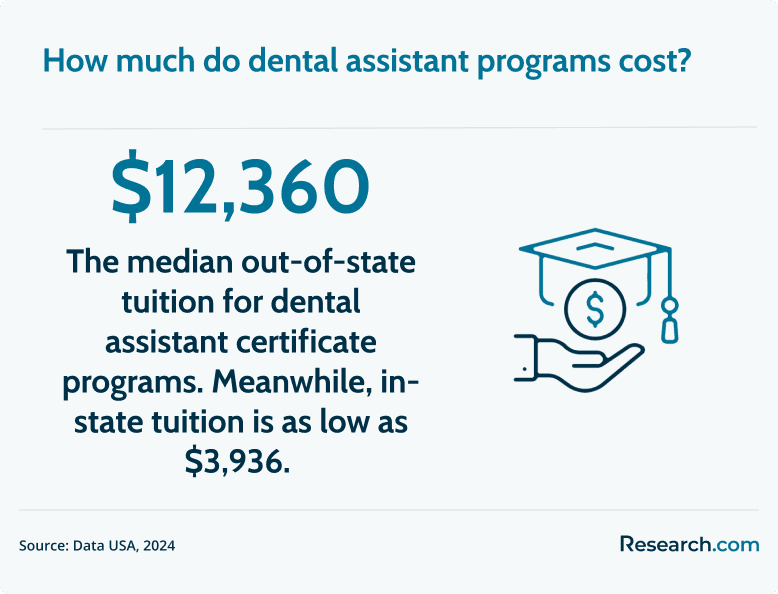
- Public two-year, in-district: Average published tuition and fees are $4,050 in 2024–25, the standard price point for many certificate programs offered by community and technical colleges.
- Private for-profit two-year: Average tuition and fees were $16,300 in 2022–23, the most recent national figure, reflecting higher institutional charges at career colleges.
- Private nonprofit two-year: Average tuition and fees were $19,500 in 2022–23, underscoring the premium pricing at nonprofit two-year institutions.
- Public two-year, state range: In 2024–25, average in-district tuition spans from $1,440 in the lowest-cost state to $8,660 in the highest-cost state, illustrating wide geographic variation.
These figures confirm that tuition alone can range from under $2,000 in the lowest-cost states to nearly $20,000 at private institutions, making careful program comparison essential.
What extra expenses can increase the cost of dental assistant programs?
Tuition rarely reflects the full price of training. Programs layer in course materials, clinical requirements, and compliance items that can add meaningfully to the total. Understanding these categories helps you plan for the real cost of attendance.
Books, scrubs, and dental tools
Programs list required textbooks, scrubs, and basic instruments for preclinical and chairside practice. Colleges publish line items for books, uniforms, and student kits so learners arrive with the proper references, attire, and tools for skills labs and externships.
Lab and clinical fees
Laboratory and clinical courses often carry dedicated fees to cover consumables, simulation materials, sterilization, and equipment maintenance. Institutions disclose these charges alongside tuition because hands-on coursework uses supplies beyond standard classroom needs.
Background checks and immunizations
Most clinical partners require a criminal background check and drug screening before patient contact. Immunizations and proof of immunity are standard for placements, with programs listing vaccines such as MMR, varicella, Tdap, hepatitis B, TB testing, influenza, and COVID-19.
Insurance
Student liability coverage is commonly required for clinical rotations, and many schools also mandate accident insurance during lab and externship activities. Some programs advise or require active health insurance to meet site policies and protect students in training.
Closing these gaps in planning ensures that students avoid unexpected financial strain. Factoring in books, supplies, compliance checks, and insurance alongside tuition provides a realistic view of total program costs and supports more accurate budgeting.
Similar considerations apply in related healthcare pathways, including accelerated online surgical tech certification programs, where lab fees, tools, and clinical requirements add to tuition in shaping overall affordability.
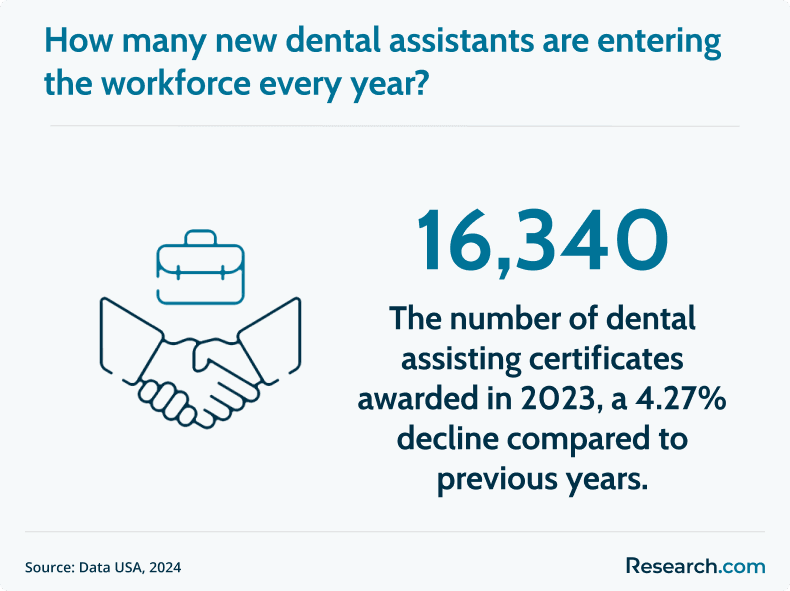
Do online dental assistant programs cost less than on-campus programs?
Online dental assistant programs often advertise lower costs, but the comparison depends on how tuition and fees are structured. Public colleges typically charge the same per-credit rate for online and in-person courses, though some states offer reduced online tuition to in-district residents. This means that while classroom delivery does not always change tuition itself, students may save on transportation, parking, and campus activity fees when studying remotely.
Private vocational schools also deliver online dental assisting certificates, sometimes at a flat program rate. These options may appear less expensive up front, but students should review whether clinical externships, exam fees, or course materials are included in the advertised price. Online learners may also need to budget for mailed lab kits or proctored exams, which can offset savings from reduced commuting.
Overall, online pathways can provide cost efficiency when factoring in indirect expenses like travel and housing. For prospective students, it’s also important to consider program length and completion time, as understanding how long does it take to become a dentist assistant helps in planning both finances and career entry.
What factors increase or lower the cost of dental assistant training?
Tuition is only part of what determines affordability. Institutional rules and funding mechanisms can raise or reduce what you actually pay long before you buy supplies. Focusing on these levers helps you compare programs on net price rather than sticker price.
The most common cost drivers that move net price up or down are explained in detail the following:
- Residency and in-district pricing: Community colleges set lower in-district rates, and some systems offer specific residency pathways or waivers that significantly reduce tuition.
- Transfer and prior learning credit: Accepted transfer credits or evaluated prior learning shorten time to completion, cutting the number of credits you must pay for.
- Apprenticeships and employer support: Earn-while-you-learn models and employer tuition assistance can offset tuition and fees, especially when the occupation is apprenticeable.
- Aid mix and work options: Federal Pell Grants and Federal Work-Study reduce out-of-pocket costs or replace higher-interest borrowing with subsidized earnings during study.
- Academic progress and retakes: Falling below satisfactory academic progress or repeating courses can extend timelines and add unsubsidized costs that raise the total.
Ask programs to quantify each policy for your situation. Verifying residency rules, credit awards, aid eligibility, and apprenticeship options upfront prevents surprises and reveals the true low-cost path.
Additionally, students considering long-term career outcomes may want to explore opportunities beyond clinical roles, including highest paying non clinical physician jobs, to understand potential salary trajectories after training.
The following graph shows how sticker tuition across institution types in 2024–25 compares with 2023–24, highlighting year-over-year changes in published prices.
What financial aid options are available for dental assistant students?
Managing dental assistant certification cost often requires more than relying on a single source of funding. Alongside federal options, students can draw on scholarships from professional organizations, state initiatives, and workforce programs that specifically include dental assisting. These resources reflect the recognition of the field as a critical healthcare occupation and provide a direct way to lessen expenses.
The following resources show how dental assisting students can secure support that is both broad and profession-specific:
- Federal aid programs: Pell Grants, Federal Work-Study, and subsidized loans provide a baseline of assistance for those who qualify at accredited schools.
- ADAA/DANB Scholarship: The American Dental Assistants Association (ADAA) and the Dental Assisting National Board (DANB) award $250–$1,000 annually to members pursuing accredited programs or DANB credentials.
- DANB/DALE Foundation Scholarships: The DALE Foundation, the nonprofit affiliate of DANB, funds scholarships that offset certification exam and continuing education expenses.
- Workforce Ready Grant (Indiana): Indiana’s Next Level Jobs program covers full tuition and fees for eligible residents completing approved short-term healthcare certificates such as dental assisting.
- WIOA workforce grants: The Workforce Innovation and Opportunity Act (WIOA) channels training vouchers to qualifying adults and displaced workers for high-demand careers, with dental assisting often included.
These programs give students a clearer view of how to pay for training. By combining profession-specific scholarships with state and federal support, future dental assistants can keep education accessible while preparing for certification.
How much do fast-track dental assistant certifications cost?
Fast-track certificates condense training into less than a year, but the total price depends on how institutions calculate tuition and whether required materials are included. Schools publish itemized cost sheets that make these differences clear.
The main cost patterns appear in the following categories:
- Public community and technical colleges: In-district students often see total estimates under $10,000 when tuition, lab fees, instruments, uniforms, and exam fees are combined. Out-of-district rates increase the total.
- Private career schools: Tuition charges are generally higher per credit, so even short programs frequently surpass public-college costs and can climb beyond $10,000.
- State-subsidized options: Workforce initiatives in certain states classify dental assisting as a high-demand certificate, covering tuition and mandatory fees entirely for eligible residents.
- Bundled costs: Some institutions package scrubs, background checks, and the DANB Certified Dental Assistant exam into tuition, while others list them separately, creating variation in published totals.
Choosing a fast-track program reduces time in school, but the affordability of that choice depends on institutional type, state support, and whether supplemental fees are absorbed into tuition or billed to students directly.
Students considering a fast track associate's degree dental assistant pathway should also compare these accelerated certificates to ensure the shorter timeline aligns with their budget and career goals.
Which states have the most affordable dental assistant training programs?
Students pursuing dental assisting certificates often find that state residency rules matter as much as institutional choice. Because most programs are housed in public two-year colleges, statewide tuition averages and workforce initiatives are the clearest measures of affordability.
The states with the strongest affordability advantages in 2024–25 are highlighted below:
- California: Average in-district tuition is $1,440, the lowest in the nation, offering residents the cheapest published entry point into certificate programs.
- New Mexico: With an in-district average of $2,220, New Mexico also stands out nationally, keeping allied health certificates accessible at comparatively low cost.
- Indiana: The Workforce Ready Grant fully covers tuition and mandatory fees for eligible residents pursuing high-demand certificates, including dental assisting, making Indiana unique for its tuition-free path.
Together, these cases illustrate two distinct models of affordability: states that maintain exceptionally low tuition levels across community colleges, and states that use targeted funding to eliminate tuition entirely. Both approaches demonstrate how geography and policy decisively shape dental assistant certification cost and overall accessibility.
For students interested in related health fields, there are also flexible options such as nutrition masters programs online no GRE, which allow learners to advance their education without standardized testing barriers.
The following graph shows the projected percent change in employment for dental assistants from 2022 to 2032, based on data from the BLS.
How much does it cost to take the Certified Dental Assistant (CDA) exam?
The Certified Dental Assistant (CDA) exam is the national certification offered by the DANB, and it requires careful budgeting beyond tuition and program fees. Candidates must account not only for the initial application but also for potential retests, scheduling changes, and annual renewal fees to maintain the credential.
DANB’s published 2025 fee schedule outlines these specific charges:
- Full CDA exam: $450 for all three components (General Chairside, Radiation Health and Safety, Infection Control), including a nonrefundable application fee.
- Single components: $270 for any one of the individual exams if taken separately.
- Two-exam combinations: $375 for candidates registering for two sections together, such as Infection Control and General Chairside.
- Testing adjustments: $60 to request an additional 60-day testing window; cancellations retain $115 in fees.
- Annual renewal: $75 per year to maintain active CDA status, plus completion of continuing education requirements.
Factoring in these expenses is essential for an accurate view of dental assistant certification cost. Candidates who plan ahead not only anticipate tuition but also budget for application, retake, and renewal fees, especially if they later consider advancing into related pathways such as the shortest dental assistant to dental hygienist online programs.
What additional fees should I expect when applying for certification?
Students often encounter costs tied to verifying eligibility, handling paperwork, and meeting regulatory requirements, all of which add to the investment of becoming a Certified Dental Assistant (CDA).
Several specific expenses commonly appear during the application stage:
- Transcript requests: Most candidates must submit official academic records to confirm program completion, and colleges usually charge a small fee per transcript.
- Background checks and fingerprinting: Many states and clinical sites require criminal history screening before approving an applicant, with fees set locally.
- Application processing adjustments: While the CDA fee includes a base application cost, late submissions or special processing may trigger extra administrative charges.
- Documentation for accommodations: Applicants requesting testing accommodations must provide professional documentation, and the cost of obtaining medical records or evaluations is generally the student’s responsibility.
What employer or apprenticeship support is available for dental assistant students?
For students worried about affordability, employer and apprenticeship pathways can reduce costs while providing valuable workplace experience. These opportunities connect training directly to employment, often pairing financial assistance with paid learning.
Employer-based support takes several distinct forms that reshape the cost of entering the dental assisting field:
- Apprenticeship wages: Registered apprenticeships allow students to earn income during on-the-job training while completing required coursework, helping offset living and educational expenses.
- Tuition sponsorship agreements: Some dental practices pay part or all of a student’s tuition in return for a post-graduation work commitment, reducing upfront financial pressure.
- Certification reimbursement: Employers may cover the cost of the CDA exam and annual renewal fees as part of professional development benefits.
- Scheduling flexibility: Practices that adjust work hours to accommodate classes and clinical rotations provide indirect support by minimizing lost wages.
- State and federal funding for apprenticeships: In states where dental assisting is a recognized apprenticeable occupation, employers can access public funding to subsidize training costs for their employees.
These supports show how aligning education with workplace demand can lower overall dental assistant certification cost and allow students to gain both financial stability and career experience simultaneously.
Similarly, nurses interested in expanding their clinical roles can explore pathways for how to become a physician assistant from a nurse, which often combine advanced coursework with practical healthcare experience to accelerate career growth.
Is dental assistant certification worth the cost?
Weighing the value of certification requires looking at both expenses and long-term career outcomes. Tuition, fees, and exam costs can add up to several thousand dollars, but national certification provides benefits that extend well beyond the classroom. Certified dental assistants gain access to a wider pool of jobs, stronger starting salaries, and more consistent employment opportunities compared to those without credentials.
Employers often prefer or require certification, which signals readiness to handle patient care, infection control, and radiology responsibilities with confidence. This translates into higher job security in a field projected to grow faster than the average for all occupations.
Certified status can also improve upward mobility, with greater eligibility for expanded duties and specialized positions that may not be open to uncertified staff. Similar advantages are often noted in related healthcare fields, such as the fastest sterile processing technician certificate programs, where credentialing directly improves employability.
When measured against these advantages, the cost of certification represents an investment rather than a barrier. For students who budget carefully and take advantage of financial aid or apprenticeship support, the return in employability and career stability often outweighs the upfront expenses.
Here’s What Graduates Have to Say About Being a Dental Assistant
- Keisha: "I had been working as a receptionist in a dental office and wanted to do more. Certification opened the door for me to assist chairside and take on expanded duties. My dentist supported my training, and the investment quickly paid off in higher wages."
- Savannah: "Affordability was important to me because I was the first in my family to attend any kind of program. Community college tuition kept my costs manageable, and I earned financial aid as well. Now I’m working in a pediatric dental clinic with a career I truly love."
- Cameron: "Completing my dental assistant certification gave me the confidence to transition from retail into healthcare. The program prepared me for real patient care, and within months I found a position that doubled my hourly pay. The low tuition made this change possible without taking on major debt."
Key Findings
- Public two-year colleges charge $1,440–$8,660 in 2025 for dental assistant certificate tuition, depending on state.
- Private institutions, on the other hand, average $16,300–$19,500 for their dental assistant certificate programs.
- Net price is driven by residency status, accepted transfer or prior-learning credit, apprenticeships or employer support, and Pell or Work-Study, while retakes and lost progress push costs higher.
- Dental assistant students can lower certification costs through federal aid, ADAA/DANB and DALE scholarships, state grants like Indiana’s Workforce Ready Grant, and WIOA workforce funding.
- California and New Mexico post the nation’s lowest in-district tuition, while Indiana’s Workforce Ready Grant can eliminate dental assistant certification cost for eligible residents.
- The CDA exam costs $450 for all components in 2025, with $270 per section if taken separately, plus renewal and rescheduling fees that add to total dental assistant certification cost.
References:
- Bureau of Labor Statistics. (2024). Dental assistants. U.S. Department of Labor, Occupational Outlook Handbook. https://www.bls.gov/ooh/healthcare/dental-assistants.htm
- College Board. (2024). Trends in College Pricing and Student Aid 2024. https://research.collegeboard.org/media/pdf/Trends-in-College-Pricing-and-Student-Aid-2024-ADA.pdf
- Data USA. (2024). Dental Assisting – Tuition Costs (Public, Private Institutions). https://datausa.io/profile/cip/dental-assisting
- Dental Assisting National Board & DALE Foundation. (2024). Scholarship programs for dental assistants. https://www.dalefoundation.org/resources/scholarship
- Dental Assisting National Board. (2024, Dec.). 2025 recertification requirements. https://danbsfprodassets.azureedge.net/assets/docs/default-source/recertification-and-renewal/recertification-requirements.pdf
- National Center for Education Statistics. (2024). Price of attending an undergraduate institution. U.S. Department of Education. https://nces.ed.gov/programs/coe/indicator/cua
- U.S. Department of Education, Federal Student Aid. (2025). Federal student aid programs. https://studentaid.gov/understand-aid/types
- U.S. Department of Labor. (2025). Workforce Innovation and Opportunity Act (WIOA). https://www.dol.gov/agencies/eta/wioa
Other Things You Should Know About the Cost of Becoming a Dental Assistant
In 2027, online dental assistant programs can be more cost-effective than in-person ones due to reduced overhead costs. However, prices vary based on school reputation, learning format, and included materials. While online programs offer flexibility, ensure they meet certification requirements and offer the necessary hands-on experience.
In 2027, the cost of becoming a certified dental assistant typically ranges from $1,000 to $5,000, depending on various factors. These factors include the program's duration, location, and type of institution, as well as additional costs such as textbooks, exam fees, and materials. It's vital for prospective students to research multiple programs to find the one that suits their budget and career goals.
In 2027, dental assistant students can access financial aid options such as federal student loans, Pell Grants for eligible candidates, and scholarships from dental organizations. Apprenticeships and employer-sponsored tuition assistance may also reduce education costs significantly.
In 2027, factors affecting the cost of dental assistant classes and certification include geographic location, course type (online vs. in-person), and the institution's reputation. Programs at community colleges may be more affordable, while private institutions often charge higher fees. Additional expenses can include textbooks, supplies, and certification exam fees.


