
2027 How Much Does a Licensed Professional Counselor (LPC) Make

Co-Founder and Chief Data Scientist
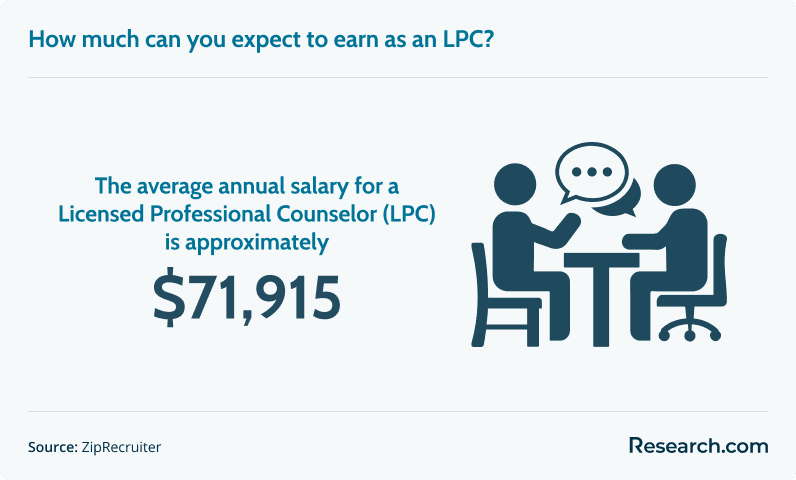
Licensed Professional Counselors (LPCs) are at the frontlines of mental health care. They help people manage challenges like stress, anxiety, and depression. However, their work is not only meaningful but also comes with solid earning potential. In 2027, the average LPC salary is about $71,915 per year.
If this is a career path you want to explore, it helps to understand what influences salary and what can boost your earning potential. This guide breaks down everything you need to know about LPC salaries in 2027, including trends, growth opportunities, and insights from professionals already in the field.
Key Things to Know About Becoming a Licensed Professional Counselor (LPC) in 2027
- LPCs enjoy strong job growth prospects. Employment for substance abuse, behavioral disorder, and mental health counselors is projected to grow 17% from 2024 to 2034.
- Advancement in experience yields higher pay. The top 10% can draw salaries of around $101,000 or more.
- LPCs can work in private practice, hospitals, community health centers, schools.
- What is the average annual salary for a licensed professional counselor in 2027? Average Salary
- Which industries offer the highest salaries for licensed professional counselor? Top Industries
- What qualifications can increase an entry-level LPC's starting salary? What qualifications can increase an entry-level LPC's starting salary?
- How does an LPC's salary increase with years of experience? How does an LPC's salary increase with years of experience?
- How does an LPC's salary compare to that of a licensed clinical social worker (LCSW)? LPC vs. LCSW
- Are salaries higher for LPCs in government roles? Are salaries higher for LPCs in government roles?
- Which LPC certifications lead to higher salaries in 2027? Certifications
- Can LPCs make more money in private practice? Private Practice
- What is the job outlook for LPCs in 2027 and beyond? Job Outlook
- What trends will drive changes in LPC over the next years? Trends
- Which educational programs offer the most cost-effective pathway to LPC licensure? Which educational programs offer the most cost-effective pathway to LPC licensure?
Licensed professional counselor salary in 2027: quick answer
If you are considering becoming a Licensed Professional Counselor (LPC), salary is probably one of the first practical questions you need answered. LPC pay can vary widely because counselors work in many settings: community agencies, hospitals, private practices, religious organizations, schools, courts, telehealth platforms, and government programs. Your income will depend on licensure status, location, specialty, employer type, client volume, and whether you work for an organization or run your own practice.
The average annual salary for a Licensed Professional Counselor in the United States is approximately $71,915. Pay commonly falls between the 25th percentile of about $58,500 per year and the 75th percentile of about $80,000 per year. LPCs in the 90th percentile can earn up to $101,000 annually.
New LPCs usually earn less. Entry-level counselors with under one year of experience often make closer to $45,000 per year. Graduates coming from online counseling psychology programs may start near this level, particularly when they work in rural communities, nonprofit agencies, or lower-income service areas.
Higher starting salaries are more common in large metropolitan areas, hospital systems, specialized treatment programs, and private practices with strong referral networks. Over time, LPCs can improve earnings by gaining clinical experience, adding credentials, building a specialty, supervising other counselors, or moving into leadership roles.
| Salary point | Annual amount | What it usually means |
| Entry-level LPC | Closer to $45,000 | Common for counselors with under one year of experience or those working in lower-paying community settings |
| 25th percentile | About $58,500 | Typical for early-career or lower-paid LPC roles |
| Average annual salary | Approximately $71,915 | A broad national estimate across LPC roles and work settings |
| 75th percentile | About $80,000 | More common for experienced counselors, specialized roles, or stronger-paying employers |
| 90th percentile | Up to $101,000 | Often tied to advanced experience, private practice, leadership, or high-demand specialties |
Highest-paying industries for licensed professional counselors
LPCs do not all earn the same because counseling jobs are funded in different ways. Community mental health agencies and nonprofits may offer meaningful clinical experience but lower pay. Hospitals, specialized programs, private-sector organizations, and certain religious or professional organizations may offer stronger compensation because the roles can involve complex cases, administrative duties, consulting, or leadership responsibilities.
The industries below are among the stronger-paying options for counselors based on the salary figures available in the source article.
| Industry or work setting | Reported salary level | Why pay may be higher |
| Religious organizations | Mean annual wages of about $86,480 | Roles may combine counseling, pastoral care coordination, family support, crisis response, and program leadership |
| Business, professional, labor, and political organizations | Average wages around $80,680 per year | Counselors may work in employee support, organizational wellness, consulting, or specialized private-sector services |
| Insurance-related entities | Average wages in the $76,000–$78,000 range | These roles may involve behavioral health review, care coordination, case management, or treatment planning support |
| Hospitals | Median wage of about $61,930 per year | Hospital jobs may offer stable employment, interdisciplinary teams, benefits, and exposure to higher-acuity cases |
How to use industry salary data
Do not choose an LPC job based on salary alone. A higher-paying role may also require evening coverage, crisis response, productivity targets, documentation pressure, or experience with high-risk clients. A lower-paying role may provide better supervision, stronger training, or a more manageable caseload early in your career.
As LPCs grow professionally, some consider doctoral training to move into advanced clinical practice, psychological assessment, leadership, or organizational consulting. If you are thinking beyond counselor licensure, it may be useful to review how to get a PsyD in counseling psychology, since that pathway can lead toward psychologist licensure and a broader clinical scope.
Qualifications that can raise an entry-level LPC salary
Entry-level LPC salaries are not fixed. Two new counselors can have very different offers depending on their supervised experience, licensure progress, specialty preparation, and fit for the employer’s client population. Even students who begin their education through affordable online community colleges can improve long-term earning potential by choosing later programs and clinical placements carefully.
The most valuable qualifications are the ones that reduce an employer’s training burden and show that the counselor can handle real client needs safely and effectively.
| Qualification | How it can affect salary | Best for |
| Full LPC licensure | Licensed counselors usually have stronger salary options than interns, associates, or pre-licensed clinicians | Candidates ready for independent or more autonomous clinical work |
| Specialized certifications | Credentials in trauma therapy, addiction counseling, marriage and family therapy, or evidence-based treatment methods can make a candidate more competitive | Counselors targeting hospitals, rehab centers, private practice, or specialty clinics |
| Strong supervised clinical experience | High-quality practicum, internship, and supervised hours can signal readiness for complex caseloads | New LPCs competing for better-paying entry roles |
| Relevant client-population experience | Experience with trauma, substance use, family systems, crisis care, or group therapy may align with higher-need roles | Counselors who want to avoid being limited to generalist positions |
Questions to ask before accepting an entry-level LPC job
- Will the role count toward required supervised hours? If you still need hours for full licensure, verify this before accepting an offer.
- What is the caseload expectation? A higher salary may come with a much heavier client load or strict productivity requirements.
- Is supervision included? Paying separately for supervision can reduce your real take-home income.
- Does the employer support certification training? Some employers reimburse or provide continuing education that can improve future earnings.
- What benefits are included? Health insurance, retirement contributions, paid time off, and paid training can make a lower base salary more valuable.
How LPC salary changes with experience
LPC income generally rises as counselors move from direct-service roles into more specialized, independent, supervisory, or leadership positions. The increase is not automatic, however. Counselors who remain in low-paying settings without adding skills or credentials may see slower growth than those who build a specialty or move into higher-paying work environments.
At the junior level, the average annual salary is about $82,000. At the mid-level, it rises to approximately $94,675. At the senior level, compensation can reach around $108,000 annually.
| Career stage | Average annual salary noted | Common ways to reach this level |
| Junior level | About $82,000 | Full licensure, stronger clinical confidence, and experience with a defined client population |
| Mid-level | Approximately $94,675 | Specialized practice, advanced certifications, higher-acuity work, or established private-practice caseloads |
| Senior level | Around $108,000 | Clinical supervision, program leadership, consulting, private practice growth, or administrative responsibility |
Specialized clinical experience is one of the clearest ways for LPCs to strengthen their earning power. Employers and clients often value counselors who can treat trauma, substance use concerns, family conflict, mood disorders, crisis situations, or complex co-occurring conditions.
Leadership experience also matters. LPCs who supervise new clinicians, manage treatment programs, coordinate services, or oversee documentation and compliance can move into director or administrator roles. These jobs may pay more because they combine clinical judgment with operational responsibility.
In 2027, LPCs who can use evidence-based treatment methods such as cognitive behavioral therapy (CBT), dialectical behavioral therapy (DBT), or eye movement desensitization and reprocessing (EMDR) may stand out in both private practice and organizational settings.
Some counselors eventually pursue a doctorate to expand their clinical authority or qualify for psychologist licensure. If you want to compare doctoral options that do not require the GRE, Research.com covers APA accredited PsyD programs no GRE required.
LPC salary vs. LCSW salary: which path pays more?
Students interested in therapy often compare the Licensed Professional Counselor path with the Licensed Clinical Social Worker (LCSW) path. Both professionals may provide counseling and mental health support, but their training models, job settings, responsibilities, and salary patterns are not identical.
Based on the salary figures cited here, LCSWs earn more on average than LPCs. The average annual salary for LCSWs is approximately $123,000, compared with about $71,915 for LPCs. That creates a difference of roughly $51,085 on average.
| Factor | LPC | LCSW |
| Average annual salary cited | About $71,915 | Approximately $123,000 |
| Training focus | Counseling, psychotherapy, mental health assessment, and treatment planning | Clinical social work, psychotherapy, case management, systems-based support, and social services |
| Common work settings | Private practice, outpatient clinics, community mental health, teletherapy, treatment centers | Hospitals, healthcare systems, government agencies, social service organizations, private practice |
| Best fit | Students who want a therapy-centered counseling career | Students who want clinical therapy options plus broader social work and systems-focused roles |
LCSWs may have higher earning potential because their roles can span psychotherapy, healthcare coordination, complex case management, hospital-based work, and government agency positions. Their training through a master’s degree in social work (MSW) can also prepare them for broader systems-level responsibilities.
LPCs still offer an attractive path for people who want to focus primarily on counseling. Their education is centered on therapy skills, client relationships, assessment, treatment planning, and interventions for individuals, couples, families, or groups. Some LPCs may also apply counseling skills in adjacent fields, including careers in clinical research, depending on additional training and employer requirements.
Choose the LPC path if you want:
- A career centered mainly on counseling and psychotherapy
- The option to build a private practice around a therapy specialty
- Training focused on mental health treatment rather than broader social-service systems
- A pathway that may involve fewer administrative or policy-focused duties than some social work roles
Consider the LCSW path if you want:
- More flexibility across healthcare, government, and social service settings
- Clinical work combined with case management or systems-based support
- Potential access to roles where social work licensure is preferred or required
- A career that can blend therapy with advocacy, program coordination, and public-service work
Do government LPC jobs pay more than private-sector roles?
Government LPC salaries can be competitive, but the biggest advantage is not always the base salary. Public-sector roles often provide predictable pay progression, benefits, retirement options, paid time off, and job stability. For many counselors, the total compensation package can be more valuable than a slightly higher private-sector salary with fewer protections.
Government LPCs may work for agencies such as the Department of Veterans Affairs (VA), state mental health facilities, correctional systems, public hospitals, county courts, or community behavioral health programs. Federal roles often follow a structured General Schedule (GS) pay scale, which can make salary growth easier to forecast based on grade, step, experience, and years of service.
Private practice can offer a higher income ceiling, but it also carries more financial risk. Counselors who operate independently must account for rent, malpractice coverage, billing costs, marketing, unpaid cancellations, taxes, record systems, and time spent on non-clinical work. A private practitioner may earn more per session but may not receive paid leave, employer-sponsored insurance, or a guaranteed client flow.
| Option | Main income advantage | Main trade-off |
| Government employment | Stable salary structure, benefits, retirement plans, and predictable advancement | Less flexibility in scheduling, pay structure, and clinical focus |
| Private-sector employment | Potentially stronger pay in hospitals, specialty clinics, or private organizations | Compensation and benefits vary widely by employer |
| Private practice | Higher income ceiling and control over rates, caseload, and niche | Business expenses, income variability, and no guaranteed benefits |
If your goal is to maximize long-term earnings, compare roles by total compensation, not salary alone. Research.com’s guide to master's in counseling highest paid jobs can help you identify counseling-related roles where specialization, leadership, and advanced credentials may improve earning potential.
LPC certifications that may lead to higher salaries in 2027
Credentials matter in the counseling labor market. Nearly 85% of mental health counseling jobs require a professional credential, which shows that employers often view licensure and specialized training as essential rather than optional.
For LPCs, certifications are most useful when they match a clear demand area. Trauma, addiction, and substance use credentials can support access to roles in hospitals, rehabilitation centers, outpatient programs, specialty clinics, and private practice.
| Certification or specialty | Salary figure cited | How it can support higher earnings |
| Certified Addictions Counselor (CAC) | Median of $62,708 per year | Prepares LPCs for addiction treatment roles, a field with consistent demand |
| Trauma certification | Often between $68,657 and $89,286 | Can support work with trauma-focused care, EMDR, cognitive processing therapy (CPT), and higher-acuity client needs |
| Certified Substance Abuse Counselor (CADC) | Clinical substance use disorder (SUD) counselors with advanced-level training often earn $70,000 or more | Can qualify counselors for specialized clinics, hospital programs, and rehabilitation settings |
Certifications are not a shortcut around licensure, clinical skill, or ethical practice. They work best when layered onto a strong counseling foundation, supervised experience, and a clear career plan. For students still choosing a graduate program, the best online master’s programs in clinical mental health counseling can help identify programs that build advanced clinical preparation for LPC licensure and specialized practice.
Can LPCs earn more in private practice?
Yes. LPCs can earn more in private practice than in many salaried roles, but higher potential income comes with higher responsibility. Private practice income depends on session rates, client volume, cancellation rates, insurance participation, out-of-pocket fees, niche demand, marketing, and operating costs.
An LPC in private practice can set fees, choose a specialty, manage referrals, and grow a business over time. Counselors with strong reputations, full caseloads, or high-demand specialties may generate income above what many agency or nonprofit jobs offer.
Teletherapy has also changed the private-practice model. Many counselors now use online sessions to reach clients who need flexible scheduling or who cannot easily access in-person care. Clients and new clinicians often ask what is teletherapy counseling because it affects scheduling, service area, privacy practices, reimbursement, and client access.
| Private practice advantage | What it means | Risk to consider |
| Control over rates | You can set session fees based on market, specialty, and client base | Rates must still be realistic for your area and payer mix |
| Flexible schedule | You can design your workweek around client demand and personal capacity | Evenings or weekends may be needed to maintain a full caseload |
| Specialization | A clear niche can attract referrals and support stronger pricing | Building a niche takes time, training, and marketing |
| Business ownership | You benefit directly from practice growth | You also handle overhead, taxes, insurance, billing, and unpaid administrative work |
Private practice is usually a better fit for LPCs who are comfortable with both clinical work and business management. Counselors who prefer stable income, employer benefits, and less administrative responsibility may be better served by government, hospital, or agency employment.
Most cost-effective education pathways to LPC licensure
The most cost-effective LPC pathway is not always the cheapest program. A low tuition price can become expensive if the program lacks the right accreditation, does not meet state licensure requirements, offers weak clinical placement support, or makes it difficult to transfer credits.
Prospective LPCs should compare programs based on total cost, licensure alignment, clinical training quality, faculty support, online or campus format, and available financial aid. State-specific scholarships and grants can also reduce the financial burden, especially for students preparing to work in shortage areas or public mental health settings.
For a focused comparison of lower-cost options, review Research.com’s guide to the most affordable online counseling degrees. Use affordability rankings as a starting point, then verify licensure fit with your state board before enrolling.
| Cost factor | Why it matters | What to verify before enrolling |
| Accreditation and licensure alignment | A program that does not meet state requirements may delay or block licensure | Confirm the program is acceptable for LPC licensure in the state where you plan to practice |
| Clinical placement support | Practicum and internship experiences affect both licensure progress and employability | Ask whether the school helps secure placements or expects students to find sites independently |
| Total program cost | Fees, books, technology, travel, residency requirements, and supervision costs can add up | Request a full cost estimate, not just tuition per credit |
| Online vs. campus format | Online study can improve flexibility, but some programs still require in-person experiences | Check residency, internship, and local supervision requirements |
| Transfer credit policy | Accepted credits can reduce both time and cost | Ask how many credits can transfer and whether graduate counseling credits are eligible |
Job outlook for LPCs in 2027 and beyond
The labor market for mental health counseling remains strong. According to the U.S. Bureau of Labor Statistics (BLS), employment for substance abuse, behavioral disorder, and mental health counselors is projected to grow 17% from 2024 to 2034.
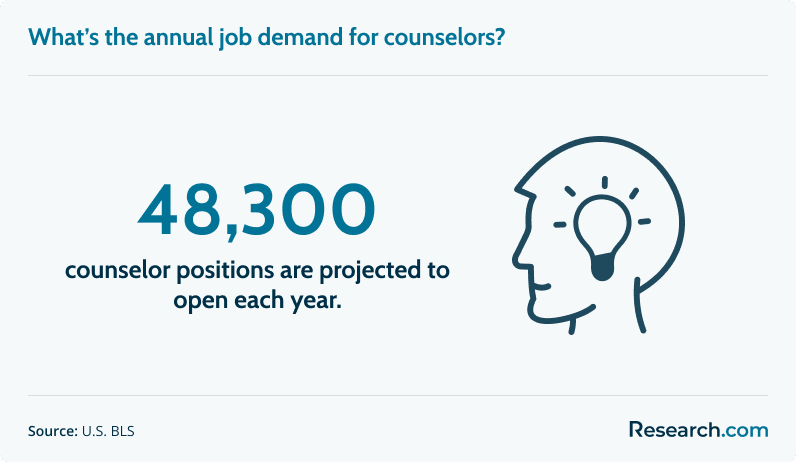
The BLS also expects about 48,300 job openings per year over that decade for these roles. Many openings are expected because workers retire, change occupations, or leave the field.
For LPCs, this outlook suggests steady demand across mental health, substance use, behavioral health, outpatient care, teletherapy, and healthcare-linked counseling services. Counselors with additional credentials, telehealth competence, and experience treating high-need populations may be better positioned for stronger jobs and higher pay.
Demand for counseling professionals is also visible in related roles. For example, trends in school counselor pay reflect the broader recognition that students and communities need more mental health support.
Trends affecting LPC salaries and career opportunities
LPC careers are being shaped by rising demand for mental health care, expanded telehealth use, payer requirements, and employer expectations for specialized skills. These trends do not guarantee higher salaries for every counselor, but they influence where opportunities are growing and which qualifications may matter most.
One major driver is the continued need for mental health services. Recent mental health data reported that about 23% of adults experienced a mental, behavioral, or emotional disorder. Greater public awareness, pandemic-related effects, youth anxiety and depression concerns, and reduced stigma have all contributed to demand for qualified counselors.
Care delivery is also changing. By January 2025, nearly 60% of all U.S. telehealth claims were tied to mental health conditions. Teletherapy can help LPCs reach clients who face geographic, scheduling, mobility, or stigma-related barriers. At the same time, it requires counselors to understand privacy practices, state telehealth rules, documentation, emergency protocols, and reimbursement policies.
What LPCs should do to stay competitive
- Build telehealth competence. Learn ethical online practice, client screening, emergency planning, and secure documentation.
- Choose a specialty deliberately. Trauma, addiction, substance use, family counseling, and evidence-based modalities can improve marketability.
- Track state requirements. Licensure rules, supervision expectations, and telehealth regulations vary by state and can change.
- Strengthen documentation skills. Employers and payers increasingly expect accurate notes, treatment plans, and measurable progress tracking.
- Evaluate total compensation. Salary, benefits, supervision, continuing education, workload, and advancement opportunities all affect career value.
Common mistakes to avoid when evaluating LPC salary
LPC salary decisions are often more complicated than they look. A job with a higher posted salary may be less attractive if it has poor supervision, limited benefits, high turnover, or unrealistic productivity expectations. A lower-paying role may be worthwhile if it builds licensure hours, provides excellent mentorship, or opens a path into a higher-paying specialty.
| Mistake | Why it can hurt your career | Better approach |
| Choosing a program without checking licensure requirements | You may complete coursework that does not qualify you for LPC licensure in your intended state | Confirm requirements with the state licensing board before enrolling |
| Looking only at tuition | Fees, travel, residency requirements, books, and supervision costs can change the real price | Compare the full cost of attendance and post-graduation licensure expenses |
| Assuming online programs automatically meet licensure rules | Online format does not guarantee state approval or clinical placement compatibility | Ask the program directly whether it meets LPC requirements in your state |
| Ignoring supervised experience quality | Weak supervision can slow skill development and reduce confidence with complex clients | Prioritize placements with experienced supervisors and relevant client populations |
| Comparing salaries without benefits | A higher base salary may be offset by poor insurance, no paid leave, or unpaid supervision | Calculate total compensation, not just annual pay |
| Assuming private practice income is guaranteed | Client volume can fluctuate, and business expenses reduce net income | Build business skills and create a realistic financial plan before going independent |
Here’s what LPCs have to say about their careers
- Brenda: "Before completing my program, I was making just under $50,000 as a caseworker. After earning my LPC and moving into addiction counseling, my income moved closer to the national LPC average of $70,000, and the work finally felt better aligned with my pay."
- Dwayne: "Specializing made the biggest difference for me. I added trauma-focused training, and that helped me move into a hospital role where salaries can reach the mid-$80,000s. The extra credential changed the kinds of jobs I could pursue."
- Mirabel: "Teletherapy training opened up my practice. I can work with clients beyond my immediate city, keep a more flexible schedule, and grow my income without relying only on in-person appointments."
References
- Bureau of Labor Statistics, U.S. Department of Labor. Substance Abuse, Behavioral Disorder, and Mental Health Counselors. Occupational Outlook Handbook. Bureau of Labor Statistics
- Bureau of Labor Statistics, U.S. Department of Labor. Occupational Requirements Survey: Occupational Profiles. Bureau of Labor Statistics
- California Healthline. Mental Health and Substance Misuse Treatment Is Increasingly a Video Chat or Phone Call Away. California Healthline
- Franklin University. Mental Health Professionals: How To Become One in 2025 (& Beyond). Franklin University
- National Conference of State Legislatures. State Coverage for Telehealth Services. NCSL
- Zippia. Mental Health Counselor Demographics & Statistics. Zippia
- ZipRecruiter. Licensed Professional Counselor Salary. ZipRecruiter
Key Insights
- The average annual salary for a Licensed Professional Counselor is approximately $71,915, but pay ranges from closer to $45,000 for many new LPCs to up to $101,000 for top earners.
- Industry matters. Religious organizations, business and professional organizations, insurance-related entities, and hospitals can offer stronger pay than many community agency roles.
- Experience raises earning potential, especially when it leads to specialization, supervision, program leadership, private practice growth, or advanced clinical responsibility.
- LCSWs show a higher cited average salary at approximately $123,000, while LPCs may be a better fit for students who want a therapy-centered counseling career.
- Government jobs may not always have the highest base pay, but benefits, retirement plans, job stability, and structured salary progression can make them financially attractive.
- Certifications in addiction, trauma, and substance use counseling can improve competitiveness, especially for hospital, rehabilitation, specialty clinic, and private-practice roles.
- Private practice can increase income, but only if the counselor can manage business costs, referrals, scheduling, documentation, taxes, and client retention.
- The safest education decision is to choose a program that is affordable, accredited, clinically strong, and aligned with LPC licensure rules in the state where you plan to practice.
Other Things You Should Know About Becoming a Licensed Professional Counselor (LPC) in CURRENT_YEAR
In 2027, Licensed Professional Counselors (LPCs) earn different average salaries based on their regions. For example, LPCs in California often earn higher wages compared to those in less populated states due to differing demand and cost of living. Always consult regional salary data for precise figures.
A Licensed Professional Counselor's (LPC) salary in 2027 can be influenced by factors such as geographical location, years of experience, specialization, and level of education. Rural areas might offer different salaries compared to urban regions, and advanced specializations could result in higher pay.
In 2027, the average salary for a Licensed Professional Counselor (LPC) in the United States varies between $49,000 and $80,000 annually, depending on factors such as location, experience, and specific practice settings.


