
2027 How to Transition from FNP to Acute Care NP

Co-Founder and Chief Data Scientist
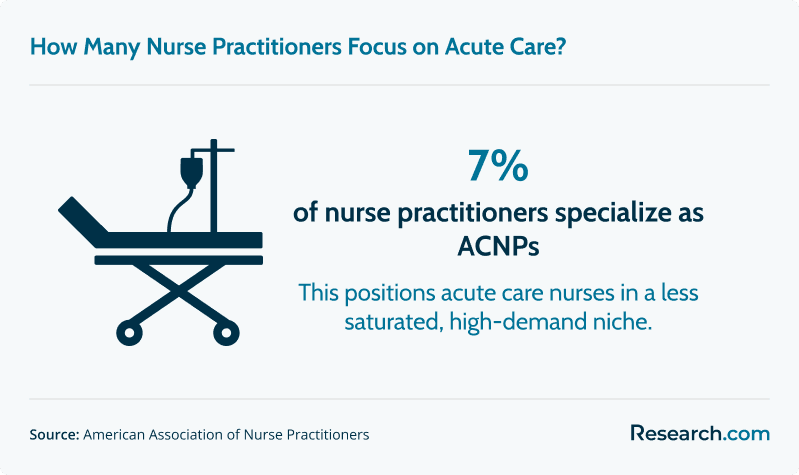
It is becoming increasingly common for family nurse practitioner (FNPs) to transition into acute care nurse practitioner (ACNP) roles. The demand for ACNPs is projected to grow by 35% by 2034, with about 134,000 new job openings expected over that period. However, only 7% of NPs are certified in acute care. This reflects a limited supply of ACNPs despite strong demand in ICUs, ERs, and hospitalist roles.
If you are interested in taking this path, this guide will walk you through everything you need to know to transition from FNP to acute care NP. From educational requirements and clinical training to certification, scope of practice, and salary outlook, we will cover the key steps and considerations for transitioning from FNP to ACNP in 2027.
Key Things to Know About Transitioning from FNP to Acute Care in 2027
- ACNPs can work in ICUs, emergency departments, and specialty units not typically open to FNPs.
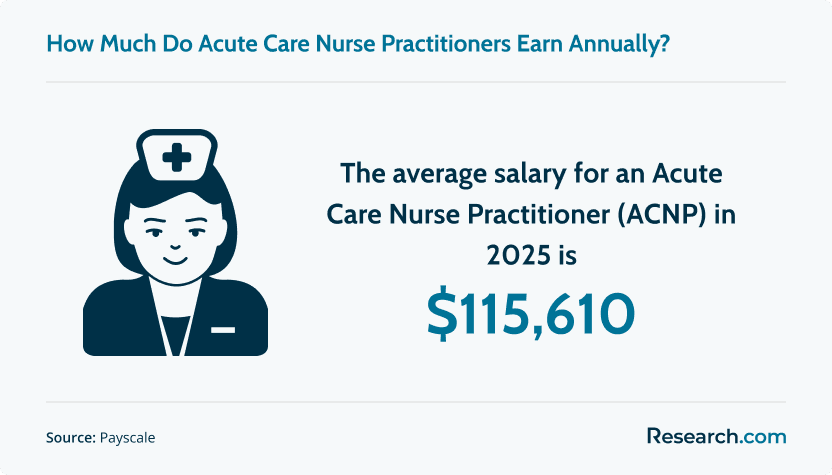
- ACNPs generally earn more than FNPs due to specialized skills in acute care settings. They earn approximately $115,610 annually.
- ACNPs can work in trauma centers, cardiology, neurology, and surgical ICUs.
- Why should an FNP consider transitioning to an ACNP? Why transition?
- How does the scope of practice expand after becoming an ACNP? Scope
- What are the educational requirements to become an ACNP? Requirements
- Are there accelerated programs for FNPs transitioning to ACNPs? Programs
- What types of procedures do ACNPs need to master during clinical hours? What types of procedures do ACNPs need to master during clinical hours?
- What certifications are required to practice as an ACNP? What certifications are required to practice as an ACNP?
- How much does ACNP certification cost in 2027? Certification Cost
- What are the common challenges FNPs face when transitioning to ACNP? What are the common challenges FNPs face when transitioning to ACNP?
- What is the job outlook for ACNPs in 2027? Job Outlook
- What are the potential earnings for ACNPs compared to FNPs? Earnings
Should an FNP transition to an ACNP role?
Family Nurse Practitioners who are considering acute care usually have one central question: is the extra certification, clinical training, and role adjustment worth it? For many FNPs, the answer is yes if they want to move from broad primary care into hospital-based care for acutely ill, unstable, or medically complex adult patients.
The FNP-to-ACNP transition matters because the two roles serve different patient needs. FNPs are trained across the lifespan, often in outpatient, preventive, and chronic disease management settings. Adult-Gerontology Acute Care Nurse Practitioners focus on adults and older adults with urgent, acute, critical, or complex conditions, commonly in hospitals, ICUs, emergency departments, and specialty services.
This guide explains what changes when an FNP becomes an ACNP, what education and certification are required, how long accelerated pathways may take, what procedures ACNPs learn, what challenges to expect, and how to decide whether this move fits your career goals.
Quick answer: Is moving from FNP to ACNP worth it?
Transitioning from FNP to ACNP can be worthwhile for nurse practitioners who want higher-acuity work, more hospital-based responsibilities, and stronger alignment with critical care, emergency care, cardiology, pulmonology, trauma, surgery, or inpatient medicine. It may also improve earning potential. In 2024, FNPs earned an average of $103,820 per year, while AG-ACNPs averaged $112,180. Another salary comparison reports average annual earnings of $108,133 for FNPs and $115,610 for ACNPs.
The labor market is also favorable for nurse practitioners overall. The Bureau of Labor Statistics projects 35% growth for nurse practitioners over the next decade. Acute care specialists are particularly important as hospitals manage more older adults and patients with complex chronic and acute conditions.
However, this path is not simply a title change. FNPs usually need a post-master’s acute care certificate, 500–700 new acute care clinical hours, and national ACNP certification before they can practice in the role. They should also be prepared for a faster clinical pace, higher-risk decision-making, and a narrower patient population than family practice.
| Choose the ACNP transition if you want... | Think carefully before transitioning if you prefer... |
| ICU, emergency, trauma, surgical, or inpatient specialty practice | Long-term primary care relationships across the lifespan |
| Higher-acuity adult and geriatric patient management | Outpatient wellness, prevention, and routine chronic care |
| Advanced diagnostics, procedures, and rapid clinical decisions | A broader family practice scope with children, adults, and older adults |
| Hospital-based collaboration with intensivists, hospitalists, and specialty teams | Clinic-based care coordination and community health practice |
Nurse practitioners comparing population-focus options may also want to review FNP vs AGNP roles before committing to an acute care pathway.
How does an ACNP scope of practice differ from an FNP scope?
Becoming an ACNP expands an FNP’s role into the management of acutely ill, critically ill, and medically unstable adult patients. The biggest shift is not just where the NP works, but the type of clinical judgment required. ACNPs are trained to assess fast-changing patient conditions, interpret complex diagnostic findings, initiate urgent interventions, and manage care across the inpatient continuum.
Depending on state practice laws, facility credentialing, and institutional policy, ACNPs may order and interpret laboratory tests and imaging, manage complex medication regimens, stabilize patients in emergencies, participate in post-surgical care, and perform selected invasive procedures such as intubation or central line placement. FNPs, by contrast, are usually prepared for primary care, preventive services, health maintenance, and chronic disease management across all ages.
| Practice area | FNP focus | ACNP focus |
| Typical setting | Primary care clinics, community health, urgent care, outpatient specialty practices | Hospitals, ICUs, emergency departments, inpatient specialty units, step-down units |
| Patient population | Patients across the lifespan | Adults and older adults with acute, critical, or complex conditions |
| Clinical emphasis | Prevention, wellness, routine management, chronic disease follow-up | Stabilization, diagnostics, acute deterioration, invasive monitoring, specialty management |
| Care timeline | Ongoing outpatient relationships | Admission, inpatient treatment, discharge planning, acute follow-up |
| Decision environment | Often scheduled, longitudinal, and preventive | Often urgent, high-risk, and rapidly changing |
If you are still clarifying the baseline role, reviewing what an FNP does can make the scope change easier to understand.
What education does an FNP need to become an ACNP?
FNPs who already hold an MSN or DNP typically do not need to repeat an entire graduate nursing degree to become an Adult-Gerontology Acute Care Nurse Practitioner. The most common route is a post-master’s certificate in acute care that fills the gap between family practice preparation and acute care competencies.
The usual requirements for changing from FNP to ACNP include:
- Completing a post-master’s certificate in acute care
- Finishing 500–700 new supervised clinical hours in acute care settings
- Passing a national ACNP certification examination
Post-master’s certificate programs generally build on prior graduate nursing coursework. That means FNPs may be able to apply earlier advanced practice courses toward the new credential and focus mainly on acute care-specific content, such as complex diagnostics, advanced pathophysiology, acute pharmacologic management, critical care decision-making, and inpatient clinical rotations.
For many working nurses, the appeal is efficiency. These bridge-style certificate pathways often take about 12-20 months, rather than requiring another full MSN or DNP. Nurses who previously selected an easy RN to BSN online program may recognize the value of a flexible academic route, but ACNP preparation is clinically intensive and should not be judged by convenience alone.
| Requirement | Why it matters | What FNPs should verify |
| Post-master’s acute care certificate | Provides the adult-gerontology acute care content missing from FNP preparation | Whether the program is designed for currently certified NPs and leads to ACNP exam eligibility |
| 500–700 clinical hours | Builds supervised experience with high-acuity adult and older adult patients | Whether clinical placements include ICU, emergency, hospitalist, or specialty acute care exposure |
| National certification exam | Validates readiness for ACNP practice | Whether the curriculum meets AACN or ANCC eligibility requirements |
| State licensure and role authorization | Determines whether the NP can legally practice in the ACNP role | Whether the state board recognizes the certification and scope for the intended practice setting |
Are accelerated FNP-to-ACNP programs available?
Yes. Accelerated post-master’s ACNP certificate programs are available for FNPs who already have graduate-level NP preparation and want to add acute care certification without starting a second full graduate degree. These programs are designed to avoid repeating completed foundational coursework while still requiring the acute care didactic courses and clinical hours needed for certification eligibility.
Some examples show how condensed these pathways can be. Hawai‘i Pacific University offers an online AGACNP certificate that can be completed in as few as 14 months. West Coast University and King University offer options that take about 16 months of full-time study. For nurses who already hold or are considering doctoral preparation, acute care specialization is one practical example of what you can do with a DNP without necessarily beginning a completely separate doctoral pathway.
Accelerated does not mean easy. These programs usually move quickly through advanced acute care content and may schedule clinical hours in concentrated blocks. Students often balance work, coursework, simulation, exams, and hospital-based clinical rotations. Before enrolling, FNPs should ask whether the program helps secure clinical placements, whether online courses require campus visits, and whether the schedule is realistic for nurses working full-time.
| Program feature | What it means for FNPs | Decision tip |
| 12–20 month timeline | Can shorten the transition compared with earning another full MSN or DNP | Confirm whether the timeline assumes full-time enrollment |
| Online coursework | May allow working NPs to continue employment while studying | Check for required intensives, simulations, or campus visits |
| Concentrated clinical rotations | Provides focused acute care exposure in a shorter period | Ask who arranges preceptors and clinical sites |
| Acute care-only coursework | Reduces duplication of prior FNP graduate content | Request a formal gap analysis before enrolling |
What clinical skills and procedures do ACNP students learn?
ACNP clinical training is more procedural and higher-acuity than typical FNP preparation. Students are expected to develop competence through supervised practice, simulation, and repeated exposure to unstable patients. The goal is not simply to know procedures conceptually, but to understand when they are indicated, how to assist or perform them safely within scope, how to monitor complications, and how to coordinate the care team.
Common procedures and technical competencies in ACNP training may include:
- Endotracheal intubation and extubation
- Central venous line insertion
- Arterial line placement and removal
- Chest tube insertion and removal
- Thoracentesis
- Lumbar puncture
- Interpretation of 12-lead ECGs and radiology
- Procedural sedation
- Management of invasive monitoring
Procedure exposure matters because confidence in acute care comes from practice under supervision. ATS Journal reports that 92% of pulmonary and critical care fellows reported experience with endotracheal intubation during training, while eighty-eight percent (88%) had exposure to bag-mask ventilation. Programs also often aim for fellows to perform 20-80 intubations over a 3-year curriculum alongside classroom and simulation training. Although those figures refer to pulmonary and critical care fellows, they illustrate why high-acuity training programs emphasize repeated hands-on exposure rather than observation alone.
FNPs entering acute care should ask prospective programs how procedure logs are tracked, which procedures are taught in simulation, and which are available during clinical placements. Institutional privileging matters too: even after certification, the procedures an ACNP can perform depend on state law, facility rules, supervision expectations, and credentialing.
Allied health professionals who are earlier in their nursing pathway may find it helpful to review how to transition from surgical tech to RN before considering advanced practice roles.
What certifications are required for ACNP practice?
FNPs cannot simply move into an acute care NP role based on family practice certification alone. To practice as an ACNP, nurses generally need graduate-level acute care preparation, an active RN license, and a recognized national acute care certification. State boards of nursing and employers may also require documentation that the NP’s education, certification, and clinical privileges match the patient population and setting.
The two major U.S. certifications for Adult-Gerontology Acute Care Nurse Practitioners are:
Adult-Gerontology Acute Care Nurse Practitioner – Acute Care (ACNPC-AG)
The American Association of Critical-Care Nurses offers the ACNPC-AG credential for nurse practitioners prepared to care for adult and geriatric patients in acute care environments.
Eligibility includes:
- A graduate-level advanced practice education program in adult-gerontology acute care nursing
- Supervised clinical and didactic preparation aligned with ACNP competencies
- An active, unencumbered Registered Nurse license
Adult-Gerontology Acute Care Nurse Practitioner – Board Certified (AGACNP-BC)
The American Nurses Credentialing Center awards the AGACNP-BC credential for nurse practitioners prepared for acute care practice with adult and older adult patients.
Requirements include:
- A Master of Science in Nursing or higher from an accredited program
- At least 500 supervised clinical hours in acute care settings
- An active RN license
Both credentials require renewal every five years through continuing education, practice requirements, and, in some cases, examination. FNPs should verify which credential is preferred by employers in their region and which one aligns with their academic program.
| Certification | Organization | Best fit | Key requirement to check |
| ACNPC-AG | American Association of Critical-Care Nurses | NPs seeking an acute care credential with a critical care organization | Graduate adult-gerontology acute care preparation and active RN license |
| AGACNP-BC | American Nurses Credentialing Center | NPs seeking board certification for adult-gerontology acute care practice | MSN or higher, at least 500 acute care clinical hours, and active RN license |
Nurses comparing highly specialized advanced practice options may also want to study how to become a CRNA after BSN, since anesthesia has separate education, training, and certification expectations.
How much does ACNP certification cost in 2027?
Certification costs vary by organization and membership status. For the ACNPC-AG certification through AACN, the computer-based exam costs $270 for members and $380 for nonmembers. Renewal by exam has retest fees of $210 for members and $315 for nonmembers.
For the AGACNP-BC certification through ANCC, initial certification fees range from $295 for American Nurses Association members to $395 for nonmembers. Renewal fees range from $275 to $375, depending on membership.
| Credential | Initial exam cost | Renewal or retest cost | Cost factor |
| ACNPC-AG | $270 for members; $380 for nonmembers | $210 for members; $315 for nonmembers | AACN membership status |
| AGACNP-BC | $295 for ANA members; $395 for nonmembers | $275 to $375 | Membership status |
Exam fees are only one part of the total cost. FNPs should also budget for certificate tuition, university fees, textbooks, clinical compliance costs, travel to clinical sites, background checks, immunization documentation, and possible lost work hours during intensive rotations. Nurses interested in acute or specialty practice can also compare whether FNPs can work in cardiology before deciding whether ACNP certification is necessary for their target role.
What challenges do FNPs face when transitioning to ACNP?
The transition from FNP to ACNP can be professionally rewarding, but it is also a major identity and competency shift. FNPs moving into acute care must adapt from a broad primary care mindset to a hospital-based model where patients can deteriorate quickly and decisions often carry immediate consequences.
Common challenges include higher patient acuity, unfamiliar procedures, complex inpatient workflows, specialty consult coordination, and the need to interpret advanced diagnostics quickly. Many FNPs also need time to become comfortable with ventilator management, invasive lines, hemodynamic monitoring, rapid response situations, and the pace of ICU or emergency care.
Role transition can also affect confidence. The AACN notes that NPs moving into acute care roles frequently experience imposter syndrome, even when they are competent and well prepared. This can be intensified when orientation is short, mentorship is inconsistent, or the new ACNP is expected to function independently too soon.
| Common challenge | Why it happens | Better approach |
| Underestimating the acuity shift | FNP training emphasizes outpatient care more than unstable inpatient care | Choose clinical sites with ICU, emergency, or specialty inpatient exposure |
| Choosing a program only for speed | Shorter programs may look attractive to working NPs | Prioritize certification eligibility, clinical quality, and preceptor support |
| Assuming certification equals full procedural authority | Privileges depend on state rules and facility policy | Ask employers which procedures ACNPs are credentialed to perform |
| Lacking structured mentorship | New acute care roles may not offer consistent onboarding | Seek jobs with formal orientation, physician collaboration, and experienced ACNP mentors |
| Ignoring emotional adjustment | High-stakes practice can trigger self-doubt | Use peer support, debriefing, continuing education, and gradual skill-building |
A strong transition plan includes both academic preparation and workplace support. Before accepting a first ACNP role, ask about orientation length, patient load, supervision expectations, night coverage, procedure training, and escalation protocols.
What is the job outlook for ACNPs in 2027?
The outlook for ACNPs is supported by the broader demand for nurse practitioners and by the need for clinicians who can manage complex adult and geriatric patients in acute care settings. ACNPs make up a smaller share of the NP workforce, approximately 7%, but their expertise is valuable in hospitals, critical care units, emergency departments, and specialty services.
Several forces support demand: an aging population, physician shortages in acute care, and expanded reliance on nurse practitioners in hospital-based teams. Globally, the need for health professionals remains significant. The World Health Organization has reported that about 50% of the global health workforce is experiencing a shortage. Canada also faces nursing shortages, creating more opportunities for acute care-trained nurses.
The NP workforce is also becoming more diverse. The percentage of men in NP roles increased from 8% in 2010 to 13% in 2022, which points to broader participation in advanced practice nursing specialties, including acute care.
Current trends affecting ACNP careers
- Hospitals are relying more on team-based specialty care. ACNPs often work with hospitalists, intensivists, surgeons, cardiologists, pulmonologists, and emergency physicians to manage complex patients.
- Employer expectations are becoming more role-specific. Hospitals increasingly want NP certification to match the patient population and setting, which makes FNP-only preparation less suitable for many acute care jobs.
- Clinical placement quality is a major differentiator. Because ACNP roles require high-acuity judgment, programs with strong hospital partnerships may offer better preparation than programs that leave students to find preceptors independently.
- Nursing pipelines remain important. Pathways such as CNA to RN online bridge programs can help more students enter nursing and eventually progress toward advanced practice roles.
How much can ACNPs earn compared with FNPs?
Salary comparisons generally show ACNPs earning more than FNPs, although actual pay depends on location, employer, shift structure, specialty, experience, union agreements, and whether the role includes nights, weekends, call, or procedures. One comparison reports average annual earnings of $108,133 for FNPs and $115,610 for ACNPs. Another 2024 comparison reports $103,820 for FNPs and $112,180 for AG-ACNPs.
The pay difference is commonly linked to ACNPs’ higher-acuity responsibilities. These clinicians manage unstable or medically complex adult patients, often in settings where rapid decisions and advanced interventions are part of daily practice. In practical terms, ACNPs may earn roughly $5,000 to $15,000 more per year than FNPs, depending on role and market.
| Role | Reported average annual pay | Why pay may differ |
| FNP | $103,820 in 2024; another comparison reports $108,133 | Broad primary care preparation, often outpatient and preventive care focused |
| AG-ACNP / ACNP | $112,180 in 2024; another comparison reports $115,610 | Acute, critical, emergency, hospital, and specialty care responsibilities |
FNPs should not base the decision only on salary. A higher-paying hospital role may also involve rotating shifts, emotional stress, exposure to patient deterioration, procedural expectations, and a steeper learning curve. The better question is whether the acute care environment fits your preferred clinical identity and long-term career direction.
Professionals comparing earning potential across health disciplines can also review the highest paid occupational therapy jobs to see how specialization and work setting affect compensation in other fields.
What do professionals say about moving from FNP to acute care NP?
- : "My neuro ICU rotation changed how I understood acute care. Stroke and subarachnoid hemorrhage cases required faster thinking than any textbook scenario. My preceptor helped me adjust treatment decisions in real time, including intracranial pressure management, and that mentorship made me more confident in urgent clinical judgment. — Kyla"
- : "Working nights while completing the ACNP program was difficult, but the coursework connected directly to what I saw at the bedside. Learning to titrate vasoactive medications and interpret complex hemodynamic data gave me skills I now use every shift. — Isobel"
- : "The simulations were stressful in the best way. Practicing intubation and managing multi-organ failure forced me to make decisions under pressure. When I reached my cardiac ICU rotation, I felt ready to participate instead of just observe. — Faye"
How to choose the right FNP-to-ACNP program
The best ACNP program is not always the fastest or least expensive. It is the one that prepares you for certification, provides high-quality acute care clinical training, fits your schedule, and aligns with the state and employer requirements for your intended role.
- Confirm accreditation and certification alignment. Ask whether graduates are eligible for ACNPC-AG, AGACNP-BC, or both.
- Request a gap analysis. The school should explain which FNP courses transfer and which acute care courses you still need.
- Evaluate clinical placement support. Ask whether the program assigns clinical sites or requires you to locate preceptors independently.
- Check acute care site quality. Look for ICU, emergency, hospitalist, trauma, surgical, cardiology, pulmonology, or specialty inpatient exposure.
- Compare total cost, not just tuition. Include exam fees, travel, compliance requirements, books, technology, and reduced work hours.
- Ask about faculty expertise. Faculty should have current or recent acute care practice experience.
- Review state authorization. Online programs may not meet requirements in every state, especially for clinical placement and licensure.
- Talk with recent graduates. Ask whether they felt prepared for certification, onboarding, and first ACNP roles.
Questions FNPs should ask before enrolling
| Question | Why it matters |
| Does the program lead to ACNP certification eligibility? | Without eligibility, you may not be able to practice in the intended acute care role. |
| How many clinical hours will I need? | FNPs commonly need 500–700 new acute care clinical hours. |
| Who finds preceptors? | Finding acute care preceptors can be one of the hardest parts of the transition. |
| Are clinical rotations available in my state? | Online programs may have state authorization or placement limitations. |
| What types of units do students rotate through? | ICU, emergency, and specialty inpatient exposure can affect readiness. |
| What is the expected weekly time commitment? | Accelerated programs can be difficult to manage with full-time clinical work. |
| What certification exam do graduates usually take? | This helps you understand whether the program is aligned with your preferred credential. |
| What support is available for role transition? | Mentorship, simulation, and faculty access can reduce the shock of moving into acute care. |
Common mistakes to avoid when transitioning from FNP to ACNP
- Choosing based only on speed. A short program is valuable only if it provides strong clinical preparation and certification eligibility.
- Assuming FNP certification is enough for hospital acute care. Many acute care roles require ACNP preparation that matches the patient population and setting.
- Ignoring state scope of practice rules. Your authority to diagnose, prescribe, perform procedures, and practice independently depends on state law and facility policy.
- Overlooking clinical placement responsibility. Programs that require students to find their own preceptors can create delays.
- Focusing only on tuition. Certification fees, compliance costs, travel, books, and lost wages can change the real cost of the transition.
- Expecting salary increases to be automatic. Earnings vary by employer, region, shift, specialty, and experience.
- Skipping mentorship after graduation. New ACNPs benefit from structured onboarding, experienced preceptors, and gradual increases in responsibility.
References
- American Association of Nurse Practitioners. (2021, September 23). Findings from 2020 survey show nurse practitioners continue to provide quality health care during the pandemic. https://www.aanp.org/news-feed/findings-from-2020-survey-show-nurse-practitioners-nps-continue-to-provide-quality-health-care-during-the-pandemic
- American Association of Nurse Practitioners. (2023, March 23). Nurse practitioners secure no. 1 spot across three U.S. News & World Report Best Jobs rankings. https://www.aanp.org/news-feed/nurse-practitioners-secure-no-1-spot-across-three-u-s-news-world-report-best-jobs-rankings
- Baylor University. (n.d.). Family NP vs. Adult-Gerontology Acute Care NP: What is the difference? https://onlinenursing.baylor.edu/news/family-np-vs-adult-gerontology-acute-care-np-what-is-the-difference
- CareerExplorer. (n.d.). Acute care nurse practitioner demographics. https://www.careerexplorer.com/careers/acute-care-nurse-practitioner/demographics/
- National Center for Biotechnology Information. (2016). Role transition from RN to NP: A systematic review. PubMed. https://pubmed.ncbi.nlm.nih.gov/27153306/
- Nurse Practitioner Journal. (2022). Workforce demographics and transition challenges for nurse practitioners. https://www.npjournal.org/article/S1555-4155(22)00268-9/
- Payscale. (n.d.). Acute care nurse practitioner salary in the United States. https://www.payscale.com/research/US/Certification=Acute_Care_Nurse_Practitioner_(ACNP)/Salary
- Regis College. (n.d.). ACNP vs FNP: Understanding the differences. https://online.regiscollege.edu/online-masters-degrees/online-master-science-nursing/family-nurse-practitioner/resources/acnp-vs-fnp
- ScienceDirect. (2018). Challenges in role transition for nurse practitioners: A review. https://www.sciencedirect.com/science/article/abs/pii/S1471595318308308
- U.S. Bureau of Labor Statistics. (2024). Nurse anesthetists, nurse midwives, and nurse practitioners. https://www.bls.gov/ooh/healthcare/nurse-anesthetists-nurse-midwives-and-nurse-practitioners.htm
Key Insights
- FNPs should consider ACNP certification if they want to move into adult-gerontology acute care, critical care, emergency care, inpatient specialty practice, or hospital-based advanced practice roles.
- The transition usually requires a post-master’s acute care certificate, 500–700 supervised acute care clinical hours, and a national ACNP certification exam.
- Accelerated pathways can take about 12–20 months, with some programs offering timelines as short as 14 months or about 16 months of full-time study.
- ACNPs generally work with higher-acuity patients than FNPs, which can bring more procedural responsibility, faster decision-making, and stronger alignment with hospital medicine.
- Salary comparisons show ACNPs earning more on average than FNPs, but pay varies by region, employer, specialty, shift structure, and experience.
- The biggest risks are choosing a program without confirming certification eligibility, underestimating clinical placement demands, and assuming an ACNP credential automatically grants procedural privileges.
- The strongest FNP-to-ACNP candidates are clinically curious, comfortable with urgent decision-making, willing to seek mentorship, and motivated by complex adult and geriatric acute care.
Other Things You Should Know About Other Things You Should Know About Transitioning from FNP to Acute Care in CURRENT_YEAR
To enroll in an Acute Care NP program after FNP, you must typically hold an active RN license and an MSN or DNP degree. Additionally, some programs require one year of clinical experience in a relevant acute care setting, such as an ICU or ER, by 2027.
In 2026, transitioning from FNP to Acute Care NP typically takes 1 to 2 years, depending on the program's structure and whether the candidate is studying part-time or full-time. Accelerated programs can shorten this duration for those meeting certain prerequisites and maintaining a rigorous study schedule.


