
2027 Pharmacy Technician License vs. Certification: Explaining the Difference

Co-Founder and Chief Data Scientist
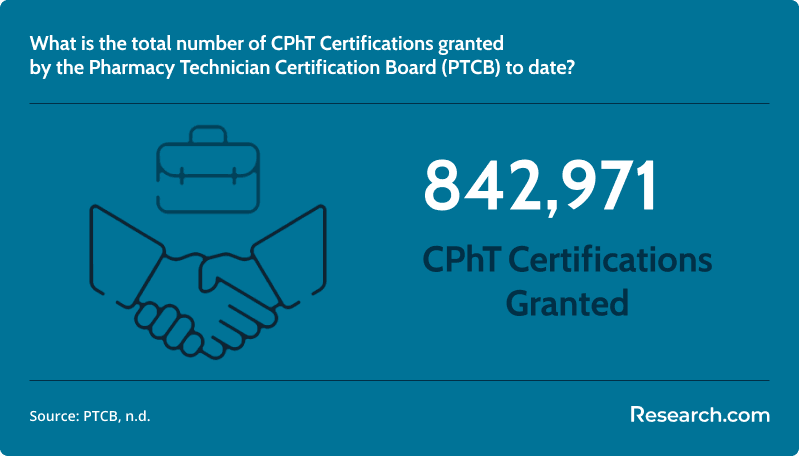
For an aspiring professional, the question often arises: What is the difference between a pharmacy technician license and a pharmacy technician certification? While both credentials are vital, confusing their respective purposes, legal authorities, and requirements can seriously delay the start of one's career. It is important to know that the Pharmacy Technician Certification Board (PTCB) has granted over 842,971 CPhT certifications to date, showing a clear professional preference for this national standard.
The Research.com team, leveraging over ten years of expertise in career planning and using only credible sources, has prepared this comprehensive guide. By reading this article, you will gain a clear understanding of the roles, requirements, and value of each credential in the profession for 2027, enabling you to make informed decisions about your professional path and quickly secure the best job opportunities.
Key Things You Should Know About Pharmacy Technician License vs. Certification
- Certification validates national competence and offers broad geographic flexibility, unlike a state-specific license, which is the legal authorization to work and is now mandated by the vast majority of U.S. states.
- The average cost of a national certification exam ($129) is comparable to a state license ($70 to $125), but certification leads to higher salaries, with Level II certified technicians earning an average of $41,919 annually.
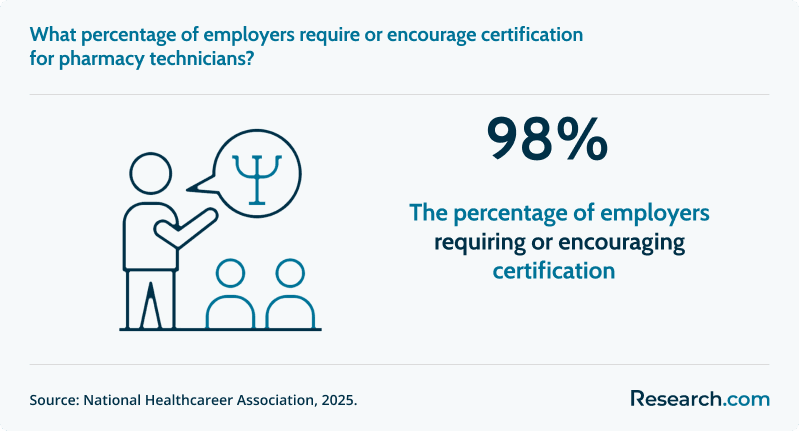
- The career field is experiencing strong demand, projected to grow 6% from 2024–2034, and certification is a major factor for advancement, with 98% of employers requiring or encouraging it for higher-paying and specialized roles.
- What is the difference between a pharmacy technician license and certification? License vs. Certification
- Do I need to get state-registered before I can apply for a national pharmacy technician certification? Do I need to get state-registered before I can apply for a national pharmacy technician certification?
- Which U.S. states require a pharmacy technician license instead of just registration or certification? Which U.S. states require a pharmacy technician license instead of just registration or certification?
- How does the national pharmacy technician certification help with state-to-state reciprocity compared to a state-only license? How does the national pharmacy technician certification help with state-to-state reciprocity compared to a state-only license?
- What are the educational prerequisites for a pharmacy technician certification exam compared to a state license application? Educational Prerequisites
- What is the average total cost for a state pharmacy technician license, and how does it compare to the certification exam fee? Average Total Cost
- What are the Continuing Education (CE) hour requirements for maintaining a pharmacy technician license versus national certification? Continuing Education
- Can employers reimburse the costs of the PTCB exam or only the state licensing fee? Can employers reimburse the costs of the PTCB exam or only the state licensing fee?
- Are there higher salaries for certified pharmacy technicians compared to licensed-only technicians in major retail pharmacies? Salaries
- What is the projected job growth rate and demand for pharmacy technicians? Job Growth
- Does holding a pharmacy technician certification qualify me for advanced roles or management positions over a license? Does holding a pharmacy technician certification qualify me for advanced roles or management positions over a license?
What is the difference between a pharmacy technician license and certification?
The key distinction between a pharmacy technician license and pharmacy technician certification lies in their purpose, scope, and who grants them, but both are essential for entering and advancing in the field.
Certification is primarily an indicator of professional competence, while licensure is a legal requirement to practice in most states. Understanding the difference helps aspiring pharmacy technicians navigate the steps needed to become fully qualified and employable.
Pharmacy technician license
A pharmacy technician license is issued by a state board of pharmacy and is required for legal employment as a technician within that state. The licensing process typically includes submitting an application, paying fees, passing a background check, and in some cases, showing proof of certification or completion of an accredited training program.
Because licensing requirements vary by state, technicians must ensure they meet the regulations in the state where they plan to work.
Pharmacy technician certification
A pharmacy technician certification is typically earned by passing a nationally recognized exam, such as those offered by the Pharmacy Technician Certification Board (PTCB) or the National Healthcareer Association (NHA).
Earning certification shows that an individual has mastered key concepts in pharmacology, medication safety, and pharmacy law. It serves as proof of professional knowledge and readiness, giving certified technicians an advantage in hiring and career advancement. However, certification alone does not grant the legal authority to work—it simply demonstrates that the person meets national standards of competence.
In some states, certification is required before licensure, while others accept alternative forms of training. Ultimately, certification validates a technician’s skills on a national level, while licensure gives them the legal right to practice within a specific jurisdiction.
To summarize, this relationship resembles the difference between a teaching license and a teaching credential, where one represents a legal authorization to practice and the other reflects verified professional qualifications.
Do I need to get state-registered before I can apply for a national pharmacy technician certification?
You generally do not need to be state-registered before applying for a national pharmacy technician certification, as the two processes serve different purposes and are managed by separate authorities.
National certification is designed to assess your knowledge, skills, and professional readiness on a nationwide level, while state registration or licensure determines your eligibility to legally practice within that specific state.
For example, certification exams such as the Pharmacy Technician Certification Exam (PTCE) offered by the PTCB and the Exam for the Certification of Pharmacy Technicians (ExCPT) from the NHA are open to candidates who meet certain prerequisites.
These requirements typically include completing an accredited pharmacy technician training program or accumulating a specific amount of verified work experience, often between 500 and 1,200 hours. Candidates can pursue certification before, during, or after meeting state-level requirements, depending on the regulations where they live.
However, it’s important to understand that national certification does not replace state registration or licensure. Many states still require pharmacy technicians to register with their State Board of Pharmacy to legally work, even if they already hold national certification. Some states even require proof of certification as part of the licensing process.
Because state laws vary widely, ranging from minimal registration to mandatory certification and background checks, it’s always best to verify the specific requirements in your state before applying for a job or beginning training.
When comparing national exams like the PTCE and ExCPT, it’s worth understanding the differences between PTCB vs NHA certification, as each follows slightly different requirements and career recognition pathways.
Which U.S. states require a pharmacy technician license instead of just registration or certification?
The vast majority of U.S. states now require pharmacy technicians to obtain a formal license rather than just registration or certification. Only a few jurisdictions, specifically Delaware, Hawaii, Pennsylvania, and the District of Columbia, require only registration or have no formal licensure requirement.
States that mandate licensing, such as California, Florida, New York, and many others, typically incorporate stringent prerequisites. These requirements generally include the following:
- achieving a national certification (like PTCB or NHA)
- completing board-approved training
- undergoing background checks
- submitting fingerprints, and
- paying associated fees as part of the formal licensing process
These rigorous requirements highlight a growing trend for standardized credentials in all healthcare sectors, much like how specialized IT professionals seek a fast-track online CCSP certification training program to quickly validate their expertise in cloud security and advance their careers.
Meanwhile, the chart below shows the most in-demand skills among pharmacist technician:
How does the national pharmacy technician certification help with state-to-state reciprocity compared to a state-only license?
National pharmacy technician certification helps significantly with state-to-state reciprocity compared to a state-only license. Certification through nationally recognized bodies like PTCB or NHA is valid and recognized across all 50 states, the District of Columbia, Guam, and Puerto Rico, making it portable nationwide.
This means a certified pharmacy technician can generally work in different states without needing to recertify, although state-specific licensure or registration requirements may still apply.
In contrast, state-issued pharmacy technician licenses are state-specific and do not automatically transfer to another state. When moving, a technician must apply for a new license in the new state, often undergoing the state's particular licensing process and requirements, which may or may not accept prior licensure easily through reciprocity. Some states do allow license reciprocity, but it is subject to conditions and varies widely.
Thus, national certification offers broader geographic flexibility and is often a prerequisite or strong advantage in obtaining licensure in another state. It demonstrates standardized competency recognized across states, facilitating smoother reciprocity and employment mobility, while state licenses are legally valid only within the issuing state until converted or transferred per state rules.
This mobility is a significant factor when considering careers; for example, a technician might also research the highest-paying state for dental assistant jobs to understand the broader landscape of pay and mobility in related healthcare fields.
What are the educational prerequisites for a pharmacy technician certification exam compared to a state license application?
The educational prerequisites for a pharmacy technician certification exam and a state license application have some similarities but also key differences:
Pharmacy Technician Certification Exam
- Generally requires a high school diploma or General Educational Development (GED) as a minimum educational requirement.
- Candidates must either complete a pharmacy technician training program accredited by recognized bodies such as the American Society of Health-System Pharmacists (ASHP) or Accreditation Council for Pharmacy Education (ACPE) or have at least 500 hours of work experience as a pharmacy technician to qualify for the exam.
- Training programs typically include coursework on pharmacy law, pharmacology, medication safety, pharmaceutical calculations, and ethics.
- The certification exam (e.g., PTCB or NHA) tests knowledge and competency to work as a technician.
State Pharmacy Technician License Application
- Most states require at least a high school diploma or GED.
- Many states require completion of a formal board-approved pharmacy technician training program or equivalent education; some accept national certification in lieu.
- Some states mandate additional requirements, such as a specific number of supervised work experience hours, background checks, fingerprinting, and passing a state exam or the national certification exam.
- States may have varying criteria on the type and duration of acceptable training or education.
Now that you know the specific educational and experience requirements for both certification and licensing, let’s look at how these translate into actual academic attainment in the profession, providing context for the most common degrees and credentials held by working pharmacy technicians.
Many technicians start with short programs but later pursue higher degrees—similar to those comparing an accounting degree vs accounting certificate, where both serve as entry routes but differ in long-term career impact.
What is the average total cost for a state pharmacy technician license, and how does it compare to the certification exam fee?
The average total cost for obtaining a state pharmacy technician license typically falls between $70 and $125, though this can vary based on local regulations and administrative fees. This amount generally includes the state application fee, which tends to be around $60 to $75, and a mandatory background check fee, averaging $30 to $35.
For instance, in Arkansas, the total cost to become licensed is roughly $105, combining a $70 licensing fee with a $35 background screening. Some states may charge additional processing or fingerprinting fees, especially in areas with stricter healthcare credentialing systems.
By comparison, the national certification exam costs slightly more upfront. The PTCE offered has a $129 exam fee, while the ExCPT is priced similarly. Beyond the initial certification, candidates should also consider recertification or renewal costs, which typically range from $40 to $55 every two years.
When evaluating costs, consider long-term benefits—similar to how prospective students analyze the benefits of a health science bachelor's degree, where the upfront investment can yield stronger job stability and advancement potential in the healthcare sector.
What are the Continuing Education (CE) hour requirements for maintaining a pharmacy technician license versus national certification?
The CE hour requirements for maintaining a pharmacy technician license versus national certification are generally similar, but can vary by state for licensure. The rigorous maintenance of national credentials helps ensure the competency of a large segment of the workforce, as evidenced by the 842,971 CPhT Certifications Granted by the PTCB to date.
For national pharmacy technician certification:
- Certified pharmacy technicians must complete at least 20 hours of CE every two years.
- The CE must include at least one hour on pharmacy law and one hour on patient safety.
- Approved CE topics are related to pharmacy practice and can be earned through various formats like live courses, online programs, workshops, or journal articles with tests.
For state pharmacy technician licenses:
- Most states require licensed pharmacy technicians to complete 10 to 20 hours of continuing education every 1 to 2 years, depending on the state’s renewal cycle.
- Many states also require specific hours on pharmacy law and/or patient safety as part of the CE.
- For example, states like Florida and the District of Columbia require 20 hours, including law and safety topics, while some states require 10 hours total.
- States may require CE from accredited providers and have reporting/tracking mechanisms for CE compliance.
Staying current with professional requirements is a commitment to lifelong learning, whether it's fulfilling a mandatory CE requirement for a license or pursuing a new advanced degree.
In the field of education, for example, many teachers look for the shortest master's in gifted education online programs to efficiently upgrade their credentials and specialization while maintaining their teaching careers.
Can employers reimburse the costs of the PTCB exam or only the state licensing fee?
Employers can reimburse both the costs of the PTCB certification exam and the state pharmacy technician licensing fee, but practices vary by employer.
- Many employers, especially large pharmacy chains and healthcare organizations, offer reimbursement or direct payment for the initial PTCB certification exam fee (around $129). Some employers also cover exam retakes if the candidate does not pass on the first try, although this varies.
- Employers also often pay or reimburse state licensing fees, which tend to be lower (around $70 to $125), as part of onboarding or employment requirements.
- Some employers use direct billing services offered by PTCB, allowing them to pay exam and renewal fees directly without requiring technician reimbursement requests.
- Reimbursement policies vary widely; some employers require submission of receipts or expense forms, while others handle payment upfront.
This support for career advancement, in addition to benefits like a cheap online bachelor's degree for veterans, makes a career in the pharmacy field an appealing option for military-affiliated individuals looking for a new path.
It's important to note that the PTCB exam is also eligible for reimbursement under the GI Bill for eligible veterans and service members.
Are there higher salaries for certified pharmacy technicians compared to licensed-only technicians in major retail pharmacies?
Certified pharmacy technicians generally earn higher salaries compared to licensed-only pharmacy technicians in major retail pharmacies.
- Entry-level or Level I pharmacy technicians, who are typically licensed but not nationally certified, earn around $19 per hour, or approximately $40,074 annually.
- Level II pharmacy technicians, who typically hold national certifications such as the PTCB Certified Pharmacy Technician (CPhT), earn an average of $20 per hour, or approximately $41,919 annually.
- Senior pharmacy technicians with additional credentials and certifications can earn up to $56,500 annually.
National certification is often a key factor for advancement to higher-paying technician roles, as it validates standardized knowledge and skills valued by employers, especially in large retail pharmacy chains. Additionally, certified technicians may have access to specialized roles such as handling medication compounding or training others, which also correlates with higher pay.
This focus on advanced credentials can be a major factor for those considering who makes more medical assistants or pharmacy technicians, as specialization and certification often provide a competitive salary edge in the healthcare field.
What is the projected job growth rate and demand for pharmacy technicians?
According to the U.S. Bureau of Labor Statistics (BLS), the employment of pharmacy technicians is projected to grow 6% from 2024–2034, a rate that is faster than the average for all occupations. This growth is expected to create 31,500 new jobs.
Demand is high, with about 49,000 openings projected each year, on average, over the decade. This includes openings from both new job growth and the need to replace workers who exit the labor force.
Certified technicians are in particularly high demand, with 98% of employers requiring or encouraging certification. The pharmacy industry is evolving, leading to more clinical duties being handled by the pharmacy and expanding the technician's role. For example, the NHA reported that 40% of employers said pharmacy technicians have more responsibilities now than in the past.
This sustained demand is further driven by demographic and clinical trends, such as the large number of older people using more prescription medications and the growing prevalence of chronic diseases. Technicians are increasingly needed to take on a greater role in pharmacy operations as pharmacists shift their focus to expanded patient care activities.
Given the strong job outlook and expanding responsibilities, it is helpful to examine where these in-demand professionals primarily work. In 2024, about 490,400 jobs were held by pharmacy technicians, and their largest employers were as follows:
Does holding a pharmacy technician certification qualify me for advanced roles or management positions over a license?
Holding a national pharmacy technician certification significantly improves career advancement opportunities over a state license alone. Certification, particularly the PTCB CPhT credential, is widely seen by employers as a mark of validated knowledge and professionalism.
This credential is a key step toward advanced and management roles because it:
- Qualifies you for specialized roles such as compounding, sterile preparation, medication history, billing, and immunization administration.
- Opens doors to leadership like supervisory, lead technician, or trainer positions, and specialized tracks in fields like oncology or informatics.
- It is often required for promotion to advanced and management positions, as it demonstrates competency beyond basic state licensing.
- Links to career ladders in retail and healthcare systems, connecting certification directly to higher pay scales and promotional eligibility.
- Facilitates access to advanced specialty certifications and continuing education, strengthening both long-term job security and professional credibility.
Here’s What Graduates Have to Say About Pharmacy Technician License vs. Certification
- Marian: "Getting my license was a necessary step; it immediately increased my earning potential by approximately $1.50 per hour compared to my initial uncertified role. Beyond the pay, knowing I'm officially recognized and regulated by the state board gives me a genuine sense of professional confidence in my daily work."
- Daniel: "The certification process standardized my knowledge and proved I met national competence benchmarks, which was crucial when I moved across the country. My employer noted that certified technicians are often given more complex duties, allowing me to engage in advanced compounding techniques, which I find very rewarding. "
- Ben: "Choosing to get my certification has significantly improved my job security and marketability; most desirable hospital positions require it now. This credential made me feel prepared and less anxious during interviews, knowing I had verifiable proof of my dedicated training and commitment to patient safety."
Key Findings
- The PTCB has granted over 842,000 CPhT Certifications to date.
- Employment for pharmacy technicians is projected to grow 6% from 2024–2034, creating 31,500 new jobs.
- 98% of employers require or encourage national certification for pharmacy technicians.
- Level II certified pharmacy technicians earn an average of $41,919 annually, compared to approximately $40,074 for licensed-only, entry-level technicians.
- The national certification exam fee (PTCB) is generally $129, which is comparable to the average state licensing fee range of $70 to $125.
References:
- 20 of the highest-paying pharmacy technician jobs in 2025. (2025). ZipRecruiter. Retrieved October 5, 2025, from https://www.ziprecruiter.com/g/Highest-Paying-Pharmacy-Technician-Jobs
- Bureau of Labor Statistics, U.S. Department of Labor, Occupational Outlook Handbook, Pharmacy Technicians, https://www.bls.gov/ooh/healthcare/pharmacy-technicians.htm
- How to become a pharmacist technician: What it is and career path - Zippia. (2025, January 8). https://www.zippia.com/pharmacist-technician-jobs
- No experience Pharmacy Technician Salary. (2025). ZipRecruiter. Retrieved October 5, 2025, from https://www.ziprecruiter.com/Salaries/No-Experience-Pharmacy-Technician-Salary#Yearly
- Pharmacy Technician Certification | CPHT. (n.d.). AscendBase. https://www.nhanow.com/certification/nha-certifications/certified-pharmacy-technician-(cpht)
- PTCB Certified Pharmacy Technician salary. (2025). ZipRecruiter. Retrieved October 5, 2025, from https://www.ziprecruiter.com/Salaries/Ptcb-Certified-Pharmacy-Technician-Salary#Yearly
Other Things You Should Know About Pharmacy Technician License vs. Certification
In 2027, pharmacy technician certification is provided by organizations like the Pharmacy Technician Certification Board (PTCB) and the National Healthcareer Association (NHA). Certification typically involves passing an exam offered by these bodies and meeting certain eligibility criteria, such as education and clean criminal record checks.
To obtain a pharmacy technician license in 2027, you typically need to complete a formal education program, pass a background check, and meet state-specific requirements, which may include passing an approved certification exam.
In 2027, understanding the difference between certification and licensure helps pharmacy technicians navigate career requirements effectively. Certification often involves passing an exam to demonstrate proficiency, while licensing, typically managed by state boards, confirms legal eligibility to work. Knowing these distinctions can aid in career planning and compliance with state regulations.


