
2027 Top Helping Professions: Careers That Make a Difference

Co-Founder and Chief Data Scientist
More than 7 in 10 workers today say they want a career that creates impact, not just a paycheck—a reminder that purpose matters as much as pay. Helping professions, from social work to public health, remain vital as communities face rising healthcare needs, aging populations, and environmental challenges.
This article highlights the top helping professions for 2025, examining salaries, job outlook, and growth opportunities. Readers will gain clear insights into which careers offer stability, demand, and the chance to make a meaningful difference.
Key Things You Should Know About Helping Professions
- Helping professions cover a wide range of roles—including social workers, teachers, counselors, public health experts, and community managers—focused on improving people’s lives. These careers prioritize service, advocacy, and support, often requiring a balance of technical skills and strong interpersonal abilities.
- Many helping professions require specialized degrees or training, such as social work, counseling, education, or public health. Licensure or certification is often necessary, especially for clinical roles, making education and continuing professional development essential for long-term success.
- Job demand is steady across these fields, with openings often driven by retirements, turnover, and growing needs in healthcare and social services. While some roles face slower growth, others—such as epidemiologists and community service managers—are expanding faster than the national average.
- Top 10 Helping Professions for 2027 Top Helping Professions
- What education or training do you need for a helping profession? Education & Training
- How much can you expect to earn in helping careers? Earnings & Salary
- Which helping careers are in highest demand now? High-Demand Roles
- What skills make someone successful in a helping profession? Key Skills
- What are the challenges or downsides of helping careers? Challenges
- How do you choose which helping profession fits you best? Choosing a Career
- Can you switch into a helping profession later in life? Career Switching
- Do fast-track online degrees enhance career growth in helping professions? Do fast-track online degrees enhance career growth in helping professions?
- What job settings or sectors hire helping professionals? What job settings or sectors hire helping professionals?
- What trends will shape helping professions in the future? What trends will shape helping professions in the future?
Top 10 Helping Professions for 2027
Helping professions take many forms, but they all share one mission: improving lives and strengthening communities. From healthcare and education to environmental sustainability and human rights, these careers address some of society’s most urgent needs. Below are ten of the most impactful roles in 2025, complete with their outlooks and earning potential, to guide readers interested in meaningful work that balances service with professional stability.
Nurse / Registered Nurse
Registered nurses (RNs) are the backbone of healthcare, providing direct patient care, administering treatments, and supporting families through medical challenges. Their work ensures that patients receive not only medical attention but also compassion during recovery. According to the Bureau of Labor Statistics (BLS), registered nursing is projected to add around 177,400 openings annually from 2024 to 2034, largely due to retirements and rising healthcare demands. The median annual wage for RNs was $86,070 in May 2024. This blend of steady demand and strong wages makes nursing one of the most critical helping professions today.
Social Worker
Social workers intervene when people face difficulties—whether those challenges involve poverty, abuse, health crises, or community struggles. They connect clients with resources, provide counseling, and advocate for systemic improvements. The BLS projects about 63,800 openings for social workers each year through 2034, reflecting turnover and growing service needs. Median annual pay for social workers stood at $58,380 in May 2024, though those in healthcare and specialized practice earn higher. Beyond salary, the role’s value lies in its impact—ensuring vulnerable populations receive the support and protection they need.
Mental Health Counselor / Psychologist
Mental health professionals address one of today’s most pressing issues: rising rates of anxiety, depression, and trauma. Mental health counselors provide therapy and support for individuals and groups, while psychologists often conduct deeper clinical assessments. Employment for substance abuse, behavioral disorder, and mental health counselors is projected to grow 18 percent from 2024 to 2034—much faster than average. Median pay in 2024 was $49,710 for counselors and $92,740 for psychologists. Choosing between these roles often comes down to training and scope, as outlined in this comparison of a clinical mental health counselor vs clinical psychologist.
Teacher / Educator
Teachers shape the next generation by fostering critical thinking, creativity, and social development. Whether in kindergarten, elementary, or secondary settings, educators provide the foundation for lifelong learning. According to BLS data, kindergarten and elementary school teachers held 1.54 million jobs in 2024, with about 103,800 openings projected each year despite a slight decline in overall employment. The median annual wage for elementary teachers was $62,340 in May 2024. While the job outlook varies by region and subject, teaching remains among the most influential helping professions.
Public Health Specialist / Epidemiologist
Epidemiologists protect communities by investigating disease outbreaks, researching health risks, and shaping policy to prevent illness. Their work became highly visible during the COVID-19 pandemic and remains critical as new public health threats emerge. BLS projects a 16 percent growth in epidemiologist employment from 2024 to 2034, far faster than the average for all occupations. With a median annual wage of $83,980 in May 2024, this career blends scientific research with real-world impact, ensuring societies are better prepared for health emergencies.
Nonprofit Program Manager / NGO Worker
Nonprofit program managers and NGO professionals coordinate projects that address education, poverty, healthcare, and humanitarian aid. They ensure that limited resources have maximum impact through careful planning and oversight. Employment for social and community service managers, a closely related role, is expected to grow 6 percent between 2024 and 2034, with around 18,600 openings annually. The median wage was $78,240 in May 2024, though earnings vary by organization and location. Beyond numbers, the role offers the chance to contribute directly to social progress and community resilience.
Environmental Scientist / Sustainability Specialist
Environmental scientists and sustainability specialists study pollution, climate impacts, and resource use to develop solutions for a healthier planet. They provide guidance to governments, businesses, and communities on reducing harm to ecosystems and protecting public health. Employment for environmental scientists is projected to grow 4 percent from 2024 to 2034, in line with the average. The median annual wage in May 2024 was $80,060, with federal employees earning the highest. This role reflects growing demand for expertise in environmental protection and sustainable development.
Human Rights Lawyer / Public Interest Attorney
Human rights lawyers advocate for justice, equality, and protection of vulnerable groups. They may represent individuals in court, challenge discriminatory laws, or work with NGOs on international cases. Employment for lawyers overall is projected to grow 4 percent from 2024 to 2034, with about 31,500 openings annually due to retirements and turnover. The median annual wage for lawyers was $151,160 in May 2024, with federal lawyers earning even more. While demanding, this career offers a powerful way to align legal expertise with social impact.
Community Organizer / Policy Advocate
Community organizers and policy advocates work directly with local populations to address pressing issues, from housing insecurity to labor rights. They mobilize groups, influence policymakers, and promote grassroots change. While specific BLS categories are limited, related roles in political science and social services show stable demand. Political scientists, for example, earned a median salary of $139,380 in 2024, though job growth is projected to decline slightly. Still, advocacy remains essential, especially as more organizations recognize the importance of shaping policy at community and national levels, a career consideration similar to exploring the best online PhD in management.
Renewable Energy Engineer / Green Technology Specialist
Renewable energy engineers design systems that make clean energy more efficient and accessible—whether through solar, wind, or emerging green technologies. Their work directly reduces carbon emissions and supports the global transition toward sustainability. Employment of environmental engineers, a key category, is projected to grow 4 percent from 2024 to 2034, with about 3,000 openings each year. The median annual wage for environmental engineers was $104,170 in May 2024. For those passionate about technology and the environment, this career offers both innovation and meaningful impact.
What education or training do you need for a helping profession?
Most helping professions require formal education paired with practical training, and the level depends on the specific role. Some careers can begin with a bachelor’s degree, while others demand graduate study and professional licensure, which is a key distinction, similar to understanding dual degree vs double major.
Below is a breakdown of the typical requirements for key helping professions:
- Nurse / Registered Nurse: A Bachelor of Science in Nursing (BSN) or associate degree in nursing plus passing the NCLEX-RN exam.
- Social Worker: Bachelor of Social Work (BSW) for entry-level; Master of Social Work (MSW) and licensure for clinical practice.
- Mental Health Counselor / Psychologist: Master’s degree in counseling or psychology with supervised clinical hours; psychologists often pursue doctoral degrees.
- Teacher / Educator: Bachelor’s degree in education plus state teaching certification; advanced degrees can open administrative roles.
- Public Health Specialist / Epidemiologist: Master’s in public health (MPH) or epidemiology; doctoral training for research-heavy positions.
- Nonprofit Program Manager / NGO Worker: Bachelor’s in social sciences, business, or nonprofit management; leadership roles favor a master’s degree.
- Environmental Scientist / Sustainability Specialist: Bachelor’s degree in environmental science, biology, or chemistry; advanced research positions may need a master’s.
- Human Rights Lawyer / Public Interest Attorney: Juris Doctor (JD) and state bar passage are mandatory.
- Community Organizer / Policy Advocate: Degrees in political science, public administration, or related fields; advocacy experience highly valued.
- Renewable Energy Engineer / Green Technology Specialist: Bachelor’s in environmental engineering or energy-related engineering; certifications may strengthen credentials.
Across these paths, continuing education, fieldwork, and licensure are crucial for staying current and advancing.
How much can you expect to earn in helping careers?
Earnings in helping professions vary widely, depending on the role, education level, and industry. Lawyers sit at the high end of the pay scale, with a median salary of $151,160 in 2024. Political scientists also earn a strong median wage of $139,380. By contrast, many roles such as social workers and teachers pay less but provide stable employment and meaningful impact. For example, the median social worker salary differs significantly by specialization and state, with licensed clinical social workers often earning higher than entry-level practitioners.
Other fields like environmental engineering and epidemiology provide solid pay alongside strong demand, offering salaries above the national median. While these careers may not always rival corporate sectors, they combine financial security with the chance to directly influence public well-being. Choosing a path often means balancing income potential with passion for service.
The chart below highlights five of the highest-paying helping professions as of 2024, providing a clear comparison of where salaries stand across this diverse field.
Which helping careers are in highest demand now?
The helping careers with the highest demand today are those tied directly to essential services such as healthcare, community programs, and environmental protection. Lawyers remain consistently sought after, with more than 31,000 projected openings each year from 2024 to 2034. This steady need reflects the broad requirement for legal services in government, business, and advocacy, which is a key factor when considering accredited online colleges vs diploma mills.
Social and community service managers are also in demand, with nearly 19,000 openings annually. Their work in overseeing programs for aging populations, addiction treatment, and family support makes them indispensable to nonprofit and public-sector operations. Environmental scientists and specialists are projected to see 8,500 yearly openings, as concerns about climate change and public health keep these roles relevant. Meanwhile, environmental engineers and epidemiologists offer fewer positions overall but remain vital for addressing pollution, disease outbreaks, and sustainability challenges.
The chart below shows which helping careers are expected to generate the most job openings, offering a clear snapshot of where workforce needs are strongest.
What skills make someone successful in a helping profession?
The skills needed to succeed in helping professions center on empathy, communication, and adaptability. These careers all require professionals to work closely with people, address challenges, and improve individual or community well-being. Below are some of the key skills tied to specific roles:
- Nurses / Registered Nurses: Compassion, patience, and attention to detail are essential when providing care, administering treatments, and monitoring patients under pressure.
- Social Workers: Strong empathy, crisis management, and advocacy skills help them support vulnerable populations and navigate complex social systems.
- Mental Health Counselors / Psychologists: Active listening, analytical thinking, and confidentiality are critical to guiding clients through emotional or psychological struggles.
- Teachers / Educators: Communication, adaptability, and classroom management allow them to connect with diverse learners and foster growth.
- Public Health Specialists / Epidemiologists: Research ability, data interpretation, and collaboration help address widespread health risks and guide public policy.
- Environmental Engineers and Scientists: Problem-solving, technical expertise, and creativity are necessary to design sustainable solutions to environmental issues.
- Lawyers and Policy Advocates: Critical thinking, negotiation, and persuasive communication enable them to protect rights and influence systemic change.
Workers in these fields must continuously adapt to evolving demands. Flexible options like one year masters programs online allow professionals to refresh skills while staying active in their careers.
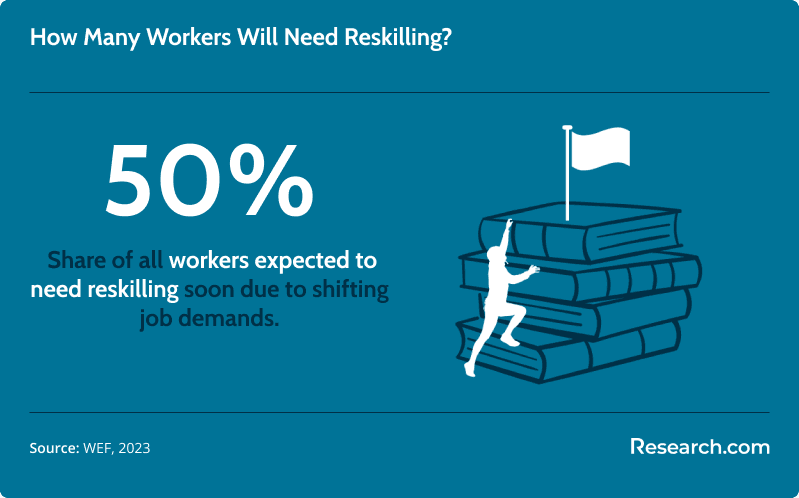
The infographic below shows that by 2025, half of all workers will require reskilling, highlighting why skill growth is crucial for anyone pursuing a helping profession.
What are the challenges or downsides of helping careers?
Helping careers are rewarding but come with significant challenges, ranging from emotional strain to heavy workloads. These roles often demand resilience and a strong sense of purpose to balance the personal costs with the professional rewards, an important consideration when evaluating accreditations like COAMFTE vs CACREP vs WASC accreditation.
- Nurses / Registered Nurses: Long shifts, physical exhaustion, and understaffing are common, often leading to burnout. Constant exposure to patient suffering can also create emotional fatigue.
- Social Workers: High caseloads, limited resources, and the emotional burden of supporting at-risk individuals can result in stress and compassion fatigue.
- Mental Health Counselors / Psychologists: Listening to trauma daily can be emotionally draining, while paperwork and insurance hurdles add administrative stress.
- Teachers / Educators: Low pay in some regions, classroom overcrowding, and pressure to meet testing standards make teaching difficult despite its importance.
- Public Health Specialists / Epidemiologists: They face pressure during outbreaks, balancing public expectations with slow-moving research and limited funding.
- Nonprofit Managers / NGO Workers: Tight budgets, job insecurity, and reliance on external funding create uncertainty.
- Environmental Scientists and Engineers: Their work often involves political resistance, slow policy adoption, and frustration at limited progress against global challenges.
- Lawyers / Policy Advocates: Public interest lawyers often face long hours, emotionally charged cases, and lower salaries compared to corporate peers.
- Community Organizers: Grassroots advocacy is rewarding but marked by irregular pay, public resistance, and demanding schedules.
- Renewable Energy Engineers: Projects can be resource-intensive, with setbacks caused by regulatory delays, high costs, or slow adoption of new technologies.
These challenges don’t erase the value of helping careers, but they highlight the resilience needed to sustain long-term commitment in these professions.
How do you choose which helping profession fits you best?
Choosing the right helping profession starts with understanding your strengths, interests, and long-term career goals. Each role requires a mix of personal traits and formal training, so aligning these factors can make your decision clearer.
- Nursing is best suited for individuals who thrive in fast-paced, hands-on environments and want direct patient care. Empathy, stamina, and problem-solving are critical traits.
- Social Work is a fit for those drawn to advocacy and community service, especially if you’re comfortable with high emotional involvement and complex caseloads.
- Mental Health Counseling / Psychology is ideal if you’re a good listener, patient, and interested in human behavior. It requires advanced degrees and licensing.
- Teaching is right for people who enjoy shaping young minds and can balance patience with classroom management.
- Public Health and Epidemiology appeal to those who like data, research, and problem-solving with wide-scale societal impact.
- Nonprofit Management fits natural leaders motivated by social causes, but it requires adaptability to tight budgets.
- Environmental Science / Engineering suits those committed to sustainability, while an environmental lawyer career path fits those who prefer advocacy through legal frameworks.
- Community Organizing / Policy Advocacy matches those passionate about grassroots movements and public policy.
- Renewable Energy Engineering works well for those who want to combine technical skills with a drive to solve global energy issues.
By weighing personal traits, salary expectations, and educational requirements, you can identify a profession that aligns with both your passions and your lifestyle goals.
Can you switch into a helping profession later in life?
Yes, you can switch into a helping profession later in life, and many people do so successfully. While the transition may require new education, certifications, or reskilling, these careers often welcome professionals with diverse backgrounds and transferable skills. For example, individuals with experience in management may pivot into nonprofit leadership, while those from healthcare-adjacent roles may retrain as nurses, social workers, or counselors.
Many helping professions offer structured pathways for mid-career changers. Nursing has accelerated degree options, while teaching allows alternative certification routes for those who already hold a bachelor’s degree. Mental health counseling, public health, and social work programs often accept students from varied academic and professional backgrounds, emphasizing commitment over age. Skills such as communication, empathy, and problem-solving transfer well, which makes these careers accessible to those who previously worked in unrelated fields.
The growing demand for helping professionals makes this transition more realistic. With aging populations, mental health awareness, and climate challenges, the need for skilled workers in these fields continues to rise. Later-life entrants often bring valuable perspective and maturity, strengthening their impact in service-oriented roles.
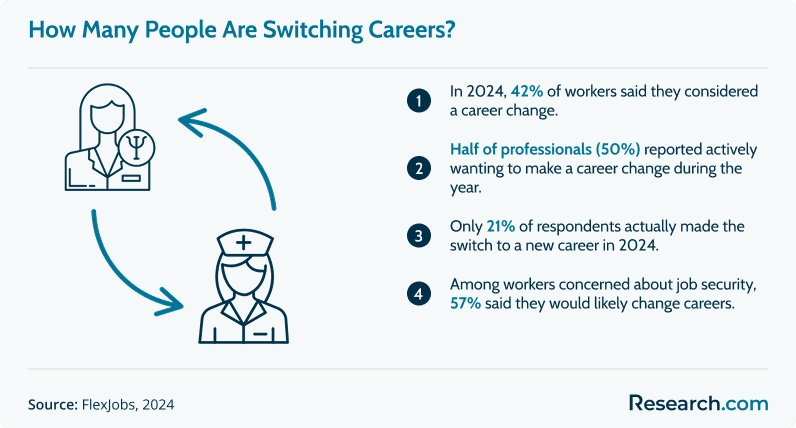
The infographic below highlights how common career change has become, reporting how 42% of workers consider or making the switch to new professions. It underscores the growing trend of mid-career pivots into meaningful roles.
Do fast-track online degrees enhance career growth in helping professions?
Fast-track online degree programs offer streamlined pathways that enable professionals to quickly acquire the specialized skills needed in the helping sectors. These programs are designed to reduce time-to-graduation without compromising academic rigor, which can be essential for those looking to transition or advance their careers efficiently. Leveraging options such as the fastest degree to get online can provide a competitive edge by aligning accelerated learning with the evolving demands of healthcare, social services, and other critical areas. This approach helps professionals meet industry requirements faster, supporting immediate contributions to addressing community needs.
What job settings or sectors hire helping professionals?
Helping professionals are employed across public, private, and nonprofit sectors, and each role often finds its niche in certain settings or industries. Below is a list of roles followed by the sectors where they are most commonly hired:
- Nurse / Registered Nurse: Hospitals, outpatient clinics, community health centers, schools, long-term care facilities; see discussion on the
- Social Worker: Government agencies (child welfare, social services), nonprofit human service organizations, hospitals, schools, mental health centers.
- Mental Health Counselor / Psychologist: Private practices, psychiatric hospitals, community mental health clinics, university counseling centers, rehabilitation facilities.
- Teacher / Educator: Public and private K–12 schools, charter schools, community colleges, adult education programs, special education settings.
- Public Health Specialist / Epidemiologist: Government health departments, CDC or equivalent national agencies, research institutions, NGOs, international health organizations.
- Nonprofit Program Manager / NGO Worker: Nonprofit organizations, foundations, international NGOs, community development agencies.
- Environmental Scientist / Sustainability Specialist: Environmental consultancies, government environmental protection agencies, research institutions, corporate sustainability departments.
- Human Rights Lawyer / Public Interest Attorney: Legal aid organizations, public defender’s offices, civil rights NGOs, policy institutes, governmental agencies.
- Community Organizer / Policy Advocate: Grassroots nonprofit groups, advocacy organizations, political campaigns, think tanks, community coalitions.
- Renewable Energy Engineer / Green Technology Specialist: Renewable energy companies, utility firms, government energy departments, sustainability consulting firms.
These settings show how helping professionals can choose environments that align with their values and influence: from clinics and schools to courts, communities, and green-tech labs.
What trends will shape helping professions in the future?
The future of helping professions will be shaped by demographic changes, advances in technology, and growing social and environmental challenges. Healthcare roles such as nurses, mental health counselors, and epidemiologists will expand due to aging populations, increasing mental health awareness, and heightened global focus on pandemic preparedness. Public health workers and community service managers will also remain vital in addressing inequality and community resilience.
Environmental professions are set to grow as climate change and sustainability become central concerns. Careers such as environmental scientists, engineers, and renewable energy specialists will gain prominence in both public and private sectors. At the same time, demand for lawyers and policy advocates in areas like human rights, environmental justice, and public policy will continue as societies confront legal and ethical complexities. For many of these roles, pursuing graduate education — even through the cheapest online master’s programs — can open doors to advancement.
The chart below highlights the helping professions with the highest projected job outlook from 2024 to 2034, showing where growth is expected to be strongest over the next decade.
Here's What Graduates Have To Say About Their Helping Professions
- Amara: "Transitioning into nursing was demanding, but completing my coursework online gave me flexibility I never thought possible. Now, I balance a stable career while making a real difference in patient care every day. The journey wasn’t easy, but the rewards are undeniable."
- Darwin: "Studying social work online gave me the freedom to keep volunteering while earning my degree. That balance taught me discipline and empathy. Today, I manage community programs that directly change lives, and I carry those lessons into every decision I make."
- Selene: "I pursued psychology through an online program while raising a family. The format fit into my life seamlessly, and the training prepared me for the realities of counseling. Supporting clients through their struggles and seeing their progress is incredibly fulfilling."
Key Findings
- Nurses are projected to add over 130,000 new jobs by 2035, showing strong demand.
- Lawyers remain the top-paid helping profession with a $151,160 median salary (2024).
- Social and community service managers expect 18,600 annual job openings through 2034.
- Half of professionals (50%) in 2024 reported wanting to switch careers.
- Epidemiologists have the fastest projected growth rate at 16% from 2024 to 2034.
- Environmental engineers earn a median salary of $104,170, with 3,000 yearly openings.
References:
- Bureau of Labor Statistics. Changing Work Landscape Career Shifts.
- Bureau of Labor Statistics. Environmental Engineers.
- Bureau of Labor Statistics. Environmental Scientists and Specialists.
- Bureau of Labor Statistics. Epidemiologists.
- Bureau of Labor Statistics. Kindergarten and Elementary School Teachers.
- Bureau of Labor Statistics. Lawyers.
- Bureau of Labor Statistics. Political Scientists.
- Bureau of Labor Statistics. Postsecondary Teachers.
- Bureau of Labor Statistics. Psychologists.
- Bureau of Labor Statistics. Registered Nurses.
- Bureau of Labor Statistics. Social and Community Service Managers.
- Bureau of Labor Statistics. Social Workers.
- Bureau of Labor Statistics. Substance Abuse, Behavioral Disorder, and Mental Health Counselors.
- FlexJobs. Changing Work Landscape Career Shifts.
- World Economic Forum. Workers Multiple Careers Jobs Skills.
Other Things You Should Know About Helping Professions
In 2027, helping professions have increasingly embraced flexible work schedules and remote work options, allowing professionals to better balance personal and professional commitments. Additionally, institutions offer wellness programs and mental health resources, recognizing the importance of supporting their staff's overall well-being.
Entry into helping professions in 2027 typically requires a relevant degree or certification. For example, social workers need a Bachelor of Social Work (BSW) degree, while clinical psychologists require a doctorate in psychology, licensure, and sometimes specific state certifications.
Key skills for success in 2027 helping professions include strong communication, empathy, problem-solving abilities, cultural competence, and adaptability. These skills help professionals effectively engage with diverse populations and navigate evolving workplace challenges, ensuring impactful and meaningful assistance to those in need.


