2027 What is Robotics Engineering: Career Paths, Skills & Salary

Co-Founder and Chief Data Scientist
Robotics engineering is the interdisciplinary field of designing, building, and programming machines that can perceive and interact with the world to perform tasks autonomously. While pop culture often highlights humanoid robots, the field is more practical, spanning industries from manufacturing and logistics to healthcare. In fact, the global robotics market is projected to reach over $45 billion by 2028, reflecting its rapid expansion.
Rather than a narrow specialty, robotics engineering blends mechanical, electrical, and computer engineering to solve real-world problems. Professionals in this field design technologies ranging from surgical arms for delicate operations to automated systems that optimize warehouse fulfillment. Understanding what is robotics engineering helps you see how it positions you at the cutting edge of technological innovation.
Key Things You Should Know About Robotics Engineering
- Robotics is not typically a standalone major. It’s a specialization built by combining knowledge from mechanical engineering, electrical engineering, and computer science.
- While building the physical robot is key, programming is what brings it to life. Strong skills in languages like Python and C++ are critical for making a robot intelligent.
- The specialized skills required for robotics engineering are in high demand, leading to a strong return on your educational investment with excellent salaries.
- When researching colleges, you’ll have the most success looking for top-rated mechanical engineering, electrical engineering, or computer science programs, as these are the primary pathways into the field.
- At its heart, this career is about using advanced technology to solve tangible, real-world problems, from making a factory safer to helping a surgeon be more precise.
- What is robotics engineering and what do robotics engineers do? Career Overview
- What are some major specializations in robotics engineering? Specializations
- What are the educational requirements to become a robotics engineer? Educational Requirements
- What skills do you need in robotics engineering aside from a degree? Top Skills
- What does a typical robotics engineering career path look like? Career Path
- What is the earning potential for a robotics engineer? Earning Potential
- Who is a good fit for a robotics engineering career? Who is a good fit for a robotics engineering career?
- Which industries rely most heavily on robotics engineering? Top Industries
- How is the field of robotics engineering evolving? How is the field of robotics engineering evolving?
- How do I start exploring robotics engineering? How do I start exploring robotics engineering?
What is robotics engineering and what do robotics engineers do?
A robotics engineer's primary role is to take a concept for an intelligent machine and guide it through the entire lifecycle of design, building, testing, and deployment. The day-to-day reality of what is robotics engineering is a methodical process that blends virtual design with hands-on work.
For those entering the field, understanding what is upskilling is essential, as continuous learning and skill enhancement are critical to keeping pace with evolving technologies.
A significant portion of an engineer's time is dedicated to computer-based modeling and simulation before any physical parts are assembled. This process includes several distinct responsibilities, from initial schematics to final reporting.
What Robotics Engineers Do
The day-to-day work of a robotics engineer is a blend of creative design, precise coding, and hands-on problem-solving. Key responsibilities include:
- Virtual Design and Simulation: Using computer-aided design (CAD) software to create detailed 3D models of the robot’s structure and testing its mechanics in a simulated environment before any physical parts are made.
- Software Development: Writing, testing, and refining the code that serves as the robot’s brain, controlling its actions, processing sensor data, and enabling intelligent decision-making.
- Prototyping and Integration: Assembling physical prototypes by integrating all the necessary components, including sensors, motors, and processors, into a cohesive system.
- Testing and Troubleshooting: Conducting rigorous tests to identify and fix issues in both the hardware and software, ensuring the robot can perform its tasks reliably and safely in real-world conditions.
- Documentation and Reporting: Creating comprehensive project documentation, which often includes formal technical reports, a well-organized code repository, and project videos that demonstrate the robot's capabilities.
The work is varied because robotics itself isn't one single topic. Let's break down the major specializations you could pursue.
What are some major specializations in robotics engineering?
The most effective way to understand robotics engineering is to break it down into three core specializations: perception, control systems, and manipulation. A key insight for anyone entering the field is that while these areas work together, most engineers develop deep expertise in just one. Similarly, students in other disciplines often ask questions like “is it possible to transfer MBA programs,” highlighting the importance of focusing early on a specific path to maximize expertise.
The professional world reflects this focus; the industrial robot market, for instance, as seen in the chart below, is dominated by highly specialized machines like Articulated Robots (34%) and SCARA Robots (26%), which are developed by teams of specialists, not generalists.
Perception is the "brain" behind the robot’s senses. Engineers in this subfield use artificial intelligence, machine learning, and computer vision to help the machine perceive and understand its environment.
In contrast, manipulation is all about the physical body of the robot. This specialty is rooted in mechanical engineering and involves designing the limbs, joints, and grippers that allow the machine to interact with the world.
Bridging these two is the work of control systems engineers, who design the complex algorithms and electrical systems that translate the brain’s commands into precise physical movements.
Choosing a specialization starts with choosing the right educational foundation.
What are the educational requirements to become a robotics engineer?
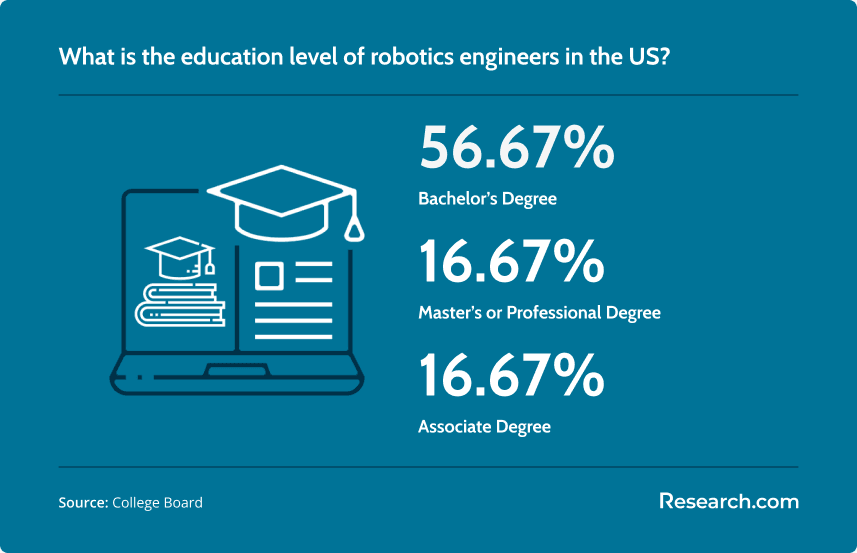
The standard educational entry point to a robotics engineering career is a bachelor's degree in one of three core disciplines: mechanical engineering, electrical engineering, or computer science.
A common point of confusion for aspiring students is searching for a specific "robotics engineering" major, but these are less common and not a requirement. Just as many people wonder “is nursing considered STEM” due to overlapping scientific and technical skills, students should understand that robotics engineering builds on established STEM foundations.
An insider tip is to focus on these foundational programs, as they provide the deep, specialized knowledge employers look for. The educational requirements for what is robotics engineering are firmly rooted in these established fields.
Your choice between them allows you to specialize. A mechanical engineering degree focuses on the robot's physical structure, an electrical engineering degree concentrates on its power and control systems, and a computer science degree hones in on the software and AI that bring it to life.
This structure gives you the flexibility to choose a path that aligns with your passions. However, a traditional four-year university isn't the only route to earning that degree.
Alternative and Transfer Pathways
A smart and cost-effective strategy is the "2+2" or transfer pathway. This educational route allows you to complete an associate's degree at a community college for your first two years before transferring to a four-year university to complete your bachelor's degree.
The key to success with this approach is to look for community colleges that have guaranteed "articulation agreements" with universities, which ensures your credits will transfer seamlessly.
As you explore options, particularly within the computer science track, it's also valuable to research the curriculum of the top information technology bachelor's degrees to see how their courses align with robotics applications.
A degree is the ticket to entry, but specific, in-demand skills are what will get you hired.
What skills do you need in robotics engineering aside from a degree?
While your degree provides the foundational knowledge, employers hire based on specific, high-demand skills. For anyone looking to enter or transition into robotics, mastering the right set of technical and collaborative abilities is the most direct path to a successful career.
Many people focus only on the technical side, but soft skills are just as critical for working on a modern engineering team—just as individuals exploring “careers in law enforcement without being a cop” need to understand that success often relies on communication, analysis, and problem-solving skills beyond the obvious role-specific training.
- Programming Languages: Proficiency in C++ and Python is non-negotiable. C++ is often used for high-performance control of the robot's hardware, while Python is widely used for higher-level programming, AI, and machine learning tasks.
- Key Software and Platforms: Experience with the Robot Operating System (ROS) is the industry standard for research and development. Alongside ROS, skills in CAD software like SolidWorks for mechanical design and platforms like MATLAB for data analysis and simulation are essential.
- Core Technical Concepts: Beyond software, a deep understanding of core concepts is vital. This includes machine vision, which allows robots to "see," and Printed Circuit Board (PCB) design for creating custom electronics.
- Systems Thinking and Collaboration: This is a crucial soft skill. Robots are complex systems, and you need to understand how all the parts—mechanical, electrical, and software—work together. With 71% of software development teams now adopting Agile project management practices, the ability to communicate and collaborate effectively is more important than ever.
Mastering a language like C++ doesn't just open doors in robotics; it's also a core skill in other high-paying fields, as seen in the typical video game designer salary. With the right skills, you can start climbing the career ladder.
What does a typical robotics engineering career path look like?
A career in robotics engineering offers a well-defined path for growth, typically starting with a task-focused role and advancing toward design ownership and strategic leadership.
Your career progression begins as a junior engineer, where you'll focus on specific, well-defined tasks like writing a piece of code for a sensor or designing a single mechanical part. This is a crucial apprenticeship phase where you hone your technical skills on real-world projects under the guidance of senior team members.
As you gain experience and prove your capabilities, you will advance to an Engineer or senior engineer role. Here, your responsibility expands from completing individual tasks to taking ownership of entire subsystems, like the robot's vision system or its gripping mechanism. You become the go-to expert for that part of the project, making key design decisions and mentoring junior engineers.
This progression is a structured journey from learning the fundamentals to mastering them.
Choosing Your Path: Technical Expert or Team Leader
A key detail to remember is that once you reach the senior level, the path can branch in two distinct and equally valuable directions. You don't have to go into management to advance your career. If you are passionate about hands-on technical challenges, you can pursue a technical track, growing into a principal or staff engineer role where you solve the most complex problems.
Alternatively, if you enjoy leading teams and managing projects, you can move onto a leadership track as a project manager or engineering lead. For those interested in this route, exploring the curriculum of the best technology management degree online can provide insight into the skills needed for that transition.
This career growth also comes with significant financial rewards.
What is the earning potential for a robotics engineer?
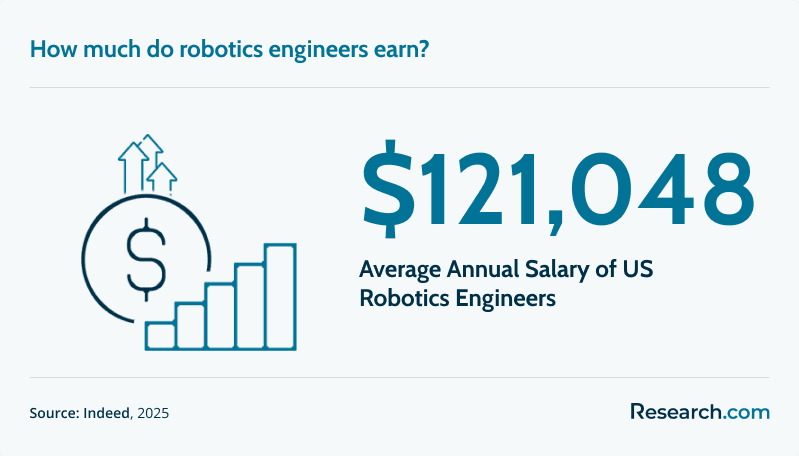
The earning potential for a robotics engineer is excellent, reflecting the high demand for this specialized skill set. According to real-world salary data, the average salary for robotics engineers is $101,208.
The career starts strong, with entry-level positions typically beginning at around $83,000 per year, and the overall salary range for the profession falls between $70,000 and $144,000.
This high earning potential is directly tied to the role's nature as an expert specialization. Because robotics engineers are senior specialists within core fields like mechanical or electrical engineering, the role isn't tracked as a separate government job category.
The most accurate financial picture comes directly from industry salary data, which confirms that mastering robotics is a financially sound and rewarding career path.
A high salary is a great motivator, but a successful career also requires the right mindset.
Who is a good fit for a robotics engineering career?
A good fit for a robotics engineering career is a persistent, curious, and collaborative problem-solver. While technical aptitude is a baseline requirement, the professionals who truly succeed and find fulfillment in this field are the ones whose mindset aligns with the nature of the work.
It’s less about being a lone genius and more about a disciplined approach to complex, multi-layered challenges. The reality of what is robotics engineering demands a specific set of personal attributes.
Successful engineers are driven by a deep curiosity to understand how things work, and they possess the persistence to troubleshoot complex problems without giving up. They are "systems thinkers," meaning they can visualize how every component—mechanical, electrical, and software—integrates into the whole.
Most importantly, they are skilled communicators and collaborators. This isn't just about being a good team player; it has a direct impact on whether a project succeeds or fails. With 37% of projects failing due to a lack of clear goals and vision, the ability to work effectively with a team is a critical predictor of success.
If these descriptions of resilience, curiosity, and teamwork resonate with you, it’s a strong indicator that you have the foundational mindset for this career. If you feel you're a good fit, the next question is where you'll apply your passion.
Which industries rely most heavily on robotics engineering?
Robotics engineers can apply their skills across a diverse and growing range of industries, well beyond the traditional image of automotive assembly lines. The top industries hiring robotics engineers today are manufacturing, logistics and e-commerce, and the rapidly expanding healthcare sector.
Each of these fields presents a unique set of challenges and opportunities, allowing you to choose a work environment that aligns with the problems you find most interesting to solve.
- Manufacturing: This remains a primary employer for robotics engineers. The work involves designing, installing, and maintaining robotic systems that perform tasks like welding, painting, and assembly with high precision and speed, making production lines safer and more efficient.
- Logistics and E-commerce: Fueled by the growth of online shopping, this sector relies on robotics for warehouse automation. Engineers in this space develop autonomous mobile robots that sort, pick, and transport packages, optimizing the entire fulfillment process from click to delivery.
- Healthcare and Medical Technology: According to the latest data, the global market size for medical robots was estimated at USD 13.26 billion. Engineers here work on everything from surgical robots that enable minimally invasive procedures to automated lab systems that analyze samples.
For those interested in the advancing field of health technology, exploring one of the fastest biotechnology master's programs online can be a strategic next step.
The chart below shows the top applications of robotics in the modern landscape.
How is the field of robotics engineering evolving?
The field of robotics engineering is evolving from a focus on pre-programmed machines that repeat a single task to the creation of adaptive, intelligent systems that can learn and make decisions.
This fundamental shift is driven by the integration of Artificial Intelligence (AI) and Machine Learning (ML), which provide the "brain" for advanced perception, path planning, and manipulation.
While the long-term vision may include complex humanoid robots, the immediate future is focused on specialized and collaborative robots, or "cobots," that can work safely alongside humans. This evolution is redefining what is robotics engineering, moving it toward a more dynamic and intelligent future.
This move toward smarter, more collaborative robots means that the way humans interact with them is becoming a critical area of focus.
The Growing Importance of Human-Robot Interaction
As robots move out of caged-off work areas and into shared human environments like hospitals and warehouses, the need for intuitive, user-friendly interfaces is paramount. The next generation of robotics engineers will need to focus not just on the robot's capabilities but also on how people train, manage, and collaborate with these machines.
This creates exciting interdisciplinary opportunities. For instance, the principles of creating effective training for robotic systems are closely related to the skills taught in an accelerated master's degree in instructional design and technology online, showing how expertise from other fields is becoming increasingly valuable.
How do I start exploring robotics engineering?
One of the biggest hurdles to exploring a career in robotics is figuring out where to begin. The great news is that you don't need access to a high-tech university lab to start learning the fundamental skills.
There are several accessible and low-cost ways to get hands-on experience right now that will help you confirm your interest and build a strong foundation for college.
- Join a robotics club. Competitions like FIRST Robotics or VEX Robotics are fantastic, team-based ways to learn the entire engineering process, from design and programming to teamwork and troubleshooting. Colleges and employers look very favorably on this kind of experience.
- Start small with a robotics kit. You can buy an affordable kit like an Arduino or Raspberry Pi and use online tutorials to learn the basics of electronics, programming, and how to make a simple robot move and react to sensors. The goal is to learn the process, and failure is an expected and valuable part of learning.
- Find online tutorials and challenges. The internet is full of free resources, from YouTube channels to coding websites, that can teach you the fundamentals of Python, C++, or how to use CAD software. Starting with a small, self-directed project is a great way to build confidence.
Taking any of these first steps will give you a significant advantage, providing you with a clearer understanding of the field and demonstrating your passion and initiative to colleges and future employers.
The chart below illustrates the market share of the global industrial robot market by region.
Here’s What Graduates Have to Say About Their Robotics Engineering Career
- Leila: "My work in medical robotics is incredibly rewarding. We design systems that assist surgeons with precision, and knowing that our technology can lead to better patient outcomes and faster recoveries is a powerful motivator. It’s an amazing feeling to merge complex engineering with compassionate care."
- Michael: "Working in a manufacturing setting, I get to see my designs come to life on a massive scale. We build autonomous systems that streamline production, increasing efficiency and safety for everyone on the factory floor. It’s truly satisfying to solve a complex problem and see the direct, tangible impact on a company's productivity."
- Omar: "As a robotics engineer in logistics, I'm at the forefront of automation. My team develops robots that can sort and transport thousands of packages per day, tackling challenges that are impossible for humans to handle alone. The satisfaction of designing a solution that optimizes an entire supply chain and makes a real difference in global commerce is immense."
Key Findings
- A career in robotics offers a strong financial return, with an average salary of $101,208 and entry−level positions starting at around $83,000.
- The path to a robotics career is through foundational degrees in Mechanical Engineering, Electrical Engineering, or Computer Science, not a specialized "Robotics" major.
- The field offers diverse opportunities beyond manufacturing, with the healthcare sector alone accounting for 16% of the robotics market revenue share in 2023.
- Success in the field requires more than just technical skill; with 37% of projects failing due to a lack of clear goals, collaborative and communication skills are essential.
- The most common types of industrial robots are highly specialized, with Articulated Robots (34%) and SCARA Robots (26%) dominating the market.
- Modern engineering teams are increasingly collaborative, with 59% of hardware development teams adopting Agile practices that emphasize communication and teamwork.
References:
- Agile Genesis. (2024). Agile vs. Waterfall: Comparing success rates in project management. Retrieved September 17, 2025, from https://www.agilegenesis.com/post/agile-vs-waterfall-comparing-success-rates-in-project-management
- KBV Research. (2025, January). Global robotics technology market size, share & trends analysis report by robot type, by component (hardware, software, and service), by application, by regional outlook and forecast, 2024 - 2031. Retrieved September 17, 2025, from https://www.kbvresearch.com/robotics-technology-market/
- Park University. (2024, October 16). From agile to waterfall: A breakdown of project management methodologies. Retrieved September 17, 2025, from https://www.park.edu/blog/from-agile-to-waterfall-a-breakdown-of-project-management-methodologies/
- Sharma, N. (2025, February 5). Project management statistics & trends you need to know. ProofHub. Retrieved September 17, 2025, from https://www.proofhub.com/articles/project-management-statistics
- Takki, K. (2024, November 6). Industrial robot market size (2023-2033): 15.2% CAGR growth analysis & key players. Statzon. Retrieved September 17, 2025, from https://statzon.com/insights/global-industrial-robot-market
- Taylor-Chadwick, H. (2023, October 9). 20+ agile statistics: All about agile adoption. Runn. Retrieved September 17, 2025, from https://www.runn.io/blog/agile-statistics
- U.S. Bureau of Labor Statistics. (2025, April 18). Architecture and engineering occupations. Occupational Outlook Handbook. Retrieved September 17, 2025, from https://www.bls.gov/ooh/architecture-and-engineering/home.htm
- U.S. Bureau of Labor Statistics. (2025, August 28). Occupational outlook handbook: Electro-mechanical and mechatronics technologists and technicians. Retrieved September 17, 2025, from https://www.bls.gov/ooh/architecture-and-engineering/electro-mechanical-technicians.htm
- U.S. National Academy of Engineering. (2008, February 15). 21 century's grand engineering challenges unveiled. Retrieved September 17, 2025, from https://www.nationalacademies.org/news/2008/02/21-centurys-grand-engineering-challenges-unveiled
- Zippia. (2025, January 8). Robotics engineer salary. Retrieved September 17, 2025, from https://www.zippia.com/salaries/robotics-engineer/
Other Things You Should Know About Robotics Engineering
In 2027, robotics engineering offers diverse career paths including autonomous systems developer, AI integration specialist, human-robot interaction designer, and robotic process automation consultant. These roles tap into advancing technologies and require a blend of engineering expertise and innovative thinking.
Yes, key skills for robotics engineers in 2027 include proficiency in programming languages like Python and C++, understanding of AI and machine learning, and expertise in CAD software. Practical experience with robotic systems and strong analytical thinking will also be vital.
Yes, it is possible to become a robotics engineer without a specific degree in robotics engineering. Many professionals enter the field with degrees in mechanical engineering, electrical engineering, computer science, or related disciplines, provided they have relevant skills and experience in robotics applications.