2027 What is Upskilling and Why is it Important?

Co-Founder and Chief Data Scientist
In a professional landscape where technological advancements and economic shifts are making existing skills less relevant, a critical question emerges for career security. What is upskilling? It is the proactive and continuous process of acquiring new competencies, directly addressing the challenge of skill obsolescence to keep your career secure.
You are not facing this shift alone. A significant 74% of workers are ready to learn new skills to adapt and remain employable, showing a collective understanding of this new reality. Prepared by career planning experts with over a decade of experience, this guide offers the clarity and actionable steps you need to transform that readiness into a confident plan for the future.
Key Things You Should Know About Upskilling in 2025
- The "half-life" of professional skills—the time it takes for a skill to be half as valuable—is expected to shrink to just 2.5 years by 2025. This means waiting to learn is no longer a viable option.
- Upskilling is about adding new, targeted competencies to your existing expertise to increase your value, not necessarily changing your entire career path.
- Professionals who proactively upskill see tangible benefits in job security, access to more senior roles, and higher earning potential.
- You don't need to enroll in a multi-year degree program immediately. Effective upskilling often begins with a single online course, certification, or workshop.
- Employers are looking for professionals who combine human-centric abilities like analytical thinking and creativity with up-to-date technological literacy.
Popular College Degrees Worth Considering in 2027
Nursing
A nursing degree combines classroom learning with clinical practice to prepare students for direct patient care. Courses often include anatomy, pharmacology, pathophysiology, and nursing fundamentals. This degree emphasizes both technical skills and compassionate care, leading to careers in hospitals, clinics, and other healthcare settings.
Psychology
A psychology degree explores human behavior, mental processes, and emotional development through both scientific and theoretical study. Students take courses in cognitive psychology, abnormal psychology, research methods, and developmental psychology. This degree prepares individuals for careers in research, mental health services, or further graduate study.
Social Work
A social work degree is a practice-based discipline dedicated to helping vulnerable individuals and communities overcome challenges and improve their well-being. The curriculum focuses on advocacy, policy, and direct practice, teaching students to connect people with vital resources. Students learn to advocate for social justice and empower people to create positive change in their lives.
Counseling
A counseling degree equips students with the knowledge and skills to support individuals’ emotional, mental, and social well-being. Coursework typically covers human development, counseling theories, crisis intervention, and ethics. Graduates are prepared for roles in schools, healthcare settings, or community organizations.
Business Administration
A degree in Business Administration provides students with a broad foundation in management, finance, marketing, and organizational behavior. Courses often include accounting, business ethics, leadership, and operations management. Graduates gain versatile skills that prepare them for leadership roles in a wide range of industries.
- What is the difference between upskilling and reskilling? Upskilling vs Reskilling
- Why has upskilling become so critical for career security? Upskilling Importance
- What major economic trends are making existing skills obsolete? Economic Trends
- How does the "half-life of skills" impact your long-term career path? How does the "half-life of skills" impact your long-term career path?
- What are the most in-demand skills employers are looking for right now? Top Skills
- How are technology and AI actively changing traditional job roles? How are technology and AI actively changing traditional job roles?
- What are the most common and effective ways to upskill? Ways to Upskill
- What are the tangible benefits of upskilling for an individual professional? Upskilling Benefits
- How do companies benefit from investing in their employees' skills? How do companies benefit from investing in their employees' skills?
- How can you identify the right skills to learn for your career? How can you identify the right skills to learn for your career?
- What are the first steps to creating a personal upskilling plan? What are the first steps to creating a personal upskilling plan?
- Is continuous learning the new standard for a successful career? Is continuous learning the new standard for a successful career?
- How do quality educational programs enhance your upskilling journey? How do quality educational programs enhance your upskilling journey?
What is the difference between upskilling and reskilling?
Upskilling is the process of learning new skills to get better at your current job, while reskilling is the process of learning new skills to do a different job. The key distinction lies in the strategic goal: upskilling is about enhancing your current expertise, while reskilling is about preparing for a career transition.
Think of it as vertical versus lateral career growth. When you upskill, you are adding capabilities to climb higher and become more effective in your current role or field. For example, a professional in human resources roles who takes advanced courses in talent analytics or employee engagement strategies is upskilling to improve performance and impact within their existing position.
Conversely, reskilling involves moving to a completely new career ladder. A retail store manager who learns to code to become a software developer is reskilling.
Understanding the answer to what is upskilling versus reskilling is the first step in building a clear career development plan. One path solidifies your position as an expert, and the other creates a pathway to a new professional identity. With these terms defined, we can now examine why they have become so essential for career security.
Why has upskilling become so critical for career security?
Upskilling has become critical for career security because the pace of technological and economic change now outstrips the traditional career lifecycle, making continuous learning an essential requirement. For generations, the professional model was to learn a set of skills that would remain valuable for decades. That stability has disappeared.
The key difference today is the sheer velocity of this transformation. The World Economic Forum, for instance, estimated that 44% of workers' core skills would be disrupted in the five years following their 2023 report. This is why many professionals turn to the largest online colleges to access flexible courses and programs that allow them to upskill efficiently without interrupting their careers.
This isn't a slow evolution; it's a rapid and fundamental shift in what employers need. After all, 78% of companies worldwide leverage AI in their daily operations.
This accelerated rate of change means that passively relying on your existing knowledge is now a significant career risk. Understanding what is upskilling and putting it into practice has moved from a 'nice-to-have' for ambitious employees to a fundamental necessity for anyone seeking long-term stability and growth.
To effectively prepare, it's crucial to understand the specific forces behind this widespread disruption.
What major economic trends are making existing skills obsolete?
Three major economic trends are the primary drivers making existing professional skills obsolete: the rise of AI and automation, the widespread shift to a digital-first economy, and the ongoing effects of globalization. These forces work together to fundamentally reshape the skills that companies need to compete and innovate.
AI and automation are taking over routine, predictable tasks, while the digital-first economy demands new competencies in data analysis, cybersecurity, and online customer engagement. Just as prospective librarians often ask “how much do librarians make with a master's degree” to understand the return on their educational investment, professionals in any field must evaluate how their current skills match the evolving economic landscape.
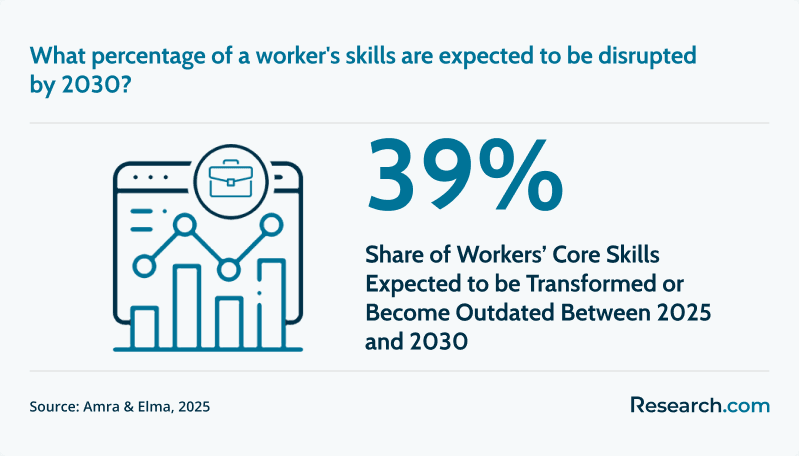
At the same time, globalization means that companies can access talent from anywhere in the world, increasing the competitive pressure on the domestic workforce. This combination of factors is why experts predict that 39% of a worker's core skills will be transformed or become outdated between 2025 and 2030.
These trends aren't just changing old jobs; they are creating entirely new fields.
Beyond Automation: The Growth of Niche Digital Economies
A key insight for career planning is that technological change also gives rise to entirely new industries with unique skill requirements. The rapid growth of sectors like the creator economy, sustainable technology, and competitive gaming are clear examples.
These niche digital economies create demand for specialized roles that didn't exist a decade ago. For those looking ahead, exploring the fastest online esports business degree programs can be an indicator of how new entertainment and technology sectors are creating novel career pathways that blend business acumen with digital literacy.
How does the "half-life of skills" impact your long-term career path?
The shrinking "half-life of skills" directly impacts your career by requiring you to treat learning as a continuous, integrated part of your professional life rather than a one-time event. This concept refers to the time it takes for a skill to become half as valuable as it once was.
As this timeframe shortens, the urgency to acquire new knowledge and capabilities grows—similar to how aspiring social workers explore options like “MSW without BSW” to advance their careers without following the traditional degree pathway.
An important detail is that value diminishes, it doesn’t disappear entirely. Foundational abilities like communication and analytical thinking have a much longer half-life than specific technical skills, such as proficiency in a particular version of software.
The key takeaway is that your skill set is not a static asset but a dynamic portfolio that needs regular updates and management.
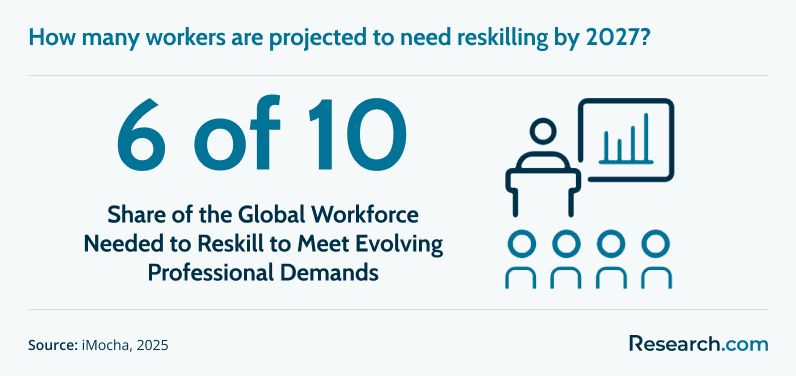
This reality makes a proactive learning mindset essential for long-term career viability. The scale of this challenge is significant, with data suggesting that 6 out of 10 workers will require significant training to keep pace with technological and economic shifts by 2027.
What are the most in-demand skills employers are looking for right now?
The most valuable professionals today possess a potent blend of human-centric abilities and modern technological literacy. While technical skills for specific jobs are important, employers consistently prioritize a core set of transferable skills that drive innovation and problem-solving.
According to the World Economic Forum, these are the top skills employers are actively seeking.
Analytical thinking
This is the single most in-demand skill because it is the engine of effective decision-making. Analytical thinking is the systematic ability to break down complex problems into manageable parts, evaluate information from multiple sources, and use logical reasoning to form sound conclusions.
For those serious about developing this competency, exploring fast-track bachelor's in analytics online programs can provide a structured path to mastery.
Resilience, flexibility, and agility
This skill set reflects your ability to adapt to unexpected changes, recover from setbacks, and thrive in dynamic work environments. Professionals with high resilience don't just endure adversity; they learn from it and use it as a catalyst for growth. This combination of mental toughness and a flexible mindset allows individuals to remain productive through major organizational or industry-wide shifts.
Leadership and social influence
This isn't a skill reserved for managers; it's a fundamental part of effective collaboration. Leadership is the ability to motivate colleagues, build consensus around a shared vision, and guide projects toward a successful outcome, regardless of your official title.
Social influence, its counterpart, is the capacity to build rapport and a strong professional network, which is essential for driving a team forward. This skill set is about inspiring confidence in others and fostering a collaborative environment.
Creative thinking
As routine tasks become increasingly automated, the ability to generate novel ideas and innovative solutions to challenges becomes a key differentiator. Creative thinking is about connecting seemingly unrelated concepts to solve problems in new and effective ways. Whether it's devising a unique marketing campaign, or designing a better user experience, this skill fuels innovation and allows companies to stay ahead of the competition.
Technological literacy
In today's digital-first world, technological literacy means having a foundational understanding of the digital tools relevant to your industry, from data analytics software to project management systems. Most importantly, it is about having a capacity to learn new technologies as they emerge. A professional who is technologically literate can use these tools to enhance their productivity and expand their professional capabilities.
The chart below displays the most prominent skill of today's workforce.
How are technology and AI actively changing traditional job roles?
Technology and AI are actively changing traditional job roles by automating routine tasks, which allows professionals to focus on higher-value strategic and creative work. This concept is known as "task augmentation" rather than job replacement. The core purpose of a role often remains the same, but the tools and required skills evolve significantly.
This shift is already visible across many common professions. For example:
- A Marketing Manager, who once focused on campaign logistics and creative direction, now must be adept at data analysis to interpret performance metrics and optimize spending.
- A Human Resources (HR) Manager is moving from administrative tasks and employee relations to leveraging HR technology and data analytics for talent acquisition and workforce planning.
- A Sales Professional now spends less time on manual prospecting and more time on solution-based selling and managing complex client relationships through sophisticated CRM proficiency.
In each case, technology isn't eliminating the job; it's elevating the strategic importance of the human in the role.
The Rise of the Tech-Augmented Creative
This trend of task augmentation is particularly relevant for creative professionals who may feel anxious about AI's impact. Instead of replacing creativity, new AI-powered tools can handle time-consuming aspects of production, freeing up designers, writers, and artists to focus more on ideation, strategy, and client vision.
The most successful creatives will be those who learn to leverage these tools as powerful assistants. For those looking to build this blended skillset, exploring the shortest graphic design programs online can offer a structured way to combine foundational creative principles with modern technological fluency.
What are the most common and effective ways to upskill?
A key part of understanding what is upskilling is choosing the right method from the wide spectrum of available options. The best pathway depends on your specific career goals, budget, and how much time you can commit.
Here are the most common and effective approaches:
- Online Courses: With a low time commitment of hours to weeks and costs from free to a few hundred dollars, these are best for acquiring a specific, targeted skill quickly.
- Professional Certifications: Requiring weeks to months of study and costing several hundred to a few thousand dollars, these are ideal for gaining a recognized credential for a specific role or technology.
- Tech Bootcamps: These are intensive, full-time programs lasting 3-6 months with costs in the $10,000-$20,000 range, designed for immersive training to facilitate a career change into tech.
- STEM MBAs: A high-commitment path of 1-2 years, these degrees are for professionals aiming to develop leadership skills at the intersection of business and technology.
- Terminal Degrees: The highest commitment of 3-7+ years, these are for those seeking top-level expertise for careers in research, academia, or highly specialized fields.
Choosing the right path often involves balancing speed and depth. While online courses offer immediate access, a formal degree provides a more fundamental shift. The rise of programs like accelerated cinematography degrees online shows how even traditional education is adapting to offer faster, more focused pathways to advanced skills.
The chart below shows that individuals who obtain key professional certifications are likely to receive a considerable salary boost.
What are the tangible benefits of upskilling for an individual professional?
For any professional, the effort invested in upskilling delivers clear and significant returns. Here are the most tangible benefits you can expect:
- Higher Earning Potential. Acquiring in-demand skills and certifications directly correlates with increased income. For example, top-tier credentials in cloud architecture, project management, and cybersecurity often lead to average salaries well over $145,000.
- Enhanced Job Security. In a competitive job market, a relevant and updated skill set is your best defense against layoffs and career stagnation. It makes you a more essential part of your organization's success.
- Access to Senior Roles. Strategic upskilling is a primary pathway to leadership. Combining your industry experience with advanced credentials, such as a fast-track MBA in marketing online, provides the blend of technical and business acumen required for management and executive positions.
- Greater Career Control. A strong portfolio of skills gives you more options and leverage, whether you're negotiating a raise, seeking a promotion, or exploring opportunities with other companies.
A key detail to remember is that these benefits are fully realized when you can apply your new skills to create and articulate value for your organization. The credential opens the door; your application of the skill secures the reward.
How do companies benefit from investing in their employees' skills?
Companies that invest in upskilling their employees see direct benefits in higher productivity, greater innovation, and significantly better talent retention. Far from being just an employee perk, a robust learning and development program is a core business strategy that delivers a clear and measurable return on investment.
Data shows that this is a widely understood principle in modern business, with 81% of companies reporting a positive ROI on their upskilling initiatives. A well-trained workforce is more efficient and better equipped to solve complex problems, which directly boosts innovation and competitiveness.
Furthermore, offering opportunities for growth is one of the most effective ways to increase employee loyalty.
An insider tip to remember is that the cost of recruiting, hiring, and training a new employee is substantially higher than the cost of upskilling a current one. This financial reality means that forward-thinking companies view employee development as a critical investment in their own future success.
This alignment between your growth and your company's goals is a powerful factor when planning your next move.
How can you identify the right skills to learn for your career?
The most effective upskilling is strategic, not random. With employers identifying "skill gaps" as the single biggest barrier to business transformation, choosing the right skill is a critical decision. You can identify the perfect skill to learn by finding the overlap between three key areas.
- Analyze industry and role-specific trends. Start by researching your field. Read industry publications, review job descriptions for roles one or two levels above yours, and identify the skills that are consistently mentioned. Are there new technologies or methodologies becoming standard?
- Align with your company's strategic goals. Look at where your organization is heading. Is it expanding into new markets, adopting new software, or focusing on data-driven decision-making? Learning a skill that directly supports these goals makes your value clear and immediate.
- Connect with your personal interests and strengths. The skill you choose should genuinely engage you. You are far more likely to master a subject that you are curious about and that plays to your natural aptitudes. This is the fuel that will sustain your learning efforts.
The ideal skill to learn lies at the intersection of these three domains. Finding that sweet spot turns your upskilling effort from a chore into a powerful career accelerator.
What are the first steps to creating a personal upskilling plan?
Getting started with upskilling doesn't require a perfect five-year plan. The most effective approach is to build momentum with small, consistent actions. Here are the four simple steps you can take this week to begin.
- Choose one specific skill. Don't try to learn everything at once. Based on your analysis from the previous section, select a single, manageable skill to focus on first. Clarity is your ally.
- Dedicate a small, consistent block of time. You don't need to find 10 extra hours a week. Start by scheduling just 30-45 minutes, two or three times a week, and protect that time on your calendar. Consistency is more important than volume.
- Find one high-quality resource. Analysis paralysis can stop you before you start. Pick one book, one well-regarded online course, or one mentor and commit to that single resource initially.
- Define a small, practical project. The fastest way to make new knowledge stick is to apply it. Plan a small, low-stakes project where you can practice your new skill, even if it's just for yourself.
This simple process is designed to overcome inertia. By taking these small steps, you are building a sustainable habit of learning that will pay dividends for years to come.
The chart below affirms that most companies aim to reskill around 11% to 20% of their workforce due to AI disruption.
Is continuous learning the new standard for a successful career?
Yes, without question. The ability to learn continuously is no longer a trait of the exceptionally ambitious but has become the foundational requirement for any professional seeking long-term success and security. The evidence presented—from the accelerating pace of technological change to the shrinking half-life of skills—all points to this single, clear conclusion.
The global economy is projected to face a staggering deficit of over 85 million skilled workers by 2030 if this skills gap is not addressed. This number represents more than a challenge; it represents an extraordinary opportunity for individuals who commit to lifelong learning. The answer to the question of what is upskilling is ultimately an answer about career ownership.
This does not have to be an exhausting endeavor. Instead of a constant chore, think of it as a natural part of your professional rhythm. By embracing a mindset of curiosity and consistent self-development, you are not just adapting to the future of work. You are actively building it to your advantage.
How do quality educational programs enhance your upskilling journey?
Quality educational programs provide a structured curriculum designed by industry experts, ensuring that every learning module is aligned with current market needs. They offer practical projects, continual feedback, and career support to help professionals monitor progress and adjust strategies accordingly. Furthermore, these programs often include performance metrics and post-completion resources that demonstrate tangible returns on your investment in learning. For a flexible yet comprehensive educational pathway that integrates theory with real-world application, consider exploring online degrees that cater specifically to fast-evolving industry demands.
Here’s What Graduates Have to Say About Upskilling
- Anja: "I was about seven years into my career and could feel the ground shifting under my feet. The skills that got me here weren't going to get me to the next level, and that created a lot of anxiety. Committing to an online certification in data analytics was the best decision I've made. It not only updated my toolkit but completely restored my confidence, and my supervisor noticed immediately."
- Stefan: "I work in marketing, and I was worried I was becoming a dinosaur who didn't understand the tech side. Learning the fundamentals of marketing automation didn't just help me speak the language of our data team; it helped me develop much smarter campaign strategies. It felt like I could suddenly see the whole picture, and my performance reviews have reflected that."
- Marco: "I knew I needed to learn more about financial modeling, but the options were overwhelming. The targeted nature of my online program was perfect. It cut through the noise and focused on exactly what I needed to advance in my current role, without forcing me to take classes that weren't relevant. It was an efficient and incredibly effective way to level up."
Key Findings
- The estimate that 44% of workers’ skills will be disrupted in the coming years confirms that career stability is no longer a passive state but requires active, continuous management.
- The shrinking "half-life of skills" to just 2.5 years means that professional development must shift from an occasional, major event to a continuous, integrated part of one's career rhythm.
- The most in-demand professionals are not pure specialists but hybrids who combine human-centric skills like analytical and creative thinking with modern technological literacy.
- With 81% of companies reporting a positive ROI on upskilling, professionals can be confident that their personal development efforts are a highly valued strategic asset to employers, not just a personal expense.
- Effective upskilling is not a one-size-fits-all path; the modern learning ecosystem provides a flexible spectrum of options, from targeted online courses to formal degrees, allowing for a personalized approach.
- The projected global deficit of over 85 million skilled workers by 2030 reframes the skills gap from a personal threat into a significant career opportunity for those who proactively upskill.
References:
- Amra & Elma. (2025). Best future of work statistics 2025. Retrieved September 19, 2025, from https://www.amraandelma.com/future-of-work-statistics/
- CFA Institute. (2025). What is a financial analyst? Retrieved September 19, 2025, from https://www.cfainstitute.org/programs/cfa-program/careers/financial-analyst
- Coursera Staff. (2024, December 17). What does a marketing manager do? A guide. Coursera. Retrieved September 19, 2025, from https://www.coursera.org/articles/marketing-manager
- ITU Online. (2024, January 25). IT support specialist: 10 essential technical skills. Retrieved September 19, 2025, from https://www.ituonline.com/blogs/it-support-specialist-skills/
- Mandloi, A. (2025, March 4). 33 key skills statistics to build a skills-based workforce (2025). iMocha. Retrieved September 19, 2025, from https://www.imocha.io/blog/skills-statistics
- Matsh. (2024, December 28). Skills gap analysis: Statistics comparing required skills vs. available talent in key industries. Retrieved September 19, 2025, from https://www.matsh.co/en/statistics-on-skills-gap-in-key-industries/
- SHRM. (2023, December 21). Human resource manager. Retrieved September 19, 2025, from https://www.shrm.org/topics-tools/tools/job-descriptions/human-resource-manager
- The Interview Guys. (2025, July 7). What experts are actually predicting for the 2025 job market (and what it means for your career). Retrieved September 19, 2025, from https://blog.theinterviewguys.com/what-experts-are-actually-predicting-for-the-2025-job-market/
- World Economic Forum. (2025, January). Future of jobs report 2025. Retrieved September 19, 2025, from https://reports.weforum.org/docs/WEF_Future_of_Jobs_Report_2025.pdf
Other Things You Should Know About Upskilling
Yes, absolutely. Developing skills related to sustainability and green technologies can provide a significant competitive advantage in the job market. In the US, for instance, job seekers with green skills currently have an 80.3% higher hiring rate than the overall workforce, making it a high-impact area for upskilling.
Many companies offer tuition assistance or professional development funds as part of their benefits package. The best way to find out is to speak directly with your manager or HR department. Frame your request around the company's strategic goals, explaining how the new skill will help you contribute more effectively to team and company objectives.
In 2027, the most sought-after upskilling areas include data science, artificial intelligence, and cybersecurity, given the growing demand for technological innovation. Additionally, leadership, communication, and critical thinking remain valuable, as they enhance adaptability in diverse work environments. Combining both technical and soft skills can maximize professional growth opportunities.