
2027 Is It Hard to Get Into an MSW Program Without a BSW?

Co-Founder and Chief Data Scientist
Many aspiring social workers wonder if it is difficult to enter an MSW program without a BSW. The concern is understandable, given that most graduate programs set prerequisites that align with undergraduate training. According to the Council on Social Work Education (CSWE), 303 MSW programs reported a combined enrollment of 83,610 students, showing the field’s competitiveness and growth.
This article explores how applicants without a BSW can approach admissions, the benefits of earning this credential, and what career paths and salaries typically look like.
What are the benefits of getting an MSW?
- Graduates of MSW programs can pursue roles such as clinical social workers, school social workers, healthcare social workers, and policy analysts.
- According to labor market data, licensed clinical social workers often earn a median salary that surpasses that of entry-level social service roles.
- An MSW credential not only provides advanced practice skills but also opens pathways toward leadership positions, licensure, and specialized practice.
What can you do with an MSW?
Completing an MSW program without a BSW still allows graduates to access the same career opportunities as those with prior social work training. This graduate degree equips individuals with clinical, research, and policy knowledge that broadens professional practice. With an MSW, one can pursue roles in therapy, community development, child welfare, and healthcare, among others. The degree also serves as a prerequisite for licensure in most states, making it a critical step for those aiming for independent clinical practice.
Where can you work with an MSW?
Graduates of an MSW program without a BSW can enter various industries, including healthcare, education, nonprofit organizations, and government agencies. Hospitals, schools, and community mental health centers are among the most common employers.
Others may pursue opportunities in research institutions, advocacy groups, or policy organizations. International NGOs, correctional facilities, and private practices also hire social workers, reflecting the versatility of this credential.
How much can you earn with an MSW?
Earnings vary depending on the field of practice and geographic location, but an MSW generally raises salary potential compared to positions available with a bachelor’s degree alone. According to the U.S. Bureau of Labor Statistics (BLS), the median annual wage for social workers was $61,330 in 2024. Clinical social workers, especially those in private practice, often surpass this average. Graduates of an MSW program without a BSW can expect higher pay as they advance into specialized roles.
- What are the admission requirements for MSW programs without a BSW? Admission Requirements
- What is the difference between entering an MSW with a BSW versus without one? MSW With & Without BSW
- Is it harder to get into an MSW program without a BSW in 2027? Admission Decisions
- What prerequisite courses are required for MSW programs without a BSW? Prereq Courses
- How long does it take to complete an MSW without a BSW? Program Length
- Can you become a licensed social worker without a BSW if you earn an MSW? Licensure
- Are salary outcomes different for MSW graduates without a BSW? Salary Outcomes
- Are there online MSW programs for students without a BSW? Online Programs
- Does volunteer work in human services help MSW admissions? Does volunteer work in human services help MSW admissions?
- Do top MSW programs accept students without a BSW? Do top MSW programs accept students without a BSW?
- How can I finance an MSW program without a BSW? How can I finance an MSW program without a BSW?
What are the admission requirements for MSW programs without a BSW?
Applicants interested in pursuing an MSW program without a BSW must meet several academic and professional requirements. While requirements vary by school, most programs expect candidates to demonstrate academic readiness, relevant experience, and a commitment to social work values.
In some cases, institutions may offer bridge or foundation coursework to help students transition into advanced study. For those looking for alternative pathways, programs such as an accelerated sustainability bachelor's degree online may provide preparation in related areas before applying.
Typical requirements include:
- A bachelor’s degree in any field from an accredited institution
- A minimum GPA (often 3.0 or higher) on prior coursework
- Prerequisite courses in social sciences, such as psychology, sociology, or human development
- Letters of recommendation highlighting academic or professional qualifications
- A personal statement outlining motivation to pursue social work and future goals
- Professional or volunteer experience in a human services field (preferred by many programs)
What is the difference between entering an MSW with a BSW versus without one?
Entering an MSW program without a BSW is possible, but the student experience differs significantly from those holding a BSW. Program length, curriculum design, and specialization opportunities are often the key areas of difference.
Some students may also consider alternative paths such as a fast track public safety degree online, which emphasizes community and organizational services that overlap with certain aspects of social work.
Entering with a BSW
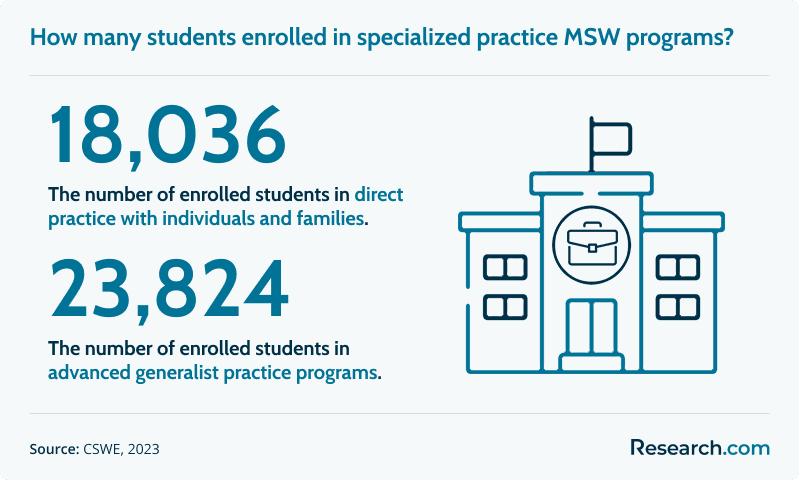
Students who already have a BSW often qualify for advanced standing MSW programs. These programs allow them to bypass introductory coursework and finish in about one year. The CSWE reports that many students in these tracks focus on areas such as direct practice with individuals and families, which accounted for over 18,000 enrolled students in recent surveys.
Entering without a BSW
Those entering an MSW program without a BSW usually take the full two-year program, beginning with foundational courses in social work theory and practice. According to CSWE, over 23,000 students are enrolled in advanced generalist practice programs that integrate both clinical and community-level training. This broader approach helps non-BSW graduates build a solid foundation before specializing.
Is it harder to get into an MSW program without a BSW in 2027?
Competition for MSW programs continues to increase as the demand for social workers grows. While students entering an MSW program without a BSW may face additional coursework, admission decisions are generally based on GPA, experience, and readiness rather than undergraduate major. For individuals seeking counseling-related careers, some consider fast track educational counseling master's programs online as alternative or preparatory routes.
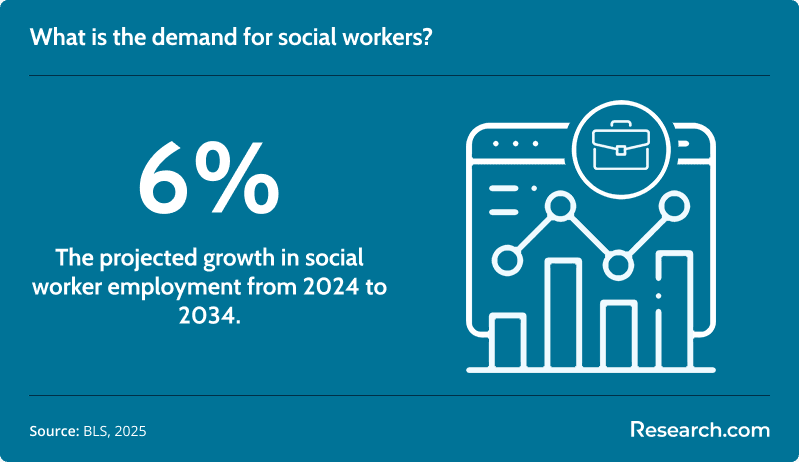
According to BLS, employment of social workers is projected to grow 6% between 2024 and 2034, faster than the average for all occupations. This growth translates to approximately 74,000 openings per year over the decade, signaling strong workforce demand. As a result, MSW programs are motivated to admit qualified applicants from diverse academic backgrounds, making entry possible even without a BSW.
What prerequisite courses are required for MSW programs without a BSW?
Most MSW programs outline prerequisite coursework to ensure that students without a BSW can handle graduate-level social work study. These courses typically provide a grounding in behavioral and social sciences. For some, a related program such as an accelerated online Master's in Legal Studies may also provide overlapping preparation in research, policy, or law.
Common prerequisite courses include:
- Introductory psychology
- Sociology or social problems
- Human growth and development across the lifespan
- Statistics or research methods
- Political science or public policy fundamentals
- Ethics in human services or related fields
How long does it take to complete an MSW without a BSW?
Program length is one of the most significant differences between students entering with or without a BSW. Those in an MSW program without a BSW typically spend two to three years completing the degree, depending on full-time or part-time enrollment. Similarly, students considering GCU nursing programs should factor in program length when planning their education and balancing work or personal commitments.
This longer timeline accounts for both foundation-level and advanced coursework. Students seeking more condensed alternatives might look into fast track master's degree special education online, which also accommodates those without prior specialized degrees.
Many institutions now offer flexible formats, such as evening, weekend, or online classes, allowing students to balance work and study. For part-time enrollees, the duration may extend to four years, while accelerated options for full-time learners can shorten completion closer to two years.
Can you become a licensed social worker without a BSW if you earn an MSW?
Yes. Licensure in social work generally requires a master’s degree, making it possible to enter the field through an MSW program without a BSW. Once completed, graduates can pursue state licensure exams and supervised practice requirements. For those aiming at school-based roles, similar pathways exist through specialized credentials such as fast track online masters in school counseling.
According to Zippia data, 55% of licensed social workers hold a bachelor’s degree, while 38% hold a master’s degree. This indicates that the MSW is a recognized route to licensure and professional advancement. Even without a BSW, completing an MSW provides the academic and practical training needed to meet licensure standards and secure long-term opportunities in the profession.
Are salary outcomes different for MSW graduates without a BSW?
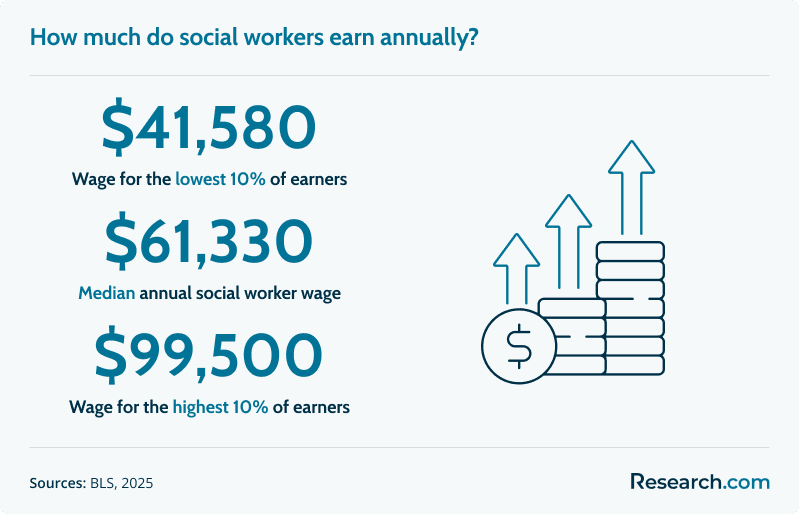
Earnings for social workers depend more on career specialization, location, and experience than on whether an individual entered their MSW program without a BSW. BLS reported that the median annual wage for social workers was $61,330 in May 2024. This means that half of professionals earned more than this figure, while half earned less. The lowest 10% earned under $41,580, while the highest 10% surpassed $99,500 annually.
Similar to how Grand Canyon University Nursing graduates leverage their degrees for competitive salaries in healthcare, MSW graduates without a BSW can still achieve earnings comparable to peers with prior social work training. Once licensed and established in clinical, healthcare, or supervisory roles, these professionals typically access higher earning brackets, reflecting the credential’s equal value across diverse academic backgrounds.
Are there online MSW programs for students without a BSW?
Yes, many institutions now offer online pathways for students pursuing an MSW program without a BSW. These options are particularly beneficial for working professionals or those balancing family and academic responsibilities.
According to CSWE, while only a small percentage of institutions currently operate full online programs, more are developing or considering online, blended, or hyflex formats. For example, 2.9% already offer online or blended courses, while 2.3% are actively developing online programs.
Just as individuals explore law enforcement jobs without being a cop to find flexible career alternatives, students without a BSW can leverage online MSW programs to transition into social work without following the traditional pathway.
This gradual expansion reflects growing interest in accessible graduate education. As online learning models continue to evolve, students without a BSW will find increasing opportunities to complete MSW coursework remotely, often with the same accreditation and rigor as campus-based programs.
Does volunteer work in human services help MSW admissions?
Volunteer experience plays an important role for applicants entering an MSW program without a BSW. Since these students lack undergraduate training in social work, admissions committees often look for practical evidence of commitment to the field. Volunteering in community organizations, mental health clinics, or youth programs helps demonstrate readiness for graduate-level coursework and alignment with professional values.
Such experience not only strengthens an application but also provides real-world perspective that enhances classroom learning. Many schools prefer applicants who can show active engagement in human services, as it signals both dedication and preparedness for the responsibilities of advanced social work practice.
Do top MSW programs accept students without a BSW?
Leading institutions across the United States admit students to MSW programs without requiring a BSW. Admissions criteria typically emphasize academic performance, personal statements, recommendations, and professional or volunteer experience rather than an undergraduate degree in social work. This inclusivity allows individuals with diverse educational backgrounds to pursue graduate training.
Just as prospective students often ask “is nursing a STEM degree” to understand how their undergraduate background aligns with graduate opportunities, MSW programs evaluate a variety of academic and professional experiences, not just prior social work coursework.
For competitive programs, strong applications are essential. Applicants should highlight transferable skills from their undergraduate studies, relevant fieldwork, and a clear commitment to the profession. With these factors in place, even the most selective MSW programs often accept candidates without a BSW, ensuring broad access to advanced social work education.
How can I finance an MSW program without a BSW?
Prospective students should explore diverse funding sources that cater specifically to non-BSW applicants. Financial assistance options typically include federal and state grants, institutional scholarships, and low-interest federal student loans. Some programs offer merit-based awards designed to encourage applicants from varied academic backgrounds. Additionally, employer tuition reimbursement and loan forgiveness programs may be available for those transitioning from other fields into social work. For students seeking cost-effective pathways, reviewing options among online MSW programs can provide insight into competitive tuition rates and associated financial aid packages. Evaluating each opportunity in terms of eligibility, repayment terms, and application deadlines is essential for making a well-informed decision.
Here’s What Graduates Have to Say About Getting Into an MSW Program Without a BSW
- Maria: "When I applied to a traditional MSW program without a BSW, I wasn’t sure I’d measure up—my bachelor’s was in biology, and I had little social work experience. The foundation courses were challenging, especially human behavior and research, but they taught me skills I didn’t even know were missing. My professors and classmates were supportive when I asked questions, and that made a big difference in my confidence. Now, I’m working in a child welfare agency doing direct practice, and I feel my background in biology actually gives me a fresh perspective in assessments. It was hard at times, but it was absolutely worth it."
- Jerome: "I came from a psychology undergraduate degree and decided to apply to an MSW program without a BSW because I wanted more clinical work. The program required prerequisites like statistics and ethics, which I hadn’t taken, so I completed those before starting. During my MSW journey, I felt increasingly sure that my decision was the right one, because field placements exposed me to real clients earlier than I expected. Now, after graduating, I’m employed as a licensed clinical social worker, and I believe entering the MSW program without a BSW didn’t hold me back at all. It was intense but validating."
- Angela: "Switching careers from public health to social work, I was worried that not having a BSW would limit my chances. But the admissions team evaluated my volunteer service, community health work, and personal statement seriously, and I was accepted into a traditional MSW program. The first year was foundational—classes in policy, intervention, and human behavior—which helped me fill gaps. Now I’m doing macro level work in nonprofit leadership, influencing social policy, and I find that my non-BSW background plus the MSW gives me both breadth and depth. Making the leap was tough, but it opened doors I didn’t imagine."
Key Findings
- It is common for many MSW programs to accept applicants without a BSW; any bachelor’s degree is generally sufficient if other admissions requirements are met.
- Graduates of MSW programs without a BSW can earn salaries comparable to their peers: median wages for social workers around $61,330 as of May 2024, with the lower 10 % below ~$41,580 and the top 10 % above ~$99,500.
- MSW programs without a BSW often require additional or foundational coursework—such as human behavior, statistics, or research methods—to ensure all students are prepared.
- Online, blended, or hyflex MSW options for students without a BSW are limited but expanding; many institutions are developing or considering these formats.
- Volunteer or related human services experience significantly strengthens an application for those entering an MSW program without a BSW.
- MSW graduates without a BSW are eligible for social work licensure and full career opportunities, provided they complete CSWE-accredited programs and required field work.
References:
- BLS. (2025, August 28). Social workers. bls.gov.
- CSWE. (2023). 2022–2023 statistics on social work education in the United States. cswe.org.
- Data USA. (2024). Social Work. datausa.io.
- Zippa. (2025, January 8). Best Colleges and Degrees for Licensed Social Workers. zippia.com.
Other Things You Should Know About Getting Into an MSW Program Without a BSW
In 2027, many MSW programs encourage applicants without a BSW to have relevant work experience. Such experience can strengthen your application by demonstrating commitment and practical understanding of social work principles. However, while not always mandatory, it can significantly enhance your chances of admission.
Schools often require applicants without a BSW to complete courses in social sciences or humanities. These might include psychology, sociology, or social work classes. Check the program's specific prerequisites to ensure you meet all academic requirements for entry.
Yes, most MSW programs have a minimum GPA requirement. This is often around 2.5 to 3.0, though more competitive schools may require higher (for example, 3.0 or above). Programs evaluate overall academic performance, and some may look more closely at grades in prerequisite or relevant courses. If your GPA is below a typical cutoff, you may compensate by demonstrating strong experience, glowing recommendations, or clear evidence of academic improvement. Always check specific program websites for exact GPA requirements.


