
2027 Largest Online Colleges: Enrollment Stats & Graduate Salaries

Co-Founder and Chief Data Scientist
Online learning has become a widely accepted mode of higher education, especially in the professional world. Recent studies show that over 70% of employers now view online programs from accredited institutions as comparable to traditional on-campus degrees, and many companies are hiring more graduates from online programs than ever before.
For students who value flexibility and accessibility, pursuing an online degree can be a strong and credible option. As such, this guide presents the largest online colleges based on the number of enrollments, prioritizing accredited institutions. It also explores various facts and facets of online degrees that prospective students would like to know.
Key Facts About the Largest Online Colleges
- The largest online colleges are Western Governors University, Southern New Hampshire University, and the University of Phoenix.
- The fields with the highest share of degrees conferred are business (18.6%), health (13%), and social sciences and history (7.4%).
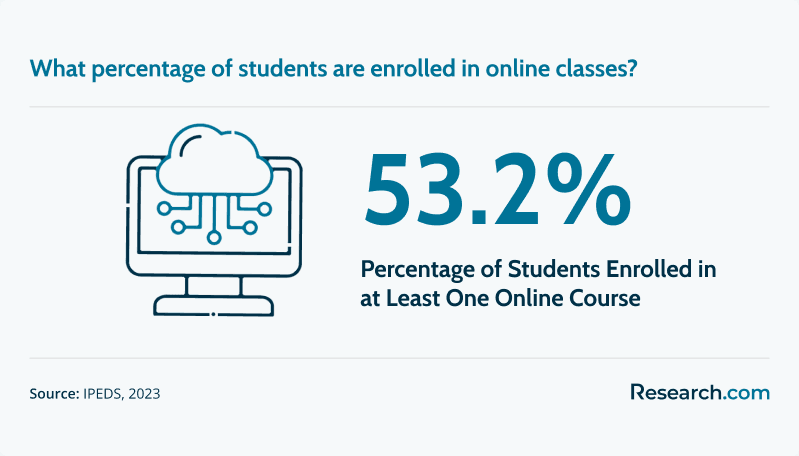
- Around 53.2% of students across 5,677 postsecondary institutions were enrolled in at least one distance education course.
- An estimated 26.4% of all students are enrolled exclusively in online programs.
- The average starting salary for bachelor’s degree graduates is $64,291.
- 54.4% of undergraduates and 53.5% of graduate students took at least one online course.
- Which online colleges have the highest student enrollment numbers? Largest Colleges
- What online programs or degrees are most popular among students? Popular Degrees
- What percentage of students take online degrees? What percentage of students take online degrees?
- How many colleges and universities in the United States offer online programs? How many colleges and universities in the United States offer online programs?
- In what ways are online programs better than on-campus ones? Online Degree Benefits
- Do graduates from online colleges earn less than graduates of on-campus degrees? Earnings
- Do employers view online degrees as comparable to on-campus degrees? What Employers Think
- What are the biggest challenges in pursuing online programs? Challenges
- How can students get financial aid for an online degree? Financial Aid
- How many existing college credits can a student typically transfer to an online program? How many existing college credits can a student typically transfer to an online program?
- How do you network and find jobs as an online student? How do you network and find jobs as an online student?
- How can you assess an online program's quality and accreditation? How can you assess an online program's quality and accreditation?
Which online colleges have the highest student enrollment numbers?
Online education has expanded rapidly, and a handful of universities now serve tens of thousands of students each year. These institutions attract learners nationwide with flexible programs, career-focused degrees, and the convenience of studying from anywhere.
Understanding roles in human resources can be particularly useful for students considering management or HR-focused online programs, as these skills are in high demand across large institutions. Below are the ten largest online colleges in 2025, ranked by undergraduate enrollment.
1. Western Governors University
Founded in 1997, WGU is one of the oldest fully online universities and a leader in competency-based learning. Its flexible model lets students advance by proving mastery of skills, which has helped it build one of the largest student bodies in online education.
- Undergraduate Online Enrollment: 98,630
- 100% of undergrads online
2. Southern New Hampshire University Online
SNHU, based in New Hampshire, is second only to WGU in online enrollment. While most of its undergraduates are online, it also has a large on-campus population and more than 20,000 graduate students.
- Undergraduate Online Enrollment: 86,849
- 93.5% of undergrads online
3. University of Phoenix
Established in 1976, the University of Phoenix was among the first schools to offer online courses, beginning in 1989. Since then, it has shifted to an overwhelmingly online student population.
- Undergraduate Online Enrollment: 72,096
- 99.1% of undergrads online
4. Strayer University
Operating primarily online, Strayer University is another Phoenix-area institution with a strong presence in distance education. Unlike some peers, it doesn’t offer associate degrees, focusing instead on bachelor’s and higher levels.
- Undergraduate Online Enrollment: 72,096
- 99.1% of undergrads online
5. Grand Canyon University
Located in Phoenix, GCU has a more even split between on-campus and online students, with two-thirds enrolled online. Its online division still makes it one of the largest virtual programs in the country.
- Undergraduate Online Enrollment: 40,001
- 67.8% of undergrads online
6. American Public University System
APUS operates entirely online and is especially popular with students in military and public service careers. Despite being smaller than some, it stands out for strong career-related outcomes.
- Undergraduate Online Enrollment: 37,335
- 100% of undergrads online
7. University of Maryland Global Campus
With a main campus near Washington, D.C., UMGC offers both online and on-site programs, but the majority of its students study online. Its location and flexible options make it a top choice for working adults in the region.
- Undergraduate Online Enrollment: 35,971
- 77.9% of undergrads online
8. Liberty University
Founded in 1971 in Lynchburg, Virginia, Liberty University is a well-known evangelical institution that has built a substantial online student base. More than a quarter of its undergraduates now study remotely.
- Undergraduate Online Enrollment: 34,092
- 72.5% of undergrads online
9. Arizona State University
Although most ASU undergraduates are on campus, its overall size allows it to maintain a large online division as well. Over 33,000 students pursue their degrees remotely through ASU Online.
- Undergraduate Online Enrollment: 33,410
- 34.5% of undergrads online
10. Purdue Global
Created in 2018 after Purdue acquired Kaplan University, Purdue Global is almost entirely online. It serves adult learners seeking flexibility and career-oriented programs.
- Undergraduate Online Enrollment: 28,447
- 98.8% of undergrads online
What online programs or degrees are most popular among students?
Online education has opened the doors for students to pursue degrees that match both their career goals and lifestyle needs. Certain programs stand out as the most popular because they combine flexibility, strong job prospects, and relevance in today’s workforce.
Students often research potential earnings, similar to checking library science master’s degree salary, when deciding which program to pursue. Below are some of the online degree programs students choose most often:
Business Administration
Business programs prepare students for careers in management, marketing, finance, and entrepreneurship. The flexibility and broad career applications make them a top pick for both undergraduates and graduate students. Those who want to pursue specialized business fields, like sports management, can look up fast track online MBA sports management programs.
Nursing
Online nursing programs allow registered nurses to earn higher credentials while continuing to work. They are especially popular among healthcare professionals looking to qualify for leadership or advanced practice roles. Meanwhile, certified nursing assistants looking to advance their careers can pursue CNA to RN online bridge programs.
Psychology
Psychology degrees attract students interested in counseling, social services, or preparing for graduate study in mental health fields. The program’s mix of theory and application makes it a strong choice for online learners.
Computer Science & Information Technology
With the demand for tech professionals growing, computer science and IT degrees are increasingly popular online. Students gain skills in programming, cybersecurity, and systems management that lead to well-paying and high-demand careers.
Education
Many teachers and education professionals pursue online bachelor’s or master’s degrees to advance into leadership roles or meet state licensing requirements. Online learning fits well with educators’ busy schedules.
Public Health
Public health programs have gained traction as demand grows for professionals in community health, policy, and epidemiology. These degrees often lead to roles in healthcare organizations, government, or nonprofits.
Data Science & Analytics
Data science is one of the fastest-growing fields, and online degrees allow students to train in areas like big data, machine learning, and business analytics. The strong job outlook and salaries make this a high-demand online program.
Healthcare Administration
Designed for professionals in healthcare settings, these programs focus on leadership, policy, and operations. They help students qualify for management roles in hospitals, clinics, and healthcare organizations.
According to the United States Bureau of Labor Statistics (BLS), as reported by Coursera, the fields with the highest share of degrees conferred are business (18.6%), health (13%), and social sciences and history (7.4%). The rest of the data can be seen in the chart below.
What percentage of students take online degrees?
Online learning has become a major part of higher education in the United States, with more than half of students choosing it in some form. In 2023, about 53.2% of students across 5,677 postsecondary institutions were enrolled in at least one distance education course, highlighting the steady integration of online learning into college programs.
A significant share of learners are also studying entirely online. Based on data from the National Center for Education Statistics (NCES), an estimated 26.4% of all students are enrolled exclusively in online programs, reflecting the growing demand for flexibility among working adults, parents, and those balancing multiple responsibilities.
Both undergraduate and graduate students are embracing this trend almost equally. Data from the Education Data Initiative shows that about 54.4% of undergraduates and 53.5% of graduate students took at least one online course, suggesting that online education has become a mainstream pathway across all levels of higher education.
According to the United States Bureau of Labor Statistics (BLS), as reported by Coursera, the fields with the highest share of degrees conferred are business (18.6%), health (13%), and social sciences and history (7.4%). The rest of the data can be seen in the chart below.
How many colleges and universities in the United States offer online programs?
According to the latest data from the NCES, there were 3,894 degree-granting postsecondary institutions in the United States classified as primarily online institutions. These are schools where more than 90% of students were enrolled in exclusively distance education courses. This figure highlights just how many colleges and universities have embraced an online-first model of higher education.
Programs like the GCU RN program exemplify this trend, offering flexible online and hybrid options that allow nursing students to balance academic goals with work or family commitments.
It is important to note that this number reflects only the institutions that are almost entirely online. Thousands of other colleges and universities operate with a mix of online and on-campus programs, offering students flexible learning paths that combine both formats. As a result, the reach of online education extends well beyond schools labeled as “primarily online.”
When you include these blended institutions, the total number of colleges and universities offering some form of online education rises even higher, with estimates ranging between 3,200 and 3,900 schools. This widespread availability shows that online learning is no longer a niche option but has become a central part of higher education in the country.
In what ways are online programs better than on-campus ones?
Online programs have become increasingly popular as students seek more flexible and affordable ways to earn a degree. Compared to traditional on-campus options, they offer unique benefits that make higher education more accessible to working professionals, parents, and those living far from universities. Discussions around topics like “is nursing STEM?” also show how online education supports fields that blend science and technology, making it easier for students to pursue specialized programs remotely.
Below are some of the key ways online programs can be better than on-campus ones.
- Flexibility: Online learning offers self-paced, adaptable schedules, allowing students to balance education with work, family, and other commitments. This flexibility is a major reason 63% of students choose online courses. For instance, aspiring sociologists can speed up their education by pursuing accelerated online sociology bachelor's degree programs.
- Cost Savings: Online programs often have lower tuition and eliminate extra expenses such as commuting, housing, and campus fees, making them more affordable overall.
- Faster Learning & Retention: Digital courses can be completed 40-60% faster, with retention rates up to 60%, compared to 8-10% in traditional settings.
- Technology Integration: Advanced tools like AI, virtual reality (VR), and mobile learning platforms enhance engagement and improve learning outcomes by up to 76%. VR-trained students and gamification techniques have been shown to reduce mistakes and increase performance significantly.
- Accessibility: Online programs enable learners from different locations, including those in remote or underserved areas, to access quality education without relocation.
- Career Continuity: Many online students continue working full-time while studying, allowing them to apply what they learn immediately in their jobs and avoid lost income.
- Environmental Impact: E-learning cuts carbon emissions per learner by up to 85%, making it a greener alternative to campus-based education.
- Diverse Peer Network: Because online programs attract students globally, learners interact with peers from different regions and backgrounds, which can broaden perspectives and professional networks.
Do graduates from online colleges earn less than graduates of on-campus degrees?
Graduates from the largest online colleges do not necessarily earn less than those from on-campus programs—the difference often comes down to the reputation of the school, the field of study, and accreditation, rather than the format of learning.
For instance, many professionals in non-police jobs with a law enforcement degree are finding that online programs offer the same earning potential and career advancement opportunities as traditional ones.
Employers are increasingly treating online and on-campus degrees as equivalent, especially when the online degree is from a well-known and accredited institution.
The shift in employer perception is a result of several factors. The rise of remote and hybrid work models has made the digital skills cultivated in online learning environments more relevant than ever. Online graduates often demonstrate strong self-discipline, time management, and virtual communication skills, which are highly valued by today's employers.
Furthermore, many online students are working professionals who bring valuable real-world experience to their studies. This practical background often gives them a significant advantage in the job market, as they can immediately apply what they learn in class to their careers.
Salary data also shows that outcomes can be comparable. The NACE 2024 Job Outlook survey revealed that employers who hire online graduates pay them the same starting salaries as on-campus graduates. The overall average starting salary for bachelor’s degree graduates is $65,677, and this benchmark applies equally to both online and traditional learners.
The field of study remains a key determinant of salary potential, regardless of the degree format. For example, a computer science graduate from a reputable online program is likely to earn a starting salary comparable to their on-campus counterpart, with an average salary for this field projected at $88,907.
For many in-demand fields such as IT, business, and healthcare, employers have fully embraced online degrees as a credible and valuable credential.
Do employers view online degrees as comparable to on-campus degrees?
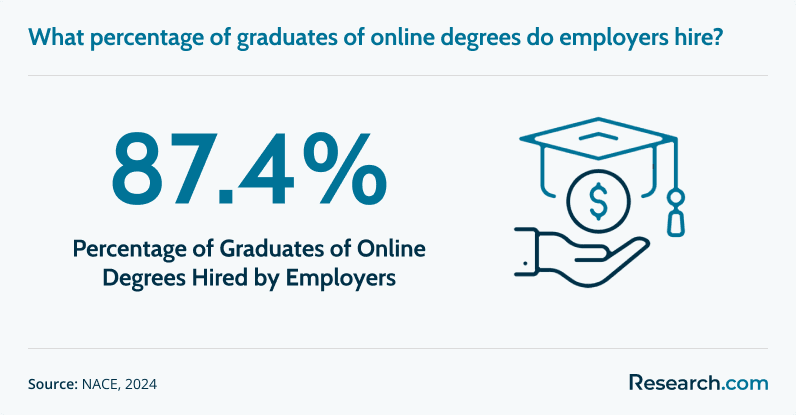
Employers are increasingly open to hiring graduates with online degrees, especially when the program is accredited and offered by a reputable institution. According to the National Association of Colleges and Employers (NACE), 87.4% of employers have hired graduates with online credentials.
All of those employers reported that online graduates receive the same starting salary as their on-campus counterparts.
Perceptions of online degrees and the largest online colleges have greatly improved over the years. According to CU Online, 83% of HR professionals now view an accredited online degree from a well-known institution as equal to traditional degrees. This highlights the growing acceptance of online education in the professional world.
The shift in perception is driven by the rise of remote work, improvements in online learning technology, and a focus on skills and practical experience over the mode of learning. However, employer acceptance can vary by industry, with tech, business, and healthcare showing higher acceptance, while fields requiring professional licensing may still favor traditional routes.
What are the biggest challenges in pursuing online programs?
Pursuing an online degree offers flexibility and accessibility, but it also comes with unique obstacles that differ from traditional on-campus learning. While many students value the convenience of studying remotely, they often face challenges related to motivation, technology, and interaction.
Understanding the hurdles below is key to preparing for success in an online program.
- Student Engagement and Motivation: Many online learners experience feelings of isolation, distraction, and lack of motivation due to limited peer interaction and the absence of a physical classroom environment. Digital learning fatigue is common, with students struggling to stay actively engaged in asynchronous courses.
- Technical Issues: Unstable internet connections, outdated devices, and software incompatibilities disrupt learning and create frustration. Accessing online platforms can be especially difficult for students in rural areas or with disabilities.
- Time Management and Procrastination: The flexibility of online programs can lead to procrastination and difficulty managing unstructured schedules, resulting in missed deadlines and incomplete coursework.
- Accessibility and Inclusivity: Students face socioeconomic barriers like lack of devices or reliable internet, as well as challenges related to disabilities and language differences that affect participation and comprehension.
- Mental Health and Well-being: Online learners often report mental fatigue, eye strain, physical inactivity, and emotional exhaustion due to prolonged screen time and a lack of social connection.
- Retention and Completion: High dropout rates remain a concern, as maintaining sustained motivation and overcoming technical or engagement hurdles is difficult for many students.
How can students get financial aid for an online degree?
Financing an online degree is often more accessible than students realize, as most of the same resources available to on-campus learners also apply to online programs. From federal aid to employer assistance, students have a variety of options to reduce tuition costs and manage expenses. Here are the main ways to secure financial aid for an online degree:
- Complete the FAFSA: The Free Application for Federal Student Aid (FAFSA) is the first step to accessing federal grants, loans, and work-study programs. Submitting it early increases your chances of receiving the maximum available aid.
- Apply for State Aid: Many states extend financial aid programs to residents enrolled in accredited online programs, even if the institution is located out of state. Students should check their state’s higher education agency website for eligibility details.
- Explore Institutional Scholarships and Grants: Universities often provide merit-based or need-based aid specifically for online learners. Contacting the school’s financial aid office can uncover unique opportunities tailored to distance students.
- Employer Tuition Assistance: Some employers cover part or all of tuition costs for employees pursuing a degree related to their field. This benefit can significantly reduce student debt while advancing career opportunities.
- Military and Veteran Benefits: Active-duty service members, veterans, and their families may qualify for education benefits like the GI Bill. These programs often cover tuition, housing, and other education-related expenses.
Nonprofits, professional organizations, and private foundations offer scholarships open to online students. Many of these awards are based on academic achievement, career goals, or personal background. For instance, students of digital photography programs online may be eligible for private scholarships from photography organizations.
How many existing college credits can a student typically transfer to an online program?
Students can typically transfer up to 60 credits from a community college or associate program and as many as 90 credits from a four-year institution toward a bachelor’s degree in an online program, like the best online bachelors in journalism degree.
This allows many learners to carry over a large portion of their completed coursework, especially general education and lower-level classes.
Most online universities require students to complete at least 30 to 45 credits at their institution to graduate, ensuring that part of the degree is earned directly through their curriculum.
Transfer credit policies may also depend on factors such as course relevance, the grade received, accreditation of the original school, and how recent the credits are.
How do you network and find jobs as an online student?
Networking and job searching as an online student may feel different from the traditional campus experience, but digital learning environments offer plenty of opportunities to build connections.
Most universities provide online career services, including résumé reviews, virtual career fairs, and access to job boards tailored for their students. Taking advantage of these resources early can make the job hunt more structured and efficient.
For instance, aspiring law enforcement officers can look into the ICE agent education requirements posted by postsecondary institutions as reference.
Beyond school-based tools, online learners can expand their reach through platforms like LinkedIn, where joining industry groups, attending webinars, and engaging with professionals helps establish a strong presence.
Online conferences, virtual networking events, and student or alumni associations also provide valuable chances to connect with peers and mentors in the field.
Hands-on experience remains one of the most effective ways to network. Internships, remote work opportunities, and freelance projects not only build résumés but also create professional relationships that can turn into job referrals.
Online students who actively engage in both academic and professional communities position themselves strongly for career success.
The chart below shows the typical starting salaries of the most popular majors in the United States.
Here’s What Graduates Have to Say About Their Online Programs
- Jenna: "My online degree allowed me to finish my education while working full-time and managing a family, which was a huge emotional relief. The flexibility to complete coursework on my own schedule was the key to my success, as I could fit classes in after my kids went to bed. I'm now in a much better-paying job. "
- Emma: "The online program prepared me exceptionally well for real-world challenges by combining practical coursework with interactive technology. I felt supported by my instructors and connected to fellow students, even without a physical campus. This experience boosted my confidence and helped me secure a job in my field right after graduation. "
- Hunter: "Studying online allowed me to access high-quality education from anywhere, saving me relocation costs and giving me a chance to learn in a comfortable environment. The convenience and variety of courses kept me motivated, and the skills I gained have been critical to my professional growth and networking success."
How can you assess an online program's quality and accreditation?
Prospective students should verify that an online program holds accreditation from a recognized agency, ensuring compliance with national or regional standards. Evaluating quality involves reviewing faculty credentials, curriculum relevancy, and student outcome statistics such as graduation rates and job placement figures. In addition, independent research on program rankings and comparisons with quick online degrees can provide actionable insights that support informed decision-making.
Key Findings
- 83% of HR professionals now view an accredited online degree from a well-known institution as equal to traditional degrees.
- In Fall 2022, there were 3,894 degree-granting postsecondary institutions in the United States classified as primarily online institutions.
- 87.4% of employers have hired graduates with online credentials.
- A notably large share of employers reported that online graduates receive the same starting salary as their on-campus counterparts.
- Students can typically transfer up to 60 credits from a community college or associate program and as many as 90 credits from a four-year institution toward a bachelor’s degree in an online program.
- The average online college student in the United States spends around $1,000 per class.
References:
- Alston, P. (2024, October 2). Rethinking Education: The Revolutionary Impact of Online Learning. ECIS
- Coursera (2025, July 20). 10 Most Popular College Majors. Coursera
- CU Online (2025, April 18). Why Employers Are Preferring Online Degrees More Than Ever in 2025? CU Online
- Fenwick, A. (2025, June 13). Do Employers Dislike Online Degrees? Honest Answers for Job Seekers. William Carey University
- Gray, K. (2024, January 30). Employers See Online Degrees as Comparable to In-person Degrees. NACE
- Hanson, M. (2025, February 22). Average Cost of Online College. Education Data Initiative
- NACE (2024). NACE Salary Survey Executive Summary. NACE
- NCES (2024, May). Graduate Degree Fields. NCES
- NCES (2023, December). Number and percentage of students enrolled in degree-granting postsecondary institutions, by distance education participation, location of student, level of enrollment, and control and level of institution: Fall 2021 and fall 2022. NCES
- University of the People (2025, September 3). What are the Best Online Schools for Transferring Credits? University of the People
Other Things You Should Know About the Largest Online Colleges
In 2027, graduates from the largest online colleges reported an average salary of $62,000 per year. This figure varies by degree and industry, with technology and healthcare fields seeing higher starting salaries. Salary data is typically sourced from graduate surveys and industry reports.
In 2026, larger online colleges often provide extensive resources and networking opportunities, which can lead to higher graduate salaries. Higher enrollment numbers may lead to more diverse alumni networks, potentially connecting graduates with better job opportunities that positively impact salary outcomes.


