
World Online Ranking of Best Earth Scientists – 2024 Report

Co-Founder and Chief Data Scientist
Research.com released the 3rd edition of its best earth scientists ranking on April 19. 2024. This guide explains what the ranking shows, how to interpret the results, and why the listed scientists, countries, and institutions matter for students, researchers, universities, and professionals following earth science research.
The ranking is useful if you want to identify influential earth science scholars, understand which institutions have strong research visibility, compare regional research strengths, or find potential experts for collaboration, graduate study, citation analysis, or academic benchmarking. It also places the 2024 ranking in context by highlighting recent earth science discoveries and the growing role of online and interdisciplinary education in research collaboration.
Quick answer: what does the 2024 best earth scientists ranking show?
The 2024 Research.com ranking identifies leading earth science researchers based on scholarly influence, publication activity, discipline-specific contributions, and awards. Research.com reviewed nearly 8,000 profiles of prominent earth science experts for this edition.
The D-index threshold for inclusion was set at 30 when most of a scientist’s publications were in earth science. Additional ranking signals included the number of earth science contributions and awards received by the scientist.
The United States has the largest representation in the 2024 ranking, with 491 scholars, equal to 49.1% of the listed earth scientists. Christopher T. Russell of the University of California in the United States ranks first overall with a D-index of 164.
How to use this ranking
This ranking should be treated as a research visibility and influence indicator, not as a complete measure of a scientist’s full contribution to society, teaching, mentoring, public service, or fieldwork. It is most helpful when used alongside other information, such as recent publications, grant activity, laboratory strengths, research fit, institutional resources, and collaboration history.
| Reader goal | How the ranking can help | What else to check |
| Find leading researchers | Use the list to identify highly cited and visible earth science scholars. | Review recent publications, research groups, and active projects. |
| Compare institutions | Look at which universities and research agencies have multiple ranked scientists. | Check department strengths, facilities, funding, and graduate outcomes. |
| Choose a graduate research direction | Identify fields and experts connected to climate, geology, ocean systems, natural hazards, and related areas. | Confirm advisor availability, program requirements, and research fit. |
| Benchmark research output | Use D-index averages, citations, and publication data to understand relative scholarly influence. | Avoid relying on one metric; compare multiple indicators and discipline context. |
Latest discoveries in earth science research
Recent earth science research continues to show how tightly connected climate, oceans, ice systems, land processes, and human communities are. One of the most visible findings in 2023 was the record-low sea ice extent in Antarctica. A decline of this scale is important because changes in polar ice can affect sea-level rise, coastal risk, ocean circulation, and climate feedbacks.
Another major research concern was the possibility of a shutdown in a key ocean current system. This current system helps regulate global temperatures, and a weakening or collapse could affect weather patterns, regional climates, and long-term climate stability.
These examples show why earth science is increasingly collaborative. No single field can fully explain climate change, polar dynamics, hydrology, geophysics, ocean circulation, or environmental risk on its own. Researchers now rely on field observations, satellite data, computational models, historical datasets, and cross-border cooperation to understand fast-changing earth systems.
How interdisciplinary academic programs strengthen earth science research
Earth science problems rarely fit within one academic department. Researchers studying climate risk, groundwater, earthquakes, coastal change, atmospheric chemistry, or mineral systems often need skills from statistics, computer science, environmental policy, data management, engineering, and geospatial analysis.
Interdisciplinary programs can help researchers build those complementary skills. Training in data analytics, environmental informatics, computational modeling, and scientific communication can improve how researchers collect, organize, interpret, and share complex earth science datasets.
For example, professionals who work with large research archives may benefit from the data organization, information retrieval, and digital curation skills taught in a masters in library science online program. Those skills can be valuable when managing geologic records, satellite observations, climate datasets, or long-term environmental monitoring files.
How advanced online degrees can support earth science careers
Advanced online programs can be useful for working professionals who want to strengthen research, data, policy, or technical skills without stepping away from their current jobs. In earth science, this flexibility matters because many professionals work in field-based roles, government agencies, environmental consulting, energy, water resources, or research support positions.
Online study may help learners build skills in remote collaboration, technical writing, digital research tools, data analysis, and project management. These abilities can support career movement into research coordination, environmental analysis, data stewardship, science communication, or interdisciplinary project leadership.
However, an online degree should be evaluated carefully. Students should check accreditation, faculty expertise, research opportunities, transfer policies, tuition, employer recognition, and whether the program offers the technical depth needed for their intended role. Readers comparing flexible options can also review Research.com’s guide to the easiest masters degree, while remembering that “easy” should never replace academic fit, rigor, or career relevance.
The key findings for the 3rd edition of the best earth science scientists ranking
- The United States has the largest presence in the 2024 ranking, with 491 scholars. That represents 49.1% of the best earth scientists included in the report.
- The remaining countries in the top 5 are the United Kingdom, with 96 scientists; Australia, with 75; Germany, with 54; and France, with 50.
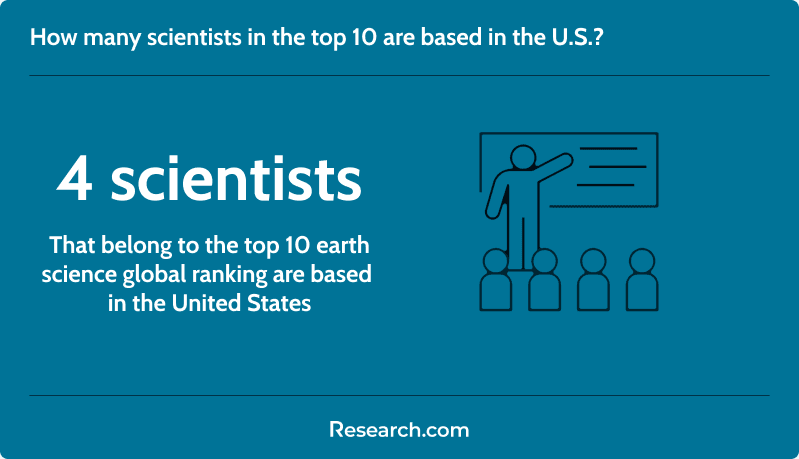
- Among the top 10 scientists in the 2024 list, 4 are affiliated with institutions in the United States.
- The California Institute of Technology ranks first among the top 10 institutions in this edition, with 23 scientists.
- Christopher T. Russell from the University of California in the United States is the highest-ranked earth scientist, with a D-index of 164.
- Institutions based in the United States account for 13 of the top 20 leading institutions. Other top institutions are located in Australia, the Netherlands, the United Kingdom, China, and Switzerland.
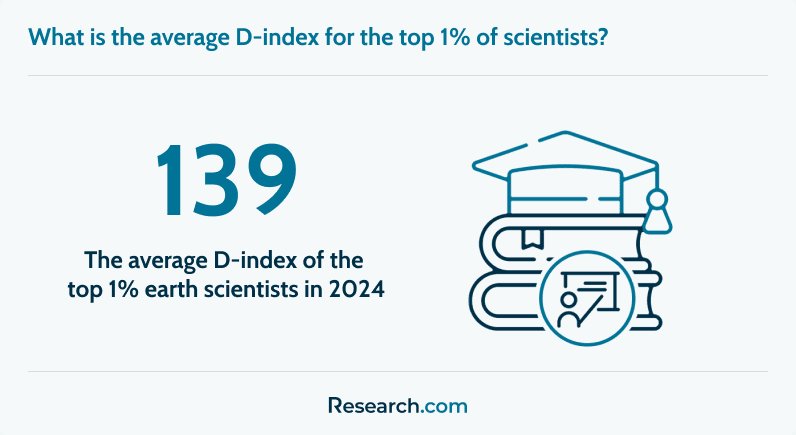
- The average D-index among the top 1% of scientists is 139, compared with an average of 79 across all scientists in the ranking.
The complete 2024 ranking is available here:
Countries with the highest number of leading earth science scientists
The United States remains the most represented country in the best earth scientists report. It has 491 scholars in the 2024 ranking, compared with 500 in the 2023 ranking.
The United Kingdom keeps the second position with 96 scientists, adding two more ranked scholars compared with the prior edition.
Australia ranks third with 75 scientists. Germany and France changed positions this year: Germany added four scientists and moved up to fourth place with 54 scientists, while France shifted to fifth place with 50 scientists.
China moved into sixth place with 48 scientists. Canada follows with 47 scientists, Switzerland has 27 scientists, the Netherlands has 23 scientists, and Japan has 18 scientists.
Germany and the Netherlands each added five more ranked scientists in 2024. Every country that appeared in the previous year’s top 10 remains in the 2024 top 10.
The country assigned to a scientist reflects the affiliated research institution listed in MAG. It does not necessarily indicate the scientist’s nationality.
| Country | Number of ranked scientists | 2024 ranking note |
| United States | 491 | Highest representation in the report. |
| United Kingdom | 96 | Maintains second place. |
| Australia | 75 | Ranks third in the 2024 list. |
| Germany | 54 | Moves up to fourth place. |
| France | 50 | Ranks fifth in the 2024 report. |
| China | 48 | Moves to sixth place. |
| Canada | 47 | Follows China in the country count. |
| Switzerland | 27 | Remains in the top 10 countries. |
| Netherlands | 23 | Adds five more ranked scientists in 2024. |
| Japan | 18 | Continues to appear in the top 10 countries. |
Institutions with the highest number of leading scientists
The California Institute of Technology leads the 2024 institutional list, followed by Stanford University. CalTech added two scientists this year and now has 23 ranked scientists. Stanford University remains at 21 scientists, the same number as in the previous year.
The Australian National University holds third place with 19 scientists. Utrecht University rose from rank 7 in 2023 to rank 4 in 2024, with 16 scientists. The Massachusetts Institute of Technology (MIT), which ranked 9th in 2023, now holds the 5th position with 16 scientists.
The United States Geological Survey (USGS) enters the top 10 this year and ranks sixth with 16 scientists. The rest of the top 10 includes the University of Oxford with 15 scientists, ETH Zurich with 15 scientists, the University of California-Los Angeles with 14 scientists, and the University of Colorado-Boulder with 14 scientists.
Among the top 20 institutions, 13 are located in the US. This group includes three research agencies: USGS, Woods Hole Oceanographic Institution, and Lamont-Doherty Earth Observatory. Other top 20 institutions are based in Australia, represented by the Australian National University; the Netherlands, represented by Utrecht University; Switzerland, represented by ETH Zurich; and China, represented by the Chinese Academy of Sciences.
| Institution | Ranked scientists | 2024 context |
| California Institute of Technology | 23 | Leads the institutional ranking. |
| Stanford University | 21 | Holds second place. |
| Australian National University | 19 | Remains in third place. |
| Utrecht University | 16 | Rises from rank 7 in 2023 to rank 4 in 2024. |
| Massachusetts Institute of Technology (MIT) | 16 | Moves from rank 9 in 2023 to the 5th position in 2024. |
| United States Geological Survey (USGS) | 16 | New entrant in the top 10. |
| University of Oxford | 15 | Appears among the top 10 institutions. |
| ETH Zurich | 15 | Represents Switzerland among leading institutions. |
| University of California-Los Angeles | 14 | Included in the top 10 institutional group. |
| University of Colorado-Boulder | 14 | Included in the top 10 institutional group. |
Strengthening research through online universities
Traditional research universities still play a central role in earth science, especially in fieldwork, laboratories, observatories, and long-running research infrastructure. Online universities and online learning platforms can support this ecosystem by expanding access to training, data analysis, remote collaboration, and cross-institutional research participation.
Digital learning environments can make it easier for geographically dispersed researchers to exchange data, review models, participate in remote seminars, and collaborate on projects involving satellite feeds, climate records, natural hazard monitoring, and environmental datasets. This can broaden participation in research questions that require diverse methods and regional perspectives.
One example of cross-institutional collaboration is the Earth Science System Interdisciplinary Center (ESSIC), a joint initiative involving the University of Maryland College Park (UMCP) and several other online universities. ESSIC uses connected research platforms to support work on climate change, natural hazards, and resource management, showing how digital collaboration can extend the reach of earth science research.
How accelerated online programs can affect earth science career paths
Accelerated online programs can help working professionals gain targeted skills in a shorter timeframe. In earth science-related careers, this may be useful for professionals who need practical training in geospatial tools, data analysis, environmental compliance, research administration, technical writing, or project management.
The main advantage is speed. A compressed program can help learners move quickly from coursework to applied projects. The trade-off is intensity. Students should confirm that an accelerated format gives them enough time to master technical content, complete projects, and build a portfolio or research experience that employers or graduate programs will respect.
Readers exploring faster education options can compare fields, costs, and outcomes in Research.com’s guide to quick programs that pay well.
How online dual degree programs can support research innovation in earth sciences
Earth science research often benefits from combining scientific knowledge with another discipline. A researcher who understands both geoscience and data analytics, engineering, public policy, emergency management, or environmental law may be better prepared to work on complex problems such as water security, climate adaptation, infrastructure risk, or sustainable resource management.
Dual degree programs online can support that kind of preparation when the curriculum is carefully designed and the two fields genuinely complement each other. Students should look for programs that provide integrated advising, clear credit requirements, applied projects, and faculty with relevant interdisciplinary expertise.
How affordable online master’s programs can encourage earth science collaboration
Cost affects who can pursue advanced training. Lower-cost online programs can make it easier for working professionals, early-career researchers, and career changers to build specialized skills while continuing to work.
Affordable online masters programs may support collaboration when they include research methods, applied projects, internships, mentorship, and connections with public agencies, laboratories, nonprofits, or industry partners. Price alone is not enough, however. Students should compare total cost, accreditation, faculty experience, technical coursework, student support, and career relevance.
How financial aid can expand earth science research opportunities
Financial aid can make advanced study more realistic for students who want to enter earth science research but face tuition, technology, travel, or fieldwork-related expenses. Funding can also help students participate in workshops, conferences, research assistantships, and cross-institutional projects.
Students should compare grants, scholarships, assistantships, employer tuition support, and federal aid eligibility before choosing a program. They should also confirm whether an online college participates in eligible aid programs and whether the degree matches their career goals. Research.com’s guide to the best online colleges that accept FAFSA can help cost-conscious students begin that review.
How online doctoral pathways may expand earth science research participation
Doctoral study in earth science and related fields can involve advanced theory, research design, data analysis, field methods, and original scholarship. Online or hybrid doctoral pathways may help some professionals continue their research training while managing work or location constraints.
Students should be careful when evaluating any doctoral program advertised as fast, free, or unusually flexible. They need to verify accreditation, funding terms, residency requirements, dissertation expectations, faculty supervision, research infrastructure, and whether the program supports the kind of earth science research they plan to do.
For readers comparing doctoral timelines and flexible formats, Research.com provides an overview of free PhD programs online.
Common mistakes when using scientist rankings or choosing a research path
| Common mistake | Why it can be a problem | Better approach |
| Using one metric as the whole story | A D-index or citation count does not capture mentoring, teaching, public impact, field leadership, or emerging research quality. | Use rankings together with publications, research fit, collaborations, and institutional context. |
| Choosing a graduate program only because a famous scientist is listed | A top researcher may not be accepting students, may work in a different subfield, or may have limited advising capacity. | Contact departments, review faculty pages, and ask about advisor availability. |
| Assuming institutional rank equals fit | A highly ranked institution may not be the best place for a specific topic, method, region, or career goal. | Compare laboratories, datasets, field sites, funding, and faculty expertise. |
| Ignoring accreditation in online programs | An unaccredited or poorly recognized program can limit transfer, employment, or doctoral study options. | Verify accreditation before applying or paying tuition. |
| Focusing only on tuition | Lower tuition does not always mean better value if the program lacks research support, technical training, or career services. | Compare total cost, curriculum quality, faculty, outcomes, and support services. |
| Assuming online study automatically provides research experience | Some online programs are coursework-focused and may not include fieldwork, lab access, or publishable research. | Ask about capstones, research assistantships, faculty projects, and data-based research opportunities. |
Questions to ask before choosing an earth science program or research collaborator
- Does the faculty expertise match the exact area I want to study, such as climate systems, geology, hydrology, geophysics, ocean science, or natural hazards?
- Are ranked scientists currently active in the department, and are they accepting students or collaborators?
- Does the institution provide access to datasets, laboratories, field sites, observatories, or computing resources?
- How does the program support interdisciplinary work with data science, policy, engineering, or environmental management?
- If the program is online, does it include research projects, mentorship, and collaboration opportunities?
- What is the full cost after tuition, fees, technology needs, travel, fieldwork, and materials?
- Is the program accredited and recognized by employers, agencies, or graduate schools?
- What evidence does the program provide about student research, publications, placements, or career outcomes?
D-index ranking leaders, averages, and distribution
In North America, Professor Christopher T. Russell of the University of California, Los Angeles, United States, is the highest-ranked scientist. Professor Russell has a D-index of 164 and ranks first overall in the 2024 report.
In Asia, Professor Guochun Zhao of the University of Hong Kong, China, leads the region with a D-index of 135. Professor Zhao ranks 8th in the full report.
In Europe, Professor Jean Poesen of KU Leuven, Belgium, has the top regional position. Professor Poesen has a D-index of 138 and ranks 5th overall.
In Oceania, Professor William L. Griffin of Macquarie University, Australia, is the leading scientist. Professor Griffin has a D-index of 139 and is the 2nd leading earth scientist in this year’s report.
In Africa, Professor Maarten J. de Wit of Nelson Mandela University, South Africa, is the top-ranked scientist in the region. He has a D-index of 69.
The average D-index for the top 1% of scientists is 139, compared with an average of 79 for all scientists included in the 2024 report.
The top 1% of scientists in the report have an average of 1070.4 published articles, while the average for all listed scholars is 354.05.
The average citation count for the top 1% of scientists is 72,303.8, compared with 24,249.03 for all scholars in the ranking.
| Region | Leading scientist | Affiliation | D-index | Overall ranking note |
| North America | Christopher T. Russell | University of California, Los Angeles, United States | 164 | Best scientist in the 2024 report. |
| Asia | Guochun Zhao | University of Hong Kong, China | 135 | Ranks 8th in the report. |
| Europe | Jean Poesen | KU Leuven, Belgium | 138 | Ranks 5th in the report. |
| Oceania | William L. Griffin | Macquarie University, Australia | 139 | Ranks 2nd in the report. |
| Africa | Maarten J. de Wit | Nelson Mandela University, South Africa | 69 | Top-ranked scientist in Africa. |
Methodology and transparency
The ranking was built from a review of nearly 8,000 profiles of leading earth science experts. For this edition, the D-index threshold was 30 when most of a scientist’s publications were in earth science. The ranking also considered discipline-specific contributions and awards.
You can read more about the ranking process and criteria on Research.com’s methodology page here.
Key Insights
- The 2024 Research.com earth science ranking highlights scholarly influence across climate science, geology, geophysics, ocean systems, environmental research, and related fields.
- The United States has the largest number of ranked scientists, with 491 scholars, representing 49.1% of the 2024 list.
- Christopher T. Russell ranks first overall with a D-index of 164.
- The California Institute of Technology leads the institutional count with 23 scientists, followed by Stanford University with 21.
- Rankings are most useful when combined with deeper evaluation: recent publications, research fit, faculty availability, institutional resources, and collaboration opportunities.
- Interdisciplinary and online education can support earth science careers, but students should verify accreditation, research support, total cost, and career relevance before enrolling.
- Recent findings on Antarctic sea ice and ocean current systems reinforce why earth science research requires global collaboration and strong data-driven methods.
About Research.com
All research was coordinated by Imed Bouchrika, Ph.D., a computer scientist with a strong history of collaboration across international academic research projects. His role was to help ensure that the data used in the ranking remained unbiased, accurate, and current.
Research.com is a research portal focused on science and educational rankings. Its mission is to help professors, research fellows, and students advance their work and identify leading experts across scientific disciplines. Research.com also provides education-focused resources to help students compare colleges, academic options, and career pathways.


