
World Online Ranking of Best Molecular Biology Scientists – 2025 Report

Co-Founder and Chief Data Scientist
On May 27, 2025 Research.com has released its fourth annual report on top molecular biology scientists. In this report, we highlight the significant achievements of leading experts, boosting their recognition within the academic community and inspiring others.
This report on the best molecular biology scientists is aimed to inspire researchers, decision-makers, and entrepreneurs worldwide. It is the report's goal to provide clear information about top experts in various molecular biology fields across countries, universities, and research institutions.
To create our 2025 report, our research team reviewed over 2,600 scientist profiles, pulling information from sources like OpenAlex and CrossRef. We looked at several factors to determine if a scientist qualified: their publications, awards, and achievements. To make our ranking, a scientist needed a D-index of at least 40, and most of their published work had to be in molecular biology.
Latest Discoveries in Molecular Biology Research
Breakthroughs in molecular biology fundamentally reshape our understanding of life itself, from the intricate workings of our cells to how we combat disease. Recent advancements powerfully underscore this progress, offering unprecedented tools and insights into complex biological processes.
One significant leap forward involves the development of AI-powered machine learning methods. These innovative methods can pinpoint the exact location of almost any protein inside human cells, even at a single-cell level. This granular capability provides a much clearer picture of what proteins do and how cells organize themselves.
Further expanding our knowledge of cellular interactions, scientists recently uncovered a novel mechanism in viral infection. Specifically, they discovered that HIV-1, the virus responsible for AIDS, hijacks human immune cells using circular RNAs (circRNAs). This cunning strategy allows the virus to evade our natural defenses and multiply. Crucially, this discovery opens exciting new avenues for creating antiviral drugs that specifically target these circRNA molecules, potentially offering a powerful new weapon against the virus.
The Key Findings for the 4th Edition of the Best Molecular Biology Scientists Ranking
- Scientists affiliated with American universities and institutions comprise 529 entries, or 52.90% of the total ranking.
- U.S. representation among the top 1% of leading researchers has further solidified, with seven out of ten now based in the United States. Nevertheless, a significant proportion still represents other nations.
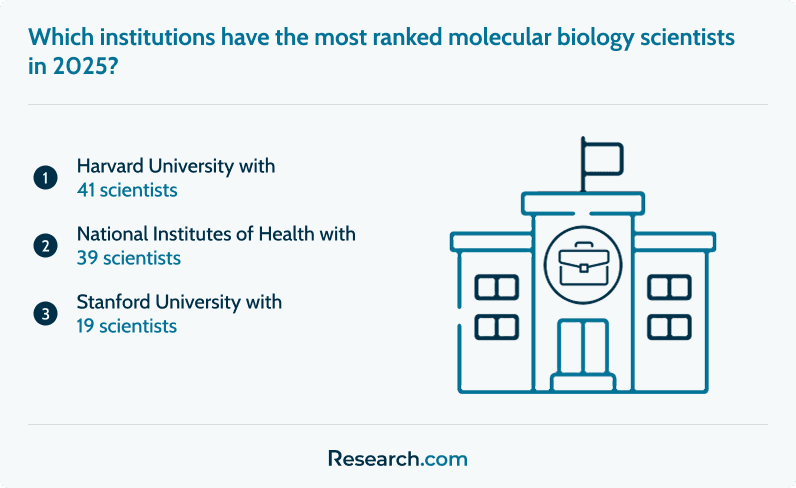
- Harvard University ranks highest in terms of scientists in our 2025 study, with 41 scientists connected to that institution.
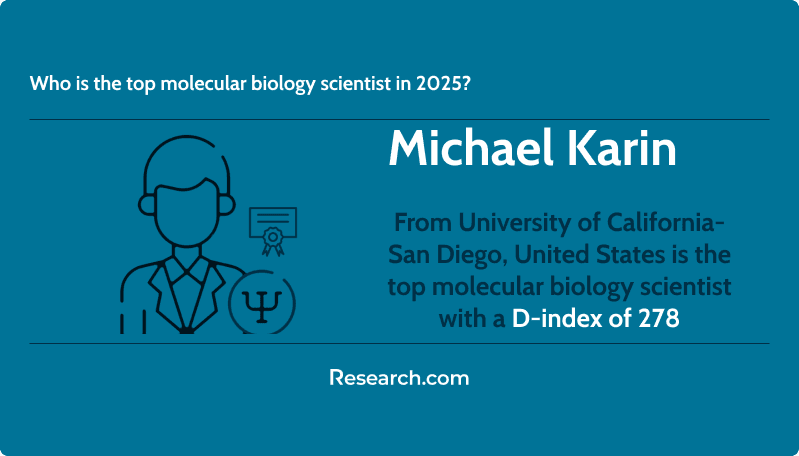
- With a D-index of 278, Michael Karin of the University of California, San Diego, in the United States is ranked as the top scientist in molecular biology.
- Universities and institutions from North America, Europe, and Asia make up the top 20 universities and institutions leading research activities in the field of molecular biology.
- The average D-index for the top 1% of scientists is 243.9 against an average of 105.45 for all scientists included in the ranking.
The full ranking for the 2025 list of the best molecular biology scientists can be found here:
BEST MOLECULAR BIOLOGY SCIENTISTS RANKING
Countries With the Highest Number of Leading Molecular Biology Scientists
In 2025, the United States continues to lead the global field of molecular biology, with 529 top-ranked scientists—accounting for 52.90% of the total. While still dominant, this marks a slight decline from 2024, when the U.S. had 535 scientists (53.5%). Notably, seven out of ten scientists in the top 1% in 2025 are affiliated with U.S. institutions, up from six out of ten the previous year, reinforcing the country's enduring influence.
Japan retains its second-place position with 82 scientists in 2025, a minor drop from 83 in 2024. Germany edges into third place this year with 79 scientists, surpassing the United Kingdom, which now ranks fourth with 77—down from 79 in 2024.
Canada maintains its upward trend, holding onto fifth place in 2025 with 31 scientists, up from 29 last year. France remains steady at sixth, contributing 26 scientists this year compared to 28 in 2024.
The Netherlands rises slightly in the rankings to seventh place with 25 scientists, improving from 21 in 2024. Australia, which previously held the fifth spot in 2024 with 28 scientists, slips to eighth with 22 in 2025.
Sweden and Switzerland both move up slightly to complete the top ten, each contributing 18 scientists in 2025—an increase from 17 and 16, respectively, in 2024.
Overall, the 2025 data reflects a relatively stable global distribution, with minor shifts in rankings and contributions, and continued U.S. dominance. Several countries show modest increases or decreases, pointing to sustained global engagement in the field of molecular biology.
Please note that the country associated with a scientist is based on their affiliated research institution according to MAG, not on their actual nationality.
Institutions With the Highest Number of Leading Scientists
Harvard University claims the top spot this year among institutions with the most leading molecular biology scientists, with 41 researchers—rising from second place in 2024. The National Institutes of Health (NIH), which led the rankings in 2024 with 39 scientists, remains a strong presence, holding steady at 39 but shifting to second place in 2025.
Stanford University maintains its third-place position, with 19 scientists in both years. The University of California, San Francisco increases its standing slightly, moving from 15 scientists in 2024 to 18 in 2025, placing it among the top institutions.
MIT also sees a modest gain, rising from 15 scientists in 2024 to 17 in 2025. UC San Diego joins the top tier with 16 scientists, a notable addition not highlighted in the 2024 top 10.
The Max Planck Society remains a major European contributor, with 14 scientists in 2025, likely consistent with 2024, though the specific number was not previously detailed. UC Berkeley appears again with 13 scientists in 2025, maintaining a strong presence. University of Cambridge and Osaka University both report 12 scientists this year, continuing their representation from 2024.
Further rounding out the 2025 list, University of Wisconsin–Madison contributes 11 scientists, while several institutions each host 10 top researchers, including Yale University, The University of Texas MD Anderson Cancer Center, Rockefeller University, and Memorial Sloan Kettering Cancer Center.
Institutions with nine leading scientists in 2025 include Columbia University, UT Southwestern Medical Center, Duke University, UCLA, and Ludwig-Maximilians-Universität München — several of which were not featured in the top 10 list in 2024.
In contrast, the 2024 list included Kyoto University among the top 10, which is absent from the 2025 highlights. Overall, the 2025 data shows more diversification among institutions while maintaining strong U.S. dominance, with several institutions improving their counts or joining the top rankings for the first time.
Strengthening Research in Online Universities
Several key strategies can boost and improve research within online universities. Effective online teaching methods for research include clear learning materials, reasonable deadlines, and readily available instructors for questions and feedback. These elements help students steadily focus on and finish their research projects. Using interactive and engaging teaching methods also makes learning more effective for students.
Additionally, universities should ensure everyone has fair internet access, provide ongoing training for faculty in research teaching, and build international partnerships to expand research opportunities. University-managed online collections also play a vital role by organizing, saving, and sharing digital research. This motivates faculty because their work gains more visibility and impact. Together, these approaches improve the quality and output of research in online learning environments.
Many diseases benefit from dedicated international research groups where scientists from different online universities and institutes work together. These groups share data, methods, and knowledge to speed up progress. For instance, the International Rare Diseases Research Consortium (IRDiRC), formed in 2011, promotes worldwide teamwork among funders, academic researchers, companies, and patient advocacy groups focusing on rare diseases. IRDiRC members from over 20 countries, including universities and institutes globally, share information, procedures, and expertise to quickly diagnose, understand, and develop treatments for rare diseases. The group also coordinates ethical and regulatory efforts to streamline research progress across borders.
Another example is the Multilateral Initiative on Malaria (MIM). This organization strengthens research abilities and teamwork among scientists in areas where malaria is common. It pools resources and knowledge to fight malaria worldwide.
D-index Ranking-Leaders, Averages, and Distribution
For North America, Professor Michael Karin of the University of California, San Diego, leads the list of best researchers with a D-index of 278. He is also the top researcher in the 2025 world ranking.
For Europe, Professor Peer Bork from European Molecular Biology Laboratory in Germany ranks first with a D-index of 254. In the 2025 world ranking, he is in the second spot.
Professor Kazuo Shinozaki of RIKEN in Japan secures the 11th spot in the world ranking and leads the list in Asia with a D-index of 213.
In Oceania, Professor Edward C. Holmes from the University of Sydney in Australia leads other molecular biology scientists in the region. Professor Holmes ranks 43rd in our report, with a D-index of 168.
The average D-index for the top 1% of scientists is 243.9 against an average of 105.45 for all scientists included in the ranking.
The scholar with the lowest index value who made it to the ranking in 2025 has a D-index of 51.
The average number of published articles for the top 1% of scientists in the ranking is 943.6 against an average of 349.07 for all scholars.
The average number of citations for the top 1% of scientists is 268150.8 against an average of 52308.91 for all scholars.
You can learn more about the methodology used to create this report here.
About Research.com
All research was coordinated by Imed Bouchrika, Ph.D., a computer scientist with a well-established record of collaboration on a number of international research projects with different partners from the academic community. His role was to make sure all data remained unbiased, accurate, and up-to-date.
Research.com is the number one research portal for science and educational rankings. Our mission is to make it easier for professors, research fellows, and students to progress with their research and find the top experts in a wide range of scientific disciplines. Research.com is also a leading educational platform that helps students find the best colleges, academic opportunities, and career paths.


