
World Online Ranking of Best Ecology & Evolution Scientists – 2025 Report

Co-Founder and Chief Data Scientist
On April 23, 2025, Research.com released the fourth edition of its ranking of the best scientists in ecology and evolution. This report highlights top researchers worldwide who have made significant contributions in these fields. The goal is to spotlight their work, support global visibility, and guide the academic community as it grows and evolves.
We share this ranking to help researchers, educators, and leaders worldwide see where innovation in ecology and evolution is happening. By learning more about these top scientists, readers can explore new trends, understand global research directions, and connect with leading minds. This report also helps students and early-career researchers find role models and institutions impacting environmental sciences.
For the 2025 edition, Research.com reviewed the profiles of nearly 9,000 scientists gathered from trusted bibliometric sources. The ranking looked at several indicators to measure influence and productivity, including citation data, research output, and how often scientists publish in their field.
To be included in the ranking, scientists needed a discipline-specific D-index of at least 20, especially if most of their work is in animal and veterinary sciences. The selection also considered how much of the scientist’s work is in ecology and evolution, along with awards, honors, and other major career achievements. These strict criteria ensure that each scientist in the report has made substantial and lasting contributions to their field.
Latest discoveries in ecology and evolution research
A new study on Timema cristinae, a stick insect native to California, has uncovered how complex structural changes in DNA—like inversions and translocations—drive repeated patterns of adaptation in different environments. Researchers compared full genome sequences of insects from two mountains. They discovered that similar color-pattern adaptations evolved through different but overlapping DNA rearrangements. These adaptations help each morph blend into its specific host plant, boosting survival. This shows that structural variation in genomes, not just single mutations, can repeatedly fuel evolution. It also suggests that adaptation can follow predictable genetic routes, even when the changes arise independently.
Another recent breakthrough from the German Centre for Integrative Biodiversity Research proposes a new concept called the “Internet of Nature.” This idea expands our understanding of ecosystems by showing how species share matter, energy, and vital information, like signals or behavioral cues. This information exchanges influence how species interact, organize, and respond to change. Researchers can now map ecosystems more accurately by combining this data with traditional food web models. This new framework also reveals that natural communities may be more tightly connected—and thus more vulnerable—than we thought, especially under climate stress and human impact.
Key findings for the 4th edition of the best ecology and evolution scientists ranking
- The United States leads the 2025 ranking with 380 scientists in the global top 1,000 for ecology and evolution.
- The University of Oxford and the Spanish National Research Council both top the institutional list, with 16 scientists ranked each.
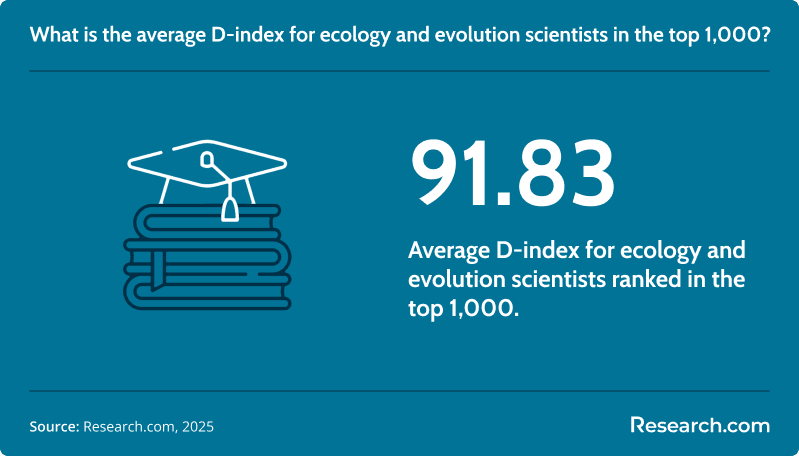
- The average D-index for the top 1% of scientists is 176.2, compared to 91.83 for all 1,000 ranked researchers.
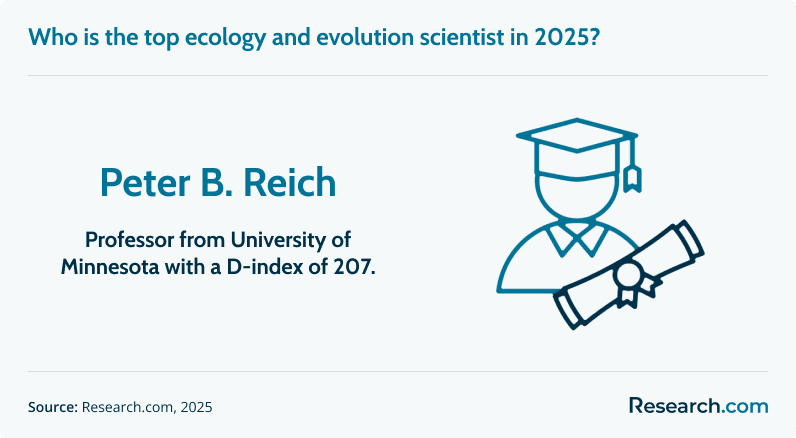
- Peter B. Reich from the University of Minnesota is the world's top-ranked scientist with a D-index of 207.
- On average, the top 1% of scientists have published 783.5 works in their field, more than double the overall average of 325.75.
The full ranking for the 2025 list of the best ecology and evolution scientists can be found here:
BEST ECOLOGY AND EVOLUTION SCIENTISTS RANKING
Countries with the highest number of leading ecology and evolution scientists
In the 2025 report, the United States continues leading the world in ecology and evolution research, with 380 scientists among the top 1,000. The United Kingdom stays in second place with 141 scientists, while Australia holds third with 80. These three countries remain the top contributors to the field, showing strong global influence and consistent academic excellence.
The rankings of the top 10 countries remained mostly stable compared to the 2024 report, but there were a few notable shifts. The United States saw a slight drop, from 384 scientists last year to 380 this year. The United Kingdom also recorded a decrease, with 141 scientists this year compared to 149 in 2024. While still holding third place, Australia has 80 scientists, down from 82 last year.
Germany moved up from fifth to fourth place in 2025, increasing its representation to 63 scientists, up from 57 in 2024. Canada, which held fourth place last year with 61 scientists, now shares the fifth spot after remaining at the same number. France and the Netherlands have 34 scientists each, but France ranks slightly higher. Spain and Switzerland follow with 25 scientists each. China has now replaced Sweden in the top 10 with 20 scientists.
Please note that the country associated with a scientist is based on the affiliated research institution according to MAG, not on their actual nationality.
Institutions with the highest number of leading scientists
In the 2025 report, the University of Oxford and the Spanish National Research Council are tied at the top, each with 16 scientists in the global top 1,000 for ecology and evolution. Following closely are the University of California, Davis; Wageningen University & Research; and Duke University, each with 14 scientists. This year’s top 5 shows a more even distribution of scientific talent across institutions in Europe, North America, and Australia.
There have been noticeable shifts in the rankings compared to the 2024 report. Stanford University held the top spot last year with 14 scientists and is now in sixth place with 13. The University of British Columbia also moved down slightly from second place to seventh, now with 13 scientists instead of 14. Meanwhile, the University of Oxford climbed from fourth place to a leading position this year. The Spanish National Research Council also returned to the top after dropping eighth in 2024.
Wageningen University & Research has made a strong move from 10th to the top 5, matching last year’s top institutions in number. James Cook University and the University of Queensland remained in the top 10 but are now joined by newer entries like the University of Wisconsin–Madison and CNRS, each with 11 scientists.
Regarding overall representation, U.S.-based institutions dominate the top 20, making up 45% of the list (9 out of 20). The UK follows with 15% (3 institutions), and countries such as Canada, Australia, the Netherlands, France, Denmark, and Spain each have one or two institutions featured. These numbers highlight a strong global presence and show the continued concentration of top-tier research in a few regions.
Online universities encouraging ecology and evolution research
Online universities are playing a growing role in supporting research in ecology and evolution. With more students turning to remote learning, the online education market continues to expand worldwide. In 2025, user penetration in online education is expected to reach 19.5%, showing that more people are choosing flexible, internet-based learning.
This shift has opened new doors for future scientists. Many online universities now offer strong environmental science, biology, and sustainability programs. These programs help students build a solid foundation in research while giving them access to digital labs, online fieldwork simulations, and collaboration tools. These resources are helping the next generation of ecology and evolution researchers learn from anywhere in the world.
Online learning also helps increase access to education in places where traditional research institutions are limited. Students from rural or underserved areas can join global conversations on climate, conservation, and biodiversity. With more people involved, the research community becomes more diverse and innovative.
The rise of online universities also means that working professionals, educators, and lifelong learners can continue studying ecology and evolution without leaving their jobs or relocating. This helps keep the field active and connected, with a broader range of voices contributing to research and problem-solving.
D-index ranking — leaders, averages, and distribution
Professor Peter B. Reich from the University of Minnesota, United States, remains the leading scientist in North America with a D-index of 207, securing the top spot in the global ranking.
For Europe, Professor Kevin J. Gaston of the University of Exeter in the United Kingdom is the highest-ranked with a D-index of 188, placing second in the world.
In Asia, Professor Carlos M. Duarte from King Abdullah University of Science and Technology in Saudi Arabia leads the region with a D-index of 180, earning the 4th spot globally.
Professor Hugh P. Possingham from the University of Queensland, Australia, holds the top position in Oceania with a D-index of 163 and ranks 10th worldwide.
Africa’s highest-ranking scientist is Professor David M. Richardson from Stellenbosch University in South Africa, who has a D-index of 147 and is ranked 27th in the world.
In South America, Professor Sandra Díaz from the National University of Córdoba in Argentina leads the region with a D-index of 103, placing 200th globally.
The average D-index for the top 1% of scientists in the top 1,000 rankings is 176.2, compared to 91.83 for the overall group.
The scholar with the lowest D-index to make the 2025 list has a score of 30.
On average, the top 1% of scientists have 783.5 discipline-specific publications, while the overall average across the 1,000 ranked researchers is 325.75.
The average number of discipline-specific citations among the top 1% is 150,054.2, well above the average of 40,376.77 for all ranked scientists in the top 1,000.
You can learn more about the methodology used to create this report here.
About Research.com
All research was coordinated by Imed Bouchrika, Ph.D., a computer scientist with a well-established record of collaboration on a number of international research projects with different partners from the academic community. His role was to make sure all data remained unbiased, accurate, and up-to-date.
Research.com is the number one research portal for science and educational rankings. Our mission is to make it easier for professors, research fellows, and students to progress with their research and find the top experts in a wide range of scientific disciplines. Research.com is also a leading educational platform that helps students find the best colleges, academic opportunities, and career paths.


