
World Online Ranking of Best Economics & Finance Scientists – 2025 Report

Co-Founder and Chief Data Scientist
On April 10, Research.com published the fourth edition of its annual ranking showcasing the leading scientists in economics and finance. This year’s report highlights top academic figures in the field, aiming to offer the global academic community insight into the work of highly influential scholars.
The report seeks to motivate researchers, policymakers, and business leaders to explore and analyze market trends through the lens of these distinguished scientists. It also serves as a valuable resource for discovering leading economics and finance experts from institutions worldwide.
For the 2025 edition, over 3,000 researcher profiles were reviewed using data from various bibliometric sources. The rankings were based on a range of indicators and performance metrics that evaluated each scientist's overall impact and contributions.
To qualify for inclusion, a scholar needed a minimum D-index (Discipline H-index) of 30, with the majority of their publications focused on economics and finance. Additional factors considered included the share of work specifically within the discipline and the individual’s recognition, such as notable achievements and awards in the field.
Latest discoveries in economics & finance research
Economics and finance scholars are at the forefront of tackling today’s most pressing global challenges by developing data-driven insights that inform policy. In the face of persistent inflation and the lingering effects of monetary tightening, researchers are refining macroeconomic models using real-time data and advanced econometrics to better understand inflation dynamics and the transmission of interest rate changes across different sectors.
Scholars are also playing a critical role in addressing the long-term economic consequences of climate change and technological disruption. Climate economists are leveraging large-scale datasets and satellite imagery to assess the impact of extreme weather events on agricultural yields, migration patterns, and regional economic performance.
In finance, experts are developing innovative models for pricing climate-related risks and evaluating ESG investment performance. At the same time, labor economists are studying the implications of AI and automation on workforce dynamics, identifying vulnerable populations, and testing policy tools like retraining programs and income support.
Across these fields, economics and finance scientists are not only generating new knowledge but also shaping public discourse and policy through peer-reviewed research, think tank reports, and advisory roles—demonstrating the enduring importance of empirical analysis and intellectual leadership in solving global economic problems.
The key findings for the 4th edition of the best economics & finance scientists ranking
- Researchers based in the United States lead the 2025 ranking, with 613 scholars making up 61.3% of the top economics and finance scientists. Other countries with strong representation include the United Kingdom with 113 scholars (11.3%), the Netherlands with 32 (3.2%), Germany with 31 (3.1%), and China with 26 (2.6%).
- Remarkably, 8 out of the top 10 scientists in the top 1% are affiliated with U.S. institutions.
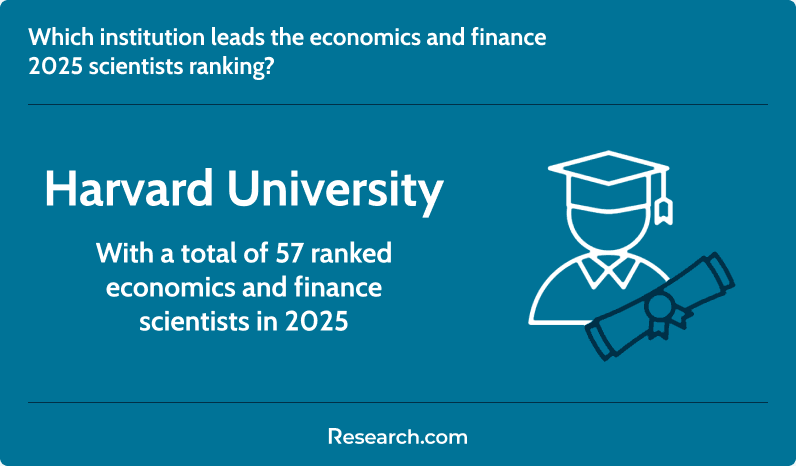
- Harvard University stands out as the top academic institution in 2025, with 57 scholars making it to the ranking, accounting for 5.7% of the top 1000. Among non-academic institutions, the World Bank holds the 14th position, making it the highest-ranked non-educational research organization.
- The average D-index for scientists in the top 1% is 157, significantly higher than the overall average of 71 among all ranked scholars.
- Among the top 1000 economics and finance scientists, 41 are recipients of Nobel Prize, 20 are awardees of the John Bates Clark Medal of the American Economic Association, 207 are members of the Fellows of the Econometric Society, and 62 are identified as Distinguished Fellow of the American Economic Association.
The full ranking for the 2025 list of best economics and finance scientists can be found here:
BEST ECONOMICS AND FINANCE SCIENTISTS RANKING
Countries with the highest number of leading economics & finance scientists
The United States continues to lead the 2025 ranking, holding the top position despite a slight decline in the number of its ranked scientists. With 613 scholars, the U.S. accounts for 61.3% of the top economics and finance researchers. Notably, 8 of the top 10 scientists in the top 1% hail from the United States, while the remaining two are from the United Kingdom and France.
The United Kingdom remains in second place with 113 scholars, marking a decrease of two scientists compared to the previous year. The Netherlands remained in the third rank with 32 scientists, while Germany follows closely in fourth with 31.
China claims the fifth spot with three more scientists with a total of 26 for 2025, followed by Canada moving from its previous 8th rank to spot 6 this time with 24 scholars. Australia still has 23 scientists, while Italy comes next at spot 8 replacing Canada with additional 4 scholars, with a total of 23 ranked scientists. Rounding up the top 10 are France and Switzerland with 21 and 16 scientists, respectively.
Please note that the country associated with a scientist is based on their affiliated research institution, not on their actual nationality.
Investing in Impact: Why Pursuing a PhD in Economics and Finance Matters
Scholars who pursue advanced studies in economics and finance play a crucial role in driving the research that helps solve some of the world’s most pressing issues—from global inflation and debt crises to climate-related financial risks and the economic impacts of technological disruption.
With their expertise in data analysis, modeling, and empirical research, PhD-level economists and finance experts produce insights that shape policy decisions, guide institutions, and inform public debate. Their work ensures the continuity and evolution of knowledge in a rapidly changing global landscape.
Institutions with the highest number of leading scientists
Harvard University remains in the lead in the 2025 ranking with 57 economists and finance researchers making the list, with its total decreasing by one scientist compared to the previous year. MIT follows in second place with 37 scholars, while the New York University secures the third ranking third with 31, two scientists less from the 2024 ranking.
Of the top 10 research institutions represented in the top 1% of scientists, eight are located in the United States, with the exception being the London School of Economics and Political Science in the UK, and the Federal University of Toulouse Midi-Pyrénées in France.
Harvard stands out further as the only university with three researchers ranked among the top 1%, occupying the 3rd, 8th, and 9th positions.
The World Bank is the only non-academic organization to appear in the top 20 institutions, with 14 affiliated scholars.
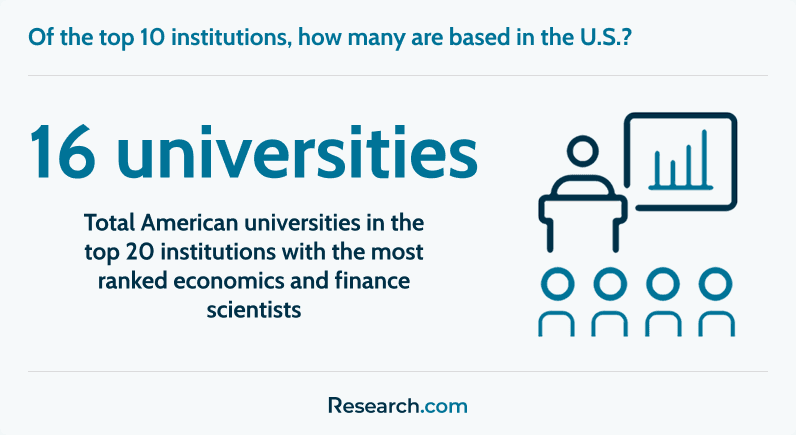
Among the top 20 institutions with the highest representation, 16 are U.S.-based universities. The rest include three from the United Kingdom including the London School of Economics and Political Science, the University of Oxford, and the University of Cambridge, and Bocconi University from France.
Accelerated Pathways to Expertise: Shaping the Next Generation of Economics and Finance Scholars
The growing availability of accelerated academic programs in fields like economics and finance is playing a pivotal role in advancing scholarly research. This is through fast-tracking the development of skilled researchers and professionals. These intensive programs equip students with essential analytical tools, data proficiency, and theoretical foundations in a condensed timeframe. As a result, it enables them to contribute to academic and policy-oriented research sooner.
As global economic challenges become increasingly complex, the demand for agile, well-trained scholars who can quickly engage in high-impact research is rising.
Connecting Minds Globally: How Online Universities Advance Research in Economics and Finance
Online universities have become powerful platforms for fostering collaboration among researchers and accelerating the advancement of knowledge in economics and finance. The Toulouse School of Economics, for instance, connects researchers from the private and public sector to produce high-level academic research. By leveraging digital tools and virtual learning environments, these institutions break down geographical barriers, allowing scholars from around the world to exchange ideas, share datasets, and co-author studies in real time.
Through partnerships, online universities offer access to global academic networks, interdisciplinary research forums, and cutting-edge resources that support both teaching and innovation. In economics and finance, where timely data analysis and collaborative insight are crucial for addressing fast-evolving global challenges, online universities are not only democratizing access to advanced education but also actively contributing to the depth and reach of academic research.
Boosting Research Excellence: The Impact of Certifications in Economics and Finance
Certifications in economics and finance add significant value by equipping researchers with specialized skills and practical knowledge that enhance the quality and credibility of their work. Programs such as CFA, FRM, or data analytics certifications provide rigorous training in quantitative analysis, risk management, and financial modeling—tools that are essential for producing robust, data-driven research.
These credentials also signal a high level of expertise and commitment to ethical standards, making certified scholars more effective in bridging academic research with real-world financial systems. For those looking to strengthen their research credentials while boosting career prospects, exploring quick certifications that pay well can be a strategic and impactful choice.
D-index ranking – leaders, averages, and distribution
Professor Joseph E. Stiglitz from Columbia University in the US leads the list of top scientists with a high D-index of 191.
For Europe, Jean Tirole from Federal University of Toulouse in France with a D-index of 150 tops the list and also secures the 6th spot in the world ranking.
Professor Muhammad Shahbaz from the Beijing Institute of Technology in China with an h-index of 133 tops the list of scientists from Asia and is ranked 14th.
For Oceania, Professor David A. Hensher from the University of Sydney in Australia tops the list of scientists with a D-index of 115 and a world ranking of 35.
Professor Rangan Gupta, a researcher from the University of Pretoria, leads the ranking in South Africa and is also ranked 194 in the world ranking.
Professor Benjamin Miranda Tabak from Brazilian Fundação Getulio Vargas is the highest-ranking scientist from South America with a world ranking of 882.
The average D-index for the top 1% of scientists is 157 against an average of 71 for all 2000 scientists included in the ranking.
The scholar with the lowest index value who made it to the ranking in 2025 has a D-index of 50.
The average number of published articles for the 1% of scientists in the ranking is 587 against an average of 276 for all 2000 scholars.
The average number of citations for the top 1% of scientists is 211,230 against an average of 40,746 for all 1000 scholars.
You can learn more about the methodology used to create the ranking here.
About Research.com
All research was coordinated by Imed Bouchrika, Ph.D., a computer scientist with a well-established record of collaboration on a number of international research projects with different partners from the academic community. His role was to make sure all data remained unbiased, accurate, and up-to-date.
Research.com is the number one research portal for science and educational rankings. Our mission is to make it easier for professors, research fellows, and students to progress with their research and find the top experts in a wide range of scientific disciplines. Research.com is also a leading educational platform that helps students find the best colleges, academic opportunities, and career paths.


