
World Online Ranking of Best Computer Scientists – 2025 Report

Co-Founder and Chief Data Scientist
On April 23, 2025, Research.com published the 11th edition of its annual rankings of the best computer scientists, aiming to enhance the online visibility of both established leaders and emerging experts in the field of computer science.
This report serves as a valuable resource for researchers, academic institutions, corporations, and other decision-makers seeking expertise in specific areas of computer science. By including each scientist’s country along with their academic and professional affiliations, the report also facilitates easier networking and collaboration across the global research community.
For the 2025 edition, the Research.com team led by Chief Data Scientist Imed Bouchrika, PhD., analyzed over 13,000 scientist profiles from various bibliometric databases. Selection was based on several metrics, including the D-index (Discipline H-index), with a threshold of 30 for most computer science publications. Additional criteria included the share of contributions within the field and notable awards or accomplishments.
Latest discoveries in computer science research
Recent advancements in computer science have led to significant breakthroughs across various domains. In artificial intelligence, researchers have developed an AI-powered tool called MELD Graph that detects subtle brain abnormalities often missed by radiologists. By analyzing global MRI data, this tool enhances the speed and accuracy of epilepsy diagnoses, potentially increasing access to surgical treatments and reducing healthcare costs.
Although not yet in clinical use, MELD Graph is already assisting doctors in identifying operable lesions, offering new hope to patients. Computer scientists play a major role in these advancements by designing the complex algorithms and machine learning models that power these diagnostic tools.
In the realm of quantum computing, tech giants like Google, Microsoft, and Amazon have unveiled new prototypes promising advancements in error correction and scalability. For instance, Google's Willow chip demonstrated its potential by solving a computational problem in just five minutes—a task that would take the most powerful supercomputers an impractical amount of time. Behind these innovations, computer scientists are instrumental in refining quantum algorithms, optimizing performance, and overcoming fundamental obstacles in hardware design.
What Impact Do Academic Rankings Have on Cybersecurity Education?
Academic rankings that highlight top scientists in computer science play a crucial role in shaping cybersecurity education by setting benchmarks for excellence and innovation. When leading researchers gain recognition for their contributions, such as developing advanced encryption methods or pioneering threat detection algorithms, their work often influences university curricula and research priorities. Students and institutions alike look to these experts for guidance on emerging trends and best practices. For affordable online cyber security degree programs in particular, these experts ensure that they remain cutting-edge and aligned with real-world challenges. Additionally, high-ranking scientists often attract funding and collaborative opportunities, further enhancing the quality of education and research in the field.
The key findings for the 11th edition of the best computer scientists ranking
- Computer scientists from the United States dominate this year's ranking report with 561 scientists representing 56.1% of all leading scientists. Following in the ranking are scientists from China (131 scientists or 13.1%), the United Kingdom (56 scientists or 5.6%), Germany (38 scientists each or 3.8%), and Canada (31 scientists 3.1%).
- Among the top 10 scientists, four are from the United States. Other scientists in the top 10 are from the U.K., Canada, Switzerland, Germany, and Spain.
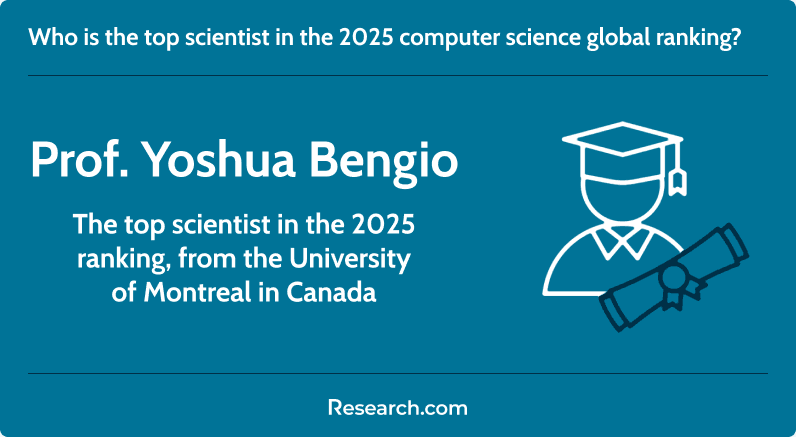
- The top position in the ranking in 2025 is awarded to Professor Yoshua Bengio from the University of Montreal in Canada, who has an H-index of 223.
- For the 2025 ranking, Stanford University and Carnegie Mellon University are the top research institutions hosting the highest number of leading computer scientists at 38 each.
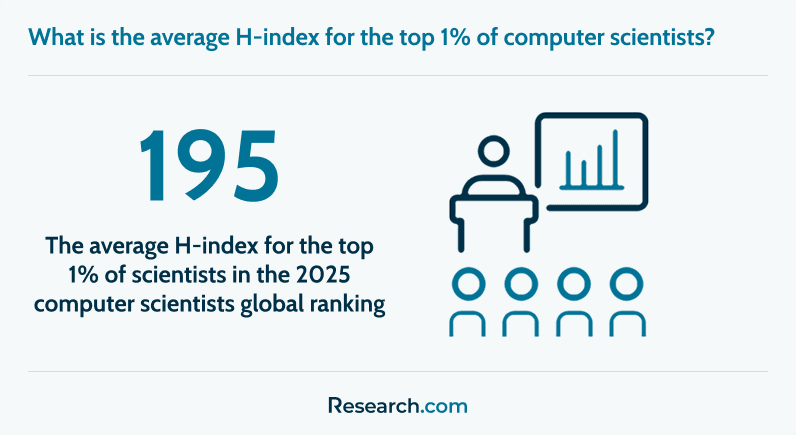
- The average H-index for the top 1% of scientists is 195 against an average of 99 for all 1,000 scientists included in the ranking.
The full ranking for the 2025 list of the best computer scientists can be found here:
WORLD'S BEST COMPUTER SCIENTISTS RANKING
Countries with the highest number of leading computer scientists
The United States continues to lead globally with the highest number of recognized computer scientists, totaling 561. However, this is 26 scientists less from its 2024 total.
China and the United Kingdom retained their second and third positions from the prior year, with China seeing notable growth—rising from 106 to 131 scientists. Germany added three more scientists reaching a total of 38, and secured the fourth spot this year. Canada moved down in the top 10 ranking to the 5th spot with 31 scientists, marking a decrease from its previous 35.
The rest of the top 10 countries remained unchanged overall, although their rankings shifted slightly with Australia climbing to the seventh place, and Singapore moving to spot 8. Belgium replaces France in the top 10, securing the 10th place with 11 scientists.
Within the top 1% of these scientists, institutional affiliations vary, including four based in the U.S., two in Germany, and one each in Canada, Switzerland, and Spain.
Please note that the country associated with a scientist is based on the affiliated research institution according to MAG, not on their actual nationality.
Institutions with the highest number of leading scientists
In the 2025 rankings, Carnegie Mellon University made it to the top position with 38 recognized computer scientists, tied with Stanford University, which was at the sole top position last year.
The Massachusetts Institute of Technology (MIT) holds steady in third place with 37 scientists, followed by the University of California-Berkeley, which has 32. Microsoft and Google maintained their fifth and sixth positions, respectively, although both saw a slight decline in their numbers—Microsoft by three scientists and Google by four.
For the 2025 ranking, it is notable that the top 10 institutions are American universities with two major tech companies which are also U.S.-based.
Among the top 20 institutions, 15 are based in the United States, while the remaining five include Tsinghua University and the Chinese University of Hong Kong from China, ETH Zurich and École Polytechnique Fédérale de Lausanne from Switzerland, and the University of Oxford from the U.K.
Strengthening research in online universities
Online collaboration among universities has significantly accelerated the advancement of computer science research by enabling seamless exchange of ideas, resources, and expertise across geographic boundaries. Through virtual labs, joint research projects, and shared data platforms, institutions can tackle complex problems more efficiently and drive innovation in areas like artificial intelligence, cybersecurity, and quantum computing.
For example, Stanford University and the Massachusetts Institute of Technology (MIT) are both known for their active involvement in collaborative research, often partnering with other universities and organizations worldwide. The MIT Computer Science and Artificial Intelligence Laboratory also collaborates with other research universities. These partnerships not only foster diverse perspectives but also enhance the impact and scalability of groundbreaking discoveries in the field.
These partnerships also encourage students in choosing online programs. In Georgia Tech online program, for instance, three out of four accepted applicants are choosing to enroll in the online option. Yale has seen a 42% increase in computer science graduates in 2024. Among chief online learning officers surveyed in the same year, 46% reported that their online programs were experiencing faster enrollment growth than their on-campus counterparts. This only shows that the accessibility of online universities are encouraging more students to pursue further studies and eventually engage in research as part of their discipline.
D-index ranking-leaders, averages, and distribution
For North America, Professor Yoshua Bengio of University of Montreal in Canada leads the list of best computer scientists in our 2025 report with a D-index of 223. Professor Bengio’s research focuses on artificial intelligence.
For Europe, Professor Andrew Zisserman of the University of Oxford in the United Kingdom ranks 3rd in the report with a D-index of 197. His research topics also revolve around AI.
For Oceania, Professor Rajkumar Buyya from the University of Melbourne, Australia is the leading scientists. He also placed 16th in the world with a D-index of 166.
Professor Dacheng Tao of Nanyang Technological University Singapore occupies the 18th spot in the world ranking and leads other Asian scientists with a D-index of 166.
For the Middle East and Central Asia, Professor Ian F. Akyildiz of the Technology Innovation Institute, United Arab Emirates leads the list of best computer scientists with a D-index of 141. Professor Akyildiz focuses on computer networks and is ranked 46th in the global list.
The average D-index for the top 1% of scientists is 195 against an average of 99 for all 1,000 scientists included in the ranking.
For 2025, the average number of published articles for the top 1% of scholars in the ranking is 1,192 against an average of 520 for all the scientists.
The average number of citations for the top 1% of scientists is 276,341 against an average of 58,848 for all the scholars in the ranking.
You can learn more about the methodology used to create this report here.
About Research.com
All research was coordinated by Imed Bouchrika, Ph.D., a computer scientist with a well-established record of collaboration on a number of international research projects with different partners from the academic community. His role was to make sure all data remained unbiased, accurate, and up-to-date.
Research.com is the number one research portal for science and educational rankings. Our mission is to make it easier for professors, research fellows, and students to progress with their research and find the top experts in a wide range of scientific disciplines. Research.com is also a leading educational platform that helps students find the best colleges, academic opportunities, and career paths.


