
World Online Ranking of Best Ecology & Evolution Scientists – 2024 Report

Co-Founder and Chief Data Scientist
Research.com released the 3rd edition of its best scientists in ecology and evolution ranking on April 19, 2024. The report is designed for researchers, students, university leaders, funding organizations, journalists, and policy teams that need a practical way to identify highly cited and influential scholars in ecology and evolution science.
This guide explains what the 2024 ranking shows, how to interpret the results, which countries and institutions are most represented, and what the data suggests about current research strength in the field. It also highlights major research trends, explains the role of education and research training, and points readers to the full scientist ranking for deeper exploration.
Quick answer: What does the 2024 ecology and evolution scientist ranking show?
The 2024 Research.com ranking identifies the top 1,000 scientists in ecology and evolution based on discipline-specific research impact indicators, including the D-index, publication record, citation count, awards, and the share of work connected to the field. The United States leads the ranking with 384 scientists, followed by the United Kingdom with 149, Australia with 82, Canada with 61, and Germany with 57.
At the individual level, Professor Peter B. Reich of the University of Minnesota ranks first globally with a D-index of 189. Professor Kevin J. Gaston of the University of Exeter ranks second globally with a D-index of 179.
The full 2024 ranking is available here: Best Ecology and Evolution Scientists Ranking.
What this ranking measures
The ranking focuses on scholars whose research has had substantial influence in ecology and evolution science. Research.com reviewed more than 7,000 scientist profiles from Google Scholar and Microsoft Academic Graph to prepare the 2024 edition.
Inclusion was based on several indicators, including discipline h-index, number of awards, and the proportion of a scholar’s contributions made within ecology and evolution science. The h-index threshold was set at 30 when most of a scientist’s publications were in ecology and evolution.
Readers should use the ranking as a research-discovery tool rather than a single measure of scientific value. Citation-based indicators are useful for identifying influence, but they do not capture every dimension of research quality, mentorship, fieldwork contribution, policy impact, local ecological expertise, or emerging scholarship.
Latest discoveries and research directions in ecology and evolution
Ecology and evolution research is increasingly centered on practical environmental questions: how ecosystems respond to climate change, how species adapt to new pressures, how biodiversity loss affects ecosystem function, and where conservation resources can have the greatest impact.
One major shift is the use of cross-field methods. Scientists are combining ecology, genetics, conservation biology, statistics, geospatial analysis, and data science to build stronger models of ecosystem change. This kind of work reflects the broader movement toward crossing disciplinary boundaries in conservation science.
Researchers are also paying closer attention to ecosystem resilience. Instead of only documenting damage after disturbance, more studies are trying to identify early-warning signals, thresholds, and tipping points. Work using advanced monitoring approaches and ecological modeling is helping scientists understand when ecosystems may recover and when they may shift into a less stable state.
| Research trend | Why it matters | Skills increasingly used |
| Climate-change impact modeling | Helps estimate how species, habitats, and ecological interactions may shift under changing conditions. | Ecological modeling, statistics, remote sensing, programming |
| Genomics and adaptation studies | Shows how populations respond biologically to environmental stress and habitat fragmentation. | Population genetics, bioinformatics, evolutionary theory |
| Ecosystem resilience research | Identifies whether ecosystems can recover after disturbance or may approach collapse thresholds. | Long-term monitoring, systems modeling, field ecology |
| Species distribution mapping | Guides conservation planning by showing where species may persist, move, or decline. | GIS, remote sensing, citizen science data, spatial analysis |
| Interdisciplinary conservation science | Connects ecological research with policy, economics, community planning, and land management. | Communication, decision science, stakeholder collaboration |
How education investment supports ecology and evolution research
Strong ecology and evolution research depends on more than individual talent. It requires training pipelines, field experience, quantitative skills, research funding, data infrastructure, and access to mentors. When universities and governments invest in education, they expand the number of researchers who can work across disciplines and respond to complex environmental problems.
Affordable and flexible education also matters because many future researchers enter the field from different academic and professional backgrounds. While not every online or low-cost program is research-focused, broader access to postsecondary learning can help students build foundational skills before moving into ecology, biology, environmental science, data science, or public health-related research areas. Research.com also maintains affordability-focused resources across fields, including its guide to medical billing and coding online courses cost, which reflects the wider demand for cost-conscious education planning.
How early-career ecology and evolution scientists can become more competitive
New researchers can improve their competitiveness by building both scientific depth and methodological range. Ecology and evolution increasingly reward scholars who can combine field knowledge with quantitative analysis, reproducible research practices, and cross-institutional collaboration.
- Develop a strong research identity. Choose a focused problem area, such as biodiversity loss, invasive species, climate adaptation, ecosystem services, or evolutionary genomics.
- Build quantitative fluency. Skills in statistics, programming, modeling, GIS, and data visualization are now valuable across many ecology and evolution subfields.
- Join collaborative networks. Multi-site and interdisciplinary projects can increase research visibility and improve access to datasets, mentors, and funding opportunities.
- Publish carefully, not just frequently. Strong methods, transparent data practices, and clear contribution statements matter for long-term credibility.
- Choose doctoral training strategically. Students comparing doctoral routes should evaluate advisor fit, funding, field resources, publication expectations, and completion requirements. Research.com’s guide to the easiest doctoral degree can help readers understand how doctoral program structure varies, although research quality and advisor alignment should remain central in ecology and evolution.
Key findings from the 3rd edition of the best ecology and evolution scientists ranking
- The United States ranks first by number of included ecology and evolution scientists, with 384 scholars in 2024. That represents 38.4% of the full ranking.
- The rest of the top five countries are the United Kingdom with 149 scientists, Australia with 82, Canada with 61, and Germany with 57.
- Stanford University has the highest number of included ecology and evolution scientists, with 14 scholars in the top 1,000.
- The first and second positions in the global ranking are held by Peter B. Reich of the University of Minnesota and Kevin J. Gaston of the University of Exeter.
- The 2024 top 10 includes scientists affiliated with institutions in the US, UK, Saudi Arabia, Germany, France, and Spain.
- The top 1% of ranked scientists have an average of 134,377.1 citations, while the full group of 1,000 scientists has an average of 35,386.45 citations.
- The average D-index is 164.5 for the top 1% and 86.58 for all 1,000 ranked scientists.
| Category | 2024 result |
| Country with the most ranked scientists | United States, with 384 scientists |
| Share of ranking represented by the United States | 38.4% |
| Top institution by number of ranked scientists | Stanford University, with 14 scholars |
| World rank #1 | Peter B. Reich, University of Minnesota |
| World rank #2 | Kevin J. Gaston, University of Exeter |
| Average citations for the top 1% | 134,377.1 |
| Average citations for all 1,000 ranked scientists | 35,386.45 |
| Average D-index for the top 1% | 164.5 |
| Average D-index for all 1,000 ranked scientists | 86.58 |
Readers can explore the complete list here: 2024 best ecology and evolution scientists ranking.
Countries with the highest number of leading ecology and evolution scientists
The top 10 countries from the previous year all remained in the 2024 ranking, although Spain, the Netherlands, and Switzerland changed positions. Spain moved from 7th in 2023 to 9th in 2024. The Netherlands and Switzerland each rose one position, reaching 7th and 8th, respectively.
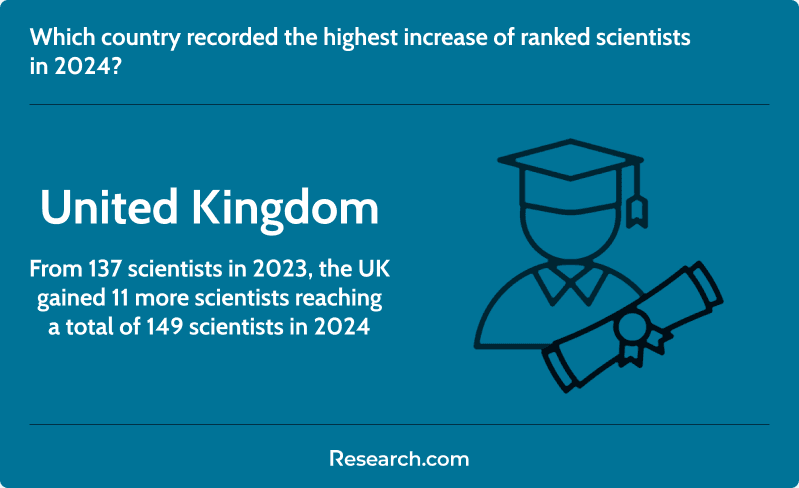
The United States remains the leading country in the 2024 report with 384 scientists, compared with 386 in 2023. The United Kingdom ranks second with 149 scientists after adding 11 more ranked scholars in 2024.
Australia remains third with 82 scientists, down from 89 in 2023. Canada is fourth with 61 scientists, followed by Germany with 57, France with 33, and Spain with 21.
The rest of the top 10 consists of the Netherlands with 32 scientists, Switzerland with 26, and Sweden with 20.
Among the top 1% of ranked scientists, five out of 10 are affiliated with research universities in the United States. Two are affiliated with institutions in Germany, and one each is affiliated with an institution in Saudi Arabia, France, and Spain.
The country listed for each scientist reflects the affiliated research institution recorded according to MAG. It does not necessarily represent the scientist’s nationality.
| Rank group | Country | Number of scientists in 2024 |
| 1 | United States | 384 |
| 2 | United Kingdom | 149 |
| 3 | Australia | 82 |
| 4 | Canada | 61 |
| 5 | Germany | 57 |
| Top 10 member | France | 33 |
| Top 10 member | Netherlands | 32 |
| Top 10 member | Switzerland | 26 |
| Top 10 member | Spain | 21 |
| Top 10 member | Sweden | 20 |
Institutions with the highest number of leading scientists
Stanford University leads the 2024 institutional list, followed by the University of British Columbia. James Cook University ranks third, the University of Oxford fourth, the University of California-Davis fifth, and Duke University sixth. Each of these institutions has 14 scientists included in the top 1,000.
The Spanish National Research Council, which held the top position in 2023, moved to 8th in the 2024 ranking. Stanford University rose to first place, while the University of British Columbia moved from 4th to 2nd.
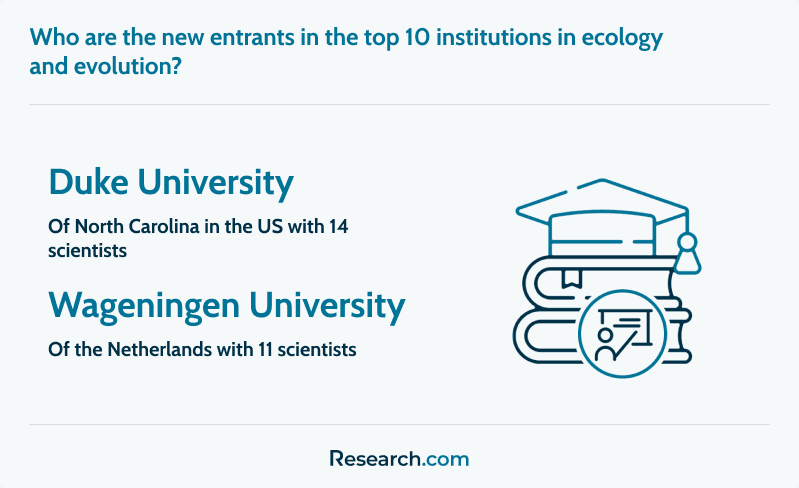
Two institutions entered the 2024 top 10: Duke University in the United States, ranked 6th, and Wageningen University & Research in the Netherlands, ranked 10th. They replaced the University of California-Berkeley and the University of Queensland.
Among the top 20 institutions in 2024, ten are located in the US and five are located in the UK. The remaining five are from Canada, Spain, the Netherlands, Australia, and Denmark: the University of British Columbia, Spanish National Research Council, Wageningen University & Research, University of Queensland, and University of Copenhagen.
How to interpret institutional strength in ecology and evolution
A high institutional count can signal a strong research ecosystem, but it should not be the only factor students or collaborators consider. Ecology and evolution research often depends on the match between a scholar’s interests and a lab’s methods, field sites, funding, datasets, and mentorship culture.
| If you are... | Use the ranking to... | Also check... |
| A prospective graduate student | Identify universities with many influential researchers in ecology and evolution. | Advisor availability, funding package, lab culture, field opportunities, publication expectations |
| A researcher seeking collaborators | Find scholars with strong publication and citation records in related subfields. | Recent papers, methods used, data-sharing practices, grant history, interdisciplinary fit |
| A university leader | Benchmark institutional visibility in ecology and evolution science. | Hiring strategy, research infrastructure, early-career support, international partnerships |
| A journalist or policy analyst | Locate recognized experts for commentary on environmental and biodiversity issues. | Current relevance, regional expertise, conflicts of interest, communication experience |
Can accredited online PhD programs contribute to research quality?
Online doctoral programs can support research development when they are accredited, well supervised, and designed around rigorous methods, active mentorship, and credible dissertation expectations. For ecology and evolution, however, students should be especially careful: many research questions require fieldwork, lab access, computational infrastructure, or close collaboration with established research groups.
Prospective doctoral students should confirm whether a program offers the research environment they need, not just a convenient format. A flexible online structure may be useful for some working professionals, data-focused researchers, or interdisciplinary scholars, but it is not automatically equivalent to a field-intensive residential ecology program. Readers comparing program length and structure can review Research.com’s guide to accredited online PhD programs.
How online college applications can widen the research pipeline
Digital admissions systems can make higher education more accessible to students who cannot easily relocate, visit campuses, or navigate traditional paper-based processes. In research fields such as ecology and evolution, a broader applicant pool can bring more geographic, socioeconomic, and disciplinary diversity into undergraduate and graduate training.
Students considering online or hybrid pathways should still verify admissions requirements, transfer-credit rules, technology expectations, tuition, and whether the program provides a realistic path toward their research goals. Research.com’s guide on what do I need to apply to online colleges explains common application materials and enrollment steps.
Strengthening ecology and evolution research through online collaboration
Online platforms are changing how research teams communicate, manage data, and collaborate across institutions. Even when ecology and evolution research depends on physical field sites or lab work, digital infrastructure can make large-scale collaboration faster and more transparent.
Shared repositories, virtual meetings, cloud-based analysis tools, and standardized protocols allow researchers in different regions to work on common questions. These systems are especially important for climate-change studies, biodiversity monitoring, invasive species tracking, and long-term ecosystem observation.
One major example is the National Ecological Observatory Network (NEON). NEON gathers standardized ecological data from field sites across diverse ecosystems in the United States and makes those data available through an online portal. Researchers can use the shared dataset to study issues such as climate impacts, invasive species, and ecosystem dynamics at a scale that would be difficult for a single lab to achieve alone.
How affordable graduate education can support ecology and evolution research
Cost is a serious factor for students who want to enter research careers. Master’s programs can help students gain quantitative, field, and interdisciplinary skills before applying to doctoral programs or research jobs. Lower-cost options may reduce financial pressure, but students should compare more than tuition.
A useful master’s program for ecology and evolution should offer relevant coursework, faculty expertise, research opportunities, statistical or computational training, and pathways into doctoral study or applied environmental work. Students comparing affordable options can start with Research.com’s guide to a low cost masters degree online.
How financial support can expand participation in ecology and evolution research
Financial aid, assistantships, fellowships, and affordable tuition can influence who is able to pursue research training. When students face fewer cost barriers, they may be more able to join field projects, accept lower-paid research assistant roles, attend conferences, and continue into graduate study.
Students should look beyond advertised tuition and ask whether a program offers research assistantships, teaching assistantships, travel support, field-course funding, equipment access, and fee transparency. For readers reviewing affordability and aid eligibility across online institutions, Research.com provides a guide to online colleges that accept FAFSA in Texas.
How affordable bachelor’s programs can help students start research earlier
Undergraduate education is where many future ecology and evolution researchers first learn scientific writing, statistics, experimental design, natural history, and data analysis. Affordable bachelor’s programs can make that starting point more accessible, especially for students who need flexible scheduling or lower-cost entry into higher education.
Students interested in research should prioritize programs that include biology, ecology, evolution, chemistry, math, statistics, field methods, and opportunities to work with faculty. A low price alone is not enough. Students can compare affordability-focused options through Research.com’s guide to the cheapest online bachelor degree.
D-index leaders, regional standouts, averages, and distribution
Professor Peter B. Reich of the University of Minnesota is the top-ranked scientist in North America and the global leader in the 2024 ranking. His D-index is 189.
In Europe, Professor Kevin J. Gaston of the University of Exeter in the United Kingdom ranks first regionally and second worldwide. His D-index is 179.
Professor Carlos M. Duarte of King Abdullah University of Science and Technology in Saudi Arabia is the leading scientist in the Middle East. He has a D-index of 162 and ranks 5th overall this year.
Professor Hugh P. Possingham of the University of Queensland in Australia leads Oceania. His D-index is 150, and he ranks 16th globally.
Professor David M. Richardson of Stellenbosch University in South Africa is the highest-ranked scientist in Africa. He has a D-index of 137 and ranks 26th in 2024.
Professor Shilong Piao of Peking University in China leads Asia. His D-index is 134, and he ranks 32nd worldwide.
Professor S. Joseph Wright of the Smithsonian Tropical Research Institute in Panama leads Central America. His D-index is 115, and he ranks 78th in the 2024 report.
The average D-index for the top 1% of ranked scientists is 164.5, compared with 86.58 for all 1,000 scientists included this year.
The scientist with the lowest index value who made it to the ranking in 2023 has an H-index of 69.
The top 1% of scientists in the ranking have an average of 768 published articles, compared with 319.63 for the full set of 1,000 scholars.
The average citation count is 134,377.1 for the top 1% and 35,386.45 for all 1,000 ranked scholars.
| Region | Leading scientist | Affiliation | D-index | World rank |
| North America | Peter B. Reich | University of Minnesota | 189 | 1st |
| Europe | Kevin J. Gaston | University of Exeter | 179 | 2nd |
| Middle East | Carlos M. Duarte | King Abdullah University of Science and Technology | 162 | 5th |
| Oceania | Hugh P. Possingham | University of Queensland | 150 | 16th |
| Africa | David M. Richardson | Stellenbosch University | 137 | 26th |
| Asia | Shilong Piao | Peking University | 134 | 32nd |
| Central America | S. Joseph Wright | Smithsonian Tropical Research Institute | 115 | 78th |
Common mistakes when using scientist rankings
- Assuming rankings measure every kind of impact. Citation and D-index indicators are helpful, but they may not fully reflect mentoring, field leadership, policy influence, conservation outcomes, or community-based research.
- Choosing a graduate advisor only by rank. Advisor fit, funding, research topic, lab culture, and publication support are often more important for student success than a scholar’s position on a ranking.
- Ignoring subfield differences. Citation patterns vary across ecology, evolution, conservation biology, genetics, modeling, and field-based research areas.
- Comparing institutions without context. A university with many ranked scientists may be strong overall, but a smaller institution may be better for a specific research niche.
- Overlooking early-career researchers. Rankings based on accumulated publication and citation impact may favor established scholars and may not fully capture rising researchers.
- Confusing affiliation country with nationality. In this report, the country reflects the affiliated institution according to MAG, not the scientist’s citizenship or origin.
Questions to ask before using the ranking for a decision
| Decision | Questions to ask |
| Choosing a graduate program | Does the institution have faculty working on my exact research interest? Is funding available? What field, lab, or data resources can students access? |
| Finding a collaborator | Has the scientist published recently in my topic area? Do their methods complement mine? Are they active in collaborative projects? |
| Identifying an expert source | Is the scholar’s recent work relevant to the question being covered? Do they have expertise in the region, species, or policy issue involved? |
| Benchmarking an institution | How many ranked scholars are active in the department? Are there early-career hires, research centers, grants, and doctoral training capacity? |
| Evaluating research influence | Are citation indicators supported by high-quality publications, reproducible methods, strong datasets, and visible contribution to the field? |
Methodology note
You can learn more about the methodology used to create this report here.
About Research.com
All research was coordinated by Imed Bouchrika, Ph.D., a computer scientist with an established record of participation in international research collaborations across the academic community. His role was to help ensure that the data remained unbiased, accurate, and current.
Research.com is a research and education portal focused on science rankings, academic discovery, and higher education guidance. Its mission is to help professors, research fellows, and students identify leading experts across scientific disciplines while also supporting students as they compare colleges, academic options, and career pathways.
Key insights
- The 2024 ecology and evolution ranking is most useful as a discovery tool for identifying influential scientists, institutions, and national research strengths.
- The United States leads the report with 384 scientists, representing 38.4% of the ranking.
- Peter B. Reich ranks first globally with a D-index of 189, followed by Kevin J. Gaston with a D-index of 179.
- Stanford University has the largest number of ranked ecology and evolution scientists, with 14 scholars in the top 1,000.
- Ecology and evolution research is becoming more interdisciplinary, with growing use of genetics, ecological modeling, remote sensing, citizen science, and data science.
- Students should not choose programs or advisors based on rankings alone. Research fit, funding, mentorship, field access, and methodological training are essential decision factors.
- Citation-based indicators are valuable but incomplete. They should be interpreted alongside recent publications, collaboration activity, field relevance, and real-world research contribution.


