
2027 World Online Ranking of Best Computer Scientists – Report

Co-Founder and Chief Data Scientist
Research.com’s 10th edition of the best computer scientist rankings, released on April 16, 2024, helps readers identify highly cited and influential computer science researchers across countries, universities, companies, and research specialties. For students, faculty members, research administrators, employers, and funding decision-makers, the ranking is useful because it connects bibliometric performance with real-world questions: Which institutions have the strongest computer science research presence? Which countries are producing or hosting leading scholars? Which experts are shaping fields such as artificial intelligence, computer networks, medical AI, and distributed systems?
This guide explains the 2024 ranking results, how Research.com evaluated more than 12,000 scientist profiles from various bibliometric sources, what the leading country and institution patterns show, and how readers can use the ranking when choosing collaborators, graduate programs, research directions, or education pathways.
Quick answer: What does the 2024 best computer scientists ranking show?
The 2024 Research.com ranking shows that the United States continues to host the largest number of leading computer scientists, with 587 scientists representing 58.7% of all ranked scholars. China follows with 106 scientists or 10.6%, while the United Kingdom has 56 scientists or 5.6%. The no. 1 position in the ranking in 2024 is awarded to Yoshua Bengio from University of Montreal in Canada, who has an h-index of 208. Stanford University is the institution with the highest number of leading computer scientists, with as many as 40.
The ranking is based on indicators including the D-index, also called the Discipline H-index, the share of a scholar’s work within computer science, and recognized awards and achievements. For most computer science papers, the D-index threshold was set at 30.
What the Research.com computer scientist ranking measures
The annual ranking is designed to make influential computer science researchers easier to discover. It can support academic networking, faculty benchmarking, graduate school research planning, institutional strategy, and industry recruiting for specialized expertise.
For the 2024 edition, the Research.com team reviewed more than 12,000 scientist profiles from various bibliometric sources. The work was led by chief data scientist Imed Bouchrika, PhD, and included analysis of multiple indices and eligibility criteria before scholars were selected for the final list.
The main inclusion criteria include the discipline-specific D-index, the proportion of a researcher’s contributions that fall within computer science, and the scientist’s awards and professional achievements. This approach is intended to highlight researchers whose publication and citation impact is meaningfully tied to the computer science discipline rather than to unrelated fields.
| Ranking element | What it helps measure | Why it matters to readers |
| D-index, or Discipline H-index | Research impact within computer science | Helps distinguish discipline-specific influence from general citation volume |
| Contribution share in the discipline | How much of a scholar’s work belongs to computer science | Reduces the risk of ranking researchers mainly for work outside the field |
| Awards and achievements | Recognition by the scientific and professional community | Adds context beyond citation counts alone |
| Institutional affiliation | Where the researcher is currently associated according to the ranking data | Helps students, universities, companies, and collaborators identify research hubs |
Latest developments shaping computer science research
Computer science research is increasingly connected to urgent problems in healthcare, security, education, and scientific discovery. One important area is medical decision-support software, including software that can analyze medical data to help clinicians detect illness. These systems are trained on large collections of patient records, images, and diagnostic information so they can recognize patterns that may be difficult to spot during routine review.
Another active research area is explainable or interpretable artificial intelligence. In medicine, an AI result is more useful when clinicians can understand why a model made a prediction. Recent work on interpretable AI models for cancer risk prediction includes models such as AsymMirai, which analyzes mammograms and estimates a woman’s risk of developing breast cancer within the next five years. By emphasizing factors such as breast tissue asymmetry, these tools aim to make AI-supported predictions clearer and more clinically usable.
These developments explain why rankings of computer scientists are not just reputation lists. They help readers locate researchers and institutions working on problems with direct social, scientific, and industry relevance.
How rankings can shape cybersecurity education decisions
Academic rankings can help students and institutions understand where cybersecurity-related research strength is concentrated. Strong computer science departments often influence curriculum design, lab investment, faculty hiring, and partnerships with employers or public-sector security organizations.
For prospective students, ranking data should not be the only factor in choosing a program. However, it can help identify schools with active research communities in areas such as network security, cryptography, secure software engineering, artificial intelligence security, and privacy. Students who need flexible or lower-cost study options can compare research reputation with practical program factors such as tuition, accreditation, transfer credit, and course delivery. A related starting point is Research.com’s guide to an affordable online cyber security degree.
| If you are evaluating cybersecurity programs | Use ranking data to check | Also verify before enrolling |
| Undergraduate students | Whether the school has visible computer science and security expertise | Accreditation, core programming courses, internship access, and total cost |
| Master’s students | Whether faculty publish in relevant cybersecurity or systems areas | Prerequisites, capstone or thesis options, employer recognition, and schedule fit |
| Doctoral applicants | Whether potential advisors have strong research records in the intended specialty | Funding, advisor availability, lab culture, publication expectations, and placement history |
| Working professionals | Whether the institution is connected to current security research and industry needs | Course flexibility, applied projects, certification alignment, and opportunity cost |
Key findings from the 10th edition of the best computer scientists ranking
- Computer scientists from the United States account for the largest share of the 2024 ranking, with 587 scientists representing 58.7% of all leading scientists.
- China ranks next with 106 scientists or 10.6%, followed by the United Kingdom with 56 scientists or 5.6%.
- Canada and Germany each have 35 scientists or 3.5%, while Switzerland has 30 scientists or 3.0%.
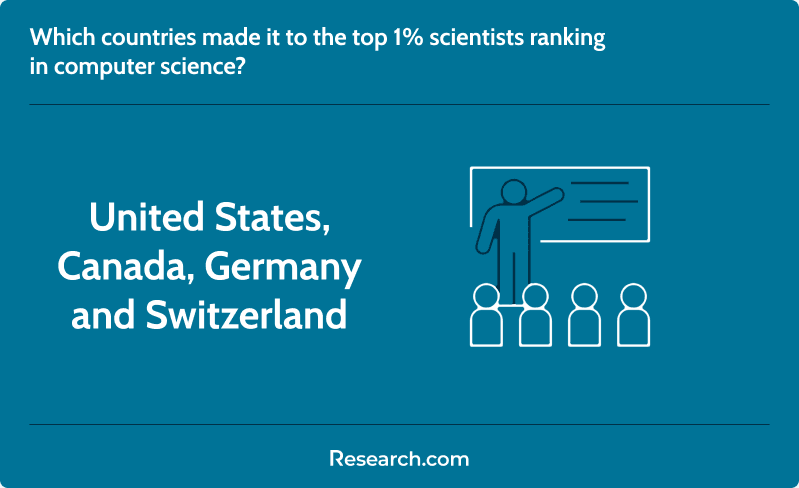
- Five of the top 10 scientists are affiliated with institutions in the United States. The remaining top 10 scientists are from Canada, Germany, and Switzerland.
- The no. 1 position in the ranking in 2024 is awarded to Yoshua Bengio from University of Montreal in Canada, who has an h-index of 208.
- Stanford University hosts the highest number of leading computer scientists in this edition, with as many as 40.
- The average H-index for the top 1% of scientists is 184 against an average of 94 for all 1,000 scientists included in the ranking.
The complete 2024 ranking is available here:
View the world’s best computer scientists ranking
Countries with the highest number of leading computer scientists
The United States remains the leading country by number of ranked computer scientists, with 587 scholars included in the 2024 list. This is four more scientists than in the previous edition.
China and the United Kingdom keep the second and third positions, with 106 and 56 scientists, respectively. China’s total increased from 92 in the previous year to 106 in the 2024 edition, adding 14 more scientists.
Within the top 1% of scientists, institutional affiliations are more distributed: 6 researchers are affiliated with institutions in the United States, 2 scientists are affiliated with German universities, and one each is affiliated with institutions in Canada and Switzerland.
The same countries remain in the top 10 compared with the prior edition, but their order changed. Canada moved up to spot 4, while Germany took the 5th spot. Australia moved to the 8th spot, and Israel moved down to rank 9.
The country assigned to a scientist is based on the affiliated research institution according to MAG. It does not necessarily represent the scientist’s nationality.
| Country | Number of leading scientists | Share of all leading scientists | What changed or stands out |
| United States | 587 | 58.7% | Maintains the top position and added four more scientists to the list |
| China | 106 | 10.6% | Remains in second place after increasing from 92 in the previous year |
| United Kingdom | 56 | 5.6% | Continues to hold third place |
| Canada | 35 | 3.5% | Moved up to spot 4 |
| Germany | 35 | 3.5% | Ranked in the 5th spot this year |
| Switzerland | 30 | 3.0% | Has one scientist among the top 1% affiliations |
Institutions with the highest number of leading scientists
Stanford University leads the 2024 institutional list with 40 ranked computer scientists. Carnegie Mellon University follows with 37 scientists, and MIT also has 37 scientists.
The top 10 institutions are still largely U.S.-based. The list also includes ETH Zurich as a major research university outside the United States, along with Google and Microsoft as private-sector research employers.
Among the 20 leading institutions, 17 are U.S.-based universities and companies. Two are in Switzerland: ETH Zurich and École Polytechnique Fédérale de Lausanne. One is in the United Kingdom, the University of Oxford, and one is based in China, Tsinghua University.
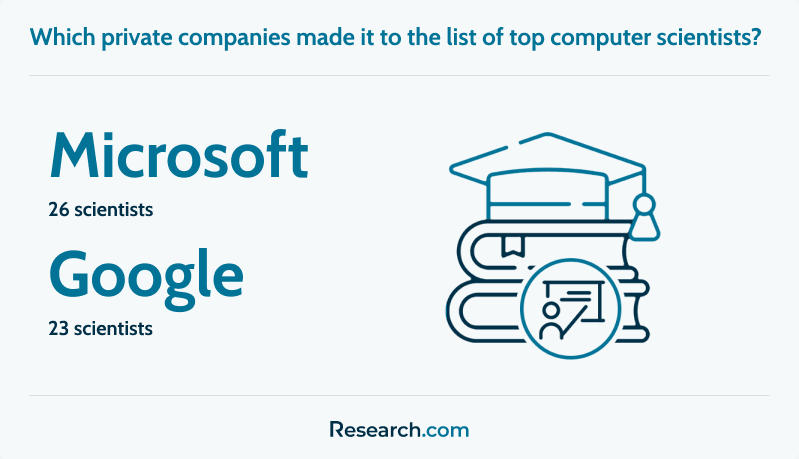
Private-sector research remains highly visible in computer science. Outside universities, Google and Microsoft employ the largest numbers of ranked scientists in this report, with Microsoft at 26 scientists and Google at 23.
| Institution or employer | Number of ranked scientists mentioned in the report | Reader takeaway |
| Stanford University | 40 | Hosts the highest number of leading computer scientists in the 2024 edition |
| Carnegie Mellon University | 37 | Remains one of the most visible computer science research institutions |
| MIT | 37 | Matches Carnegie Mellon University in number of ranked scientists |
| Microsoft | 26 | Shows the strength of industrial computer science research |
| 23 | Also has a major presence among ranked computer scientists |
How computer scientist rankings can help students assess online doctoral programs
Doctoral applicants should look closely at faculty expertise before choosing a program, especially in computer science fields where advisor fit can shape dissertation direction, publication opportunities, and long-term career outcomes. Rankings can help identify institutions and scholars with strong research influence, but applicants still need to examine whether the program’s format, mentoring structure, funding model, and research expectations match their goals.
Students comparing online or accelerated doctoral pathways should be especially careful. A short timeline can be attractive, but program quality depends on accreditation, faculty access, research support, dissertation requirements, and whether the credential is accepted in the student’s intended career setting. Readers exploring faster doctoral formats can compare options in Research.com’s guide to one year doctoral programs online.
How one year online master programs can use ranking signals for career planning
Professionals considering a one-year master’s program often want a faster route to new technical roles, leadership opportunities, or graduate-level specialization. Computer scientist rankings can help these learners identify institutions with research depth in areas such as artificial intelligence, data systems, cybersecurity, software engineering, or human-computer interaction.
Ranking visibility, however, should be treated as one input rather than a final decision rule. A practical program choice should also consider curriculum relevance, employer alignment, faculty availability, schedule intensity, total cost, and whether the program offers applied projects or research opportunities. Professionals comparing accelerated options can review Research.com’s resource on one year online master programs.
How online universities can support computer science research
Online education has changed how researchers, graduate students, and faculty members collaborate. Instead of relying only on local networks, online universities and digitally connected programs can connect researchers all over the world, creating more opportunities for cross-border projects, interdisciplinary teams, and broader participation in scientific work.
Remote collaboration also affects how computer science research is conducted. Flexible schedules, shared digital workspaces, and remote access to computing resources can allow researchers in different time zones to contribute to the same project without being physically located in the same laboratory.
Online platforms can also make it easier to exchange datasets, review findings, and coordinate technical work in real time. When used well, this type of collaboration can help push the boundaries of computer science research by allowing teams to work more continuously and draw from wider expertise.
How rankings affect academic and career choices
Computer scientist rankings can influence decisions at several levels. Universities may use them to evaluate research strengths, identify hiring priorities, and benchmark departments against peer institutions. Students may use them to find strong research environments, potential advisors, or graduate programs connected to their area of interest. Employers and research organizations may use them to identify experts for collaboration, consulting, or technical leadership.
For students, the key is to connect ranking information to personal goals. A highly ranked research institution may be ideal for a student pursuing a PhD in artificial intelligence, but a different student may need affordability, flexible scheduling, or an applied degree that supports employment more directly. Readers who are comparing practical undergraduate options can also explore Research.com’s guide to the easiest bachelor degree, while keeping in mind that “easy” should never replace accreditation, learning quality, and career relevance.
How mature learners can use computer scientist rankings when choosing online education
Adult and returning students often evaluate programs differently from traditional full-time students. They may need flexible pacing, asynchronous coursework, career-relevant projects, transfer credit, or programs that recognize prior learning and professional experience. Computer scientist rankings can help mature learners identify schools with active faculty research, but they should also compare student support, advising, technology requirements, and workload expectations.
Ranked institutions may offer strong research environments, but the best option for a mature learner is the one that fits both academic goals and life constraints. Students balancing work, family, and education can review Research.com’s guide to the best degrees for older adults to compare online pathways designed for nontraditional learners.
How computer scientist rankings can inform research funding and policy
Funding agencies, universities, and policy makers can use ranking data to identify areas of research strength and institutions with demonstrated scholarly impact. These insights may inform grant priorities, national research strategies, interdisciplinary partnerships, and investments in high-demand technical fields.
Rankings should not replace peer review or strategic evaluation, but they can provide a useful signal when combined with project quality, societal need, workforce demand, and institutional capacity. Education affordability is also part of the broader policy conversation, especially when institutions aim to expand access to technical degrees. Students comparing lower-cost options can review Research.com’s list of the cheapest online colleges that accept FAFSA.
D-index leaders, averages, and distribution
Across regions, the 2024 ranking highlights several leading scholars with high D-index scores and strong global visibility in computer science.
- For North America, Professor Yoshua Bengio of University of Montreal in Canada leads the list of best computer scientists in the 2024 report with a D-index of 203. His profile in the report also notes an h-index of 208.
- For Europe, Professor Francisco Herrera of the University of Granada in Spain ranks 11th in the report with a D-index of 168. His research topics also revolve around AI.
- For Oceania, Professor Rajkumar Buyya from the University of Melbourne, Australia placed 16th in the world with a D-index of 159.
- Professor Dacheng Tao of Nanyang Technological University Singapore occupies the 24th spot in the world ranking and leads other Asian scientists with a D-index of 150.
- For the Middle East and Central Asia, Professor Ian F. Akyildiz of the Technology Innovation Institute, United Arab Emirates leads the list of best computer scientists with a D-index of 135. Professor Akyildiz focuses on computer networks.
The average D-index for the top 1% of scientists is 184 against an average of 94 for all 1,000 scientists included in the ranking.
For 2024, the average number of published articles for the top 1% of scholars in the ranking is 1,227.9 against an average of 520.22 for all the scientists.
The average number of citations for the top 1% of scientists is 235,336.9 against an average of 53,484.36 for all the scholars in the ranking.
| Metric | Top 1% of scientists | All 1,000 ranked scientists |
| Average D-index | 184 | 94 |
| Average number of published articles | 1,227.9 | 520.22 |
| Average number of citations | 235,336.9 | 53,484.36 |
You can read more about the ranking process on Research.com’s methodology page.
How to use the ranking without overreading it
A ranking can be a strong starting point, but it should not be treated as the only measure of quality. Citation-based indicators tend to favor established scholars, widely cited fields, and institutions with long research histories. They may not fully capture teaching quality, student support, early-career researchers, emerging subfields, applied industry impact, or program affordability.
| Decision you are making | How the ranking helps | What else to check |
| Choosing a graduate program | Identifies institutions and faculty with strong research visibility | Advisor fit, funding, course availability, placement outcomes, and accreditation |
| Selecting a research collaborator | Highlights scholars with strong publication and citation records | Recent work, availability, methodological fit, and collaboration history |
| Benchmarking a department | Shows how many leading scientists are affiliated with an institution | Faculty size, research funding, student outcomes, and strategic priorities |
| Choosing an online program | Signals whether the institution has visible research strength | Online support, tuition, transfer policy, schedule, technology requirements, and career services |
Common mistakes when using computer scientist rankings
- Assuming a ranking measures teaching quality. A strong research profile does not automatically mean every course, online program, or student service is strong.
- Choosing a school only because it appears in a ranking. Program fit, cost, accreditation, admissions requirements, and career goals should still drive the final decision.
- Ignoring the difference between affiliation and nationality. In this ranking, a scientist’s country is based on the affiliated research institution according to MAG, not the person’s actual nationality.
- Overlooking subfield fit. A university may be strong in artificial intelligence but less relevant for a student interested in cybersecurity, graphics, software engineering, or computer networks.
- Assuming online and campus programs offer the same research access. Students should ask whether online learners can work with faculty, join labs, complete research projects, or access the same academic resources.
- Relying only on citation metrics. Citations are useful, but they do not capture every form of innovation, mentorship, industry contribution, or educational value.
Questions to ask before using a ranking to choose a program or collaborator
- Does the institution have ranked scholars in the exact computer science area I want to study or research?
- Are those faculty members currently accepting students, collaborators, or research partners?
- Does the program offer the format I need, such as full-time, part-time, online, hybrid, or accelerated study?
- What evidence does the school provide about graduation outcomes, research placements, internships, or employer partnerships?
- How much will the program cost after scholarships, employer support, transfer credits, and financial aid are considered?
- Is the institution properly accredited, and will the credential be recognized for my intended academic or professional path?
- Does the program support my level of preparation, especially if I am changing careers or returning to school after time away?
Key insights
- The 2024 Research.com best computer scientist ranking reviewed more than 12,000 scientist profiles and uses indicators such as the D-index, discipline contribution share, and awards or achievements.
- The United States leads the ranking with 587 scientists representing 58.7% of all leading scientists, followed by China with 106 scientists or 10.6% and the United Kingdom with 56 scientists or 5.6%.
- Yoshua Bengio from University of Montreal holds the no. 1 position in the 2024 ranking and has an h-index of 208.
- Stanford University has the highest number of leading computer scientists in the report, with as many as 40.
- Private-sector research is a major part of computer science excellence, with Microsoft employing 26 ranked scientists and Google employing 23.
- Students should use rankings as a research-quality signal, not as a complete program-selection tool. Accreditation, cost, faculty access, curriculum fit, and career support still matter.
- For graduate and online learners, the best use of a ranking is to identify strong research environments and then verify whether the program format, advisor availability, and student support match personal goals.
About Research.com
All research was coordinated by Imed Bouchrika, Ph.D., a computer scientist with a well-established record of collaboration on a number of international research projects with different partners from the academic community. His role was to help ensure that the data used for the ranking remained unbiased, accurate, and up-to-date.
Research.com is a research portal for science and educational rankings. Its mission is to help professors, research fellows, and students advance their research and identify leading experts across scientific disciplines. Research.com also supports students as they compare colleges, academic options, and career paths.


