
World Online Ranking of Best Political Scientists – 2025 Report

Co-Founder and Chief Data Scientist
On May 5, 2025, Research.com released its the fourth edition of the world online ranking of the best political scientists. This yearly report highlights the top minds in political science across the globe. Its primary purpose is to give these experts the recognition they deserve, guide the academic community in finding top research partners, and bring greater attention to the contributions of political scientists worldwide.
We share this ranking to help students, educators, and institutions better understand where the top research is happening. It offers a way to see what leading political scientists are working on and where they are based. This report also supports global collaboration by making it easier to connect with experts across universities and research organizations. For teachers, students, and policymakers alike, this list provides a helpful tool to explore active fields of political research and their key contributors.
The 2025 edition uses current bibliometric data to identify today’s leading political scientists. This year, researchers analyzed over 1,600 profiles from trusted data sources. Various metrics, such as impact, research output, and publication history, were used. These indicators helped decide who earned a spot in this year’s report.
To be considered for this ranking, scholars had to meet precise criteria. A D-index of 20 or higher was required if most of the researcher’s work was in political science. Inclusion also depended on the share of their work in the discipline, as well as honors and achievements within the field. These factors ensured that only the most impactful scholars were featured in the report.
Latest discoveries in political science research
A new study from New York University shows that how we talk about gender gaps in politics can change how people respond. When the issue is described as “men being overrepresented” instead of “women being underrepresented,” women are more likely to feel that the system is unfair. This emotional reaction, especially anger, motivates them to take action, like supporting policies that promote gender equality or learning more about how to fix the imbalance. The research points out that small changes in language can have a significant impact on public support for change, especially in political leadership.
Another critical study examines Colombia’s 2016 peace agreement with the FARC group. Researchers examined how the agreement’s gender-related parts were put into action. While these measures were meant to boost women’s role in the peace process, they weren’t implemented as fully or quickly as other parts of the deal. Still, they played a crucial role in strengthening the peace effort when they were followed through. The study shows that just adding gender-focused rules isn’t enough—they need real support to work. Without that, it’s harder to build lasting peace in societies coming out of conflict.
The key findings for the 4th edition of the best political scientists ranking
- The United States dominates the 2025 ranking with 519 political scientists, down from 527 in the previous year.
- The United Kingdom holds second place with 177 scholars, a slight decrease from 178 in 2024.
- Harvard University leads all institutions with 34 top-ranked political scientists.
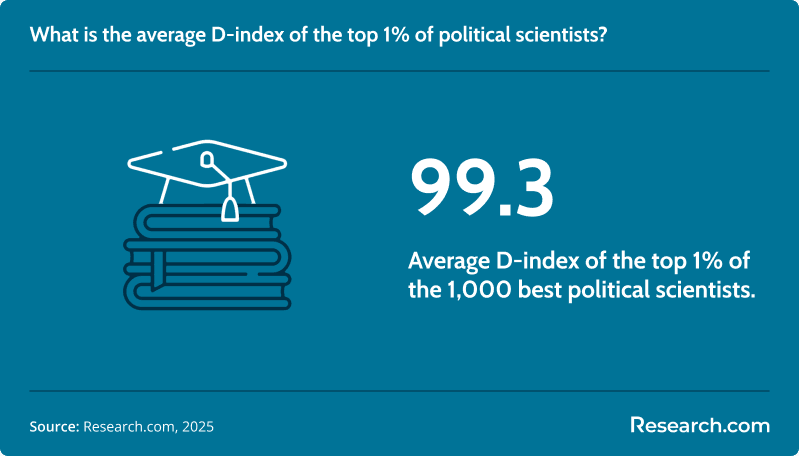
- The average D-index among the top 1,000 political scientists is 41.1, while the top 1% averages 99.3.
- The lowest D-index included in the 2025 rankings is 20.
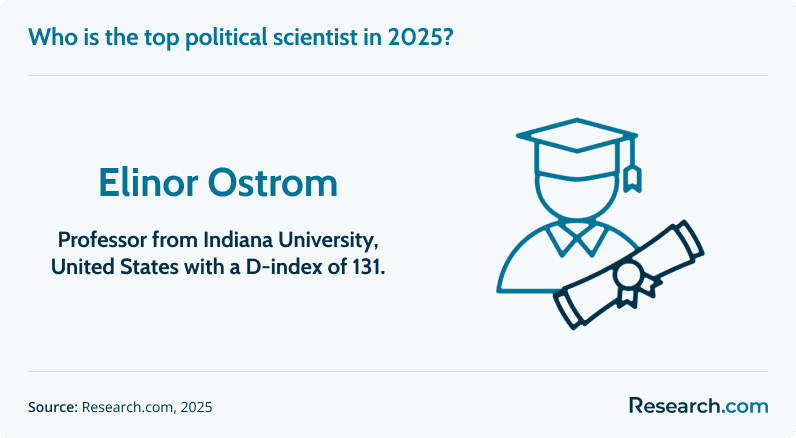
- Professor Todd Sandler from the University of Texas is ranked 1st globally with a D-index of 105.
The full ranking for the 2025 list of the best political scientists can be found here:
BEST POLITICAL SCIENTISTS RANKING
Countries with the highest number of leading political scientists
The United States continues to lead the global rankings in political science, with 519 scholars featured in the top 1,000 for 2025. While still dominant, this is a slight drop from 527 in 2024. U.S. researchers continue to make up the majority despite the decrease, confirming the country’s strong influence in the field. In last year’s report, 70% of the top 1% of scholars were based in the U.S., a trend likely to remain steady given its academic reach and research funding.
The United Kingdom remains in second place with 177 scholars, just one less than last year. This small change suggests stability in its academic performance. Germany saw a notable rise, jumping from 39 scholars in 2024 to 46 this year. Australia, which ranked third last year, now takes fourth place with 41 scholars, one fewer than before. Canada also improved its position slightly, from 35 to 38 scholars in the top 1,000.
The Netherlands, Switzerland, Italy, and Denmark each saw modest increases, confirming growing European research activity. Norway now claims the 10th spot, with 16 scholars listed, two more than in 2024. These shifts highlight expanding global interest in political science beyond traditional academic hubs.
Please note that the country associated with a scientist is based on their affiliated research institution according to MAG, not on their actual nationality.
Institutions with the highest number of leading scholars
Harvard University remains the top institution in political science for 2025, with 34 scholars in the global ranking. This marks a slight decrease from 35 last year, but Harvard still leads by a wide margin. Stanford University now ranks second with 24 scholars, down by one. The University of Oxford follows closely with 23 scholars, showing a slight gain from the previous year.
A notable shift occurred with the London School of Economics and Political Science. It dropped from 25 to 21 scholars, placing it fourth this year. Columbia University also saw a minor drop from 22 to 21 scholars. These small changes shuffled the rankings but did not affect the dominance of these institutions overall.
The University of California system continues to perform well, with four campuses—Berkeley (19), San Diego (11), Davis (11), and Los Angeles (9)—in the top 20. Altogether, U.S. institutions comprise 75% of the top 20, up from 70% last year. The U.K. holds 15% of the list through Oxford, LSE, King’s College London, and the University of Manchester. Australia and Italy contribute the remaining 10%, with the Australian National University maintaining a strong presence of 14 scholars.
These results reflect the ongoing strength of American universities in political science research and show continued contributions from institutions across Europe and the Asia-Pacific region.
Strengthening political science research through online universities
Online universities are playing a bigger role in advancing political science research. With flexible learning options and wider access, these institutions make studying political systems, policy-making, and global relations easier for students worldwide. In the United States alone, nearly 39,000 undergraduate degrees in political science were awarded recently, according to the NCES. This shows growing interest in the field, and online universities are helping meet that demand.
Many learners now choose online programs for the chance to study while working or managing other responsibilities. As more students earn political science degrees online, research participation expands beyond traditional campuses. Online universities also connect students with professors and peers from different regions and backgrounds, encouraging fresh perspectives. This broader academic exchange supports the growth of global research in political science. By reaching more students and offering innovative tools, online universities help shape the discipline's future, making quality research more inclusive and accessible.
D-index ranking — leaders, averages, and distribution
In North America, Professor Todd Sandler from the University of Texas at Dallas, United States, leads all political scientists globally with a D-index of 105, ranking 1st in the world.
In Europe, Professor Timothy Besley from the London School of Economics and Political Science, United Kingdom, is the region’s top scholar, ranking 2nd globally with a D-index of 103.
In Oceania, Professor John S. Dryzek from the University of Canberra, Australia, is the top scientist in the region and ranks 16th worldwide with a D-index of 82.
In Asia, Professor Jonathan Fox from Bar-Ilan University, Israel, is the region’s highest-ranking scholar, with a D-index of 44 and a world ranking of 289th.
In South America, Professor Cristóbal Rovira Kaltwasser from Pontificia Universidad Católica de Chile, Chile, is the top scholar, ranked 687th globally with a D-index of 33.
The average D-index for the top 1% of scientists in the top 1,000 rankings is 99.3, compared to the overall average of 41.1.
The scholar with the lowest D-index in the 2025 ranking has a value of 20.
The top 1% of scholars have an average of 360.5 political science publications, while the overall average for all ranked scientists in the top 1,000 is 164.22.
The average number of discipline citations for the top 1% is 79,549, compared to 14,581.91 across all included scholars in the top 1,000.
You can learn more about the methodology used to create this report here.
About Research.com
All research was coordinated by Imed Bouchrika, Ph.D., a computer scientist with a well-established record of collaboration on a number of international research projects with different partners from the academic community. His role was to make sure all data remained unbiased, accurate, and up-to-date.
Research.com is the number one research portal for science and educational rankings. Our mission is to make it easier for professors, research fellows, and students to progress with their research and find the top experts in a wide range of scientific disciplines. Research.com is also a leading educational platform that helps students find the best colleges, academic opportunities, and career paths.


