
World Online Ranking of Best Microbiology Scientists – 2025 Report

Co-Founder and Chief Data Scientist
On May 26, 2025 the 2025 edition of the World Online Ranking of Best Microbiology Scientists has been released, offering a comprehensive overview of the most influential researchers in the field today. Nearly 4,600 scientist profiles were analyzed using a discipline-specific D-index, which measures research productivity and citation impact. In this year’s report, the highest D-index recorded is 210, while the minimum threshold to be included was 40—highlighting the depth and competitiveness of global microbiology research.
This report is a valuable resource for academic institutions, funding agencies, policymakers, and aspiring microbiologists seeking to understand the current landscape of microbiological research excellence. The ranking is based on data from multiple sources including OpenAlex and CrossRef, ensuring a broad and reliable assessment of scientific contributions.
Latest Discoveries in Microbiology Research
Microbiology research in 2025 has led to remarkable breakthroughs that expand both scientific understanding and medical potential. One of the most intriguing discoveries is Niallia tiangongensis, a new bacterial species identified aboard China’s Tiangong space station. This microbe has adapted to the extreme environment of space by forming robust biofilms and demonstrating gelatin-hydrolyzing capabilities. Its existence suggests that microbial life can survive and potentially evolve in extraterrestrial settings, raising important implications for space exploration and planetary protection.
In another major advancement, Roche has moved the novel antibiotic zosurabalpin into Phase 3 clinical trials. This drug targets Acinetobacter, a superbug resistant to most existing treatments. If successful, it would be the first new class of antibiotics to combat Gram-negative bacteria in over 50 years, offering new hope in the fight against antibiotic resistance.
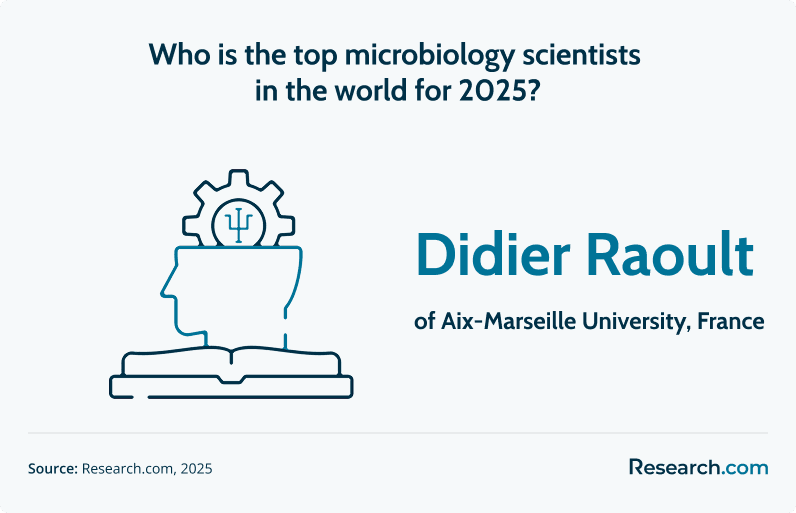
The Key Findings for the 4th Edition of the Best Microbiology Scientists Ranking
- Didier Raoult of Aix-Marseille University, France, retained the top spot with a discipline-specific H-index (D-index) of 210.
- The United States continues to dominate with 468 scientists among the top 1000—nearly half of the total.
- The United Kingdom follows with 92 scientists, while Germany (63), the Netherlands (55), and France (52) round out the top five.
- The National Institutes of Health (NIH) leads all institutions with 27 scientists featured in the top 1000.
- The Centers for Disease Control and Prevention (CDC) ranks second with 22 scientists, emphasizing its strong research footprint.
- The top 1% of microbiologists have an average D-index of 179.8, reflecting exceptional research impact.
- The overall average D-index across the top 1000 is 98.79, showing a high baseline for elite recognition.
- Only 24 scientists achieved a D-index of 150 or higher, indicating how rare ultra-high impact is within the field.
The full ranking for the 2025 list of the best microbiology scientists can be found here:
BEST MICROBIOLOGY SCIENTISTS RANKING
Countries with the Highest Number of Leading Microbiology Scientists
The United States remains the dominant force in microbiology, contributing 468 scientists to the top 1000 in 2025. While still leading by a wide margin, this figure marks a slight drop from 476 in 2024. The United Kingdom holds steady in second place with 92 scientists, down by just one from last year.
Germany moved up to third place with 63 scientists, overtaking France, which now ranks fifth with 52—down from 56. The Netherlands remains strong in fourth with 55 scientists.
Japan retained its upward momentum, staying at sixth with 28 scientists. Switzerland entered the top 10 with 26 scientists, pushing past Spain, which dropped out. Canada and Belgium tie with 24 scientists each, while Australia rounds out the top 10 with 22, slipping from its previous higher position. The rankings reflect both shifting research trends and institutional performance worldwide.
Please note that the country associated with a scientist is based on their affiliated research institution according to MAG, not on their actual nationality.
Institutions with the Highest Number of Leading Scientists
The National Institutes of Health (NIH) remains the top-performing institution in microbiology, though it dropped to 27 scientists in 2025 from 31 in 2024. The Centers for Disease Control and Prevention (CDC) also saw a slight decline, now with 22 scientists compared to 24 last year.
Institut Pasteur and Harvard University are tied this year, each with 16 scientists—Harvard up by one, while Institut Pasteur dropped from 14. The University of Oxford follows with 13.
Notably, Aix-Marseille University and the University of California, San Francisco, each have 11 scientists, reinforcing their growing influence in global microbiology research.
The rest of the top 20 list features a strong mix of institutions from North America and Europe. The University of California, Los Angeles and the University of North Carolina at Chapel Hill each contributed 10 scientists, maintaining their presence from previous years. Tufts University, the University of Washington, the University of Pittsburgh, and Utrecht University follow closely with nine scientists each. Rounding out the list with eight scientists apiece are Stanford University, the University of Pennsylvania, the London School of Hygiene & Tropical Medicine, and the University of Helsinki—highlighting a diverse geographic spread of microbiological research excellence.
The Role of Online Universities in Advancing Microbiology Research
Online universities are increasingly contributing to microbiology research by expanding access to education and fostering global collaboration. Approximately, 9.4 million undergraduate students in the U.S.—61% of all undergraduates—were enrolled in at least one distance education course, reflecting the growing reach of online learning.
These programs enable aspiring microbiologists from diverse backgrounds to engage in research activities, often through virtual labs and remote collaborations. The flexibility of online education allows professionals to pursue advanced degrees while contributing to ongoing research projects. Moreover, online platforms facilitate interdisciplinary studies, integrating microbiology with fields like data science and bioinformatics, thereby accelerating innovation.
As online education continues to evolve, its role in democratizing access to microbiology research and fostering innovation is expected to grow, making it a vital component of the scientific community's future.
D-Index Ranking-Leaders, Averages, and Distribution
In Europe, Professor Didier Raoult from Aix-Marseille University, France, continues to lead with a D-index of 210, securing his position as the top microbiology scientist in the world.
In North America, Professor Robert E. W. Hancock from the University of British Columbia, Canada, is the regional leader and ranks second globally with a D-index of 186—reflecting a shift in leadership from the U.S. to Canada.
Professor Kwok-Yung Yuen of the University of Hong Kong remains the top scientist in Asia and ranks seventh globally with a D-index of 174, showing steady upward progress.
In Oceania, Professor Edward C. Holmes from the University of Sydney maintains his lead with a D-index of 173, now ranking eighth in the world.
Professor Paul D. van Helden of Stellenbosch University, South Africa, leads the African region with a D-index of 97, placing him 374th globally.
In South America, Professor Mariangela Hungria from the Brazilian Agricultural Research Corporation is the top-ranked microbiologist, with a D-index of 87 and a global rank of 628.
The average D-index for the top 1% of scientists in 2025 is 179.8, higher than last year, while the average for all top 1000 scientists is 98.79. Only 24 scientists reached a D-index of 150 or more this year, underscoring how rare elite research impact remains in microbiology.
About Research.com
All research was coordinated by Imed Bouchrika, Ph.D., a computer scientist with a well-established record of collaboration on a number of international research projects with different partners from the academic community. His role was to make sure all data remained unbiased, accurate, and up-to-date.
Research.com is the number one research portal for science and educational rankings. Our mission is to make it easier for professors, research fellows, and students to progress with their research and find the top experts in a wide range of scientific disciplines. Research.com is also a leading educational platform that helps students find the best colleges, academic opportunities, and career paths.


