
World Online Ranking of Best Mechanical & Aerospace Engineering Scientists – 2025 Report

Co-Founder and Chief Data Scientist
On April 125, 2025, Research.com released the fourth edition of its yearly ranking of the top mechanical and aerospace engineering scientists. This ranking aims to help the academic community stay informed and connected in research.
We share this ranking to highlight the contributions of researchers worldwide and give students, educators, and professionals a chance to see where mechanical and aerospace engineering is heading. This report brings together experts from different countries and institutions, giving us a clearer picture of who is shaping the field today.
For the 2025 edition, the ranking examined over 2,700 scientist profiles using various data sources. The selection was based on multiple indicators, including research impact, volume of work, and influence within the field. These profiles were studied to ensure a fair and balanced report reflecting global research efforts in mechanical and aerospace engineering.
To qualify for the ranking, scientists needed a Discipline H-index (D-index) of at least 30, provided most of their work was in mechanical and aerospace engineering. The selection criteria focused on the D-index, the share of research done in the field, and notable honors or achievements throughout their careers.
Latest discoveries in mechanical & aerospace engineering research
Recent mechanical and aerospace engineering studies are helping reshape how we design and control unmanned vehicles. One breakthrough involves improving the aerodynamic performance of UAVs through advanced airfoil analysis. Researchers studied three airfoil types—NACA 2412, NACA 4415, and NACA 0012—using computational fluid dynamics (CFD), XFOIL simulations, and a hybrid machine learning model. The NACA 4415 profile stood out for its smooth airflow, high lift-to-drag ratio, and delayed stall behavior, making it ideal for UAVs in demanding environments like agriculture and infrastructure monitoring.
Another key innovation centers on vehicle control systems. A 2025 study introduced a new active steering strategy for autonomous electric vehicles using Model Predictive Control (MPC). Unlike older methods, this one predicts how a car will behave in real-time and adjusts steering accordingly. In tests, the system improved lane accuracy by 30% during high-speed maneuvers and reduced oversteering on slippery roads. It offers a more stable and reliable driving experience for future autonomous vehicles.
These discoveries are important because they show how combining traditional engineering with modern tools like machine learning and real-time optimization can solve real-world problems. They also open the door for safer, smarter, and more efficient vehicles across land and air.
Key findings for the 2025 edition of the best mechanical & aerospace engineering scientists ranking
- The United States leads the ranking with 432 scientists, making up nearly 43% of the top 1,000 researchers in mechanical and aerospace engineering.
- China secured second place with 109 scientists, showing continued growth in global research output.
- The University of Michigan-Ann Arbor has the highest number of leading scientists, with 24 scholars in the top 1,000.
- The average H-index for the top 1% of scientists in the ranking is 141.2, while the overall average for all ranked scientists is much lower.
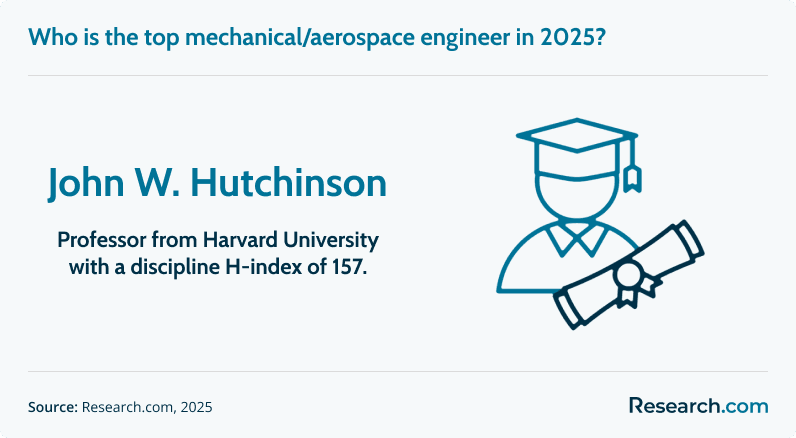
- Professor John W. Hutchinson from Harvard University ranks 1st globally with an H-index of 157.
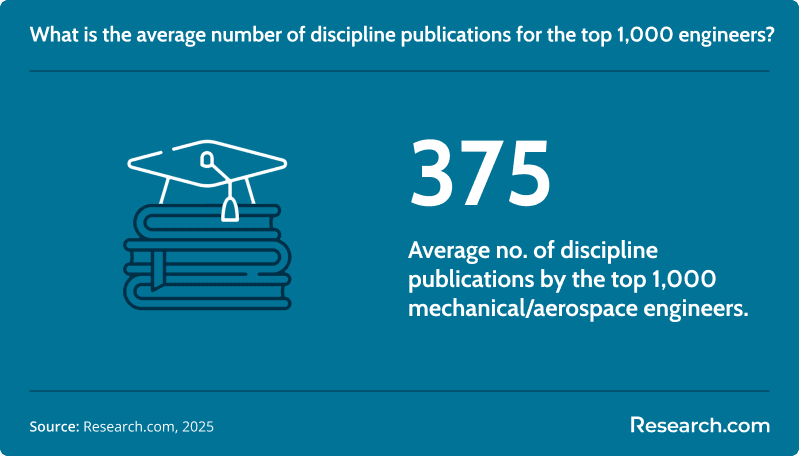
- The top 1% of scientists published an average of 923.7 discipline-related papers, compared to the overall average of 375.44.
The full ranking for the 2025 list of top mechanical & aerospace engineering scientists can be found here:
TOP MECHANICAL & AEROSPACE ENGINEERING SCIENTISTS RANKING
Countries with the highest number of leading mechanical & aerospace engineering scientists
The 2025 report shows the United States' continued dominance in mechanical and aerospace engineering, with 432 scientists among the top 1,000. While the U.S. still leads by a wide margin, this marks a slight drop from 436 scientists in 2024 and 442 in 2023. The gradual decline, though small, suggests a shift as other countries strengthen their research efforts. Despite the decrease, U.S.-based scientists still make up nearly half of the global leaders in this field.
China, in second place, shows steady progress. In 2024, it had 89 scientists—up from 81 in 2023. In 2025, the number jumped to 109, reflecting growing investments in aerospace and engineering research. The United Kingdom remains third, though its count dropped slightly from 75 in 2024 to 69 in 2025.
Some countries have seen minor reshuffling in the rankings. Canada moved ahead of Australia this year with 42 scientists, just edging past Australia's 38. Singapore now holds 22 spots—slightly down from 25 in 2024. Meanwhile, Iran (24), Germany (28), and France (19) remain consistent. South Korea rejoined the top 10 this year, replacing Italy, which had temporarily entered the list in 2024. These shifts show how dynamic global research contributions remain in this fast-moving field.
Please note that the country associated with a scientist is based on their affiliated research institution, according to MAG, not on their actual nationality.
Institutions with the highest number of leading scientists
In the 2025 report, the University of Michigan–Ann Arbor again holds the top spot, with 24 scientists ranked among the world's leading mechanical and aerospace engineering experts. This marks a slight drop from its 2024 count of 26. MIT, which shared the lead last year with 26 scientists, now ranks second with 23. Stanford University moved to third with 19 scholars, while Georgia Institute of Technology remains strong in fourth with 18. These four U.S. universities alone comprise 8.4% of the top 1,000 scientists.
American institutions continue to dominate the list. In 2025, 12 of the top 20 universities are based in the United States—60% of the total. Institutions like UC Berkeley (15), Caltech (13), and Texas A&M (12) help solidify the U.S. lead. The share of top scholars from these institutions reflects the country's continued strength in academic research and innovation.
Among the remaining eight institutions, five are from outside the U.S.: the National University of Singapore (15 scientists), the University of Cambridge (13), Imperial College London (12), ETH Zurich (11), and Hong Kong Polytechnic University (8). Singapore's National University tied with UC Berkeley for fifth place, highlighting Asia's growing presence.
Online universities advancing mechanical engineering & aerospace research
Online universities are playing a more significant role in advancing research and education in mechanical and aerospace engineering. As more students turn to flexible learning options, these institutions are helping to expand access to high-quality programs in STEM fields. Over 50% of colleges reported that online program enrollment grew faster than on-campus options. At the same time, 60% said online classes filled up first, showing a clear shift in student demand.
This growing interest in online education is helping shape the future of engineering research. Many online universities are now investing in remote labs, virtual simulations, and collaborative platforms supporting advanced learning in fluid dynamics, materials science, and aerospace systems. These tools allow students and researchers worldwide to contribute to major projects, even without being in the same physical location.
As access improves and technology advances, online universities are proving that they can support serious academic work, not just teaching. By removing barriers to entry and promoting global collaboration, they are helping more students and researchers make fundamental contributions to mechanical and aerospace engineering. This shift is helping the field grow stronger, faster, and more inclusive.
H-index ranking — leaders, averages, and distribution
For North America, Professor John W. Hutchinson from Harvard University in the United States ranks 1st in the world. With an outstanding H-index of 157, he leads the global list of mechanical and aerospace engineering scientists. His work continues to shape key areas of applied mechanics and solid mechanics.
In Asia, Professor Mohsen Sheikholeslami from Babol Noshirvani University of Technology in Iran ranks 5th globally and holds the top spot in the region. His H-index of 142 reflects his extensive research in heat transfer, nanofluids, and energy systems.
Europe’s top-ranking scientist is Professor Ioan Pop from the Karlsruhe Institute of Technology in Germany. He is ranked 9th in the world, with an H-index of 125. His contributions focus on superconducting quantum circuits.
For Oceania, Professor Nam-Trung Nguyen from Griffith University in Australia leads the region with a global rank of 47. He holds an H-index of 96, and his work focuses on microfluidics and biomedical engineering.
Africa’s highest-ranked scientist is Professor Josua P. Meyer from Stellenbosch University in South Africa. With a world rank of 252 and an H-index of 72, he leads research in heat exchangers and thermodynamics.
In South America, Professor Michael J. Brennan from Sao Paulo State University in Brazil ranks 402nd globally and first in the region. He holds an H-index of 64 and is known for his vibration and noise control work.
The average H-index among the top 1% of scientists in this year’s ranking is 141.2, while the overall average for all ranked scientists is significantly lower.
The lowest H-index value that qualified for the 2025 ranking is 30.
The top 1% have an average of 923.7 discipline-specific publications, compared to an overall average of 375.44.
Scientists in the top 1% have received an average of 82,272.7 citations, while the average for all ranked scholars is 18,151.65.
You can learn more about the methodology used to create this report here.
About Research.com
All research was coordinated by Imed Bouchrika, Ph.D., a computer scientist with a well-established record of collaboration on a number of international research projects with different partners from the academic community. His role was to make sure all data remained unbiased, accurate, and up-to-date.
Research.com is the number one research portal for science and educational rankings. Our mission is to make it easier for professors, research fellows, and students to progress with their research and find the top experts in a wide range of scientific disciplines. Research.com is also a leading educational platform that helps students find the best colleges, academic opportunities, and career paths.


