
World Online Ranking of Best Genetics Scientists – 2025 Report

Co-Founder and Chief Data Scientist
On May 26, 2025, Research.com released the 4th edition of its annual ranking of the world’s best genetics scientists. This report aims to highlight top-performing experts in genetics, support academic research efforts, and help strengthen the global recognition of leaders in this field. By showcasing their work, the report also hopes to encourage more researchers to contribute to ongoing breakthroughs in genetics.
We share this ranking to facilitate connections between the academic community, research organizations, and industry leaders with experts in genetics. It’s a valuable tool for those seeking partnerships, scholarly insight, or research direction. At the same time, we hope this inspires students, educators, and policymakers to learn from top minds in the discipline and follow the latest scientific progress worldwide.
For the 2025 edition, Research.com reviewed 3,932 researcher profiles. These came from several trusted bibliometric databases. Each profile was evaluated using multiple indicators, including publication performance and citation impact, to determine which researchers should be featured in the ranking.
To qualify for the ranking, scientists need a discipline-specific D-index of at least 30, with most of their work focused on genetics. Other factors include the share of their published work and any major awards or professional achievements. This approach helps ensure the report highlights individuals with substantial, relevant contributions to genetics science.
Latest discoveries in genetics science research
In 2025, scientists unveiled a new bacterial defense protein called Cat1, which adds to the existing knowledge of CRISPR-based immune systems. Cat1 works by depleting NAD+, a vital molecule for cell survival, effectively halting viral replication. This discovery, led by researchers at Rockefeller University and Memorial Sloan Kettering Cancer Center, highlights bacteria's diverse strategies to combat viral infections. Understanding Cat1's mechanism could inform the development of novel antimicrobial therapies and enhance our grasp of microbial immunity.
Another significant finding involves 'introners,' transposable elements that insert introns into genes. A study from the University of California, Santa Cruz, demonstrated that introners can move between species through horizontal gene transfer, with giant viruses potentially facilitating this process. This research sheds light on the mechanisms driving genome complexity and evolution, offering insights into how genetic material can be reshaped across different organisms.
The key findings for the 4th edition of the best genetics scientists ranking
- The United States leads globally in genetics research, with 490 scientists ranked in the top 1000.
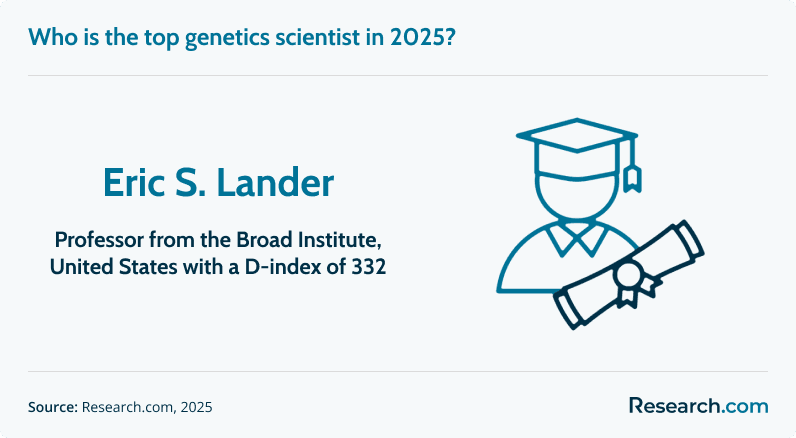
- Eric S. Lander of the Broad Institute (U.S.) ranks 1st worldwide with a D-index of 332.
- Harvard University tops institutional rankings with 41 scientists in the top 1000.
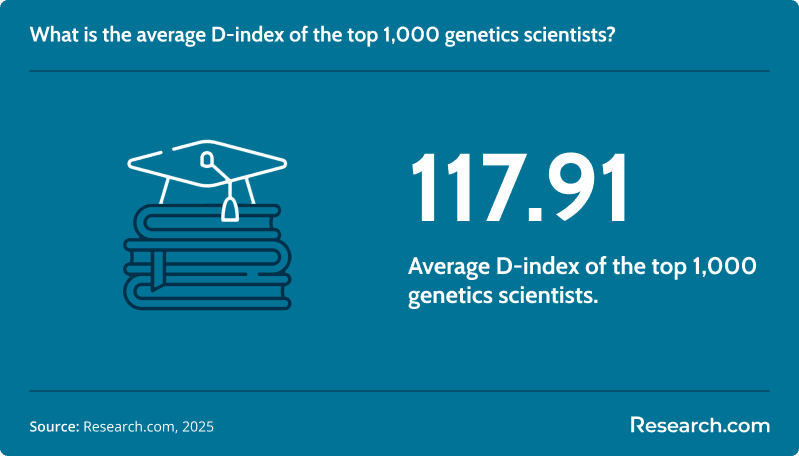
- The average D-index of the top 1% of scientists is 253.9, compared to 117.91 for all ranked scientists.
- The scholar with the lowest D-index to make the 2025 ranking has a score of 40.
The full ranking for the 2025 list of the best genetics scientists can be found here:
BEST GENETICS SCIENTISTS RANKING
Countries with the highest number of leading genetics scientists
The United States remains a dominant force in the global landscape of genetics research. In the 2025 report, 490 U.S.-affiliated scientists appear in the top 1,000 rankings. Although this is less than last year’s 491, the country still holds a strong lead in the field. The United Kingdom remains second but with a slight drop—141 scientists this year compared to 143 previously. Despite the decrease, the UK maintains its solid presence in global genetics research.
Germany shows a small gain, moving from 78 to 80 scientists and holding third place. Japan holds steady with 37, keeping its fourth-place position. France, however, drops slightly from 34 to 33 scientists. The Netherlands also sees a slight dip, from 35 to 32 scientists, pushing it down in the ranking. Meanwhile, Australia (28) and Canada (28) improve their rankings, with the former gaining one scientist while the latter adding three compared to last year. China makes a notable jump from 13 to 16 scientists. Switzerland rounds up the top 10, replacing Spain with 14 scientists, as Spain exits the top group.
These shifts suggest that while the top spots remain mostly unchanged, several countries are making small but essential gains in genetics research leadership.
Please note that the country associated with a scientist is based on their affiliated research institution according to MAG, not on their actual nationality.
Institutions with the highest number of leading genetics scientists
Harvard University remains the leader in genetics research among all institutions. In the 2025 report, Harvard has 41 scientists ranked among the top 1,000, an increase from 35 the previous year. This marks a 17% rise and strengthens its position as the global leader in genetics. The National Institutes of Health (NIH) maintains second place, with 30 scientists this year, up from 29 the previous year. Stanford University remains stable with 21 top-ranked researchers.
Notable changes appear further down the list. The Max Planck Society has only 19 scientists making it into the list this year, down slightly from 20, while the University of Washington drops from 20 to 18. The University of Cambridge advances with 19 scientists, surpassing the University of Oxford and the University of Washington, each with 18. The University of Edinburgh also sees a jump from 14 to 16 scientists, reflecting increased research impact.
Baylor College of Medicine and the University of California, San Francisco, maintain strong positions with 14 scientists each. Meanwhile, institutions like the Wellcome Sanger Institute (13 scientists) and MIT (10 scientists) stay consistent in their rankings.
In this year’s report, U.S.-based institutions represent 60% of the top 10, a 10% increase from last year. UK and European institutions make up the remaining 40%, showing that while American leadership in genetics is growing, global contributions remain essential.
The role of online universities in advancing genetics research
Online universities are playing a growing role in shaping the future of genetics research. As digital education expands, more students are gaining access to high-quality programs in biological and biomedical sciences from anywhere in the world. This flexibility allows a broader range of learners, including those in underserved or remote areas, to pursue genetics-related degrees and eventually contribute to the research community.
According to the latest NCES data, over 131,000 bachelor’s degrees were awarded in biological and biomedical sciences in the most recent academic year. This illustrates the growing demand for education in these fields, and online universities are responding to that demand. Many now offer specialized coursework in genetics, molecular biology, and data analysis, all of which are crucial for modern research.
By allowing students to learn at their own pace and from institutions beyond their geographic region, online universities help build a more diverse and skilled pool of future researchers. These programs also support working professionals who want to shift into genetics or advance in the field without leaving their jobs. As a result, online universities are not just expanding access—they are helping strengthen the global pipeline of talent entering genetics science.
D-index ranking — leaders, averages, and distribution
In North America, Eric S. Lander from the Broad Institute, United States, leads genetics scientists in the region and ranks 1st globally, with a D-index of 332.
In Europe, Kari Stefansson from deCODE Genetics, Iceland, is the top scientist, ranking 2nd globally with a D-index of 258.
In Oceania, Nicholas G. Martin from the QIMR Berghofer Medical Research Institute, Australia, is the regional leader and ranks 8th globally with a D-index of 232.
In Asia, Yusuke Nakamura from the Japanese Foundation for Cancer Research is the top scientist in the region, ranked 17th worldwide with a D-index of 211.
In South America, Jeremy A. Squire from the Universidade de São Paulo, Brazil, leads the region with a D-index of 102, ranked 608th globally.
In Africa, Gerard Tromp from Stellenbosch University, South Africa, is the top scientist, ranked 1,369th globally, with a D-index of 81.
The average D-index for the top 1% of scientists in the top 1,000 rankings is 253.9, compared to 117.91 for all included scientists.
The average number of publications for the top 1% is 1,003.9, while the overall average is 434.18.
The average citation for the top 1% of scientists is 368,529.5, against an overall average of 79,882.33.
The lowest D-index value among the top 1,000 in 2025 is 40.
You can learn more about the methodology used to create this report here.
About Research.com
All research was coordinated by Imed Bouchrika, Ph.D., a computer scientist with a well-established record of collaboration on a number of international research projects with different partners from the academic community. His role was to make sure all data remained unbiased, accurate, and up-to-date.
Research.com is the number one research portal for science and educational rankings. Our mission is to make it easier for professors, research fellows, and students to progress with their research and find the top experts in a wide range of scientific disciplines. Research.com is also a leading educational platform that helps students find the best colleges, academic opportunities, and career paths.


