
World Online Ranking of Best Materials Scientists – 2025 Report

Co-Founder and Chief Data Scientist
On May 13, 2025, Research.com unveiled the 4th edition of its annual global ranking of top materials scientists, spotlighting the world’s most influential researchers in the field. The report honors scientists whose work has significantly advanced materials science, boosting their visibility across academia, industry, and policymaking circles.
The 2025 report builds on previous editions by offering a clearer picture of international excellence in materials science research. By ranking leading scientists by country, institution, and global standing, the report helps universities, companies, and fellow researchers identify experts working on specialized themes within the discipline.
To compile this year’s rankings, Research.com analyzed more than 12,900 researcher profiles sourced from multiple bibliometric databases. Candidates were assessed using a blend of quantitative and qualitative measures, including the D-index (Discipline H-index), which required a minimum score of 40 for those whose primary output falls within materials science. Additional criteria included the share of publications in the discipline, career achievements, and prestigious awards.
Latest discoveries in materials science research
Materials science in 2025 is building on last year’s breakthroughs with innovative discoveries that blend sustainability and next-generation electronics. One major advancement involves rare earth metal recycling using ionic liquid technology. Researchers from Queen’s University Belfast have developed a new method that uses custom-designed ionic liquids to extract valuable metals from industrial waste without the need for corrosive acids. This discovery addresses growing concerns about supply chain security for materials used in electric vehicles and wind turbines, offering a more environmentally friendly way to recover high-purity rare earth elements.
Another exciting development is the discovery of altermagnetism—a new class of magnetism that could transform microelectronics. Unlike traditional ferromagnets, altermagnetic materials exhibit magnetic effects without being conventionally magnetic, making them highly promising for faster, more efficient electronics. Led by an international team of researchers at the University of Nottingham, this breakthrough paves the way for ultrafast data storage and low-energy computing components. As the demand for energy-efficient electronics increases, altermagnetism offers a fresh path forward in spintronics and semiconductor design.
Key findings for the 4th edition of the best materials science scientists ranking
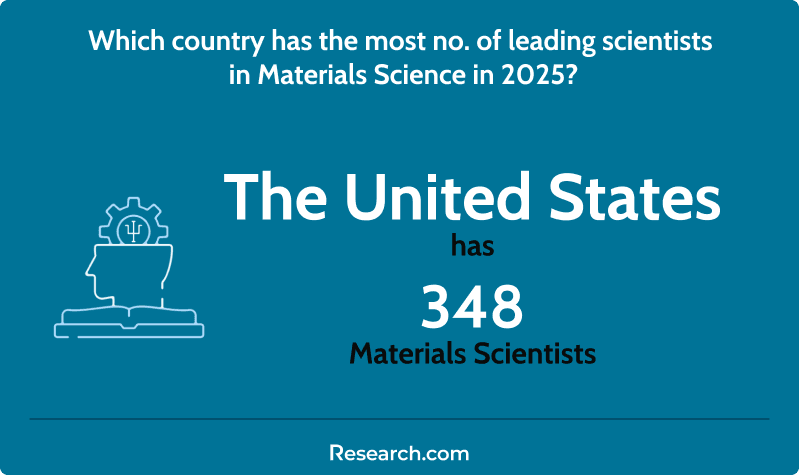
- The United States leads with 348 scientists in the top 1,000, followed by China with 284.
- The average D-index of the top 1% of scientists is 261.8, nearly double the average of 123.27 for all ranked researchers.
- Professor Zhong Lin Wang retains the global top spot with a D-index of 315.
- The Chinese Academy of Sciences ranks first among institutions, with 42 scientists in the top 1,000.
- Australia and Singapore increased their top scientist counts to 36 and 34, respectively.
- Top-performing scientists in the 1% group have published an average of 1,322 articles.
The full ranking for the 2025 list of the best materials science scientists can be found here:
BEST MATERIALS SCIENCE SCIENTISTS RANKING
Countries with the highest number of leading materials science scientists
The 2025 edition of Research.com's global ranking of top materials scientists reveals notable shifts in the international research landscape. The United States continues to lead with 348 scientists in the top 1,000, maintaining its dominance despite a slight decrease from 369 in 2024. China has made a significant leap, increasing its representation from 254 to 284 scientists, narrowing the gap with the U.S. This surge underscores China's growing investment and focus on materials science research.
Germany remains in third place with 55 scientists, a slight decline from 64 in 2024. The United Kingdom follows with 41 scientists, down from 45, while Japan holds steady in fifth place with 38 scientists. Australia and Singapore have shown remarkable progress, with Australia increasing its count to 36 scientists and Singapore to 34, reflecting their strategic emphasis on advanced materials research. South Korea also improved its standing, rising from 24 to 27 scientists. Canada and Switzerland round out the top ten, with Canada increasing to 20 scientists and Switzerland experiencing a slight decrease to 13.
These changes highlight a dynamic shift in global materials science research, with emerging economies making significant strides and traditional leaders adapting to maintain their positions. The increasing contributions from countries like China, Australia, and Singapore indicate a more diversified and competitive global research environment in materials science.
Please note that the country associated with a scientist is based on their affiliated research institution, according to MAG, not on their actual nationality.
Institutions with the highest number of leading scientists
In 2025, the Chinese Academy of Sciences continues its dominance in materials science, topping the global ranking with 42 scientists—a slight increase from 41 in 2024. While the number has not fully rebounded from its 2023 total of 45, the Academy maintains its stronghold as the premier institution for materials research.
The Massachusetts Institute of Technology (MIT) remains in second place with 24 scientists, the same figure it held in 2024 when it overtook Tsinghua University. Tsinghua University follows closely in third, but its count declined slightly from 24 scientists in 2024 to 23 in 2025. Holding steady in fourth place, the National University of Singapore (NUS) once again features 18 top scientists, showing remarkable consistency in its research leadership across Asia.
Northwestern University rounds out the top five with 17 scientists, unchanged from the previous year. Despite the steady number, it slipped in rank as UC Santa Barbara, which had 20 scientists in 2024, dropped to 17 in 2025, now sharing the sixth position with Northwestern.
The rest of the top 20 includes leading institutions such as City University of Hong Kong, Stanford University, University of Science and Technology of China, and Nanyang Technological University, with small fluctuations in their counts. Notably, U.S. institutions continue to dominate the list, holding 10 of the top 20 spots, while China contributes five, Singapore two, and the remainder spread across the UK, Germany, and other global research hubs. These patterns underscore a sustained transcontinental race for leadership in advanced materials innovation.
Expanding Access to Materials Science Research Through Online Universities
Online universities are increasingly playing a pivotal role in democratizing materials science research, particularly by extending opportunities to students from underrepresented or resource-limited institutions. A notable example is the Materials Initiative for Comprehensive Research Opportunity (MICRO), spearheaded by Northwestern University. This program enables undergraduates from colleges lacking robust materials science programs to engage in virtual research collaborations with leading laboratories at Northwestern and the Massachusetts Institute of Technology (MIT). Through these partnerships, students participate in remote research projects, gaining valuable experience and mentorship that would otherwise be inaccessible.
Such initiatives not only broaden participation in materials science but also foster a more inclusive and diverse research community. By leveraging online platforms, programs like MICRO bridge the gap between institutions with varying levels of resources, allowing for a more equitable distribution of research opportunities.
D-index ranking-leaders, averages, and distribution
The 2025 edition generally saw a continued upward trend in both productivity and impact among the leading materials scientists globally.
In North America, Professor Zhong Lin Wang of the Georgia Institute of Technology, United States, remains the leading scientist in materials science. He not only tops the regional list but also continues to lead globally with a D-index of 315.
In Europe, Professor Michael Grätzel from the École Polytechnique Fédérale de Lausanne, Switzerland, holds the top regional position and is ranked second in the world. His D-index rose to 292 in 2025, maintaining his position as one of the most influential scientists in the field.
Meanwhile in Asia, Professor Jiaguo Yu from the China University of Geosciences continues to lead the region with a D-index of 233. He holds the 8th position in the global ranking, reflecting the sustained impact of his work in photocatalysis and nanomaterials.
Down south, Professor Shi-Zhang Qiao from the University of Adelaide, Australia, is Oceania’s top-ranked scientist in 2025 with a D-index of 189. He now ranks 37th in the global listing, an improvement from his 46th place in 2024.
Lastly, Professor Ado Jorio of the Universidade Federal de Minas Gerais, Brazil, continues to lead South America with a D-index of 100. He remains among the top 800 materials scientists in the world, contributing significantly to nanomaterials and spectroscopy research.
The average D-index for the top 1% of scientists in 2025 is 261.8, while the average for all scientists included in the ranking stands at 123.27. On the other hand, the average number of published articles for the top 1% of scientists is 1,322.0 compared to 671.21 for all those ranked.
About Research.com
All research was coordinated by Imed Bouchrika, Ph.D., a computer scientist with a well-established record of collaboration on a number of international research projects with different partners from the academic community. His role was to make sure all data remained unbiased, accurate, and up-to-date.
Research.com is the number one research portal for science and educational rankings. Our mission is to make it easier for professors, research fellows, and students to progress with their research and find the top experts in a wide range of scientific disciplines. Research.com is also a leading educational platform that helps students find the best colleges, academic opportunities, and career paths.


