
World Online Ranking of Best Earth Scientists – 2025 Report

Co-Founder and Chief Data Scientist
On April 29, 2025, Research.com released the 4th edition of its best earth scientists ranking. This report aims to boost the visibility of outstanding scientists and guide the academic community by showing where top research is happening. It highlights leading experts whose work pushes the field of earth science forward.
We share this ranking to inspire researchers, students, and academic leaders across the globe. It is a way to spotlight exceptional work in earth science and to show how different universities and institutions contribute to the field. This report offers a chance to discover new role models, build networks, and better understand today’s major trends in earth science.
For the 2025 edition, Research.com reviewed nearly 9,000 scientist profiles, which came from different trusted bibliometric databases. Experts were assessed using several indicators and metrics to ensure that only those with the most substantial impact and achievements were included in the ranking.
To be considered for this report, scientists needed a D-index of at least 20, as long as most of their published research was in earth science. The team also looked at how much of each scientist’s work falls within the discipline, along with their awards and professional achievements. This approach ensures that the ranking only features those who have made significant and lasting contributions to the field.
Latest discoveries in earth science research
One of the most significant discoveries in earth science this year comes from a study of the Arctic Ocean. Researchers, for the first time, observed the Transpolar Drift (TPD) across a full seasonal cycle. They found that the movement of substances from Siberian rivers through the Arctic is much more complex and variable than we thought. These results raise new concerns about pollutants spreading through the Arctic as climate change speeds up. The study shows that changes in sea ice and river flows make predicting how pollutants and nutrients will travel harder. This new knowledge is critical for understanding the health of fragile Arctic ecosystems and how they might change in the future.
Another breakthrough focuses on coastal risks in Bangladesh. A new study modeled how rising sea levels and stronger cyclones could threaten the country's low-lying coastline. Researchers used a physics-based method that combined cyclone activity, sea-level rise, and storm tides to better predict future risks. Their findings show that millions could face much higher flood risks without stronger defenses. They also identified new threats, like back-to-back storms during the post-monsoon season. This research is vital because it gives policymakers better tools to protect vulnerable communities and plan for a changing climate.
The Key findings for the 4th edition of the best earth science scientists ranking
- The United States leads with 481 scientists in the top 1000 animal and veterinary scientists ranking.
- The California Institute of Technology has the highest number of leading earth scientists, with 23 scholars ranked.
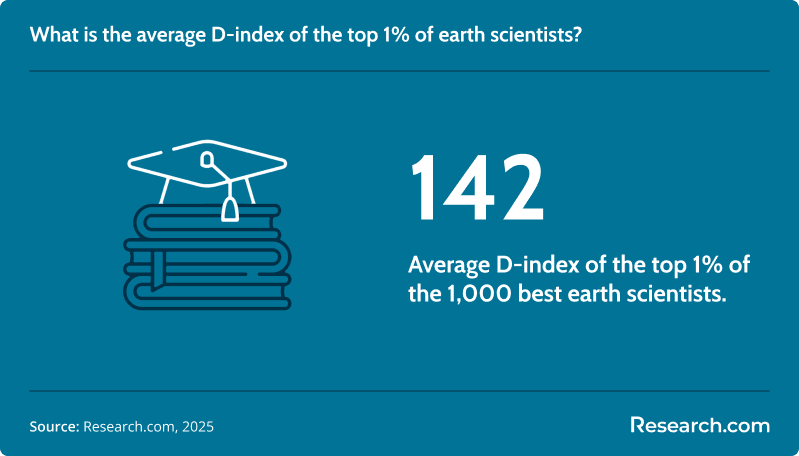
- The average D-index for the top 1% of scientists in the 2025 ranking is 142.0.
- Average discipline-specific publications for the top 1% of scientists are 967.5, compared to 355.01 for all ranked scientists.
- The average number of citations for the top 1% of scientists is 79,014.7, while the overall average for all scientists is 26,451.19.
The full ranking for the 2025 list of the best earth scientists can be found here:
Countries with the highest number of leading earth science scientists
The United States continues to dominate the World Online Ranking of Best Earth Scientists, securing the top spot with 481 scientists in the top 1000. However, this number slightly drops compared to last year’s 491 scientists. The United Kingdom holds steady in second place with 91 scientists, slightly decreasing from the 96 scientists listed in 2024. Australia remains third, with 70 scientists, down slightly from 75 last year.
Germany maintains fourth place with 58 scientists, gaining momentum from last year’s 54. On the other hand, France also remains in fifth place with 55 scientists, an improvement from the 50 recorded in the previous year, but not enough to overtake the rankings. China follows closely with 52 scientists, improving from last year’s 48. Canada ranks seventh with 46 scientists, dropping slightly compared to its previous 47.
The Netherlands and Switzerland share eighth place, each listing 27 scientists this year. This marks a rise for the Netherlands, which had 23 scientists in 2024. Switzerland’s number stayed steady. Japan rounds out the top 10 with 15 scientists, a slight decrease from 18 last year. This year's report includes all countries from the 2024 top 10 list.
Please note that the country associated with a scientist is based on their affiliated research institution, according to MAG, not on their actual nationality.
Institutions with the highest number of leading scientists
The California Institute of Technology (Caltech) ranks first among earth scientists. It maintains 23 scientists in the 2025 report, the same number it had in 2024. Stanford University also holds steady at second place with 21 scientists. Utrecht University continues its substantial rise, now ranking third with 19 scientists, one more than last year.
The Australian National University moved slightly, now sitting fourth with 18 scientists, down from 19 in the 2024 edition. The Massachusetts Institute of Technology (MIT) remains consistent with 16 scientists, keeping its fifth spot. ETH Zurich and the University of Oxford each have 15 scientists this year, staying stable compared to last year’s numbers. The Chinese Academy of Sciences and the United States Geological Survey (USGS) list 14 scientists in 2025. USGS, a new entrant into the top 10 last year, maintains its strong presence.
Of the top 20 institutions, 13 are based in the United States, making up 65% of the leading affiliations. This includes top agencies like Woods Hole Oceanographic Institution and Lamont-Doherty Earth Observatory. Institutions from Australia, the Netherlands, Switzerland, and China complete the list. These results underline the ongoing strength of US institutions in shaping cutting-edge earth science research worldwide.
Strengthening earth science research in online universities
The rise of online universities is opening new doors for earth science research and education. As more students choose flexible learning options, the field benefits from a larger, more diverse talent pool. According to the latest NCES data, 26.4% of postsecondary students in the US were enrolled exclusively in distance education courses. This trend shows how online universities are becoming a significant part of the academic landscape.
Earth science programs offered by online universities allow students from different regions and backgrounds to join research projects, contribute to global discussions, and gain access to leading scientists and resources. This accessibility helps boost innovation and brings fresh perspectives to essential topics like climate change, environmental protection, and geological exploration. Online learning also encourages collaboration across borders, making it easier for researchers to connect, share data, and build stronger networks.
As earth science research continues to grow, the role of online universities will become even more critical. They help future scientists develop the necessary skills while making advanced education more affordable and reachable for many. This new education model strengthens the scientific community and supports the ongoing search for solutions to the world’s most urgent environmental challenges.
D-index ranking — leaders, averages, and distribution
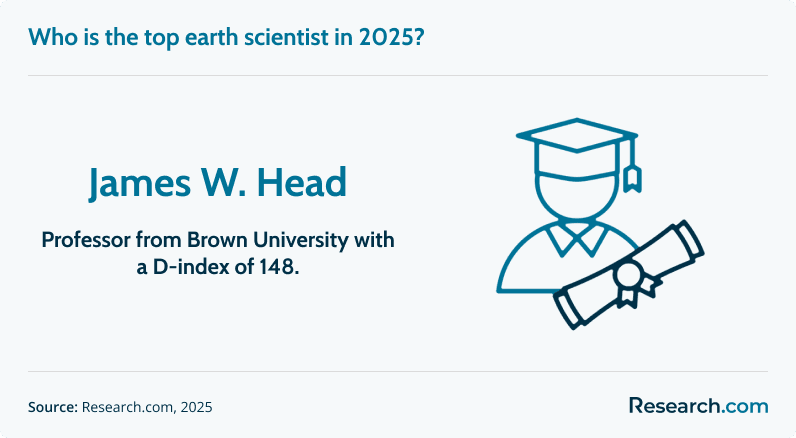
In North America, Professor James W. Head from Brown University, United States, leads with a D-index of 148 and ranks 1st globally.
In Europe, Professor Jean Poesen from KU Leuven, Belgium, is the leading scientist with a D-index of 147 and ranks 2nd in the world.
In Oceania, Professor William L. Griffin from Macquarie University, Australia, tops the region with a D-index of 144 and is ranked 3rd globally.
In Asia, Professor Guochun Zhao from the University of Hong Kong, China, leads with a D-index of 140 and ranks 8th in the global ranking.
In South America, Professor M. Th. van Genuchten from the Federal University of Rio de Janeiro, Brazil, is the top scientist with a D-index of 85 and ranks 317th worldwide.
In Africa, Professor Emmanuel John M. Carranza from the University of the Free State, South Africa, leads with a D-index of 78 and ranks 488th globally.
The average D-index for the top 1% of scientists in the top 1000 ranking is 142.0, compared to an overall average of 82.39.
The scholar with the lowest D-index to make the 2025 ranking has a D-index of 26.
The average number of discipline-specific publications for the top 1% is 967.5, while the overall average for all scientists in the ranking is 355.01.
The average number of citations for the top 1% is 79,014.7, compared to 26,451.19 for all scientists in the 2025 ranking.
You can learn more about the methodology used to create this report here.
About Research.com
All research was coordinated by Imed Bouchrika, Ph.D., a computer scientist with a well-established record of collaboration on a number of international research projects with different partners from the academic community. His role was to make sure all data remained unbiased, accurate, and up-to-date.
Research.com is the number one research portal for science and educational rankings. Our mission is to make it easier for professors, research fellows, and students to progress with their research and find the top experts in a wide range of scientific disciplines. Research.com is also a leading educational platform that helps students find the best colleges, academic opportunities, and career paths.


