
World Online Ranking of Best Electronics and Electrical Engineering Scientists – 2024 Report

Co-Founder and Chief Data Scientist
Research.com published the 3rd edition of its annual ranking of the best scientists in electronics and electrical engineering on 8 April 2024. The ranking is designed for researchers, graduate students, university leaders, industry R&D teams, and policymakers who want to understand which scholars and institutions are producing highly influential work in this fast-moving field.
Electronics and electrical engineering now sits at the center of several major technology shifts: artificial intelligence, power electronics, renewable energy integration, semiconductor systems, signal processing, communications, robotics, and intelligent infrastructure. Knowing where leading research is being produced can help readers identify potential collaborators, benchmark institutions, choose graduate programs, and follow emerging areas of innovation.
This guide explains the 2024 ranking results, the indicators used to evaluate scientists, the countries and institutions with the strongest representation, and the broader education and career implications for people planning advanced study or research careers in electronics and electrical engineering.
Quick answer: what does the 2024 electronics and electrical engineering ranking show?
The 2024 Research.com ranking highlights the most influential electronics and electrical engineering scientists based on discipline-specific bibliometric indicators and research impact. Nearly 5,000 scientist profiles from multiple bibliometric data sources were reviewed for the 2024 edition. To be considered, scholars generally needed a D-index, or Discipline H-index, of at least 30 when most of their publications were in electronics and electrical engineering.
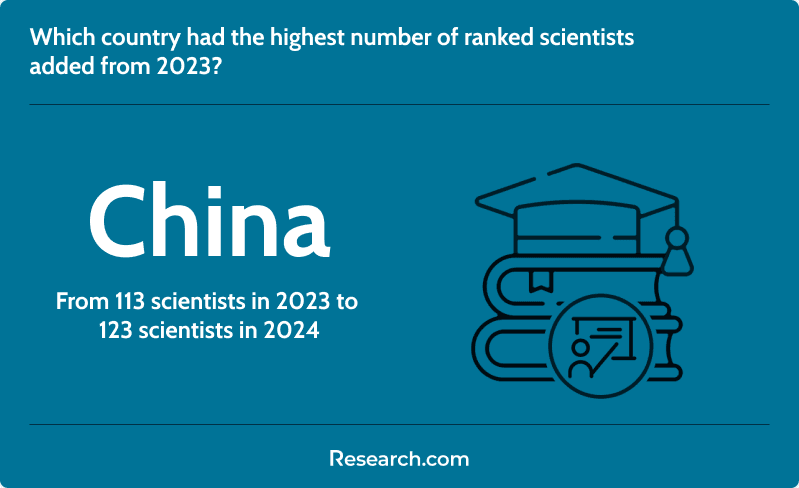
The United States has the largest presence in the ranking with 465 scientists, representing 46.5% of the listed researchers. China follows with 123 scientists or 12.3%, while Canada, the United Kingdom, Australia, Japan, and Switzerland also have strong representation. Professor Frede Blaabjerg of Aalborg University in Denmark remains the highest-ranked scientist, with a D-index of 183.
What the ranking measures
The ranking focuses on research influence within electronics and electrical engineering. It is not a general university ranking, a teaching-quality ranking, or a measure of undergraduate student outcomes. Instead, it identifies individual researchers whose published work has had substantial impact in the discipline.
Research.com reviewed several indicators before including scientists in the list. The main screening measure was the D-index, which is a discipline-specific version of the H-index. The evaluation also considered how much of a scholar’s work belongs to electronics and electrical engineering, along with awards, recognitions, and other achievements.
| Factor | How readers should interpret it |
| D-index | A discipline-specific research impact indicator used to assess influence within electronics and electrical engineering. |
| Publication relevance | The ranking considers whether a substantial share of a scientist’s work belongs to the electronics and electrical engineering field. |
| Awards and achievements | Recognitions help provide additional context about a researcher’s contributions and professional standing. |
| Institutional affiliation | Country and institution counts are based on the scientist’s affiliated research institution according to MAG, not personal nationality. |
Latest discoveries in electronics and electrical engineering research
Artificial intelligence is changing how electrical and electronics engineers design, monitor, and optimize complex systems. In power systems, AI-supported models are being used to improve grid reliability, support energy-efficiency strategies, and detect early warning signs in electrical equipment. Predictive maintenance tools, for example, can help engineers identify potential failures before they cause downtime or system disruption.
AI is also becoming increasingly important in renewable energy systems. Optimization methods can support better planning and operation of solar, wind, storage, and hybrid energy infrastructure, making these systems more efficient and easier to manage. In signal processing, AI-enabled methods are improving data compression, denoising, image processing, and communication performance, with applications that include AI in bioimaging and signal processing. These developments show why electronics and electrical engineering research is closely tied to the future of sustainable energy, intelligent devices, advanced communications, and automated systems.
Key findings from the 3rd edition of the best electronics and electrical engineering scientists ranking
- The United States has the strongest representation, with 465 scientists, equal to 46.5% of the top electronics scientists.
- China ranks second with 123 scientists or 12.3%, followed by Canada with 54 scientists or 5.4%, the United Kingdom with 47 scientists or 4.7%, Australia with 36 scientists or 3.6%, Japan with 29 scientists or 2.9%, and Switzerland with 26 scientists or 2.6%.
- Only 5 out of 10 scientists in the top 1% are from the United States. The other 5 researchers represent Denmark, Canada, Australia, China, and Singapore.
- Professor Frede Blaabjerg from Aalborg University in Denmark continues to hold the top position, with a D-index of 183.
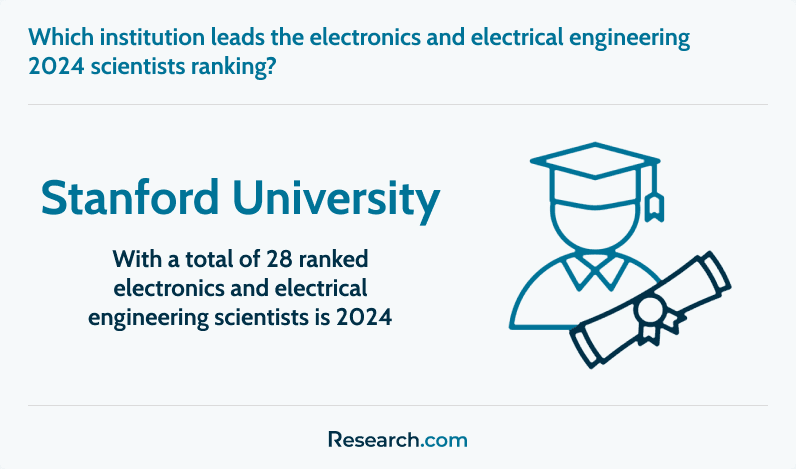
- In the 2023 edition of the top scientists in electronics and electrical engineering, Stanford University is the leading institution with a total of 28 scientists included in the ranking.
- 5 out of 10 leading institutions are American universities. Two are from Switzerland, and the remaining institutions are from Singapore, China, and Belgium.
- The average D-index for the top 1% of scientists is 158.8, compared with an average of 79.9 for all scientists included in the ranking.
Readers who want to review the complete 2024 list can access the full ranking here:
World's Best Electronics and Electrical Engineering Scientists Ranking
Countries with the highest number of leading electronics and electrical engineering scientists
The United States leads the 2024 ranking with 465 scholars, representing 46.5% of the full list. The U.S. had 468 scientists in 2023, meaning three fewer U.S.-affiliated researchers appear in the 2024 ranking.
Within the top 1% of scientists, five researchers are affiliated with U.S.-based institutions. The other top researchers represent Denmark, Canada, Australia, and Singapore. China holds second place overall with 123 scientists, an increase of 10 from 113 in 2023.
Canada ranks third with 54 scientists. The United Kingdom remains in fourth place with 47 scientists, although its total decreased from 53 in 2023.
Australia is another leading country in the ranking, gaining four more scientists for a total of 36. Japan has 29 scientists, while Switzerland has 26 scientists.
Germany has 25 scientists, Singapore has 24 scientists, and Italy has 22 scientists. Germany, ranked as the 8th top country in 2024, replaced South Korea in the top 1% list.
The country assigned to a scientist is based on the affiliated research institution listed in MAG. It should not be interpreted as the scientist’s nationality.
| Country | Scientists in the 2024 ranking | Share or context stated in the ranking |
| United States | 465 | 46.5% of the ranking |
| China | 123 | 12.3% of the ranking |
| Canada | 54 | 5.4% of the ranking |
| United Kingdom | 47 | 4.7% of the ranking |
| Australia | 36 | 3.6% of the ranking |
| Japan | 29 | 2.9% of the ranking |
| Switzerland | 26 | 2.6% of the ranking |
| Germany | 25 | Ranked as the 8th top country in 2024 |
| Singapore | 24 | Included among the leading countries |
| Italy | 22 | Included among the leading countries |
Institutions with the highest number of leading scientists
Stanford University leads the 2024 edition with 28 scientists. MIT follows with 28 scholars, and the University of California-Berkeley ranks third with 24 scientists.
Among the 10 leading institutions, five are American universities. Two are located in Switzerland, while the remaining institutions are based in China, Singapore, and Belgium.
Two institutions entered the top 1% list in the 2024 ranking: the City University of HongKong and KU Leuven. They replaced the University of California-San Diego and the University of Southern California.
Among the 20 leading institutions, 9 universities are based in the U.S. Other highly represented institutions include the École Polytechnique Fédérale de Lausanne and ETH Zurich in Switzerland, the National University of Singapore in Singapore, the City University of Hong Kong and Tsinghua University in China, and KU Leuven in Belgium.
| Institutional pattern | What it means for readers |
| High concentration in U.S. universities | The U.S. remains a major center for electronics and electrical engineering research output and citation impact. |
| Strong Swiss representation | Institutions such as the École Polytechnique Fédérale de Lausanne and ETH Zurich show the continued importance of European research hubs. |
| Rising Asian research presence | China and Singapore are strongly represented through institutions such as Tsinghua University, the City University of Hong Kong, and the National University of Singapore. |
| Institutional movement year over year | Changes in the top 1% list show that institutional standing can shift as researcher affiliations, publication impact, and citation profiles evolve. |
How to use this ranking when choosing a research path or graduate program
A scientist ranking is most useful when it is treated as one evidence source, not as the only decision factor. A highly ranked scholar or institution can indicate strong research influence, but students and professionals should also consider program fit, lab access, funding, advising quality, publication expectations, location, and career goals.
| If your goal is... | Use the ranking to identify... | Also verify before deciding |
| Doctoral research | Potential supervisors, research groups, and institutions with strong publication impact. | Advisor availability, funding support, lab resources, placement outcomes, and research alignment. |
| Master’s study | Universities with active researchers in your area of interest. | Curriculum depth, thesis or project options, industry partnerships, cost, and delivery format. |
| Industry R&D collaboration | Experts whose work matches your organization’s technical challenges. | Prior collaboration record, intellectual property policies, grant capacity, and applied research experience. |
| Academic benchmarking | Countries and institutions with concentrated research strength. | Methodology limitations, discipline scope, institutional strategy, and emerging faculty not yet reflected in citation metrics. |
Education pathways for electronics and electrical engineering research careers
People who want to contribute to advanced electronics and electrical engineering research usually need a strong technical foundation in mathematics, physics, circuits, systems, computation, and experimental design. The right academic pathway depends on whether the goal is industry employment, applied engineering work, academic research, or leadership in R&D.
Affordability is often a major constraint, especially for working professionals who want to continue their education without pausing employment. An affordable masters degree online can make advanced study more realistic when the program is accredited, technically rigorous, and aligned with the student’s research or career goals.
Financial aid can also shape access. Scholarships, grants, employer tuition support, assistantships, and federal aid eligibility may reduce the cost burden for qualified students. Prospective students comparing online options should confirm institutional accreditation, program quality, and aid eligibility; researching online schools that accept FAFSA can be one starting point for cost-conscious planning.
Some learners consider faster academic routes to reduce time away from the workforce. A 1 year doctorate program may appear attractive to professionals who want to move quickly, but research-focused engineering doctorates require careful scrutiny. Students should examine dissertation expectations, faculty expertise, research methods training, accreditation, and whether the program is respected in their intended field.
Not every valuable credential has to be directly within electronics and electrical engineering. In interdisciplinary areas such as biomedical devices, imaging systems, health technology, and sensor-enabled care, some professionals may benefit from complementary training, including medical certifications that pay well. The key is relevance: an additional credential should strengthen a specific career direction rather than distract from core engineering expertise.
For early-career learners, an accelerated credential can be useful when it builds a clear foundation for technician roles, transfer pathways, or later engineering study. A fast track associates degree may help some students reduce time and cost, but those aiming for licensed engineering work, graduate research, or faculty roles should verify whether credits transfer into an ABET-accredited or otherwise appropriately recognized engineering program.
Specialized online master’s programs can help working engineers deepen technical skills in areas such as power systems, communications, embedded systems, control, signal processing, and semiconductor technologies. Short-format options, including the best 6 month online master's degree programs, should be evaluated carefully for academic depth, admissions standards, faculty qualifications, and whether the credential supports the student’s long-term research or career plan.
Online universities and digital research collaboration
Online and hybrid education models are changing how researchers collaborate, especially when teams are spread across countries and institutions. Digital research environments can support shared datasets, remote meetings, simulation work, cloud-based experimentation, and faster exchange of ideas. These tools are particularly useful in electronics and electrical engineering, where projects often involve software, hardware design, modeling, and interdisciplinary teams.
Established research universities also use digital infrastructure to coordinate labs and research groups. For example, the Cornell Engineering Research Group provides information about research groups, centers, and labs in electrical and computer engineering.
Similarly, CalTech Electrical Engineering Research highlights active research areas in the field. These examples show how students and professionals can look beyond course catalogs and evaluate the actual research ecosystem around a program or institution.
How undergraduate preparation affects future research and career options
A strong undergraduate background can influence access to research assistantships, competitive graduate programs, internships, and early-career engineering roles. Students interested in electronics and electrical engineering should look for programs with rigorous coursework in circuits, electronics, electromagnetics, signals and systems, programming, controls, and laboratory methods.
Undergraduate performance also matters because faculty recommendations, research experience, capstone projects, and technical portfolios often play a role in graduate admissions and research hiring. Students comparing majors may also want to review broader degree outcomes, including programs commonly associated with strong earnings potential, such as those listed among the highest paying bachelors.
D-index ranking: regional leaders, averages, and research distribution
In Europe, Professor Frede Blaabjerg of Aalborg University in Denmark ranks first in the region and first worldwide, with a D-index of 183.
In Oceania, Professor Peng Shi of the University of Adelaide in Australia leads the region and ranks 4th globally, with a D-index of 160.
Professor Guanrong Chen of the City University of Hong Kong in China leads Asia and holds the 5th position worldwide, with a D-index of 159.
In North America, Professor Stephen R. Forrest of the University of Michigan-Ann Arbor in the U.S. ranks first regionally and second overall, with a D-index of 161.
Professor Jose Rodriguez of San Sebastián University in Chile is the highest-ranked scientist from South America, with a world ranking of 73.
Professor Qing-Guo Wang of the University of Johannesburg in South Africa is the highest-ranked scientist in South Africa, with a world ranking of 515.
The average D-index for the top 1% of scientists is 158.8, compared with 79.92 for all scientists included in the ranking.
The scholar with the lowest index value who made it to the ranking in 2023 has a D-index of 69.
The top 1% of scientists in the ranking average 1527 published articles within electronics, while the average for all ranking scholars is 593.
The top 1% of scientists average 110,729 citations, compared with 29,428 citations for all ranking scholars.
| Measure | Top 1% of scientists | All ranking scholars |
| Average D-index | 158.8 | 79.92 |
| Average published articles within electronics | 1527 | 593 |
| Average citations | 110,729 | 29,428 |
Questions to ask before using a ranking to make an education or research decision
- Does the scientist’s research area match my intended specialization, or is the institution strong in a different subfield?
- Is the faculty member currently accepting students, postdoctoral researchers, or collaborators?
- Does the program provide funding, lab access, computing resources, and publication opportunities?
- Is the degree format appropriate for my goals: campus-based, online, hybrid, full-time, or part-time?
- Will the program support the kind of career I want, such as industry R&D, academic research, product engineering, or technical leadership?
- Are the credits, accreditation, and degree requirements suitable for licensure, transfer, or doctoral admission if those goals apply?
- Am I comparing total cost, not just tuition, including fees, equipment, travel, lost work time, and financing costs?
Common mistakes to avoid
| Mistake | Why it can hurt your decision | Better approach |
| Choosing a school only because it appears in a ranking | A ranking may reflect research impact, but not program fit, advising quality, affordability, or student outcomes. | Use rankings as a starting point, then evaluate faculty match, curriculum, funding, and career support. |
| Assuming all online engineering programs are equally credible | Program quality, accreditation, lab access, and employer recognition can vary widely. | Check accreditation, course rigor, faculty credentials, and whether the program supports your intended pathway. |
| Focusing only on tuition | Fees, equipment, residency requirements, travel, and time away from work can change the real cost. | Calculate total cost and compare financial aid, employer support, and expected career value. |
| Ignoring research alignment | A prestigious institution may not have faculty working in your niche area. | Review publications, lab pages, current projects, and advisor availability before applying. |
| Assuming faster always means better | Accelerated programs may not provide enough research depth for advanced engineering goals. | Match program length to the credential’s purpose, especially for thesis, dissertation, or lab-intensive work. |
Methodology and research coordination
You can read more about the ranking methodology here.
About Research.com
All research was coordinated by Imed Bouchrika, Ph.D., a computer scientist with a strong record of participation in international research collaborations across the academic community. His role was to help ensure that the data remained unbiased, accurate, and up-to-date.
Research.com is a research portal for science and educational rankings. Its mission is to help professors, research fellows, and students advance their work and identify leading experts across scientific disciplines. Research.com also supports students by providing information about colleges, academic options, and career pathways.
Key insights
- The 2024 ranking is a research-impact ranking of individual scientists in electronics and electrical engineering, not a general measure of teaching quality or student experience.
- The United States remains the most represented country, with 465 scientists and 46.5% of the ranking, while China ranks second with 123 scientists.
- Professor Frede Blaabjerg of Aalborg University in Denmark is the top-ranked scientist, with a D-index of 183.
- Stanford University, MIT, and the University of California-Berkeley are among the institutions with the highest number of ranked scientists.
- The D-index helps compare discipline-specific influence, but students and collaborators should also evaluate research fit, funding, lab access, advisor availability, and program quality.
- AI, renewable energy systems, signal processing, power electronics, and intelligent infrastructure are among the areas making electronics and electrical engineering research especially important.
- Prospective students should use the ranking as a starting point, then verify accreditation, total cost, financial aid, curriculum depth, and whether a program supports their specific career or research goals.


