
World Online Ranking of Best Electronics and Electrical Engineering Scientists - 2025 Report

Co-Founder and Chief Data Scientist
On April 7, 2025, Research.com published the fourth edition of its annual ranking of the top scientists in electronics and electrical engineering. This report highlights distinguished researchers and aims to increase awareness within the academic community about the significant contributions made by leading experts in the field.
We hope this ranking report serves as a source of inspiration for scholars, decision-makers, and entrepreneurs worldwide, encouraging them to explore the future of electronics and electrical engineering. It also provides a valuable opportunity to learn about top specialists across different research areas, countries, universities, and institutions.
For the 2025 edition, over 6,200 scientist profiles were analyzed using various bibliometric data sources. Several indicators and metrics were assessed to determine each scientist’s inclusion in the ranking.
To qualify, scholars needed a minimum D-index (Discipline H-index) of 30, provided that most of their publications were in electronics and electrical engineering. The ranking criteria also considered a researcher’s discipline-specific D-index, the proportion of their contributions to the field, and their awards and achievements.
Latest discoveries in electronics and electrical engineering research
Groundbreaking research continues to redefine the landscape of electronics and electrical engineering, demonstrating the critical role of scientific innovation in shaping the future of technology. Based on a Deloitte study, chip industry research and development spending, as a percentage of EBIT rose from 45% in 2015 to an estimated 52% in 2024.
One of the most influential discoveries of 2024 in electronics and electrical engineering is altermagnetism, a revolutionary magnetic behavior that could replace traditional ferromagnetic materials in data processing. This breakthrough enables faster, more energy-efficient microelectronic components and digital memory systems.
By eliminating the need for inherently magnetic materials, altermagnetism offers a sustainable alternative for high-speed computing, reinforcing the power of fundamental research in driving technological progress.
Beyond materials science, researchers have also reimagined core electrical engineering principles. Electrostatic motors replaced conventional electromagnetic designs with alternating positive and negative charges, drastically improving efficiency while reducing dependence on rare-earth materials.
Meanwhile, a team at the University of Florida has pushed the boundaries of wireless communication with 3D processor technology, integrating multiple frequencies on a single monolithic chip for enhanced data transmission.
These discoveries highlight how research not only refines existing systems but also paves the way for entirely new paradigms in electronics. As top-ranking scientists continue to push technological frontiers, their work ensures that the field remains at the cutting edge of innovation, driving advancements that will define the next generation of electronic and electrical systems.
Key findings for the 4th edition of the best electronics & electrical engineering scientists ranking
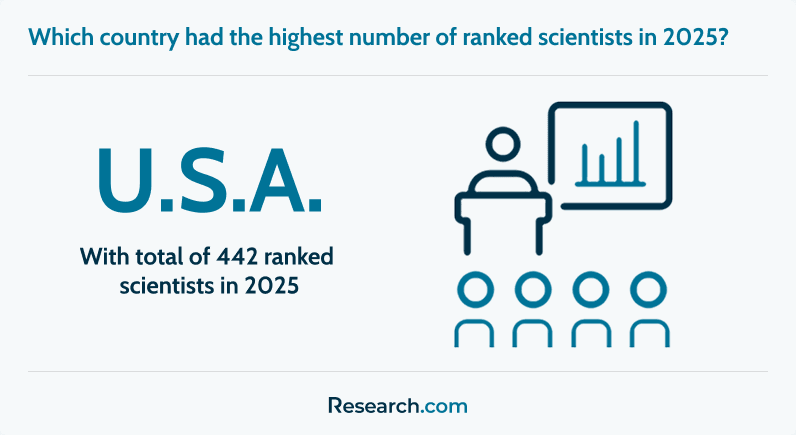
- Scholars from the United States managed to keep their top spot in the ranking with 442 scientists representing 44.2% of the top electronics scientists. The other countries with leading positions in the ranking are China (142 scientists or 14.2%), Canada (52 scientists or 5.2%), the United Kingdom (47 scientists or 4.7%), Australia (37 scientists or 3.7%), Singapore and Japan (26 scientists or 2.6%), Germany (24 scientists or 2.4%), and Switzerland (23 scientists or 2.3%).
- Only 6 out of 10 scientists in the top 1% are from the United States, while the other 4 researchers represent Denmark, Singapore, Australia, and China.
- Professor Frede Blaabjerg from Aalborg University in Denmark remains at the top of the ranking with a D-index of 200.
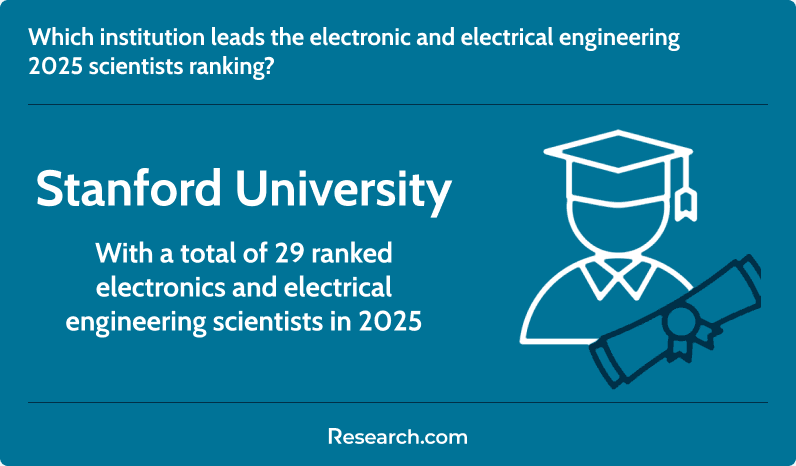
- In the 2025 edition of the top scientists in electronics and electrical engineering, Stanford University is the leading institution with a total of 29 scientists included in the ranking.
- 5 out of 10 leading institutions are American universities, while two are from China, and the rest are from Singapore, Belgium, and Switzerland.
- The average D-index for the top 1% of scientists is 171.1 against an average of 83.69 for all scientists included in the ranking.
The full ranking for the 2025 list of top electronics and electrical engineering scientists can be found here:
WORLD'S BEST ELECTRONICS AND ELECTRICAL ENGINEERING SCIENTISTS RANKING
Countries with the highest number of leading electronics & electrical engineering scientists
In 2025, the United States continues to lead the rankings, with 442 scientists making the list, accounting for 44.2% of the total. This marks a decrease from 2024, when 465 U.S.-based scientists were included, meaning 23 researchers did not retain their spots in the latest ranking.
Among the top 1% of scientists, six are affiliated with U.S. institutions, while the remaining six represent Denmark, Singapore, Australia, and China. China holds the second position with 142 ranked scientists, an increase of 19 scientists from its 2024 total of 123.
Canada follows in third place with 52 scientists, slightly down from 54 the previous year. The United Kingdom remains in fourth place with 47 scientists.
Other leading countries include Australia, which added one more scientist in the ranking for a total of 37, Singapore, which gained two to reach 26, and Japan, also with 26. Germany follows with 24, while Switzerland and Italy each have 23 scientists in the ranking.
Please note that the country associated with a scientist is based on their affiliated research institution according to MAG, not on their actual nationality.
Institutions with the highest number of leading scientists
In the 2025 edition of our ranking, Stanford University leads with 29 scientists. Climbing from its previous third-place position in 2024, the University of California-Berkeley now ranks second with 25 scholars, followed by MIT, which holds the third spot with 24 scientists.
Among the top 10 institutions, five are based in the United States, two in China, and the remaining three in Singapore, Belgium, and Switzerland. Tsinghua University in China entered the top 10 with 16 scientists securing the 5th spot, while ETH Zurich advanced from 10th place to 8th with 13 scientists.
Meanwhile, the National University of Singapore dropped to the 10th spot with 12 researchers. In the broader top 20, 12 of the leading institutions are U.S.-based, with other top-ranking universities including City University of Hong Kong and Tsinghua University in China, National University of Singapore and Nanyang Technological University in Singapore, ETH Zurich in Switzerland, and KU Leuven in Belgium.
How Does This Ranking Expand Career and Research Opportunities?
The global ranking of electronics and electrical engineering scientists plays a crucial role in expanding career and research opportunities by spotlighting top researchers and institutions at the forefront of innovation.
By recognizing leading scientists and their contributions, the ranking enhances visibility within the academic and professional communities, attracting funding, collaborations, and career advancements. It encourages knowledge exchange across borders, fostering international partnerships that drive technological progress.
For early-career researchers and students, the ranking serves as a valuable guide to identifying influential mentors, leading universities, and research hubs. Moreover, it helps industries and policymakers align their investments with emerging trends, ensuring that cutting-edge research translates into real-world applications.
How can accelerated educational paths boost career success in electronics & electrical engineering?
Accelerated educational paths can significantly boost career success in electronics and electrical engineering by allowing professionals to enter the workforce faster while staying ahead of rapid technological advancements. These programs, which condense coursework into shorter time frames or integrate hands-on industry experience, equip students with the latest skills and knowledge needed to excel in the field.
By reducing the time and cost of traditional education, accelerated degrees make it easier for aspiring engineers to gain specialized expertise, qualify for high-demand roles, and quickly adapt to emerging trends such as AI-driven electronics, renewable energy systems, and advanced semiconductor technologies.
How can online universities advance the tradition of research in electronics and electrical engineering?
Online universities can advance the tradition of research in electronics and electrical engineering by making high-quality education, collaboration, and innovation more accessible to a global audience. These institutions leverage cutting-edge digital tools, virtual labs, and AI-driven simulations to provide hands-on learning experiences that were once limited to physical campuses.
In 2024, several online universities reported significant increases in research funding, indicating a positive trend in collaborative financial support. For instance, the City University of New York (CUNY) received $672 million in external research awards for fiscal year 2024, marking a 6% increase over the previous year. In University of of South Carolina, research grants rose by 31% to $225 million, with federal funding totaling $245 million, which is a 35% rise over the previous year.
Additionally, partnerships with industry leaders, open-access research initiatives, and cloud-based experimentation platforms allow students and faculty to contribute to groundbreaking discoveries. Through these innovations, online universities help bridge the gap between academia and industry, ensuring that research in electronics and electrical engineering continues to thrive in the digital age.
D-index ranking – leaders, averages, and distribution
For Europe, Professor Frede Blaabjerg from Aalborg University in Denmark is ranked first in the region, and is also the top 1 scientist in the world ranking, with a D-index of 200.
For Oceania, Professor Peng Shi from the University of Adelaide in Australia tops the list and is also ranked 5th in the world ranking with a D-index of 169.
Professor Guanrong Chen from the City University of Hong Kong in China who leads in Asia is also at the 6th spot in the world ranking with a D-index of 164.
For North America, Professor Edward H. Sargent, from Northwestern University in the U.S. leads the list and ranks second on our top 100 list with a high D-index of 187.
Professor Jose Rodriguez from San Sebastián University in Chile is the highest-ranking scientist from South America with a world ranking of 73.
Professor Qing-Guo Wang from the University of Johannesburg in South Africa is the highest-ranking scientist in South Africa with a world ranking of 516.
The average D-index for the top 1% of scientists is 171.1 against an average of 83.69 for all scientists included in the ranking.
The scholar with the lowest index value who made it to the ranking in 2025 has a D-index of 65.
The average number of published articles within the field of electronics for the 1% of scientists in the ranking is 1,534 against an average of 600 for all ranking scholars.
The average number of citations for the top 1% of scientists is 129,724 against an average of 32,331 for all ranking scholars.
You can learn more about the methodology used to create the ranking here.
About Research.com
All research was coordinated by Imed Bouchrika, Ph.D., a computer scientist with a well-established record of collaboration on a number of international research projects with different partners from the academic community. His role was to make sure all data remained unbiased, accurate, and up-to-date.
Research.com is the number one research portal for science and educational rankings. Our mission is to make it easier for professors, research fellows, and students to progress with their research and find the top experts in a wide range of scientific disciplines. Research.com is also a leading educational platform that helps students find the best colleges, academic opportunities, and career paths.


