
World Online Ranking of Best Environmental Scientists – 2025 Report

Co-Founder and Chief Data Scientist
On May 28, 2025, Research.com released the 4th edition of its annual ranking of the world’s best environmental scientists. This report celebrates outstanding figures in the field who are making a global impact through their work. It aims to raise awareness of key contributors in environmental science, support scholars in advancing their research, and highlight those whose studies influence policies and practices worldwide.
We share these rankings to spotlight leaders in environmental science and encourage more collaboration across the global research community. The 2025 report helps educators, students, institutions, and organizations connect with top experts in different areas of environmental science. We also aim to inspire the next generation of scientists and decision-makers by recognizing these researchers.
The 2025 edition draws from a large pool of data. This year, the evaluation process reviewed more than 8,800 profiles of environmental scientists. These profiles were sourced from trusted bibliometric databases and analyzed using a range of key indicators. The goal was to ensure that the scientists featured in the report met strong academic and research standards.
To be considered for inclusion, a scientist must meet specific benchmarks. This edition required a minimum D-index of 30 in the environmental sciences field. Additional factors, such as how much of their work falls within environmental science and any notable awards or achievements, also played a role in the selection process. This method ensures that the report highlights both productive and influential individuals in their field.
Latest discoveries in environmental science research
A global study has revealed that fertilizers can help grasslands endure short-term droughts. Researchers tested 26 sites across nine countries and found that while drought reduced plant growth by 19%, adding nutrients increased it by 24%. When both drought and fertilizer were present, their effects balanced each other out. Grasses, especially in drier areas, responded well to added nutrients even during drought. This suggests that fertilizers may temporarily offset the impacts of drought, which is crucial for agriculture in changing climates.
In clean energy, scientists from Tohoku University and Vietnam National University have made a breakthrough using Janus heterobilayers. These two-sided materials achieved an efficiency of 16.62% in converting sunlight to hydrogen, surpassing many existing materials. Their unique structure generates internal electric fields that enhance charge separation, thereby improving water-splitting performance. This advancement brings us closer to efficient, sustainable hydrogen fuel production, offering a promising alternative to fossil fuels.
The key findings for the 4th edition of the best environmental science scientists ranking
- The United States leads globally in environmental science, with 449 scientists ranked in the top 1,000, significantly ahead of the United Kingdom (84) and China (82).
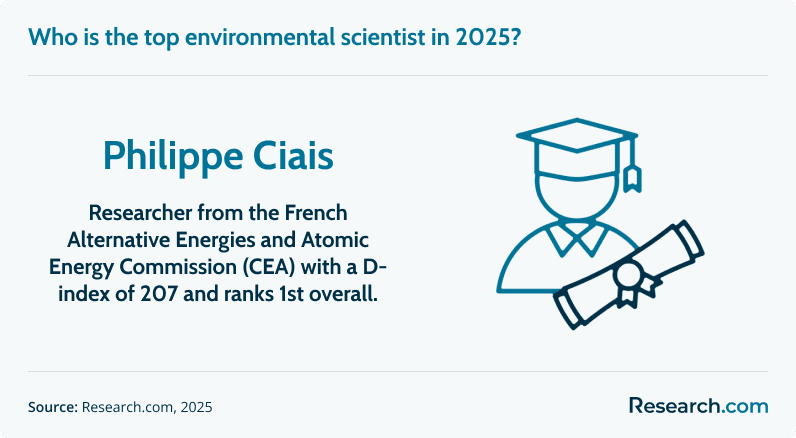
- Philippe Ciais from France is the top environmental scientist worldwide in 2025, with a D-index of 207.
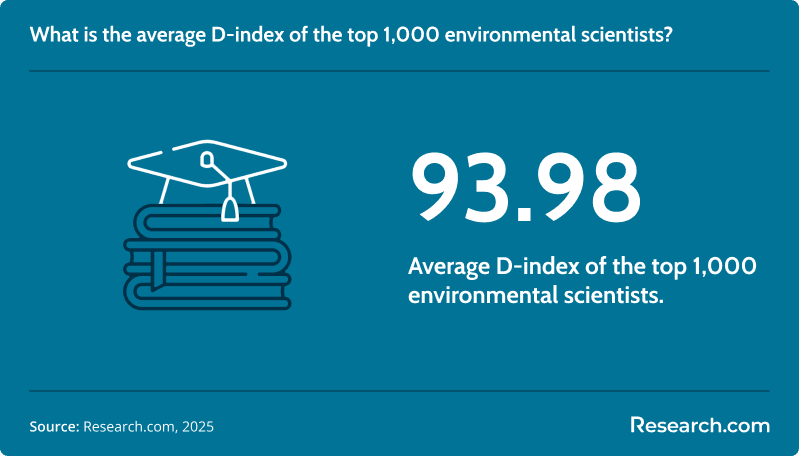
- The average D-index among the top 1% of scientists is 181.9, while the average for all ranked scientists is 93.98.
- The top 1% of environmental science researchers have an average of 1,217.1 publications and 136,531.9 citations.
- The Chinese Academy of Sciences ranks highest among institutions, with 23 scientists in the top 1,000 list.
The full ranking for the 2025 list of the best environmental scientists can be found here:
BEST ENVIRONMENTAL SCIENTISTS RANKING
Countries with the highest number of leading environmental science scientists
In the 2025 report, the United States remains a leader with a strong presence in the field of environmental science. This year, 449 scientists from U.S. institutions are ranked among the top 1,000. While the U.S. remains firmly at the top, it has seen a slight drop from 472 scientists in 2024. This shift could reflect changes in research output, global collaboration patterns, or institutional focus areas.
The United Kingdom keeps its second-place position with 84 scientists, slightly down from 89 in 2024. China follows closely in third with 82 scientists, showing growth compared to previous years. Germany ranks fourth with 63 scientists, also experiencing a modest drop from 65 in 2024 and 70 in 2023. Australia now holds the fifth position with 43 scientists, up from a tied sixth-place rank with Switzerland last year, when both had 37.
Canada remains in sixth with 37 scientists, showing stable representation. Switzerland slips to seventh with 33 scientists. France follows with 31, maintaining its eighth-place rank. The Netherlands and Spain also keep their positions with 25 and 22 scientists, respectively.
Overall, the top 10 countries remain the same, with minor shifts in rankings and totals. The data highlights continued global engagement in environmental science, with growing contributions from Asia and Oceania.
Please note that the country associated with a scientist is based on their affiliated research institution, according to MAG, not on their actual nationality.
Institutions with the highest number of leading scientists
The 2025 report reveals notable shifts among the top institutions in the field of environmental science. The Chinese Academy of Sciences now ranks first with 23 scientists in the global top 1,000, jumping from third place in 2024 when it had 18. This 28% increase reflects China’s growing influence in the field. In contrast, last year’s leader with 22 scientists, the National Center for Atmospheric Research, drops to fourth place in 2025 with 17 scientists.
The National Oceanic and Atmospheric Administration (NOAA) places second with 18 scientists. Goddard Space Flight Center also reports 17 scientists, moving it from second place in 2024 to third. These shifts suggest increased competition among U.S. research bodies.
ETH Zurich continues to represent Switzerland in the top five with 15 scientists, showing stable performance. The University of Washington also hosts 15 leading scientists, indicating consistent research excellence. Institutions such as the University of Maryland (12), Caltech (11), and MIT (10) continue to be strong contributors.
Of the top 20 institutions, 15 are based in the United States, making up 75% of the list. The remaining five are from China, Switzerland, Spain, and the U.K. This data shows that while the U.S. remains dominant, research leadership is increasingly shared with top institutions abroad, especially in China and Europe.
The role of online universities in advancing environmental science research
As climate change accelerates, so does the need for new scientific solutions. Global surface temperatures rose 2.39°F above the 20th-century average, making it the hottest January ever recorded. This environmental shift highlights the need for faster, broader access to science education and research opportunities. That’s where online universities are stepping up.
Online universities play a growing role in environmental science by making research education more accessible. With flexible schedules and remote lab technologies, students worldwide can now contribute to climate change, conservation, and sustainability studies. This format also enables professionals working in environmental fields to upskill without leaving their current roles. As a result, more researchers, regardless of location, can join global networks focused on solving today’s environmental challenges.
Enrollment in online programs has continued to climb. In the U.S. alone, more than 60% of all college students took at least one online course last year. This shift toward digital learning opens the door for future environmental scientists to access training and collaborate on research projects from anywhere in the world. By expanding access, online universities help diversify the field and speed up innovation in environmental science.
D-index ranking — leaders, averages, and distribution
For Europe, Philippe Ciais from the French Alternative Energies and Atomic Energy Commission (CEA), France, is the leading scientist worldwide with a D-index of 207 and ranks 1st overall.
For North America, John H. Seinfeld from the California Institute of Technology, United States, is the top scientist in the region with a D-index of 194 and a world ranking of 2nd.
Professor Yong Sik Ok from Korea University, South Korea, leads the top scientists in Asia and ranks 8th globally with a D-index of 170.
Professor Paulo Artaxo from Universidade de São Paulo, Brazil, continues to lead in South America, ranking 48th globally with a D-index of 131.
Professor Nanthi Bolan from the University of Western Australia is the top-ranked scientist in Oceania, holding the 55th spot globally with a D-index of 128.
Philip K. Thornton from Kenya's Climate Change, Agriculture, and Food Security program leads in Africa with a global ranking of 233 and a D-index of 101.
The average D-index for the top 1% of environmental science scientists is 181.9, compared to 93.98 for all researchers ranked.
The lowest D-index among scientists included in the 2025 ranking is 30.
On average, the top 1% of scientists have 1,217.1 publications and 136,531.9 citations, while all scientists ranked have an average of 386.39 publications and 39,375.65 citations.
You can learn more about the methodology used to create this report here.
About Research.com
All research was coordinated by Imed Bouchrika, Ph.D., a computer scientist with a well-established record of collaboration on a number of international research projects with different partners from the academic community. His role was to make sure all data remained unbiased, accurate, and up-to-date.
Research.com is the number one research portal for science and educational rankings. Our mission is to make it easier for professors, research fellows, and students to progress with their research and find the top experts in a wide range of scientific disciplines. Research.com is also a leading educational platform that helps students find the best colleges, academic opportunities, and career paths.


