
World Online Ranking of Best Economics & Finance Scientists – 2024 Report

Co-Founder and Chief Data Scientist
Research.com published the 3rd edition of its annual ranking of the best scientists in economics and finance on April 5, 2024. This guide explains what the ranking measures, which countries and institutions are most represented, how to interpret D-index results, and what the findings suggest for researchers, graduate students, academic leaders, and professionals following economics and finance research.
The ranking is useful for readers who want to identify influential scholars, understand where leading research activity is concentrated, compare institutions, or explore research trends shaping economics and finance. It should not be read as a complete measure of a scientist’s value or future impact, but as a structured bibliometric view of highly cited and discipline-relevant research output.
Quick answer: what does the 2024 economics and finance scientist ranking show?
The 2024 Research.com ranking highlights leading economics and finance scholars using the D-index, also known as the Discipline H-index, along with discipline-specific publication relevance, achievements, and awards. For this edition, Research.com reviewed nearly 2,800 scientist profiles from multiple bibliometric data sources. Scholars were considered if they had a D-index of at least 30 and if most of their publications were in economics and finance.
| Ranking question | 2024 finding |
| Which country has the most ranked economics and finance scientists? | The United States leads with 627 scholars, representing 62.7% of the ranking. |
| Which institution has the largest number of ranked scholars? | Harvard University ranks first with 58 affiliated scientists, equal to 5.8% of the ranking. |
| How strong is the top 1% by D-index? | The top 1% has an average D-index of 152.7, compared with 69.04 for all scientists included in the ranking. |
| Which non-educational institution is most prominent? | The World Bank ranks 12th and is the highest-ranking non-educational research institution noted in the report. |
| Where can readers see the full list? | The complete 2024 ranking is available through the best economics and finance scientists ranking. |
How the 2024 ranking was built
For the 2024 edition, Research.com analyzed nearly 2,800 profiles of scientists whose work is connected to economics and finance. The ranking relied on several bibliometric indicators, with final inclusion determined by each researcher’s measured output, discipline relevance, and recognized contributions.
The D-index threshold was set at 30. To be considered, a scholar also needed to have most of their publications in economics and finance. Additional criteria included the share of contributions made within the discipline and the scientist’s awards and achievements in the same field.
Because the ranking is based on institutional affiliation, the country assigned to a scholar reflects the location of the affiliated research institution. It does not necessarily indicate the scientist’s nationality.
Latest research directions in economics and finance
Two research directions are especially visible in current economics and finance work: the economic valuation of environmental systems and the use of machine learning in financial markets. Both areas matter because they connect technical research with decisions made by governments, investors, companies, and international organizations.
One growing area examines how to measure the economic value of biodiversity conservation. As climate-related losses intensify, economists are working to show how preserving ecosystems can support long-term economic welfare, public health, food systems, and resource stability.
A practical method in this area is ecosystem service valuation. This approach assigns economic value to benefits such as carbon sequestration, water purification, and pollination. These estimates can help policymakers compare conservation investments with competing budget priorities and make trade-offs more visible.
Another active research area is the use of machine learning to study stock price trends. More financial data and stronger algorithmic tools have made it easier to test models that identify market patterns. However, stock markets remain uncertain, and machine learning should be treated as a decision-support method rather than a guarantee of prediction accuracy.
Key findings from the 3rd edition of the best economics and finance scientists ranking
- The United States has the largest representation, with 627 scholars, or 62.7% of all leading economics and finance scientists in the ranking.
- The next most represented countries are the United Kingdom with 115 scholars or 11.5%, the Netherlands with 32 scholars or 3.2%, Germany with 30 scientists or 3.0%, and China with 23 scholars or 2.3%.
- Among scientists in the top 1%, 8 out of 10 are affiliated with institutions in the United States.
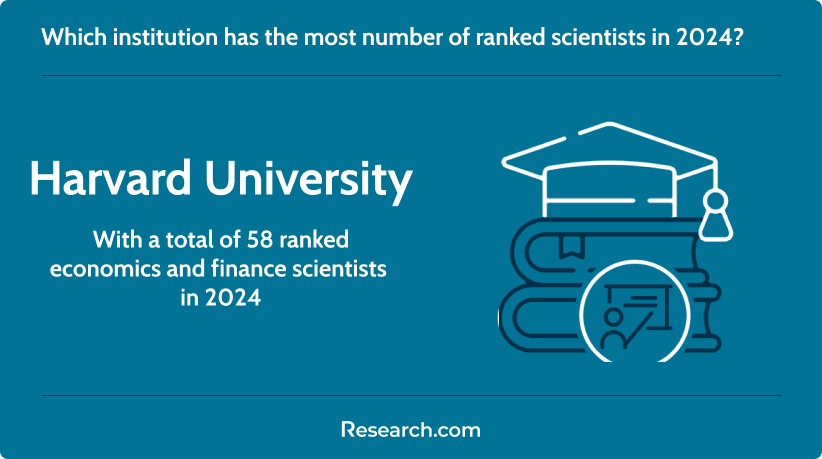
- Harvard University is the leading research institution in 2024, with 58 affiliated economics and finance scientists, representing 5.8% of the ranking.
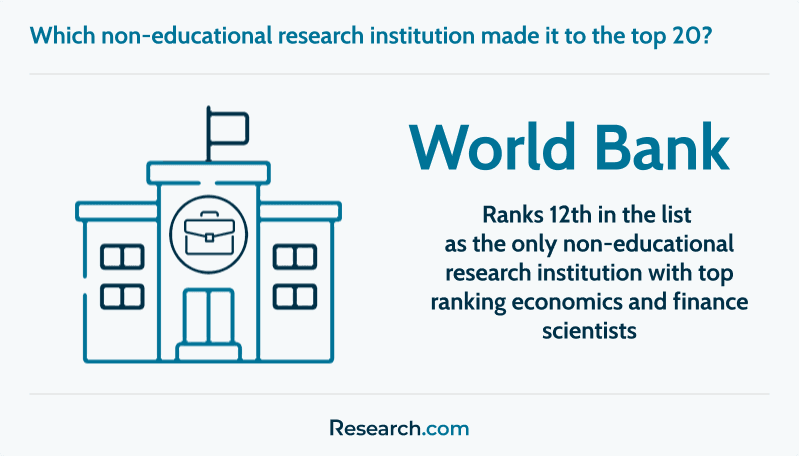
- The World Bank ranks 12th and is the highest-ranking non-educational research institution in the report.
- The average D-index for the top 1% of scientists is 152.7, while the average for all scientists included in the ranking is 69.04.
Readers who want to review individual profiles, institutions, and country-level results can access the full list here:
View the full Research.com ranking of best economics and finance scientists
Countries with the most leading economics and finance scientists
The United States remains the dominant country in the 2024 report, even though its total number of ranked scientists declined. It accounts for 627 scholars, equal to 62.7% of the best economics and finance scientists list. In the top 1%, 8 out of 10 scientists are based in the United States, while two scholars are affiliated with institutions in the United Kingdom and France.
The United Kingdom places second with 115 scientists, which is 18 fewer scientists than the previous year. The Netherlands follows in third place after moving up one position, with 32 ranked scholars. Germany holds fourth place with 30 scholars.
China ranks fifth in the 2024 edition with 23 scientists. Australia also has 23 scholars. France added five more scholars for a total of 22, while Canada has 20 scholars.
The country listed for each scientist is based on the affiliated research institution, not the scholar’s citizenship or nationality.
| Country | Number of ranked scholars | Share or ranking note |
| United States | 627 | 62.7% of the ranking; 8 out of 10 scientists in the top 1% |
| United Kingdom | 115 | 11.5%; second overall |
| Netherlands | 32 | 3.2%; third overall |
| Germany | 30 | 3.0%; fourth overall |
| China | 23 | 2.3%; fifth overall |
| Australia | 23 | Also listed with 23 scholars |
| France | 22 | Added five more scholars |
| Canada | 20 | Included among the countries with notable representation |
How doctoral cost can influence research careers in economics and finance
For many future researchers, the path to economics and finance scholarship begins with doctoral study. The cost of that path can affect who enters the field, how long students can remain in full-time research, and whether early-career scholars have the flexibility to pursue academic roles, policy research, or industry positions.
When comparing doctoral options, prospective students should evaluate tuition, fees, assistantships, research funding, living expenses, and the opportunity cost of years spent outside full-time professional employment. A lower-cost program is not automatically better, but a financially sustainable program can reduce pressure and give students more room to focus on publishing, conference participation, and long-term research development.
Students who are planning for advanced study can use Research.com’s guide to PhD costs to understand the major expenses that may affect doctoral decision-making.
Institutions with the highest number of leading scientists
Harvard University leads the 2024 ranking after gaining 8 more scientists, with 58 researchers included among the top economics and finance scientists. MIT ranks second with 36 scientists, followed by the University of Chicago in third place with 33 scholars.
In the top 1%, 9 out of 10 research universities are located in the United States. The exception is the London School of Economics and Political Science in the United Kingdom.
Among the leading U.S. universities, Harvard is the only institution with three scientists in the top 1%. Those scholars hold the 4th, 8th, and 10th positions.
The World Bank is the only non-educational institution appearing prominently in the top 20 list, with 16 scholars.
Among the 20 institutions with the highest number of scientists, 16 universities are based in the United States. Three are in the United Kingdom: the London School of Economics and Political Science, the University of Oxford, and the University of Cambridge. The World Bank is also included as an international financial institution.
| Institution | 2024 ranking detail | Why it matters |
| Harvard University | 58 affiliated scientists; 5.8% of the ranking | Highest institutional representation in the 2024 list |
| MIT | 36 scientists | Second-highest number of ranked scholars |
| University of Chicago | 33 scholars | Third-highest institutional count |
| World Bank | 16 scholars | Only non-educational institution highlighted in the top 20 list |
How financial accessibility affects research impact
Access to affordable education can influence who becomes a researcher and what kinds of questions enter the field. Students with fewer financial barriers may have more opportunity to pursue graduate study, acquire research skills, participate in academic networks, and contribute to economics and finance from a wider range of backgrounds.
Financial accessibility matters most when it is paired with academic quality. Students should not judge a program only by advertised price. They should also check institutional accreditation, faculty research strength, funding availability, placement outcomes, and whether the curriculum supports quantitative, policy, or finance-focused goals.
For students looking for lower-cost college pathways, Research.com’s guide to cheap online colleges that accept FAFSA can be a starting point for comparing financial aid-friendly options.
Can shorter doctoral programs improve research momentum?
Shorter doctoral timelines can help some students move into research, teaching, policy, or industry work sooner. This can be useful in fields such as economics and finance, where data tools, market behavior, and policy questions evolve quickly.
However, speed should not be the only factor. A doctoral program must still provide sufficient methodological training, dissertation support, access to faculty mentors, and opportunities to publish. A faster program may be a good fit for highly prepared students with clear research goals, but it may not suit students who need more time to build quantitative foundations or explore research areas.
Students comparing flexible doctoral routes can review Research.com’s overview of the fastest online PhD options while also checking program rigor, dissertation expectations, and faculty expertise.
How advanced degrees can shape economics and finance careers
Advanced degrees can help professionals move into roles that require deeper analytical training, stronger research methods, and more specialized knowledge of markets, policy, risk, or financial systems. They may be especially valuable for people targeting research posts, quantitative finance, central banking, consulting, policy analysis, or academic careers.
At the same time, a degree alone does not guarantee a higher salary, promotion, or research visibility. Outcomes depend on the field of study, school quality, work experience, location, professional network, and the student’s ability to apply technical knowledge to real problems.
Professionals comparing graduate options can explore Research.com’s guide to master’s degrees with strong earning potential to see how advanced credentials may align with career planning.
Can accelerated academic programs support faster career growth?
Accelerated academic programs can be useful for working professionals who need targeted credentials quickly. In economics and finance, shorter programs may help learners build practical skills in data analysis, business decision-making, financial modeling, or management without committing to a longer traditional pathway.
The trade-off is depth. A condensed program may not provide the same research preparation as a thesis-based master’s or doctoral program. It is often better for career switching, skill upgrading, or advancement in applied roles than for someone whose main goal is to become a tenure-track researcher.
Readers interested in compact study routes can compare Research.com’s list of 1 year degrees that pay well and consider whether a shorter program matches their long-term goals.
How online universities and digital collaboration support economics and finance research
Online platforms have made it easier for economics and finance scholars to collaborate across institutions and countries. Researchers can share datasets, co-author papers, attend virtual seminars, and exchange methods without being limited by geography.
Digital collaboration can also support multidisciplinary work. Studies of academic collaboration show that shared networks can broaden research perspectives, and online tools make it easier to combine knowledge from economics, finance, data science, public policy, and environmental studies. This type of collaboration across disciplines can strengthen the design and interpretation of research.
Online research networks are also useful for following applied topics in development economics. Resources such as the World Bank’s roundup of recent development economics research show how scholars and institutions track emerging evidence on policy and economic outcomes.
Are industry certifications helping close skill gaps in economics and finance?
Industry certifications can help professionals gain focused skills without enrolling in a full degree program. In economics and finance, this can be useful for people who need practical training in analytics, compliance, financial technology, risk management, or data-driven decision-making.
Certifications are not a substitute for a research doctorate or a rigorous graduate degree. They work best as complements: a way to update applied skills, signal commitment to employers, or build competence in a specific tool or practice area.
Professionals considering shorter credentials can review Research.com’s guide to quick certifications that pay well, while also verifying whether a credential is respected by employers in their target field.
How cost-effective online education can support professional growth
Online graduate education can reduce some barriers for students who need flexibility, especially working adults, caregivers, and learners who cannot relocate. In economics and finance-related careers, online programs may provide access to quantitative methods, applied analytics, research design, and management training.
Students should still evaluate online programs carefully. Important questions include whether the school is accredited, whether faculty have relevant expertise, how the program supports research or capstone work, and whether employers or doctoral programs recognize the credential.
For learners comparing flexible graduate pathways, Research.com’s guide to affordable online master’s degree programs can help identify options that may reduce cost while preserving academic quality.
D-index ranking: leaders, averages, and distribution
Professor Joseph E. Stiglitz of Columbia University in the United States leads the global list with a D-index of 187.
In Europe, Professor Mike Wright of Imperial College London in the United Kingdom has a D-index of 146 and ranks 6th worldwide.
In Asia, Professor Muhammad Shahbaz of the Beijing Institute of Technology in China leads with an h-index of 112 and ranks 39th globally.
In Oceania, Professor David A. Hensher of the University of Sydney in Australia leads the region with a D-index of 111 and a world ranking of 42.
Professor Rangan Gupta of the University of Pretoria is the leading ranked researcher in South Africa and holds the 301st position worldwide.
Professor Benjamin Miranda Tabak of Fundação Getulio Vargas in Brazil is the highest-ranking scientist from South America, with a world ranking of 1077.
| Metric | Reported value |
| Average D-index for the top 1% of scientists | 152.7 |
| Average D-index for all 2000 scientists included in the ranking | 69.04 |
| Lowest D-index value for a scholar included in the ranking in 2023 | 53 |
| Average number of published articles for the top 1% | 637 |
| Average number of published articles for all 2000 scholars | 274 |
| Average citations for the top 1% | 194,773 |
| Average citations for all 1000 scholars | 38,115 |
You can review additional details about the ranking process in Research.com’s methodology.
How to use this ranking responsibly
Scientist rankings can help identify influential researchers, strong institutions, and active research communities. They are especially useful for students searching for potential mentors, universities evaluating research strengths, and professionals tracking experts in economics and finance.
Still, a ranking should be only one part of the decision process. Bibliometric measures may favor established researchers, highly cited subfields, English-language publications, or scholars affiliated with large institutions. Readers should combine ranking data with publication quality, current research fit, mentorship availability, program funding, and institutional culture.
Questions to ask before using the ranking for a major decision
- Does the scholar’s current research match your intended topic, method, or policy interest?
- Is the scientist actively publishing or advising students in the area you want to study?
- Does the institution offer funding, research assistantships, datasets, seminars, or lab support?
- Are you comparing scholars within the same subfield, or across areas with different citation patterns?
- Does the university’s overall program fit your academic and career goals, beyond one highly ranked faculty member?
Common mistakes when interpreting scientist rankings
| Common mistake | Better approach |
| Assuming a high institutional count means every program at the school is the best fit | Compare the specific department, faculty availability, research area, funding, and student outcomes. |
| Using D-index as the only measure of research quality | Review recent publications, citation context, field norms, awards, and the scholar’s current work. |
| Choosing a graduate program only because one famous scholar is affiliated there | Confirm whether that scholar is accepting students and whether multiple faculty members match your interests. |
| Ignoring cost while pursuing research prestige | Evaluate tuition, funding, living expenses, debt risk, and opportunity cost before enrolling. |
| Assuming online, accelerated, or low-cost programs are automatically weaker or stronger | Check accreditation, curriculum depth, faculty expertise, employer recognition, and research support. |
Key insights
- The 2024 Research.com economics and finance ranking is built around the D-index, discipline relevance, and recognized scholarly contributions.
- The United States has the strongest representation, with 627 scholars and 62.7% of the ranking.
- Harvard University leads all institutions with 58 affiliated scientists, while the World Bank is the most prominent non-educational institution highlighted in the report.
- The top 1% of ranked scientists has a much higher average D-index, 152.7, than the overall listed group, which averages 69.04.
- Research trends in the field include biodiversity valuation, climate-related economic analysis, financial machine learning, and digital research collaboration.
- Students and professionals should use the ranking as a starting point, not a final decision tool. Fit, funding, faculty availability, accreditation, and career goals still matter.
About Research.com
All research was coordinated by Imed Bouchrika, Ph.D., a computer scientist with an established history of collaboration across international academic research projects. His role was to help ensure that the data remained unbiased, accurate, and up to date.
Research.com is a research and education portal focused on science rankings, academic discovery, college information, and career guidance. Its mission is to help professors, research fellows, students, and professionals identify leading experts, compare educational options, and make better-informed academic and career decisions.


