
World Online Ranking of Best Genetics Scientists – 2024 Report

Co-Founder and Chief Data Scientist
Research.com published the third edition of its best genetics scientists report on May 7, 2024. The report is designed for readers who need a clear view of influential genetics researchers, major research hubs, and the institutions and countries shaping the field.
This guide explains what the ranking measures, what the 2024 results show, and how students, researchers, policymakers, and industry leaders can use the list responsibly. It also summarizes current developments in genetics research, education pathways for aspiring scientists, and practical questions to ask before using rankings to guide collaboration, hiring, study, or funding decisions.
Quick answer: What does the 2024 genetics scientists ranking show?
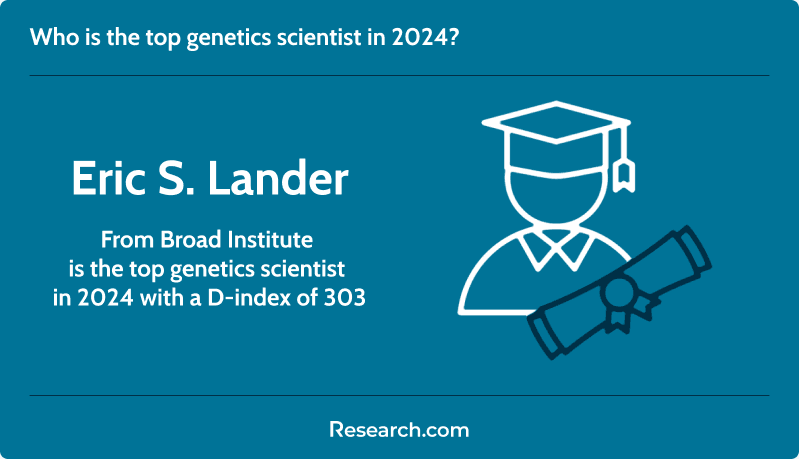
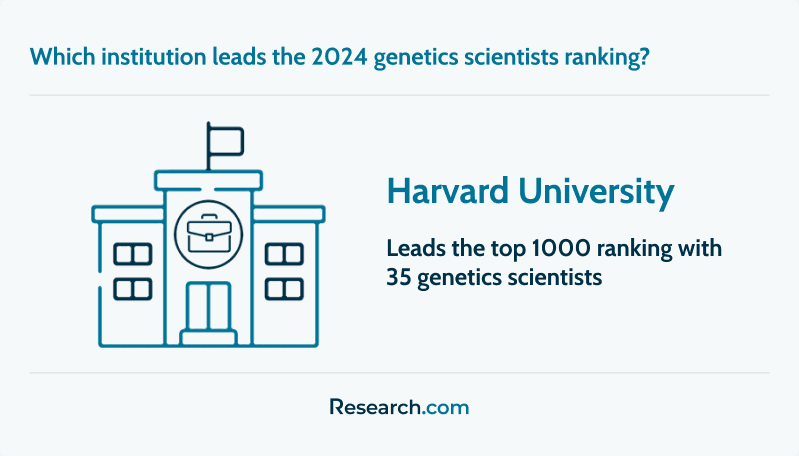
The 2024 Research.com ranking highlights leading genetics scientists based on bibliometric indicators, research output, field recognition, and related academic accomplishments. The United States has the largest presence in the report, with 491 affiliated scholars. Harvard University leads all institutions with 35 affiliated scientists. Eric S. Lander of Broad Institute, United States, ranks as the top genetics scientist worldwide, with a D-index of 303.
The full list is available here: best genetics scientists ranking.
How the 2024 genetics scientists report was developed
To prepare the 2024 edition, the Research.com team reviewed nearly 4,000 scientist profiles using bibliometric databases, OpenAlex, CrossRef, and additional publication sources. The evaluation emphasized measurable research impact, including published work, honors in genetics, and other documented achievements across each scientist’s career.
Profiles considered for inclusion had a D-index score of at least 40 and were associated primarily with journals and publications focused on genetics research. The D-index is used as one indicator of research influence, but readers should treat it as part of a broader assessment rather than as a complete measure of a scientist’s value, originality, mentorship, or current project relevance.
How to use this ranking effectively
A ranking of leading genetics scientists can help identify influential researchers, but it should not be used as the only basis for decisions. The best use depends on the reader’s goal.
| Reader goal | How the ranking can help | What else to check |
| Finding research collaborators | Identify scientists with strong publication records and institutional visibility. | Review recent papers, active grants, lab focus, availability, and fit with your project. |
| Choosing graduate programs or research mentors | Spot institutions with many highly cited genetics scholars. | Compare mentorship style, lab openings, funding, program outcomes, and student support. |
| Tracking global genetics research hubs | See which countries and institutions have strong representation in the report. | Look at local funding, research infrastructure, regulatory environment, and collaboration networks. |
| Policy or industry outreach | Locate experts who may advise on genetics-related initiatives. | Confirm current affiliations, conflicts of interest, translational experience, and domain specialization. |
Latest discoveries in genetics science research
Two active areas show why genetics research remains central to medicine, biotechnology, and public health. One area involves deeper investigation of the innate immune system, the body’s immediate defense against pathogens. Researchers are studying how genetic factors affect immune-cell recognition and response, which may help identify targets for therapies related to infections and chronic inflammatory conditions.
Personalized medicine is also advancing through genome-matched treatments. In this approach, clinicians and researchers examine a patient’s genetic profile to guide therapy selection. The strategy is especially relevant in cancer care, where specific tumor mutations may be matched with targeted drugs. Similar approaches are being studied for conditions such as cystic fibrosis and melanoma.
How can aspiring genetics scientists build career momentum through advanced online education?
Future genetics researchers can strengthen their preparation by combining formal coursework with hands-on research exposure. Online and hybrid programs may be useful for learners who need flexibility while developing skills in genetics, bioinformatics, statistics, molecular biology, health sciences, or data analysis.
The best online education choice depends on career intent. A student aiming for laboratory research may need a biology, genetics, genomics, bioinformatics, or biomedical sciences pathway. A professional moving toward healthcare leadership or interdisciplinary clinical work may need a different type of graduate preparation. For readers comparing health-related pathways beyond genetics, online direct entry MSN programs can provide context on another advanced health sciences route.
Key findings from the 3rd edition of the best genetics scientists ranking
- The United States has the strongest representation in the 2024 report, with 491 scholar profiles.
- Harvard University ranks first among institutions for genetics science research, with 35 affiliated scholars included.
- American universities account for 5 out of the top 10 institutions in the report.
- Eric S. Lander of Broad Institute, United States, is the highest-ranked genetics scientist, with a D-index of 303.
- The average D-index for the top 1% of scientists is 228, compared with an average of 105.91 for the top 1000 scholars in the ranking.
Countries with the highest number of leading genetics scientists
The United States leads the 2024 ranking by affiliated research institution, with 491 scholars included in the report.
The United Kingdom follows with 143 scientists, which is five more than in the previous year. Germany ranks third with 78 scientists. Japan is next with 37 scientists, followed by The Netherlands with 35 scientists.
The remaining countries in the top 10 are France with 34 scientists, Australia with 27, Canada with 25, Spain with 14, and China with 13.
The country assigned to each scientist reflects the affiliated research institution listed according to MAG. It should not be interpreted as the scientist’s nationality.
| Rank context | Country | Number of scientists in the report |
| Highest representation | United States | 491 |
| Second | United Kingdom | 143 |
| Third | Germany | 78 |
| Fourth | Japan | 37 |
| Fifth | The Netherlands | 35 |
What challenges and opportunities are shaping genetics research today?
Genetics research is expanding quickly, but progress brings practical challenges. Scientists must manage large and sensitive datasets, work within evolving ethical and regulatory expectations, and address unequal access to research funding, tools, and clinical implementation. These issues matter because genetic discoveries can influence diagnosis, treatment decisions, public health policy, and commercial biotechnology development.
At the same time, genetics researchers now have more opportunities to collaborate across disciplines. Computational biology, artificial intelligence-assisted analysis, cloud-based research environments, and online learning resources can help teams work across institutions and countries. Students and professionals who need flexible study options may also compare financial-aid-aware pathways such as online colleges that accept FAFSA, especially when cost and access are major constraints.
Institutions with the highest number of leading genetics scientists
Harvard University has the highest institutional representation in the 2024 genetics science report, with 35 affiliated scientists included.
The National Institutes of Health ranks second, with 29 scientists in the ranking. Stanford University follows with 21 scientists. The University of Washington and the Max Planck Society each have 20 scientists included.
Other institutions appearing in the top 10 include the University of Oxford, the University of Cambridge, the University of Edinburgh, Wellcome Sanger Institute, the University of California-San Francisco, Baylor College of Medicine, and MIT.
American universities and institutions make up 50% of the top 10 leading institutions. The rest of the top group includes three universities in the U.K., one from Scotland, and one from Germany.
| Institution | Scientists included in the report | What this may indicate |
| Harvard University | 35 | Large concentration of highly visible genetics research activity. |
| National Institutes of Health | 29 | Strong federal research presence across genetics-related fields. |
| Stanford University | 21 | High institutional visibility in genetics and adjacent biomedical research. |
| University of Washington | 20 | Notable representation among leading genetics scholars. |
| Max Planck Society | 20 | Strong international research presence in genetics and related sciences. |
Can a fast online master’s degree support innovation in genetics?
A fast master’s degree online may help some learners build skills more quickly, but it is not the right option for every aspiring genetics scientist. Accelerated programs are most useful for students who already have a strong science foundation, clear career goals, and enough time to handle an intensive workload.
For genetics-related careers, the most valuable graduate programs usually include rigorous training in research methods, genomics, molecular biology, statistics, bioinformatics, ethics, and scientific communication. Students should verify whether an accelerated format includes meaningful faculty access, research opportunities, thesis or capstone options, and preparation for doctoral study or industry roles. Those comparing compressed graduate timelines can review options for a fast master’s degree online.
Strengthening genetics research through online universities and digital collaboration
Online universities and digital learning platforms can broaden access to genetics, bioinformatics, computational biology, and related coursework. This matters for students who cannot relocate, working professionals who need flexible schedules, and researchers who want to update technical skills without pausing their careers.
Digital environments can also support collaboration across institutions. Shared workspaces, remote seminars, online datasets, and virtual research meetings make it easier for teams to review data, discuss findings, and coordinate projects across locations. Examples of university-linked digital research environments, such as online platforms connected to genetics research, show how distance-based tools can support scientific exchange.
However, online learning has limits. Genetics is a laboratory-intensive field, and many research careers require in-person training, supervised experiments, access to specialized equipment, or clinical research settings. Students should confirm whether an online program includes lab components, research mentorship, internship options, or pathways into doctoral-level work.
How does educational background affect genetics research careers?
Education level strongly shapes the type of genetics work a person can do. Entry-level laboratory or technical roles may be possible with undergraduate preparation, while independent research positions usually require graduate study. Faculty roles, principal investigator positions, and advanced research leadership generally require doctoral training and a strong publication record.
| Education pathway | Best fit | Important limitation |
| Associate-level study | Students exploring biology, laboratory science, or transfer pathways. | Usually not enough for independent genetics research roles. |
| Bachelor’s degree | Preparation for lab assistant roles, graduate school, or entry-level biotech work. | Career growth may be limited without research experience or graduate training. |
| Master’s degree | Specialization in genomics, bioinformatics, molecular biology, or applied research. | May not qualify graduates for independent academic research leadership. |
| Doctoral degree | Students seeking advanced research, faculty careers, or principal investigator roles. | Requires a major time commitment and sustained research productivity. |
Students still deciding between undergraduate options may benefit from comparing an associate degree and a bachelor’s degree before committing to a long-term research pathway.
Can advanced genetics education lead to high-earning career opportunities?
Advanced genetics education can open doors to research, biotechnology, pharmaceutical, academic, healthcare, and data-focused roles. Earnings vary widely by role, employer, location, experience, funding environment, and whether the position is academic, clinical, or industry-based. A degree alone does not guarantee a specific salary.
Students who want to connect scientific training with stronger earning potential should look for programs that combine genetics expertise with applied skills: bioinformatics, statistics, programming, regulatory knowledge, project management, scientific writing, and experience with large biological datasets. Readers comparing broader degree-to-career options can use this guide on degrees linked to $100k salary jobs as additional context.
Can fast-track doctoral programs increase research impact in genetics?
Accelerated doctoral pathways may help qualified students move into advanced research faster, but speed should not come at the expense of research quality. In genetics, doctoral training depends on rigorous methods, publication development, mentorship, data interpretation, ethical research conduct, and deep specialization.
Fast-track doctoral formats may be most appropriate for students who already have strong preparation, a defined research interest, and access to a suitable advisor. Before enrolling, applicants should ask whether the program provides dissertation support, lab or computational research infrastructure, funding options, and realistic timelines. Students comparing accelerated doctoral routes can review fast PhD programs while also checking academic rigor and research fit.
D-index leaders, averages, and distribution
In North America, Eric S. Lander of Broad Institute, United States, leads the region. He is also the top-ranked genetics scientist globally, with a D-index of 303.
In Europe, Kari Stefansson of deCODE Genetics, Iceland, is the leading scientist. He ranks fifth worldwide, with a D-index of 219.
In Oceania, Nicholas G. Martin of QIMR Berghofer Medical Research Institute, Australia, holds the top regional position and ranks 9th in the report, with a D-index of 206.
In Asia, Yusuke Nakamura of the Japanese Foundation For Cancer Research, Japan, is the leading scientist. He ranks 10th in the report, with a D-index of 202.
In the Middle East, Takashi Gojobori of King Abdullah University of Science and Technology, Saudi Arabia, is the region’s top scientist. He ranks 517 in the report, with a D-index of 97.
The average D-index for the top 1% of scholars is 228, compared with 105.91 for all scientists included in the ranking.
The average number of published articles for the top 1% of scholars is 1093.1, while the average for all scholars is 382.26.
The average citation count for the top 1% of scientists is 279,606.4, compared with 62,599.75 for all scholars.
| Metric | Top 1% of scholars | All scholars in the ranking |
| Average D-index | 228 | 105.91 |
| Average published articles | 1093.1 | 382.26 |
| Average citations | 279,606.4 | 62,599.75 |
You can read more about the ranking process and data approach in the Research.com methodology here.
Common mistakes when interpreting genetics scientist rankings
- Assuming one metric tells the whole story. The D-index is useful, but it does not capture every form of scientific contribution, including mentorship, team leadership, translational impact, or emerging work.
- Ignoring research fit. A highly ranked scientist may not be the right collaborator or mentor if their current research does not align with your project.
- Using institutional counts as a proxy for program quality. A university with many leading researchers may still vary by department, lab, funding availability, admissions competitiveness, and student support.
- Overlooking current activity. Rankings reflect documented research impact, but readers should still review recent publications, active grants, lab websites, and current affiliations.
- Choosing education pathways based only on speed or prestige. Genetics careers require strong technical training, research experience, and careful mentorship—not only a recognizable school name or a shorter program timeline.
Questions to ask before choosing a genetics research or education pathway
- Does the program or lab match the area of genetics I want to study?
- Will I receive training in both biological methods and data analysis?
- Are there opportunities for supervised research, publication, internships, or thesis work?
- Does the institution offer access to relevant laboratories, datasets, clinical partnerships, or computational tools?
- How do graduates progress into doctoral programs, research roles, biotech positions, or healthcare-related careers?
- If the program is online or accelerated, how does it handle laboratory training, mentorship, and research quality?
- What are the full costs, including fees, materials, travel, residency requirements, and lost work time?
Key insights
- The 2024 Research.com genetics scientists report reviewed nearly 4,000 profiles and included scientists with a D-index score of at least 40 whose work is primarily tied to genetics research.
- The United States leads the country-level distribution with 491 affiliated scholars, while Harvard University leads institutions with 35 affiliated scientists.
- Eric S. Lander of Broad Institute, United States, ranks first worldwide in the report, with a D-index of 303.
- Genetics research is advancing through areas such as innate immune system research and genome-matched treatments, but ethical, privacy, regulatory, and access issues remain important.
- Students should use rankings as a starting point—not a final decision tool—when choosing mentors, graduate programs, collaborators, or research institutions.
- Online and accelerated education can support career growth when programs offer strong scientific training, research support, and credible pathways into genetics-related work.
About Research.com
All research was coordinated by Imed Bouchrika, Ph.D., a computer scientist with extensive experience collaborating on international research projects with academic partners. His role was to help ensure that the data remained unbiased, accurate, and up-to-date.
Research.com is a research portal for science and educational rankings. Its mission is to help professors, research fellows, and students identify leading experts across scientific disciplines and advance their research. Research.com also supports learners by providing information on colleges, academic opportunities, and career pathways.


