
World Online Ranking of Best Immunology Scientists – 2025 Report

Co-Founder and Chief Data Scientist
On April 24, 2025, Research.com released the third edition of its annual ranking of the leading scientists in immunology. This report aims to spotlight researchers and professionals who have made significant academic contributions through their work.
A key goal of this report is to assist students, institutions, and decision-makers in identifying and engaging with top-tier immunology experts. The ranking provides insight into each scientist's research focus, making it easier for others to find potential mentors or collaborators for academic and professional projects.
For the 2025 edition, our research team analyzed over 4,300 scientist profiles from OpenAlex, CrossRef, and other bibliometric databases. We reviewed each scientist's career accomplishments and applied specific criteria to determine their eligibility for inclusion.
To qualify for the ranking, researchers primarily publishing in immunology must have a minimum D-index of 40. Selection is based on a combination of D-index score, the relevance of their contributions to immunology, and notable awards and achievements.
Latest discoveries in immunology research
The recent breakthroughs in immunology are not only advancing scientific understanding but also highlighting the contributions of leading researchers.These developments underscore the pivotal role these experts play in driving innovation and shaping the future of immunological research.
The identification of ID3+ stem-like T cells by researchers at the Peter Doherty Institute and the Peter MacCallum Cancer Centre represents a significant advancement in understanding long-term immune responses. This discovery aligns with the work of top-ranked immunologists such as Shizuo Akira (Osaka University, Japan) and Richard A. Flavell (Yale University, USA), who have extensively studied T-cell biology and immune system regulation. Their foundational research has paved the way for such breakthroughs, emphasizing the importance of sustained immune responses in combating chronic diseases and cancers.
A recent breakthrough from researchers at NYU Langone Health has uncovered a key player in preventing food allergies: a specialized group of immune cells in the gut known as tolerogenic dendritic cells. These cells help regulate the body’s immune response to food proteins, allowing them to pass through the digestive system without triggering inflammation. When these cells fail to function properly, however, they may contribute to the development of food allergies.
Discoveries like this underscore how cutting-edge immunology research continues to advance our understanding of immune system regulation. By identifying the cellular mechanisms behind immune tolerance, scientists can develop more targeted treatments for allergies and autoimmune diseases. This progress not only deepens scientific knowledge but also drives innovation in diagnostics, therapeutics, and preventive care, ultimately improving health outcomes around the world.
The key findings for the 4th edition of the best immunology scientists ranking
- Researchers affiliated with U.S. universities and institutions make up the majority of the immunology ranking, with 561 scientists representing 56.1% of the total list. This strong presence highlights the United States’ continued leadership in the field of immunological research.
- Moreover, 6 out of 10 scientists in the top 1% are from the United States.
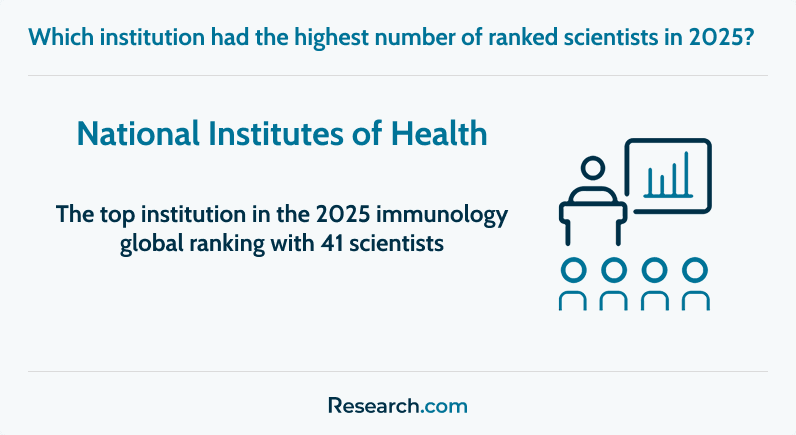
- In the 2025 edition of our report, the U.S. National Institutes of Health stands out as the most represented institution, with 41 scientists featured in the ranking.
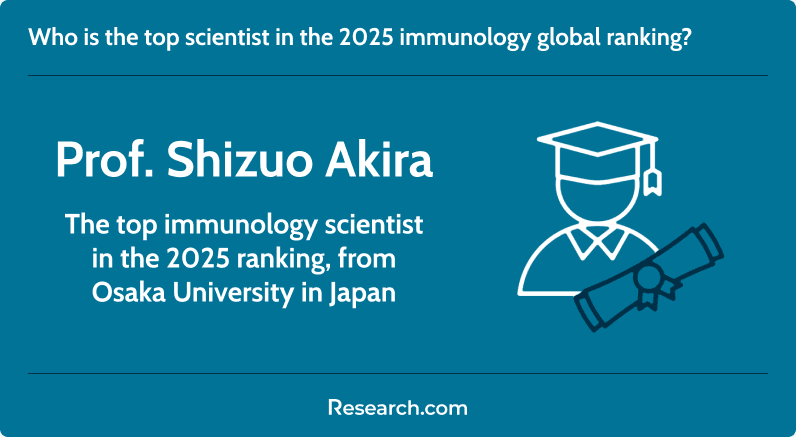
- Shizuo Akira from Osaka University retains his top spot in the ranking with a D-index of 306.
- The leading 10 universities and research institutions in the field of immunology are based in the United States and the United Kingdom.
- The average D-index for the top 1% of scientists is 230 against an average of 114 for all scientists included in the ranking.
The full ranking for the 2025 list of the best immunology scientists can be found here:
BEST IMMUNOLOGY SCIENTISTS RANKING
Countries with the highest number of leading immunology scientists
Scientists affiliated with institutions in the United States lead the ranking, with 540 researchers making the list—an increase of three from 2024—accounting for 54% of the total. Notably, six of the top 10 scientists in the highest 1% are associated with U.S.-based universities and research centers.
The United Kingdom holds the second spot once again, with 87 scientists included in the ranking, maintaining its position from the previous year. From having 85 scientists in 2024, two more scientists from the UK joined the top 1000 ranking.
Germany comes in third with 65 scientists, four more from the previous 61 total in the 2024 list.
Other countries with strong representation include the France with 37 scientists, the Netherlands with 35 scientists, Japan with 34 scientists, and Australia with 32 scientists. From its previous 9th ranking, Japan moved to the 6th position overtaking Switzerland and Italy.
It’s important to note that the country designation is based on the location of a scientist’s affiliated research institution, as recorded by MAG, and does not necessarily reflect their nationality.
Institutions with the highest number of leading scientists
According to the 2025 edition of our ranking, the U.S. National Institutes of Health (NIH) remains the most represented institution, with 41 scientists, which is consistent with its total in 2024.
Harvard University continues to hold second place with three more scientists, bringing its total to 37 scientists recognized for their contributions to immunology, maintaining its position from last year.
Taking the third spot is the National Institute of Allergy and Infectious Diseases (NIAID), with 24 scientists included in the ranking. NIAID stands out for its impactful work in developing vaccines, treatments, and diagnostic innovations.
Of the top 10 institutions driving global immunology research, eight are located in the United States. The remaining two are leading European institutions: the University of Oxford and Imperial College London.
Aside from Imperial College London, the other two institutions that made it to the top 10 in 2025 include the Washington University in St. Louis with 13 scientists and the Icahn School of Medicine at Mount Sinai with 12 scientists.
Notably, both NIH and NIAID are among the few non-academic organizations to rank in the global top 10, highlighting the critical role of government-funded research in advancing immunological science.
Enhancing research in online universities
Online universities play an increasingly vital role in advancing immunology research by expanding access to education, fostering global collaboration, and streamlining data sharing. Through flexible and accessible learning platforms, these institutions make immunology education and training available to a broader, more diverse pool of students and professionals—including those in underserved or remote regions.
This expanded reach not only nurtures the next generation of immunologists but also democratizes the field by encouraging participation from a wide range of cultural and scientific perspectives. Many online programs now incorporate virtual labs, remote research projects, and AI-driven simulations, enabling students to conduct experiments and contribute to real-world research from anywhere in the world.
Moreover, online universities are integral to the growth of cross-institutional research collaborations, which have surged in recent years. According to a 2023 study by Elsevier, over 65% of academic research projects now involve international collaboration, much of which is facilitated through digital platforms.
Tools such as cloud-based data storage, shared research databases, and real-time communication apps allow immunologists to co-author studies, share findings, and analyze data together regardless of geographic location. These digital advancements not only speed up the research process but also promote interdisciplinary partnerships—for example, connecting immunologists with bioinformaticians and data scientists—ultimately accelerating the development of new vaccines, treatments, and diagnostic tools in the field.
D-index ranking-leaders, averages, and distribution
In Asia, Professor Shizuo Akira of Osaka University, Japan, leads the region and holds the top spot globally in the 2025 ranking with an impressive D-index of 306.
In North America, Professor Richard A. Flavell from Yale University in the United States is the highest-ranked scientist. He is also second in the global standings, with a D-index of 275.
Europe’s top immunologist is Professor Alberto Mantovani of Humanitas University in Italy. He ranks fifth worldwide, earning a D-index of 218.
Professor Mark J. Smyth, affiliated with the QIMR Berghofer Medical Research Institute in Australia, is the leading immunology expert in Oceania and holds the 17th spot in the global ranking with a D-index of 188.
In South America, Professor Fernando Q. Cunha from the University of São Paulo, Brazil, stands as the region’s top scientist. He ranks 386th globally with a D-index of 112.
Africa’s top contributor is Professor Shabir A. Madhi, affiliated with the University of the Witwatersrand in South Africa. He holds a global rank of 393 with a D-index of 102.
Among the elite top 1% of scientists, the average D-index is 230, compared to 114 across all scientists featured in the ranking. The lowest D-index included in the 2024 list is 88.
On average, the top 1% of scientists have published 1,142 articles, nearly double the average of 505 across all ranked scholars. In terms of citations, the top 1% have amassed an average of 23,473, significantly higher than the average 56,576 for the entire cohort.
You can learn more about the methodology used to create this report here.
All research was coordinated by Imed Bouchrika, Ph.D., a computer scientist with a well-established record of collaboration on a number of international research projects with different partners from the academic community. His role was to make sure all data remained unbiased, accurate, and up-to-date.
Research.com is the number one research portal for science and educational rankings. Our mission is to make it easier for professors, research fellows, and students to progress with their research and find the top experts in a wide range of scientific disciplines. Research.com is also a leading educational platform that helps students find the best colleges, academic opportunities, and career paths.


