
World Online Ranking of Best Physics Scientists – 2025 Report

Co-Founder and Chief Data Scientist
May 27, 2025 - Research.com recently released its fourth annual edition of the most influential scientists and researchers in physics.
Our team aims to inspire scientists, decision-makers, and business owners worldwide. We want them to explore the latest physics discoveries, understand research trends from top experts, and identify leading scientists across different countries and organizations.
For the 2025 report, Research.com examined over 4,500 scientific profiles from bibliometric databases like OpenAlex and CrossRef. We prioritized specific criteria to evaluate these profiles, including a scientist's published papers, field awards, and other career achievements in physics research. To be considered, a scholar needed a D-index threshold of 70 if most of their publications were in physics.
Latest Discoveries in Physics Research
Recent advancements in physics have unveiled two particularly significant discoveries. First, physicists at Brown University observed fractional excitons, a novel class of quantum particles. These intriguing particles carry no overall charge, yet they display unique quantum statistics, behaving as a hybrid between bosons and fermions. This groundbreaking discovery, linked to the fractional quantum Hall effect within graphene layers under intense magnetic fields, paves the way for deeper exploration into quantum phases of matter. Moreover, it could revolutionize quantum computing technologies by enabling innovative methods for storing and manipulating information at the quantum level.
Simultaneously, researchers at CERN's Large Hadron Collider made another pivotal finding: detecting charge-parity (CP) violation in beauty-lambda baryons. This phenomenon, where matter and antimatter exhibit different behaviors, marks the first time CP violation has been observed in baryons (particles composed of three quarks). This crucial insight sheds light on why matter predominates over antimatter in the universe. With high statistical significance, this confirmed finding may guide the search for physics beyond the Standard Model and deepen our understanding of the early cosmos.
The Key Findings For the 4th Edition of the Best Physics Scientists Ranking
- The list is predominantly composed of scientists from the United States, with 531 scholars included in the 2025 report. This represents 53.10% of the physics scientists who made it to the top 1,000 rankings.
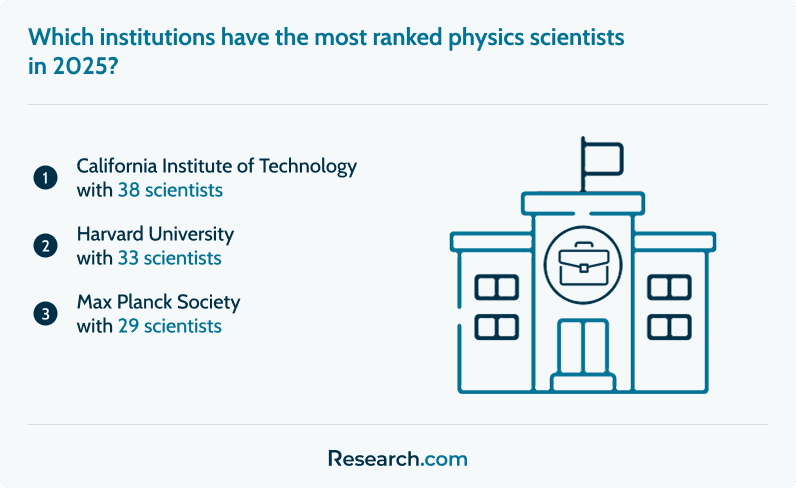
- The California Institute of Technology maintains its position as the top university housing the greatest number of scientists (38) engaged in physics research in the 2025 edition of our ranking.
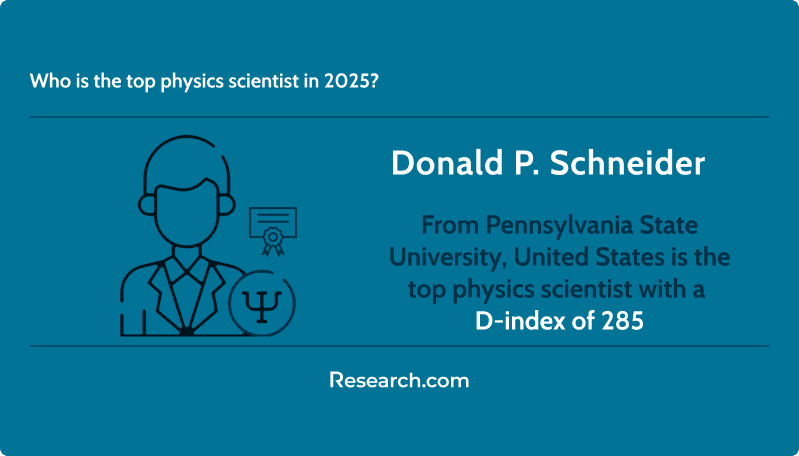
- The top-ranking scientist in physics is Donald P. Schneider from Pennsylvania State University, United States, with a D-index of 285.
- The average D-index for the top 1% of scientists is 236.5, against an average of 141.9 for the top 1,000 scientists included in the ranking.
The full ranking for the 2025 list of the best physics scientists can be found here:
BEST PHYSICS SCIENTISTS RANKING
Countries With the Highest Number of Leading Physics Scientists
The United States continues to dominate the global landscape of top physics scientists in 2025, with 531 researchers in the top 1,000—accounting for 53.10% of the total. While still the leader, this marks a slight decrease from 2024, when the U.S. had 540 top scientists (54.0%). Nonetheless, the U.S. maintains a commanding lead, with seven out of ten of the top 1% of scientists hailing from American institutions.
The United Kingdom remains in second place in 2025 with 95 scientists, up from 92 in 2024. Germany also shows growth, rising from 83 to 87 top scientists and maintaining a strong third-place position.
Italy's count remains stable at 45 top physicists, while France adds to its total, increasing from 40 in 2024 to 47 in 2025. Other notable changes include Australia increasing from 20 to 25 scientists and Japan rising slightly from 22 to 23. Canada holds steady at 23 scientists, matching its 2024 total.
Switzerland improves its presence with 20 top researchers in 2025, up from 19 the previous year. The Netherlands remains consistent with 16 top physicists in both years.
Please note that the country associated with a scientist is based on their affiliated research institution according to MAG, not on their actual nationality.
Institutions With the Highest Number of Leading Scientists
In both 2024 and 2025, the California Institute of Technology retains its position as the leading institution, though the number of top-ranked scientists affiliated with it has decreased from 42 in 2024 to 38 in 2025.
Harvard University remains in second place but also sees a slight drop, going from 35 top scientists in 2024 to 33 in 2025. The Max Planck Society holds steady in third place, with 29 scientists in 2025, just slightly down from 2024, when it had secured the same position.
Stanford University, which had made a major jump to fourth place in 2024 with 22 scientists, sees a small decrease to 20 in 2025, now sharing that spot with Italy’s National Institute for Astrophysics. Princeton University moves up slightly in visibility with 21 scientists in 2025, compared to its less defined position in 2024’s rankings.
Other notable institutions in 2025 include MIT with 19 scientists, University of Cambridge with 17, and several campuses within the University of California system: UCLA (16), UC Berkeley (15), and UC Santa Cruz (14). These figures show a more distributed presence across UC campuses in 2025 compared to the singular mention of UC Berkeley in 2024’s top 10.
Institutions hosting between 10 and 13 leading scientists in 2025 include Fermilab (13), University of Tokyo (13), Lawrence Berkeley National Laboratory, University of Geneva, and University of Michigan–Ann Arbor (each with 12), and University of Florida, The Ohio State University, Durham University, and University of Colorado Boulder (each with 10).
In contrast, the 2024 data highlighted a more consolidated list of top institutions, with American entities comprising 80% of the top 10, and the Max Planck Society and University of Cambridge as the main international representatives. The 2025 data suggests a slight diversification, with more institutions entering the top tier, albeit with smaller individual counts.
The dominance of U.S. institutions remains consistent, with seven of the top 10 scientists in both years affiliated with American universities. The other top affiliations continue to include the Max Planck Institute for Astrophysics in Germany and the University of Cambridge and University of Oxford in the United Kingdom.
What are the optimal academic pathways for a successful career in physics research?
The optimal academic pathway for a successful career in physics research typically involves earning a bachelor’s degree in physics or a closely related field, followed by a Ph.D. specializing in a specific area of physics. During graduate studies, gaining hands-on research experience through internships, lab work, and collaborations is essential. Postdoctoral positions further develop expertise and professional networks. Continuous learning, publishing research, and attending conferences are also crucial for staying current and advancing in the competitive field of physics research.
For those seeking a practical start, flexible program options, like those found among the easiest college majors, offer an accessible entry point. These programs still equip graduates with the skills needed for both academic research and industry careers.
Strengthening Research Through Online Universities
Collaborations between research institutions and online universities significantly advance physics research. These partnerships allow for wider participation, shared resources, and new interdisciplinary ideas. For instance, the University of Colorado's Physics Education Research group works with other national teams to create adaptable quantum mechanics curricula. They blend traditional and online teaching methods to help students better grasp the material.
Similarly, virtual co-creation projects connect university physics research groups with K-12 students. Using online breakout rooms, these projects encourage close interactions between researchers and students, sparking interest in STEM and offering research experiences to those beyond typical geographic reach. Ultimately, these collaborations use platforms in online universiteis to make physics education more accessible and speed up research discoveries.
D-Index Ranking-Leaders, Averages, and Distribution
In North America, Professor Donald P. Schneider from Pennsylvania State University, United States, is the top scientist in the region and around the world. Prof. Schneider has a D-index of 285.
Professor Simon D. M. White from Max Planck Institute for Astrophysics, Germany, leads other scientists in Europe and ranks number four in our world ranking. His D-index is 231.
In Asia, Professor Xiang Zhang from the University of Hong Kong, China, is ranked first in the region and number 48 globally with a D-index of 203.
Professor Maria-Teresa Dova from the National University of La Plata, Argentina, is the leading scientist in South America. Professor Dova holds the rank of 126 globally with a D-index of 179.
For Oceania, Professor Yuri S. Kivshar from Australian National University, Australia, ranks first on our list of leading scientists in that region. He is also listed as no.162 in the world ranking with a D-index of 169.
The average D-index for the top 1% of scientists is 236.5, against an average of 141.9 for the top 1,000 scientists included in the ranking.
The average number of published articles for the top 1% of scientists in the ranking is 1587.2, against an average of 798.55 for the top 1,000 scholars.
The average number of citations for the top 1% of scientists is 332298.5, against an average of 106156.18 for the top 1,000 scholars.
You can learn more about the methodology used to create this report here.
About Research.com
All research was coordinated by Imed Bouchrika, Ph.D., a computer scientist with a well-established record of collaboration on a number of international research projects with different partners from the academic community. His role was to make sure all data remained unbiased, accurate, and up-to-date.
Research.com is the number one research portal for science and educational rankings. Our mission is to make it easier for professors, research fellows, and students to progress with their research and find the top experts in a wide range of scientific disciplines. Research.com is also a leading educational platform that helps students find the best colleges, academic opportunities, and career paths.


