
World Online Ranking of Best Medicine Scientists – 2025 Report

Co-Founder and Chief Data Scientist
On May 22, 2025--Research.com recently released the fourth edition of the annual ranking of the world’s top medical scientists. This report recognizes the most influential experts in medical research today. It aims to raise awareness of outstanding contributions in the field, support the academic community in identifying thought leaders, and encourage sharing scientific knowledge across borders. The ranking also helps highlight key achievements and give these scientists the recognition they deserve within global academic and research circles.
We publish this ranking to help students, teachers, researchers, and institutions better understand who is shaping the future of medicine. It provides readers with a clear view of the individuals leading critical medical studies in universities and research centers worldwide. We also hope this report inspires new collaborations, sparks fresh ideas, and helps connect experts across different fields.
For the 2025 edition, our team reviewed detailed data from 18,786 scientist profiles. These profiles were collected from several trusted bibliometric sources. We used a range of performance indicators to evaluate and rank each scientist. This helped ensure a well-rounded and accurate selection process for inclusion in the final list.
To qualify for the ranking, scientists needed a discipline-specific D-index of at least 30, with the majority of their published work in the field of medicine. Other factors included the share of a scientist’s work dedicated to the field and any notable awards or professional accomplishments. This careful selection ensured that only the most active and impactful medicine researchers were included in this year’s report.
Latest discoveries in medicine research
Scientists at Duke University this year introduced SBI-810, a new non-opioid pain reliever. This compound targets a specific nerve receptor, NTSR1, to block pain signals before they reach the brain. Tests in mice showed that SBI-810 effectively reduced pain from surgery, bone fractures, and nerve injuries without causing common opioid side effects like sedation or constipation. Unlike traditional opioids, SBI-810 did not lead to tolerance or addiction, making it a promising alternative for managing both acute and chronic pain.
Meanwhile, researchers at the University of Copenhagen achieved a significant breakthrough in cancer treatment. They identified the final two enzymes required for the biosynthesis of Taxol, a widely used chemotherapy drug, in yeast cells. This advancement could halve the cost of Taxol production, making it more accessible, especially in low and middle-income countries where ovarian cancer rates are rising. The new method is also more sustainable, reducing reliance on the Pacific yew tree and harmful chemicals used in traditional production.
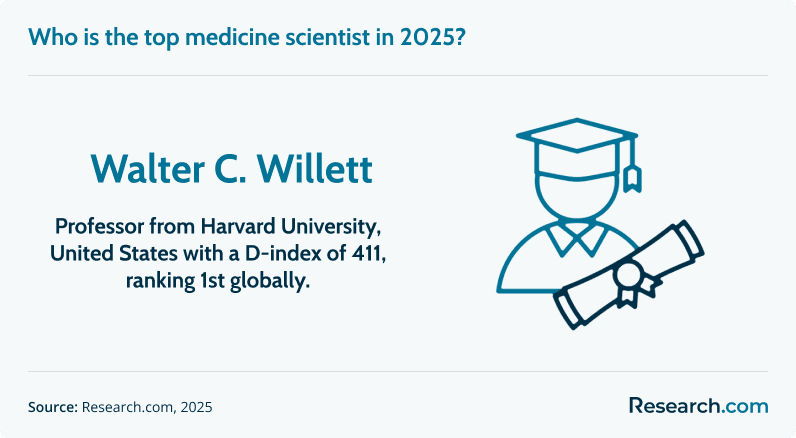
The Key findings for the 4th edition of the best medicine scientists ranking
- The United States leads the top 1,000 ranking in medicine, with 574 scientists, accounting for over half of all ranked scholars.
- Harvard University remains the top institution, hosting 55 scientists in the ranking.
- Professor Walter C. Willett of Harvard is ranked #1 globally, with a D-index of 411, the highest in the world.
- The average D-index for the top 1% of scientists is 324.6, compared to 177.59 across the full ranking.
- The scholar with the lowest D-index to make the 2025 list scored 70.
The full ranking for the 2025 list of the best medicine scientists can be found here:
BEST MEDICINE SCIENTISTS RANKING
Countries with the highest number of leading medicine scientists
In the 2025 report, the United States continues to lead with 574 scientists ranked among the top 1,000. While still the clear frontrunner, the number drops slightly from 587 in 2024. Despite this decrease, American researchers still make up the majority, highlighting the country’s continued strength in medical science. The United Kingdom remains firmly in second place with 105 top scientists, a slight rise from 104 the previous year. Germany holds the third position again, increasing its total from 47 to 50 scientists.
The Netherlands comes in fourth with 37 scientists, one more than last year. Canada follows with 31 scientists, slightly down from 34. Australia rises from 27 to 28 scientists, while France advances from 21 to 23, regaining 7th place. Italy, which overtook France last year, now ranks 8th with 21 scientists. Sweden also lists 21 scientists, showing no change in rank. Japan stays in 10th place with 17 scientists, marking a modest gain from 16 in 2024.
Overall, most countries maintain their rankings, with slight shifts in totals. The U.S. remains dominant, but other nations hold steady or grow in their representation in global medicine research.
Please note that the country associated with a scientist is based on their affiliated research institution according to MAG, not on their actual nationality.
Institutions with the highest number of leading scientists
Harvard University remains the top institution for medicine research in the 2025 report, with 55 scientists ranked among the world’s best. This shows a slight drop from 61 in 2024, a decrease of nearly 10%. The National Institutes of Health (NIH) secures the second spot again with 35 scientists, just one more than its 2024 total. The Mayo Clinic holds third place with 22 scientists, down from 25 the previous year. These shifts indicate a slight redistribution of top medical talent, although U.S. institutions continue to dominate the field.
The University of California, San Francisco, moves up to fourth with 19 scientists, surpassing the University of Oxford, which now ranks fifth with 17. Brigham and Women’s Hospital claims sixth place with 16 scientists. Meanwhile, the University of Cambridge, University College London, the Icahn School of Medicine at Mount Sinai, and Memorial Sloan Kettering Cancer Center are tied at seventh with 15 scientists each. Compared to last year, more U.K. institutions in the top 10 show a growing international spread.
Still, U.S.-based institutions lead, making up 85% of the top 20 schools. The United Kingdom claims the remaining three spots. Harvard alone represents 5.5% of all scientists in the top 1,000. These figures confirm the continued global influence of elite U.S. research centers, while also highlighting the rising visibility of major European universities.
The role of online universities in advancing medical research
Online universities are playing an increasingly important role in the future of medical research. With the rise of flexible and accessible education, more students are now entering the field of health and biomedical sciences from diverse backgrounds and locations. This wider access to training helps fill the growing demand for healthcare professionals. It feeds into the research ecosystem by preparing more students for advanced academic work. Online universities offer degree pathways that help students build strong foundations in subjects like biology, neuroscience, and public health, key areas in medical research.
Recent NCES data shows that health-related programs accounted for over 263,800 bachelor’s degrees, about 13% of all degrees awarded in the U.S. Additionally, the biological and biomedical sciences accounted for 7% of total degrees, with over 131,000 graduates. These figures show the strong interest in medical fields and how online education helps meet that demand. Online universities have contributed to this trend by removing barriers to entry, especially for working adults, rural learners, and international students. As a result, the pipeline of researchers and professionals in the medical field continues to grow. The shift toward online learning is not just about convenience; it’s also about empowering the next generation of scientists to contribute to groundbreaking medical discoveries.
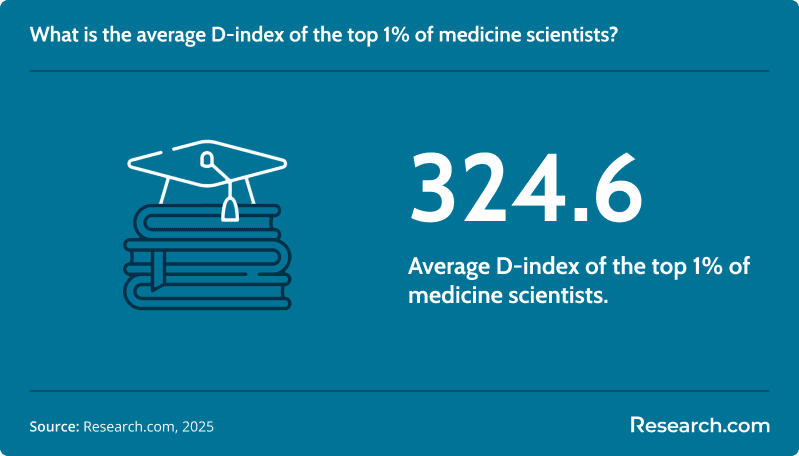
D-index ranking — leaders, averages, and distribution
For North America, Professor Walter C. Willett from Harvard University, United States, leads his region and the world with a D-index of 411, ranking 1st globally.
In Europe, Professor George Davey Smith from the University of Bristol, United Kingdom, holds the top spot with a D-index of 281 and a world ranking of 13th.
For Asia, Professor Masayuki Yamamoto from Tohoku University, Japan, ranks first in the region with a D-index of 213 and is 86th in the world.
In Oceania, Professor Nicholas J. Talley from the University of Newcastle, Australia, leads with a D-index of 198 and ranks 159th globally.
Professor Dan J. Stein from the University of Cape Town, South Africa, is Africa’s highest-ranking scientist with a D-index of 189 and is placed 214th globally.
In South America, Professor Cesar G. Victora from Universidade Federal de Pelotas, Brazil, ranks highest in the region with a D-index of 163 and a global rank of 553rd.
The average D-index for the top 1% of scientists in the top 1,000 ranking is 324.6, while the average for all scientists on the list stands at 177.59.
The scholar with the lowest D-index in the 2025 ranking scored 70.
The top 1% of scientists in the ranking have published an average of 1,755.4 articles in their field, compared to an overall average of 1,066.8.
Regarding discipline citations, the top 1% average 482,617.1 citations, while the full ranking average is 155,023.33.
You can learn more about the methodology used to create this report here.
About Research.com
All research was coordinated by Imed Bouchrika, Ph.D., a computer scientist with a well-established record of collaboration on a number of international research projects with different partners from the academic community. His role was to make sure all data remained unbiased, accurate, and up-to-date.
Research.com is the number one research portal for science and educational rankings. Our mission is to make it easier for professors, research fellows, and students to progress with their research and find the top experts in a wide range of scientific disciplines. Research.com is also a leading educational platform that helps students find the best colleges, academic opportunities, and career paths.


